


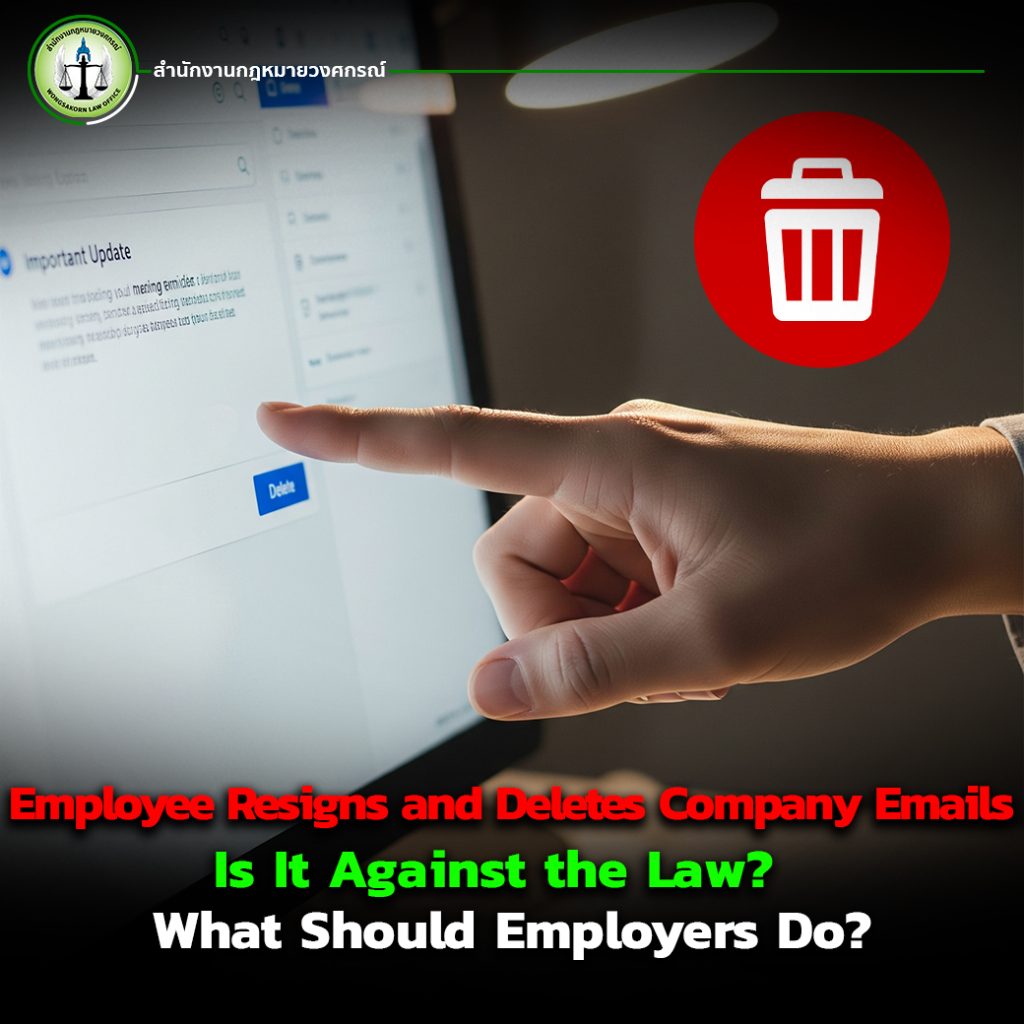
In today’s digital era, company emails often contain critical business information and are considered valuable corporate assets. A common issue arises when employees resign and delete company emails or files, whether client data, partner communications, or important project documents. Such actions can cause employers significant business losses.
This leads to two key questions: “Is this action illegal?” and “What legal remedies are available to employers?”
Which Laws Are Involved in Deleting Company Emails?

1.Labor Law
If an employee deletes company data while still employed, it may constitute serious misconduct under the Labor Protection Act B.E. 2541 (1998), Section 119, which allows an employer to terminate the employee without severance pay if the act was intended to cause severe harm to the employer.
However, if the deletion occurs after the employee has resigned, it is no longer considered a violation under labor law, as the employment relationship has ended.
2.Civil and Commercial Code
If deleting company data results in damages, such as the loss of a customer contract, it may be deemed a tort under Section 420 of the Civil and Commercial Code, which requires the wrongdoer to compensate the injured party.
3.Criminal Law and the Computer Crime Act
If a former employee unlawfully accesses the company’s email system and deletes data, it may constitute an offense under the Computer Crime Act B.E. 2560 (2017), Section 9, punishable by up to 5 years’ imprisonment, a fine not exceeding 100,000 THB, or both.
Case Studies and Court Decisions
1.Central Labor Court Judgment
In one case, an employee deleted sales records and client lists before resigning. The Labor Court ruled that this caused serious damage to the employer, allowing termination without severance pay under labor law.
2.Computer Crime Case
In another case, a former employee used a password to access the company’s email after resignation and deleted project files related to a pending client contract. The Criminal Court sentenced the defendant to 1 year imprisonment (suspended) and a fine of 50,000 THB, as the act constituted unauthorized access and data destruction under criminal law.
What Can Employers Do Under the Law?

1. Preserve Evidence
Collect logs, timestamps of deletions, and evidence of destroyed emails. These serve as key evidence in both civil and criminal cases.
2. Review Employment Contracts and Policies
Check whether IT usage agreements or confidentiality clauses have been violated to support legal claims.
3. Exercise Civil Rights
Employers may sue for damages if data deletion caused measurable harm, provided sufficient evidence exists.4.Exercise Criminal Rights
If the act falls under the Computer Crime Act, employers may file a police complaint to initiate criminal prosecution.
Preventive Measures for Employers
1. Draft clear IT usage policies prohibiting deletion of work-related data.
2. Terminate system access immediately upon employee resignation.
3. Retain log files as admissible legal evidence.
4. Apply the law correctly:
o While still employed → Termination under labor law.
o After resignation → Civil lawsuit and/or criminal complaint.
5.Consult a Lawyer – Multiple legal aspects may overlap; professional guidance prevents employers from unintentionally violating laws themselves.
Why Should Employers Consult a Lawyer on This Matter?

In complex cases involving labor law, civil law, and criminal law, even a minor mistake in judgment could put an employer at a disadvantage or expose them to legal liability. Consulting a lawyer is therefore the most appropriate choice because:
- A lawyer can assess which area of law should be applied in the situation.
- They can review and verify the completeness of evidence, reducing the risk of unsuccessful litigation.
- They can devise a sound legal strategy to prevent violations of labor rights or personal rights.
As mentioned, while employers do have legal rights, taking action without a proper understanding of the legal details may create risks, such as:
- Unintentional violation of employees’ personal rights, for example accessing private data without authorization.
- Incorrect exercise of rights, such as filing a lawsuit without sufficient evidence, which could result in unnecessary time and expenses.
- Negative impact on labor relations, if other employees perceive the employer as overstepping legal boundaries.
Consult a Lawyer – The Safest Choice for Employers

In cases where an employee resigns and deletes company emails, such actions may not constitute a violation of labor law if committed after the termination of employment. However, they may still fall under other legal frameworks, such as civil law and criminal law, particularly the Computer Crime Act, which imposes clear penalties.
Employers should implement preventive measures, such as controlling access to company data and establishing clear agreements regarding the use of company email. If such an incident occurs, it is essential to preserve evidence and exercise legal rights properly.
Above all, consulting a lawyer is the most prudent choice. Legal counsel ensures that employers take the correct legal approach, minimizing the risk of making mistakes that could lead to unintended violations of the law. Most importantly, consulting a lawyer helps employers navigate the legal process appropriately and effectively. 👉 Click here to contact us