


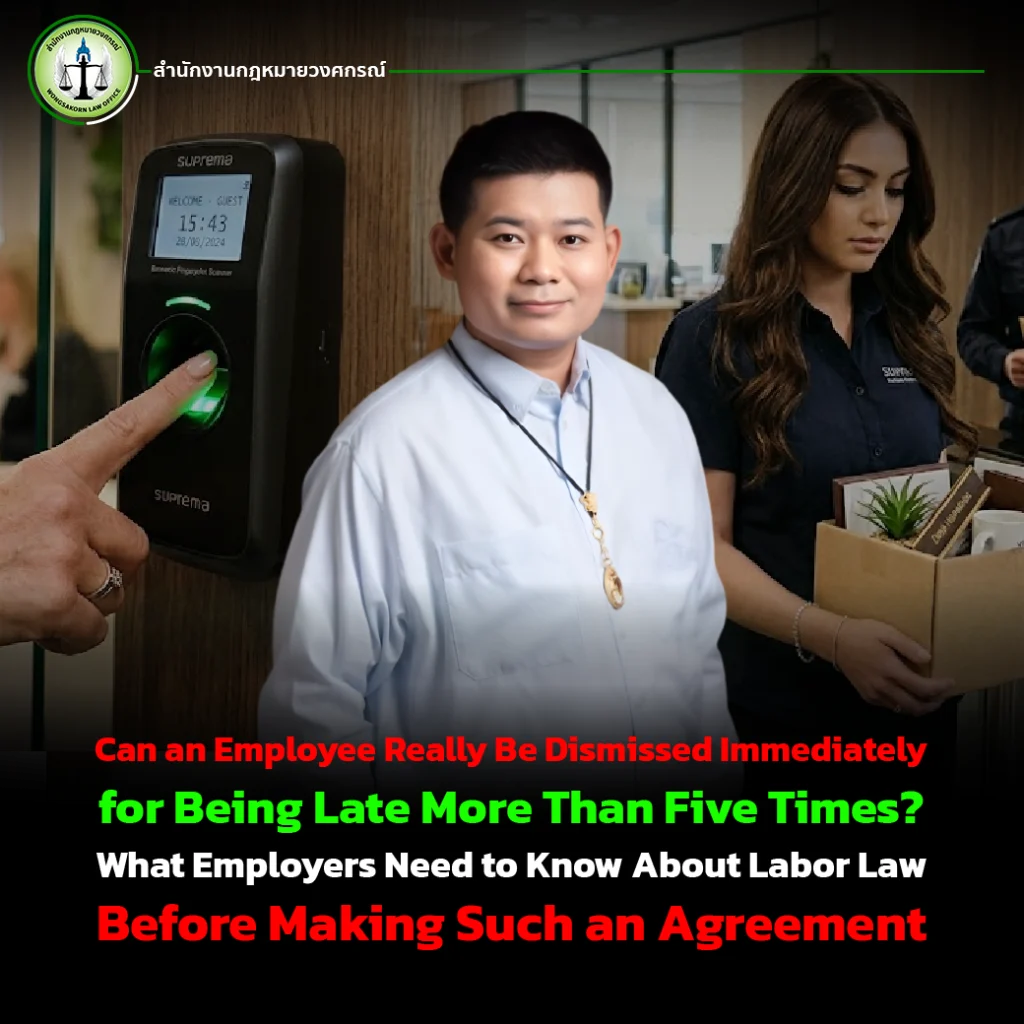
In the business world, employee-related issues are among the challenges that employers inevitably face, especially matters concerning workplace discipline, such as lateness, absenteeism, or failure to comply with company regulations.
When confronted with these problems, many companies often try to find a way to “manage” them by entering into a written agreement with employees to clearly specify disciplinary measures, for example
“If an employee is late more than five times, a warning letter will be issued, and such conduct shall be deemed to have caused serious damage. The company shall have the right to terminate employment without payment of wages, severance pay, or any compensation for termination.”
At first glance, this may seem like an effective solution for employers. However, the crucial question is does such an agreement actually have legal effect?
The answer is that it can be made, but whether it is legally enforceable is another matter altogether. This is precisely the point that many employers misunderstand.
A Written Agreement with an Employee Does Not Necessarily Mean That the Court Will Always Uphold It
What employers need to understand is that entering into an agreement with an employee does not mean that every provision in that agreement will be fully enforceable.
This is because, under labor law, a fundamental principle is:
Labor Law Exists to Protect Employees
Therefore, regardless of any contract or written agreement an employer may enter into with an employee, if any provision is contrary to the principles of labor law or unfairly deprives the employee of their rights, the court has the authority to interpret and determine its enforceability.
Is Employee Tardiness Equivalent to Serious Damage?
This is the most important issue. Many companies often believe that if an employee is frequently late, such conduct constitutes serious misconduct and justifies immediate termination. However, from a legal standpoint, that is not always the case.
Tardiness Must Be Proven to Have Caused “Serious Damage”
An employee being late 5 times or even 10 times does not automatically constitute “serious damage.” What is crucial is that the employer must be able to prove that the tardiness actually caused damage, the extent to which such damage is serious, and how it has affected the business.
If this cannot be proven, terminating the employee without severance pay may be deemed unfair dismissal.
Do Not Assume That Having the Employee Sign Means the Matter Is Settled
This is a very common misunderstanding.
Many employers believe that:
“If the employee signs to acknowledge it, then it is enforceable.”
But in reality, even if the employee has signed the agreement, the court still has the authority to consider whether the agreement is fair, whether it is contrary to labor law, and whether it unfairly disadvantages the employee. If the court finds it to be unfair, the agreement may be unenforceable.
What Risks Does an Employer Face If Such an Agreement Is Used Improperly?
Entering into an agreement with an employee without careful consideration can create significant legal and business problems for the company.
1. Labor Lawsuits
If an employer terminates an employee based on an unlawful agreement, the employee may file a labor claim immediately.
2. Liability for Back Severance Pay
Even if the company intended not to pay severance, if the court rules that the termination was unlawful, the company may still be required to pay it in full.
3. Time and Costs of Litigation
Labor disputes require substantial time and resources to resolve, which can directly affect business operations.
Employee Management Must Be Based on Law, Not Emotion
Managing employees is not a matter of feelings; it must be grounded in the law.
For example
-Issuing warning letters must be done properly.
-Disciplinary measures must be appropriate.
-Termination must be supported by valid reasons and sufficient evidence.
Every step must be handled with great care.
Human resources professionals may know a great deal, but that does not necessarily mean their actions are always legally correct.
In many cases, problems arise because HR personnel or executives are overly confident in their own understanding.
For example, they may
-Draft agreements on their own.
-Determine disciplinary measures on their own.
-Make decisions based on personal experience.
However, labor law is highly detailed and involves complex legal principles and requirements.
What may seem correct in practice may, in fact, be legally incorrect.
The Best Solution Having Legal Counsel
If an employer encounters employee-related issues, the best course of action is not to make decisions without legal counsel.
Let a lawyer assist you by
✔ Reviewing company regulations
✔ Drafting legally compliant written agreements
✔ Establishing an effective employee management system
✔ Providing legal advice before termination
✔ Minimizing the risk of litigation
Employee Problems Never Truly Go Away
This is the reality of every organization. No matter how small or large the business may be, employee-related issues will always arise whether it is lateness, absenteeism, sudden resignation, or violations of company rules and disciplinary policies.
What matters most is not hoping that such problems will never occur, but being fully prepared to handle them effectively.
Wongsakorn Law Firm Stands Ready to Support Employers
If you are currently facing employee-related issues, or if you are uncertain whether the written agreements your company is using are legally valid and enforceable, you may consult Wongsakorn Law Firm at any time.
We understand that labor and employment issues are complex and can arise every day.
Do Not Enter into Risky Agreements with Employees
Although employers are permitted to enter into agreements with employees, the key question is whether such agreements are legally enforceable.
And the answer to that question is not determined by the employer, it is determined by the court.
Therefore, before issuing a warning, terminating an employee, or entering into any agreement with an employee, employers should always consult legal counsel first.
Having legal counsel is the best long-term protection for your business.