



Land is a major asset associated with numerous legal rights, obligations, and statutory procedures. Consequently, the appearance of an individual’s name on a title deed or ownership document should not lead to the hasty conclusion that they hold absolute and complete rights to the land in every scenario. From a legal standpoint, additional underlying facts and legal relations may need to be evaluated.
Authored by Lawyer Arm Supasit Siri of Wongsakorn Law Firm, this article aims to help the public recognize that land ownership cannot be determined merely by looking at a single document. Instead, one must verify the origin of rights, acquisition details, actual possession, and all relevant legal restrictions.
Reflecting on his recent trip to Hong Kong to meet with business partners and establish collaborative networks between Thai and Chinese law firms, Lawyer Arm Supasit Siri highlighted that international legal practice demands a deep understanding of both local legislation and country specific contexts.
Among these international issues, land and real estate rights remain uniquely intricate. Lawyer Arm noted that while the public often forms opinions based on media coverage or surface level facts, alegal professional’s duty is to conduct a exhaustive verification of all underlying documents and evidence. The mere presence of a name on a title deed or ownership certificate is never sufficient to draw immediate conclusions about a complex property dispute.
Land Transfers Involve Far More Legal Conditions Than Expected
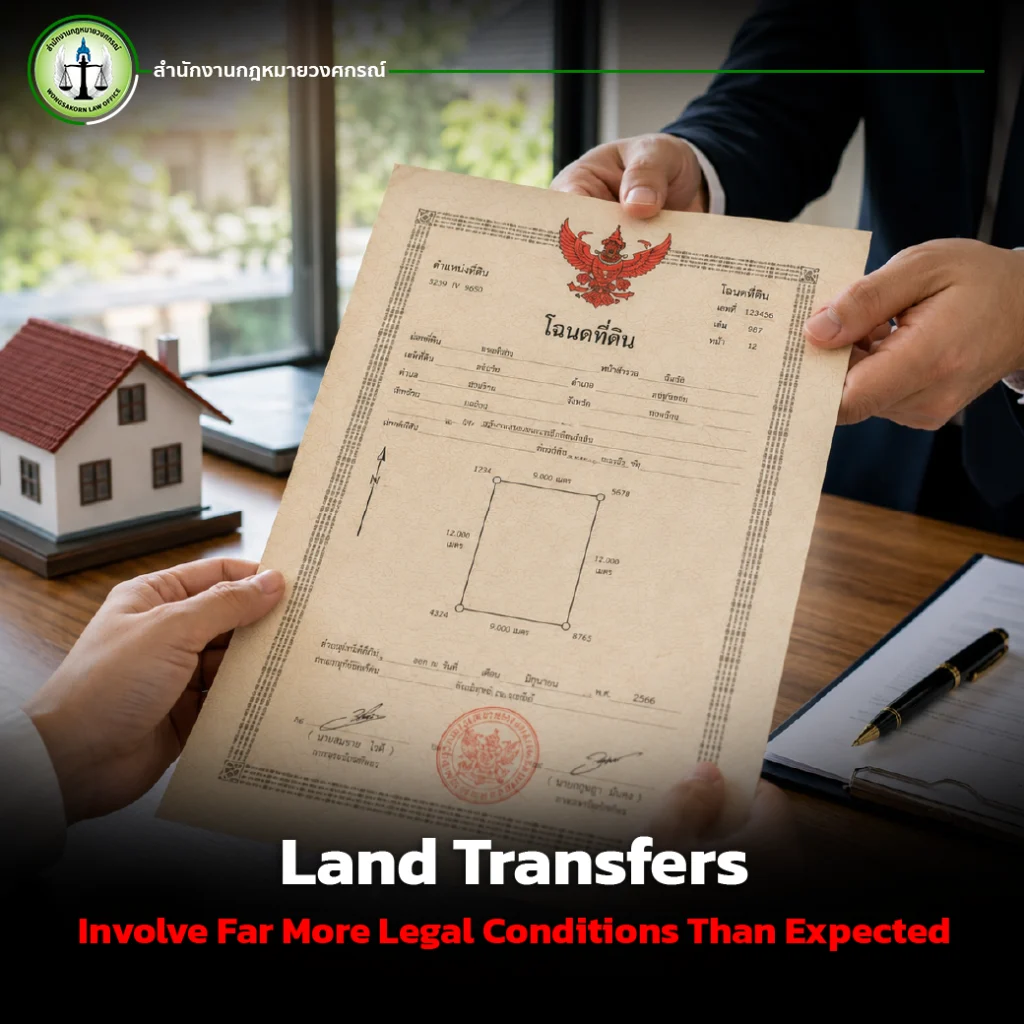
Lawyer Arm Supasit Siri highlighted the donation of land to a temple as a prime example of legal complexity. While many assume that a landowner with clear charitable intent can simply visit the Land Office to transfer ownership immediately, the legal conditions and administrative procedures are far more extensive than publicly understood.
Transfers involving religious entities or land donated to temples typically require strict compliance with statutory workflows, including prior approval from relevant government agencies. It is never a simple matter of “owner consent” alone. Drawing from his own practice, Lawyer Arm emphasized that even with unambiguous intent to donate, the transfer process must follow rigid legal protocols and takes time.
This scenario illustrates that all land transactions whether involving sales, transfers, gifts, religious donations, or title verifications must be evaluated on a case by case basis. One should never rely on general assumptions regarding procedural timelines. Different document types carry distinct legal effects, and specific restrictions may apply to transferee qualifications, agency approvals, or pre registration steps. Consequently, rigorous legal and document verification prior to executing high value or complex multi party land transactions remains paramount.
Consult a Lawyer First When Facing Legal Issues
In closing, Lawyer Arm Supasit Siri offered key advice to the public When legal issues arise, consult a lawyer first.
Lawyer Arm emphasized that seeking legal counsel early on does not necessarily mean initiating a lawsuit or taking a matter to court. Instead, it is about clarifying your legal rights and establishing the correct strategy before making binding decisions. This is especially vital in land matters, where a single procedural error can lead to lost time, substantial expenses, and protracted disputes.
Understanding the law and verifying the facts upfront is the most effective way to mitigate risk and manage your assets with maximum diligence. If you have any inquiries regarding land ownership, property transfers, or title disputes, feel free to contact Wongsakorn Law Firm for expert legal counsel prior to taking action.