


Today, human trafficking remains a tragic and deeply rooted issue in many parts of the world. Many people still believe that “human trafficking” refers only to forced prostitution or labor in heavy industries. In reality, however, modern human trafficking has evolved into more complex and harder-to-detect forms, often using technology as a tool. A significant number of victims are now being forced to work “online,” in ways that are nearly invisible to outsiders.
Today, Wongsakorn Law Office will take you through a new form of human trafficking that many may not have imagined or encountered before. This information aims to help you protect yourself and those around you from situations that could lead to human trafficking.
⚠️ What Is the New Form of Human Trafficking in Thailand?
In the past, when people spoke of “human trafficking,” they often thought of forced prostitution, labor in fishing factories, or child abduction—usually involving physical violence and illegal cross-border movement.
However, today’s trafficking operations have evolved into “new forms” that focus on forcing victims to work in the online world, characterized by the following:
📌 1. Victims are lured willingly
Traffickers commonly use social media or job websites to deceive victims, advertising “well-paid online jobs abroad” or “travel opportunities with side gigs.”
Once the victims arrive in Thailand (often with valid visas), their passports are confiscated, preventing them from returning home.
📌 2. No factories, no brothels — but call centers or ‘online scam farms’
Victims are forced to engage in illegal online activities such as:
- Pig butchering scams (romance/investment fraud)
- Fake app promotion / crypto schemes / pyramid scams
- Investment scams via chat platforms
They work under strict 24-hour surveillance, with CCTV monitoring and constant orders from trafficking leaders.
📌 3. Victims are made to “blend in” to avoid suspicion
Some are trained to speak Thai or English.
They open Thai bank accounts (or use mule accounts), use Thai SIM cards, and dress like students or office workers.
There is often forgery of documents like work permits or migrant labor ID cards.
📌 4. Victims are often treated as ‘offenders’ instead of ‘victims’
Because they enter on tourist visas or work without permits, some authorities mistakenly treat them as illegal workers and deport them.
As a result, they do not receive protection under Thailand’s Anti-Human Trafficking Act.
📌 Victims Silenced: Fear, Shame, and the Inability to Speak Out
Although they are victims of human trafficking, many individuals are unable—or unwilling—to seek help or even tell anyone that they’ve been coerced or deceived. The primary reason is fear—fear of being arrested for engaging in illegal activities they were forced into, such as running call center scams, online fraud, or possessing forged passports. They also fear retaliation from traffickers, who often threaten harm to the victims and their families.
Another major factor is shame, particularly in Thai society, where victims are often stigmatized as being “naive” or “greedy” for falling into such traps. In cases where victims were tricked into taking part in online crimes—such as pretending to be a romantic partner to scam money or chatting with other victims—many feel that they are not worthy of help, or believe they deserve punishment.
There are also language and cultural barriers, especially for migrant workers or those deceived from rural areas, who often do not understand legal procedures, don’t know where to turn for help, or distrust government authorities. As a result, trafficking operations continue in silence—because the victims themselves stay silent.
All of this shows that helping these victims is not just about law enforcement or arrests, but also about creating safe spaces, both physically and emotionally, where survivors feel empowered to speak out, ask for help, and not feel like criminals.
⚖️ Legal Gaps Mean Opportunities for Criminals
Although Thailand has the Anti-Trafficking in Persons Act B.E. 2551 (2008), which provides legal protections and preventive measures against human trafficking, the law still primarily focuses on traditional forms of trafficking—such as prostitution, child labor, or forced labor in agriculture and industry. Meanwhile, new forms of trafficking in the digital age—such as forced online labor, romance scams, fraudulent call centers, or virtual money laundering—are not clearly or adequately addressed in the legislation, making it difficult to effectively prosecute perpetrators.
In addition, inter-agency cooperation remains weak, and international collaboration is limited, especially in cases involving transnational crime networks. For example, a Chinese group might run operations from Cambodia, lure victims in Thailand, and use bank accounts in the Philippines. These legal and jurisdictional loopholes create obstacles for prosecution, often requiring lengthy extradition requests or making it impossible to obtain crucial digital evidence in time.
Most critically, law enforcement in border regions and cyberspace remains underpowered, as officers often lack the necessary technological tools or access to platforms used by trafficking networks. This enables traffickers to continue operating with little to no interference.
⚖️ From Victims to Survivors : Lawyers Against Human Trafficking
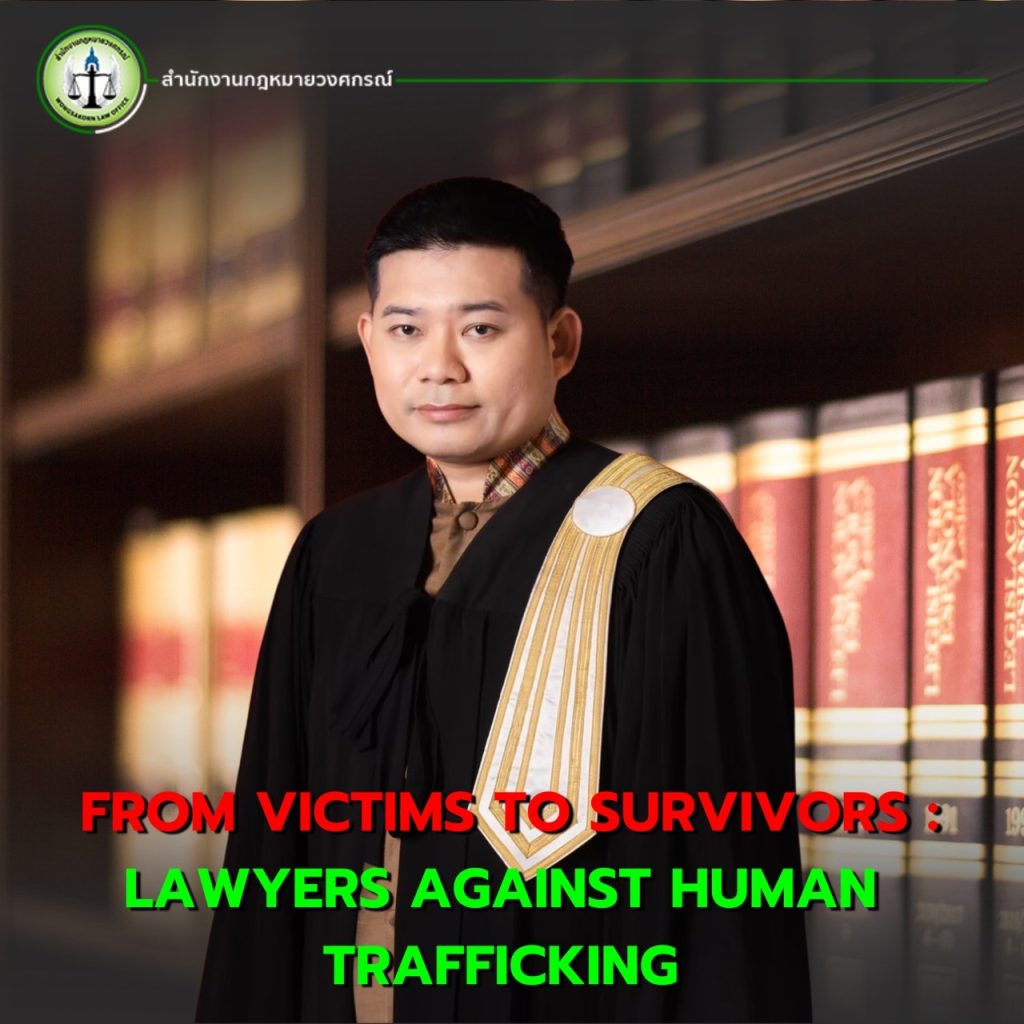
🔹 1. Proving That the Victim Is Not a Criminal
In many cases, victims are forced to commit illegal acts, such as:
- Online scams or fraud
- Using forged documents
- Entering a country illegally
A lawyer can clarify whether someone acted under coercion or deception, helping courts see them as a victim, not a criminal.
🔹 2. Providing Legal Advice and Clarifying Rights
Most victims are unaware of their legal rights, including:
- The right to apply for asylum or temporary protection
- The right to state assistance and services
- The right to remain silent without a lawyer present
A lawyer can explain these rights clearly, and communicate on behalf of the victim with the police, prosecutors, or the courts.
🔹 3. Representing the Victim in Legal Proceedings or Compensation Claims
In criminal proceedings against trafficking networks, a lawyer can:
- File a petition for the victim to be formally recognized as an “injured party”
- Seek civil compensation (e.g. for medical costs or forced labor damages)
- Protect the victim during court questioning to prevent retraumatization or intimidation
🔹 4. Coordinating with Other Agencies
Lawyers often collaborate with:
- Social welfare officers
- NGOs
- Embassies (in cases involving foreign victims)
This ensures the victim’s safety and supports their recovery and reintegration, including safe shelter, psychological care, and a dignified return home.
Although escaping from a trafficking network can be incredibly difficult, victims still have the chance to stand up for their rights—especially with the guidance of knowledgeable and compassionate legal professionals. A lawyer plays a critical role in explaining rights, navigating the complex justice system, and advocating for humane treatment. They also act as a bridge to connect victims with essential support services and prevent them from being prosecuted for actions committed under coercion.
Ultimately, having a lawyer by your side is not a weakness—it is a vital step toward protection, dignity, and justice. At Wongsakorn Law Office, we are committed to standing against human trafficking and all forms of exploitation. We are here to support you every step of the way—with compassion, professionalism, and unwavering dedication to your rights.
Don’t face injustice alone—contact us for a confidential consultation. Our legal team is ready to help.
Reference : https://doe.go.th/prd/assets/upload/files/ipd_th/e88a724796b3526a3034d9495a8f168a.pdf
Written by : Wararat Wongpothisarn (Internship Student in Chinese Language)