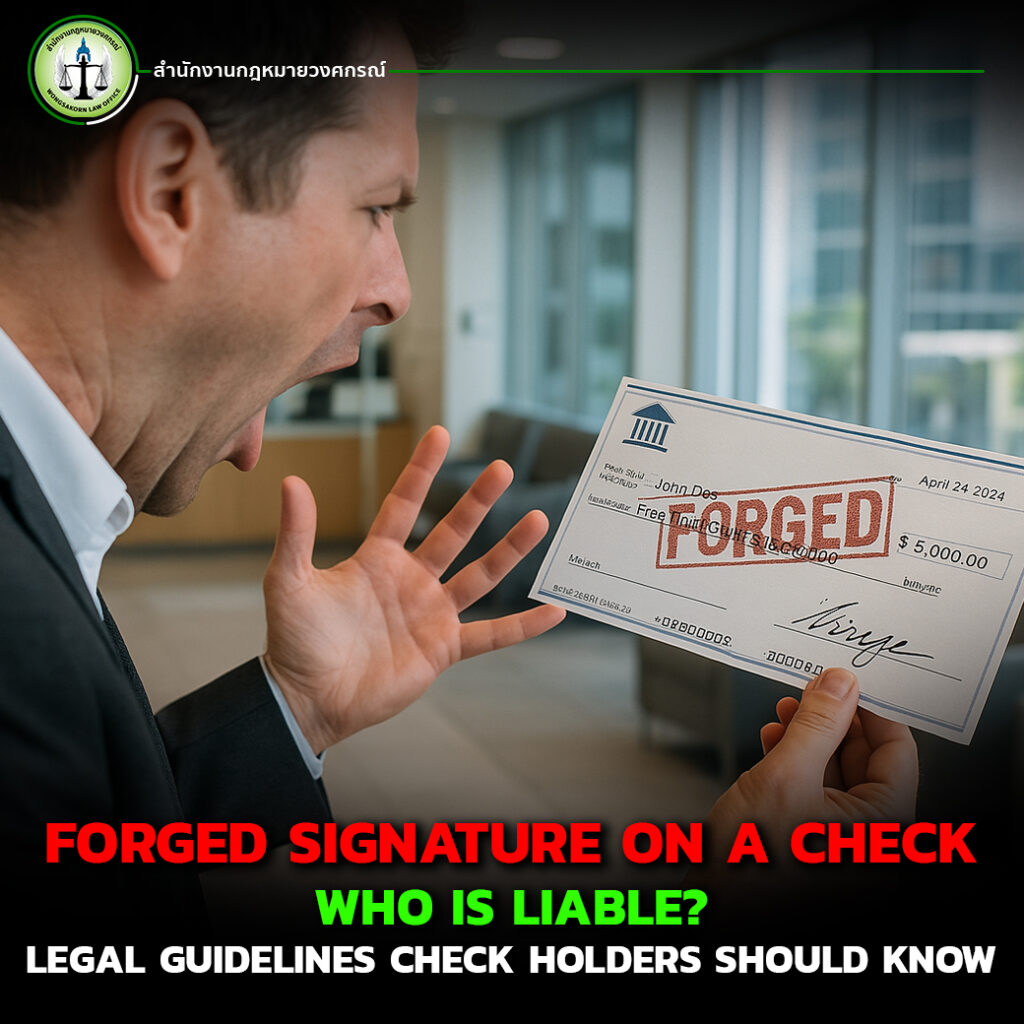
Forged Signature on a Check – Who is Liable? Legal Guidelines Check Holders Should Know

As we all know, a “check” is an important financial document used for various transactions, whether it’s for paying for goods, borrowing money, or other business transactions. However, if a check is forged and then cashed, it can affect the check owner, the bank, and the check recipient. So in such a case, who is liable? And what are the preventive measures? Let’s find the answers in this article from Wongkorn Law Office.

Forgery of Signatures on Checks and Cashing Them
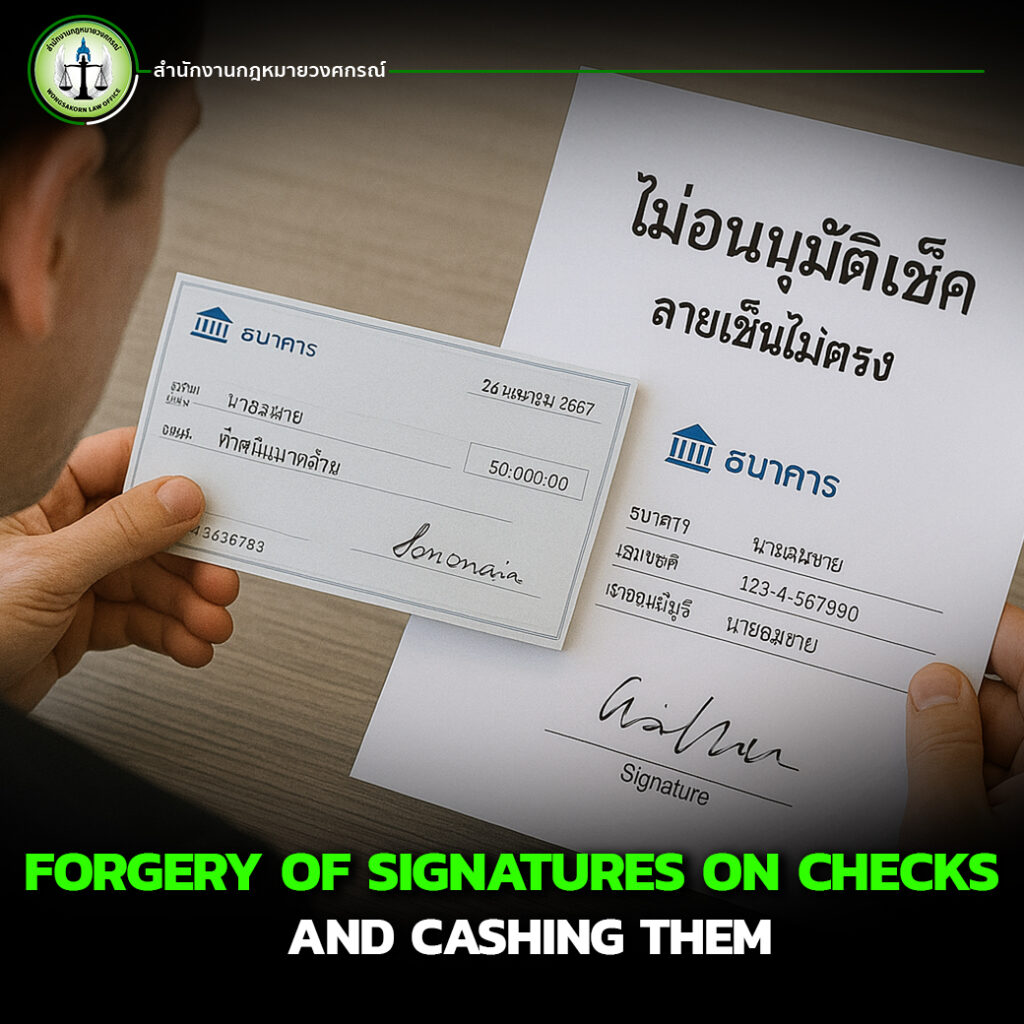
Forgery of signatures on checks occurs when someone impersonates the account holder’s signature and presents the check to a bank for payment or uses it as evidence in various transactions. If the bank fails to conduct proper verification and approves the withdrawal without realizing the signature is forged, the account holder or check bearer often suffers the damage.  

Common Scenarios Include: 

– Insider Fraud: Close associates or employees forging the account holder’s signature to cash checks.  

– Scam Operations: Fraudsters using scanning or forgery techniques to create fake checks and cash them at banks.  

– Lost or Stolen Checks: Someone finding a lost check, forging the signature, and cashing it.  
The Critical Question: When a forged check is cashed, who is liable?

Who is Liable Between the Check Owner, Bank, or Forger?
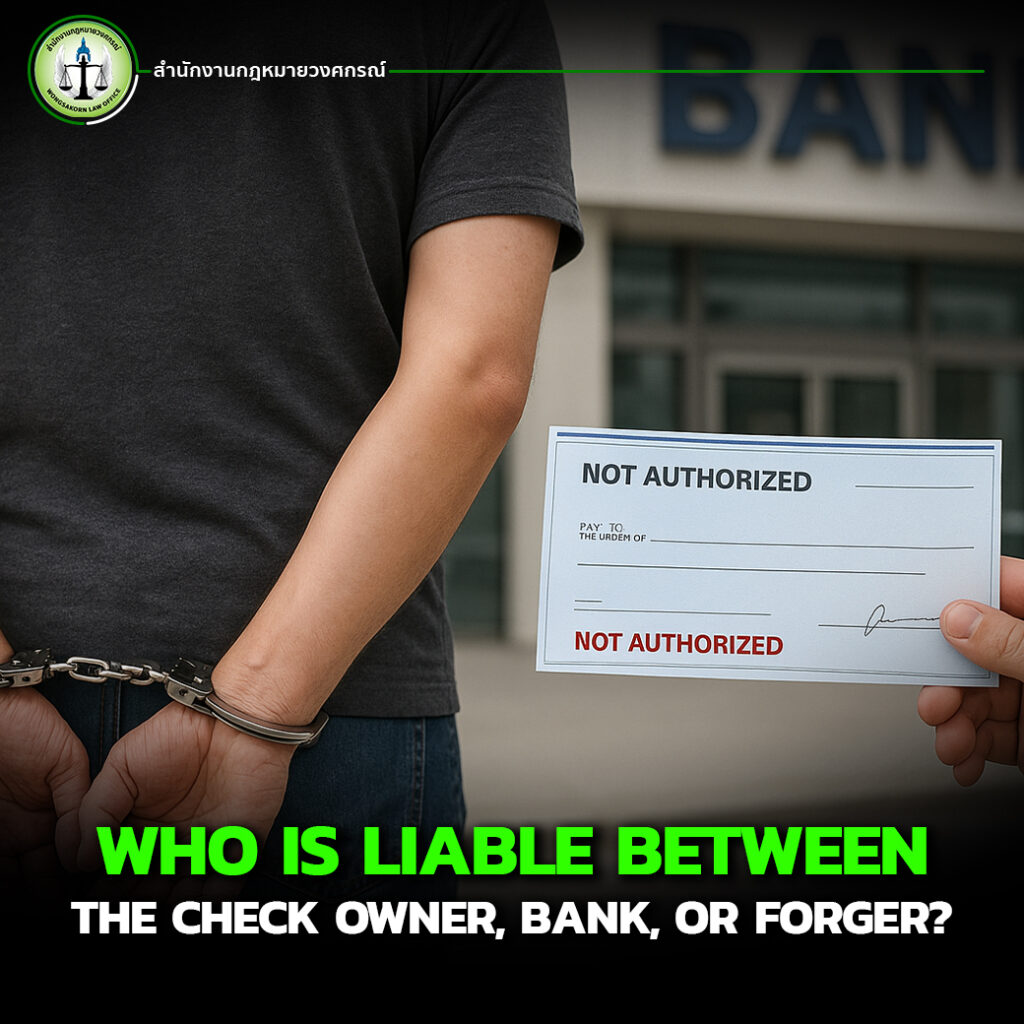
1. The Person Who Forged the Signature

The individual who forged the check commits a criminal offense under the Thai Penal Code, Section 264 (document forgery), punishable by:  

Imprisonment up to 5 years ,  

A fine not exceeding 100,000 THB , or  

Both imprisonment and a fine.  

2. The Bank That Cashed the Forged Check 

Banks are obligated to verify signatures before processing checks. If a bank negligently approves a forged check, the account holder can hold the bank liable.  

Key Supreme Court Precedents:

  1. Supreme Court Judgment No. 1405/2557: A bank that paid out on a check with a forged drawer’s signature was held liable to reimburse the customer, as the payment resulted from the bank’s failure to verify the signature, breaching its deposit account agreement.  
  2. Supreme Court Judgment No. 3776/2537: The court ruled that a bank must bear responsibility for cashing a check with a forged signature, as this constituted negligence in its duty to scrutinize signatures.  

These rulings confirm that banks must carefully examine signatures and will be held accountable for approving forged checks.  

3. The Account Holder Who Issued the Check Generally, the account holder is not liable for forged checks. However, if the holder was negligent—such as failing to safeguard their checkbook or carelessly issuing checks—the bank may refuse reimbursement.

How to Prevent Signature Forgery on Checks  
To prevent damage caused by signature forgery on checks, the following preventive measures should be taken:  

✅ 1. Carefully verify the signature and details on the check

  •  Avoid pre-signing checks.  
  •  Use a signature that is difficult to forge.  

✅ 2. Safely store checkbooks

  •  Prevent others from accessing your checkbook.  
  •  Use a safe or secure location to store checks.  

✅ 3. Set up transaction alerts with your bank

  •  Enable SMS notifications or banking app alerts to monitor all transactions.  
  • If any suspicious withdrawals are detected, contact the bank immediately.  

✅ 4. Report forgery immediately if detected

  • Gather all relevant evidence, such as copies of the forged check and bank statements.  
  •  File a police report to take legal action against the offender.

What to Do If Your Check is Forged?
If you discover that your check has been forged, you should take the following steps immediately:  

1️⃣ Contact Your Bank Immediately  

   – Notify the bank to suspend any related transactions and request a copy of the forged check.  

2️⃣ File a Police Report

   – Submit all evidence to the police so they can take legal action against the perpetrator.  

3️⃣ Consult a Lawyer to Pursue Legal Action  

   – A lawyer can help determine whether the bank was negligent in processing the forged check.  

   – Provide guidance on filing both civil and criminal lawsuits.  

   – Assist in gathering evidence to claim compensation for damages.  

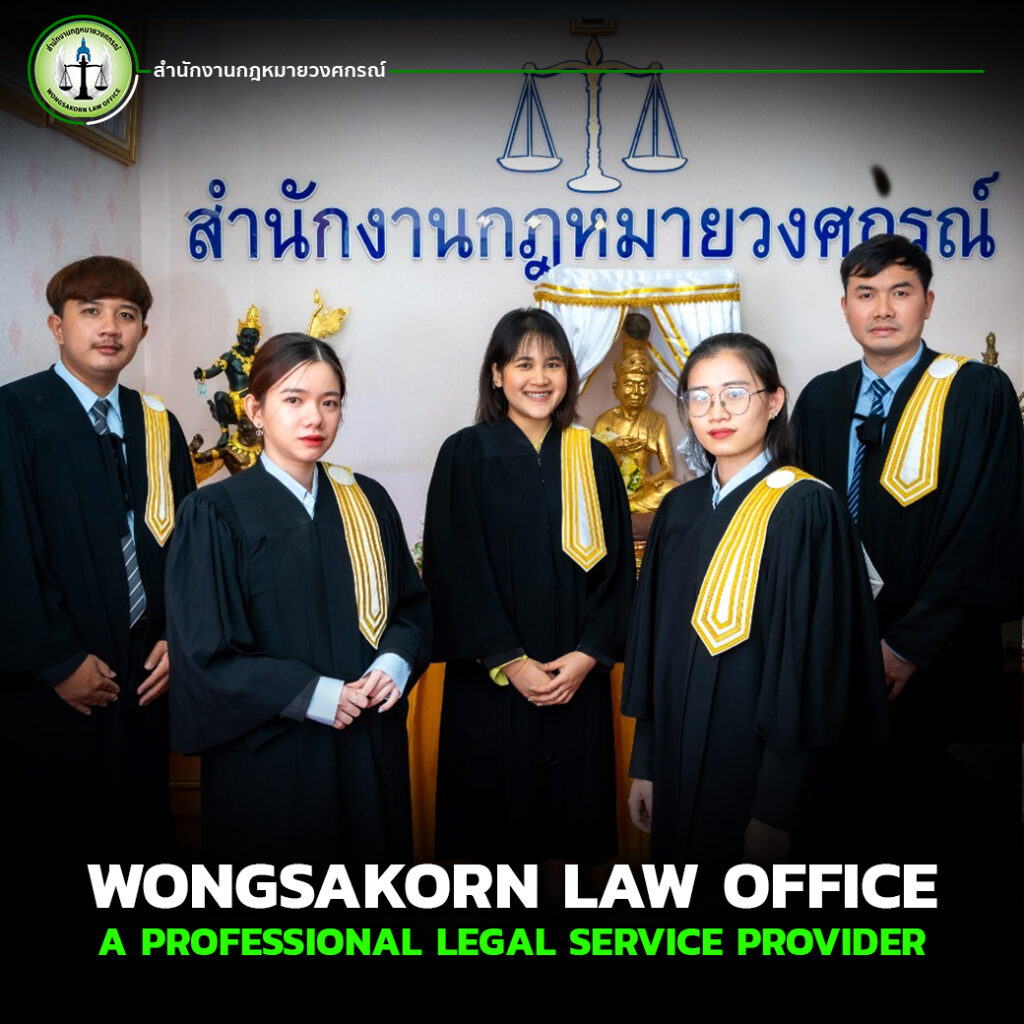
Wongsakorn Law Office specializes in cases involving check forgery and financial fraud. Our team of experienced lawyers is ready to advise and support you through every step of the legal process.  

In conclusion , Check forgery is a serious legal issue that can lead to significant financial losses. Those who forge signatures commit a criminal offense, and banks that negligently process forged checks may be held liable for reimbursing the account holder.  

To prevent check forgery, Always verify signatures, Store checkbooks securely and Use your bank’s transaction alert system.  

If you suspect check forgery, report it to the police immediately and consult a lawyer to take legal action.  

If you need legal assistance regarding check forgery, Wongsakorn Law Office is ready to provide expert advice and representation to ensure you receive the justice you deserve.  >> Contact Us <<

Stay Smart Against Scams! Don’t Fall Victim to Money Laundering Schemes

The Central Investigation Bureau continues its crackdown on transnational money laundering networks. In a recent operation, authorities raided a network linked to a Chinese call center gang, arresting 10 suspects—both Chinese and Thai nationals. Assets worth over 440 million baht were seized, following the discovery of a financial flow totaling more than 6.5 billion baht.

Fraud Tactics Used to Trick Victims

This criminal network exploits social media platforms to lure victims, disguising their scams as online job offers—such as getting paid to like posts and boost follower counts. They also entice people with short-term investment schemes, falsely promising high returns of up to 30–50%.

In the initial stages, victims often receive real payouts to build trust. Once confidence is gained, the scammers persuade them to invest larger sums. However, when the amount grows, victims find themselves unable to withdraw their money. The scammers then claim that “special conditions” must be met or additional fees must be paid.

Money Laundering Methods Used by the Network

The money obtained through fraud was converted into digital assets (cryptocurrency) and transferred through multiple accounts before being exchanged back into cash in Thailand via P2P crypto exchangers or mule accounts.

In addition, the suspects set up front companies using Thai nationals as nominees to buy and sell real estate as a way to conceal their illicit funds.

Police conducted raids at 20 locations across 8 provinces, seizing over 210 items of evidence worth a substantial amount. The investigation led to arrest warrants being issued for 32 individuals involved in the operation.

Related Legal Charges

The suspects face prosecution on the following charges:
– Conspiring to defraud the public
– Conspiring to commit money laundering
– Being members of a secret criminal society (unlawful association)
– Violations of the Computer Crimes Act

Money laundering through digital channels and the use of front companies to conceal assets are considered serious crimes that have significant impacts on both the national economy and security.

Seek Legal Advice Before It’s Too Late!

If you suspect that you may be a victim or have been affected by a money laundering scheme, don’t hesitate to reach out to Wongsakorn Law Office for professional legal advice and proper prevention guidelines. We’re here to help you stay informed and protected.

Reference: https://thestandard.co/police-bust-chinese-gray-network-investment-scam/

Written by : Kannikar Charoenweerawong (Internship Student in Chinese Language)

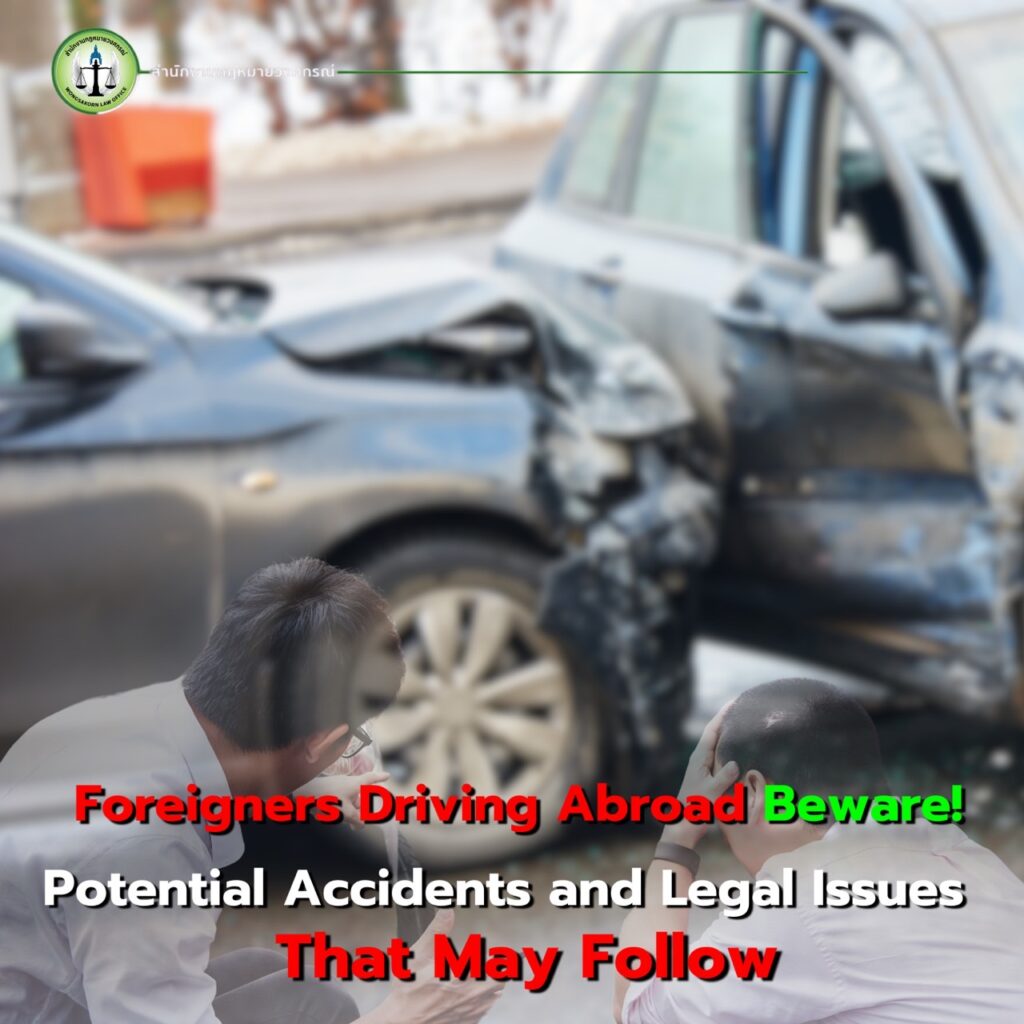
Foreigners Driving Abroad: Accidents and Legal Issues That May Follow!

  • Example case

Severe Accident on Motorway 7: A Car Cut Off a Cement Truck, Crashing Severely, Two Dead, Two Injured

February 19, 2025 – A severe accident occurred on the parallel road of Motorway 7 at km 110+900 in the area of Takian Tia Subdistrict, Bang Lamung District, Chonburi Province. The accident resulted in two deaths and two injuries. The incident occurred when a white Ford car with a Rayong license plate, carrying four Chinese passengers, exited a tunnel and cut off a cement truck with 22 wheels traveling at high speed. The truck could not brake in time and collided forcefully.

Rescue workers from the Sawang Boriboon Thammasathan Pattaya Foundation and doctors from Bangkok Pattaya Hospital reported that two Chinese passengers were severely injured and rushed to the hospital. Unfortunately, the other two passengers in the Ford car died at the scene, despite efforts to revive them. Additionally, a black Toyota Yaris, which was parked by the roadside, was also damaged due to the impact from the accident.

Mr. A, 43, the owner of the Toyota Yaris that was damaged, explained that while he was parked eating by the side of the road, the Ford car came out of the tunnel and was hit by the cement truck, which caused it to collide with his car. Mr. B, 56, the driver of the 22-wheel cement truck, explained that as he was driving from Saraburi to Mab Ta Phut Industrial Estate, the Ford car cut in front of his truck suddenly, leaving him unable to brake in time.

Bang Lamung Police Station officers investigated the scene, collecting evidence and hypothesized that the accident occurred due to the Ford car cutting off the truck suddenly, leading to a severe collision resulting in deaths and injuries, as well as property damage.

Legal Responsibility in Traffic Accidents: Responsibility of Drivers and Affected Parties

  • Responsibility of the Ford Driver (Chinese National) and Relatives of the Deceased
    In the case of the Ford driver (a Chinese national) who suddenly cut off the cement truck, if the investigation reveals that the driver was negligent, careless, or violated traffic rules, they could face charges under the Land Traffic Act of 1979, specifically Section 3, which outlines that driving carelessly or in a manner that endangers lives or property constitutes an offense.

In the event that the Ford driver died in the accident, while they would no longer face criminal penalties, their relatives or heirs may be liable for compensating damages or paying for the funeral expenses if a lawsuit is filed by affected parties. A lawsuit may also be filed to claim damages by injured parties or the family members of the deceased.

As for the survivors from the Ford, they may be held jointly responsible if it is proven that they contributed to the negligence by not following traffic laws while in a dangerous situation, which could result in lawsuits for damages by those affected.

  • Responsibility of the 22-Wheel Cement Truck Driver
    The driver of the 22-wheel cement truck (Mr. B) who sustained damage from the crash may not be criminally liable if it is proven that they were driving normally and could not avoid the sudden cut-off by the Ford car. However, if the investigation shows that the truck driver was speeding or driving carelessly, they could be considered at fault under Section 43 of the Land Traffic Act of 1979, which addresses reckless driving.

Driving at excessive speed or without caution, leading to an accident, may be interpreted as negligent driving, and the driver could be liable for both civil and criminal responsibilities, such as compensating for injuries or paying damages for fatalities.

  • Damages to Affected Parties (Mr. B, Owner of the Toyota Yaris)
    In the case of Mr. B, who suffered damage from the impact of the Ford car after it collided with the truck, if he has car insurance, he is entitled to claim compensation from his insurance company. The insurance company should compensate according to the terms of the policy. However, if he lacks insurance or if the insurance does not cover this incident, Mr. B may have to seek damages from the party responsible for the accident (e.g., the owner of the Ford car or its insurance provider).

In the case of fatalities, such as the Chinese passengers who died in the accident, the family of the deceased can claim compensation under the Road Accident Victim Protection Act of 1992, which allows victims to seek compensation for injuries or fatalities caused by another person’s driving.

Conclusions from This Incident and Legal Knowledge to Know

This accident highlights the importance of following traffic rules and driving cautiously, not only for one’s own safety but also for the safety of others who may be affected by careless driving or violations of traffic laws. The compensation for damages will depend on insurance claims and legal action taken to ensure justice for all involved parties.

Driving abroad for foreigners is a matter that requires extra caution, as each country has different traffic laws and regulations. In the case of the Chinese driver driving in Thailand, the incident emphasizes the importance of understanding the laws in each country before driving, in order to avoid mistakes and potential damage.

In the case of Thai law, foreign drivers must understand the Land Traffic Act (Traffic Law) of 1979 and the Motor Vehicle Act of 1979, as well as the requirements for holding a Thai driver’s license for foreign drivers. Specifically, foreign drivers without a Thai driver’s license or a license recognized in Thailand could be violating the law, which may affect their liability in the case of an accident.

Foreign drivers should also check their vehicle documents, such as their driving license, insurance, and vehicle ownership contracts, to ensure everything is legally in order.

Additionally, drivers should ensure their car insurance covers incidents abroad. Having comprehensive vehicle insurance or consulting with insurance professionals familiar with Thai laws will help reduce the risk of legal issues in case of accidents. Also, checking the legality of car ownership and ensuring the proper paperwork for driving in Thailand will help avoid legal problems in the event of an accident.

Finally, if a foreign driver causes an accident in Thailand and is found to be violating Thai law, they will face legal consequences according to Thai law, including provisions for compensation for injury and death under the Road Accident Victim Protection Act.

In conclusion, driving abroad not only requires caution for one’s own safety and the safety of others but also understanding the regulations and legal requirements of the country in which one is driving. Ensuring proper insurance coverage and the legal status of one’s driving documents can provide the best protection in unexpected events.

Consulting WongsaKorn Law Office : If You Are Facing Car Accident Legal Issues

If you or someone you know, who is a foreign national, is involved in a car accident, whether at fault or not, do not let the damage continue without protecting your rights. If you are not at fault, the experienced legal team at WongsaKorn Law Office is ready to provide consultation and legal action to protect your reputation and rights to the fullest. If the case is more complex than the example given, feel free to consult with our team of attorneys to ensure you receive protection under the terms of your insurance policy. Consult a lawyer  >> Contact Us <<
Reference :   https://www.matichon.co.th/local/crime/news_5056114 , https://shorturl.asia/LIg2u

Written by : Wararat Wongpothisarn (Internship Student in Chinese Language)

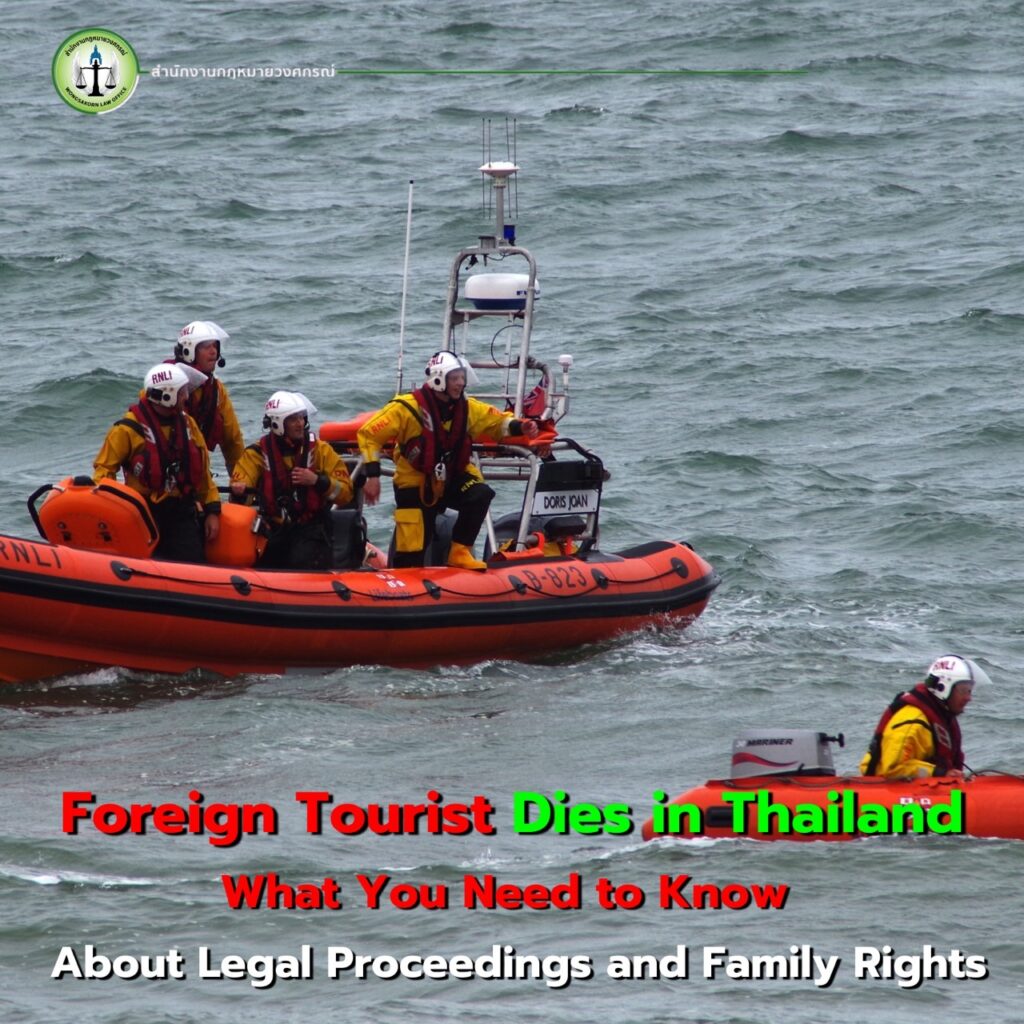
Foreign Tourist Dies in Thailand: What You Need to Know About Legal Proceedings and Family Rights

Chinese Tourist Drowns While Snorkeling in Phuket, Family Questions Rescue Efforts

During the Chinese New Year holiday, Ms. Zhong traveled to Phuket, Thailand, with her 5-year-old daughter and 31-year-old sister, and booked a snorkeling package for February 6  2025 through an online platform. However, this trip turned into a tragedy, causing her to lose her sister.

Snorkeling Accident: Delayed Rescue?

On the morning of February 6 2025 , Ms. Zhong, along with her sister and daughter, followed the plan to go to Coral Island, with around 20-30 tourists on the same boat. Most of the crew were Thai, and there was a Chinese-speaking guide who provided information about the tour program and safety precautions, such as wearing a life jacket while snorkeling and avoiding areas with deep water. However, Ms. Zhong mentioned that the life jackets were only brought out after the guide finished the briefing, and tourists could pick them up on their own. As other tourists began entering the water, Ms. Zhong, who was watching her daughter on the beach, didn’t notice whether her sister was wearing a life jacket.

Around 12:30, Ms. Zhong noticed a speedboat rushing toward the shore. Sensing something was wrong, she quickly ran over and found her sister unconscious on the boat, with the crew performing CPR—her sister had drowned! Witnesses said that the area had both snorkeling activities and jet skiing. Although there were buoys marking the boundaries, some jet skis still entered the snorkeling area. Two French tourists and a Thai jet ski driver discovered Ms. Zhong’s sister’s body and helped bring her out of the water, after which the crew performed CPR and took her to a hospital in Phuket.

Died 16 Days After Brain Death, Family Questions the Rescue Efforts

Ms. Zhong stated that when the staff took her sister to the hospital, she requested to go along but was refused. She arrived at the hospital around 2:30 PM and was informed that her sister was in a brain-dead state.

Afterward, the family attempted to arrange a transfer to another hospital and considered the possibility of sending her sister back to China for treatment. However, after 16 days of battling life and death, her sister passed away on February 22.

Ms. Zhong’s family believes that the cessation of CPR during two transfer processes may have been a factor in missing the opportunity to save her life. They also questioned the safety measures taken by the tour company, arguing that the staff had not provided proper snorkeling training before the activity.

Dispute Over Compensation: Family Rejects the Tour Company’s Offer

Following this tragedy, Ms. Zhong attempted to negotiate with the tour company for fair compensation and called on relevant authorities to review safety measures, such as providing additional life-saving equipment and effective first-aid training.

However, the tour company offered compensation of 1 million Thai baht (approximately 20,000 RMB or 200,000 Thai baht) from the Thai side, and 200,000 RMB (approximately 1 million Thai baht) from the Chinese side, totaling about 1.2 million Thai baht. This amount is lower than the 1.5 million RMB (approximately 7.5 million Thai baht) that the family had requested.

Lawsuit and Proving the Mistakes of the Tour Operator (Dive Supervisor) That Caused Damage

The claim for compensation from this accident can be pursued under the law and the rights of those who have suffered damage due to the negligence or actions of others, including mistakes made by the tour operator or the supervisor of the snorkeling activity. This applies if there was a violation of duties or negligence that led to harm or danger to the life or body of the tourist, particularly in cases related to safety and the management of life-saving equipment that was either substandard or insufficiently prepared.

Under Thai law, the injured party can file a lawsuit in both civil and criminal court if it can be proven that the tour operator or the involved staff made a mistake due to negligence or failure to manage safety properly. This includes failing to provide adequate life-saving equipment or not performing CPR promptly and effectively, which is a breach of their duty with a direct impact on the life of the tourist.

In cases where the compensation offered by the tour operator is unsatisfactory—such as the amount being insufficient for the loss suffered—the injured party can file a lawsuit in court to seek appropriate compensation. The court will consider the evidence and facts to determine a fair amount of compensation based on the extent of the damage caused.

Moreover, the claim for compensation from the tour operator can be pursued either through negotiations or litigation in court if the affected party disagrees with the offered settlement (for example, the offer of 1,200,000 Baht). In such cases, the court will evaluate the relevant evidence and facts to determine the appropriate compensation amount.

In summary, the family of Ms. Zhong can exercise their right to claim compensation from the actions of the tour operator and the supervisor of the snorkeling activity if it can be proven that the staff or the tour operator failed to provide adequate safety measures or neglected important steps in assisting the accident victim. This includes the lack of proper training and the failure to use appropriate life-saving equipment.

Reference :   https://mp.weixin.qq.com/s/PCKqYV4Wfo3J2rXN6Kn5DA 

Written by : Wararat Wongpothisarn (Internship Student in Chinese Language)

Illegal Chinese Labor in Thailand: Legal Challenges Employers Need to Know!

On December 14, 2024, police officers apprehended five Chinese nationals aged between 34 and 61 in the Huai Khwang district of Bangkok. The individuals were found illegally working as construction laborers without valid work permits. This incident highlights the ongoing issue of employing foreign laborers without proper authorization in Thailand. 

Mr. Tanit Sorat, President of the National Labor Development Advisory Council, observed that the suspects possess specialized skills in the construction industry. This indicates the illegal importation of skilled labor without following proper procedures, especially considering that there are approximately 28,000 Chinese workers legally employed in Thailand. However, despite clear penalties under foreign labor laws, enforcement remains inconsistent, leading to gaps that result in repeated violations.

In addition to the issue of illegal labor, there is a growing trend of Chinese nationals investing in various businesses in Thailand, including restaurants, logistics, and retail. This development affects market competition, particularly impacting small and medium-sized Thai enterprises. Some Chinese workers exploit legal loopholes by disguising their roles, such as falsely claiming to be engineers to participate in construction projects.

Currently, the employment of foreign labor, especially Chinese workers, continues to rise across various industries. However, hiring workers without proper work permits is not only illegal but also poses several risks that employers should carefully consider before making such decisions.

Employing foreign workers without proper work permits in Thailand carries significant risks and consequences, including:

  1. Risk of Fines and Imprisonment: Under the Royal Decree on the Management of Foreign Workers Employment B.E. 2560 (2017), employers hiring foreign workers without valid work permits may face fines ranging from 10,000 to 100,000 Thai Baht per worker. Repeat offenses can result in increased fines of 50,000 to 200,000 Baht per worker and a three-year ban on hiring foreign workers. Additionally, if the workers entered Thailand illegally, employers could be prosecuted for assisting in illegal activities, potentially leading to further imprisonment.
  2. Business and Reputational Risks: Being apprehended or prosecuted can severely damage a company’s reputation. Negative publicity may erode trust among customers and business partners, leading to lost business opportunities and increased scrutiny from government authorities in the future.
  3. Risk of Labor and Wage Disputes
    Undocumented workers are often not protected under labor laws. In cases of disputes over wages, benefits, or termination, legal action may be taken against the employer. This could result in negative consequences, such as being held liable for back pay and potentially having to pay higher-than-standard compensation.
  4. Risk of being inspected by government agencies                                                 
    Hiring illegal foreign labor may cause the company to become a target of inspections by the Ministry of Labor, the Immigration Bureau, or related agencies. This could lead to the revocation of the business license or even partial suspension of operations.  
  5. Risk of being blacklisted                                                                                                    
    If a company has previously faced legal action regarding illegal foreign labor, it may be placed on a government watchlist. This could result in future applications for foreign labor permits being denied or subject to stricter conditions.  
  6. Risk of safety and labor accidents                                                                                  
    If illegal foreign workers are injured or killed on the job, the employer may be held fully responsible for all expenses, including medical costs and compensation to the worker’s family, which could be several times higher than normal wages. Additionally, if it is found that the workers do not have social security or are not covered by workplace safety protections, the employer may face further legal action under labor protection laws.

Avoid Risks by Complying with the Law

To prevent legal issues and potential damages, employers should hire foreign workers legally by verifying their work permits and complying with the requirements of the Ministry of Labor.

For those involved in hiring foreign workers—whether employers or businesses aiming to operate legally—it is crucial to thoroughly study labor regulations to minimize legal risks. If there are any uncertainties regarding compliance, seeking advice from labor law experts is highly recommended. This ensures business stability and safeguards against legal complications.  

By following the law, businesses can operate smoothly, avoid penalties, and maintain a strong reputation.

Reference https://news1005.mcot.net/news/18436/

Written by : Kannikar Charoenweerawong (Internship Student in Chinese Language)

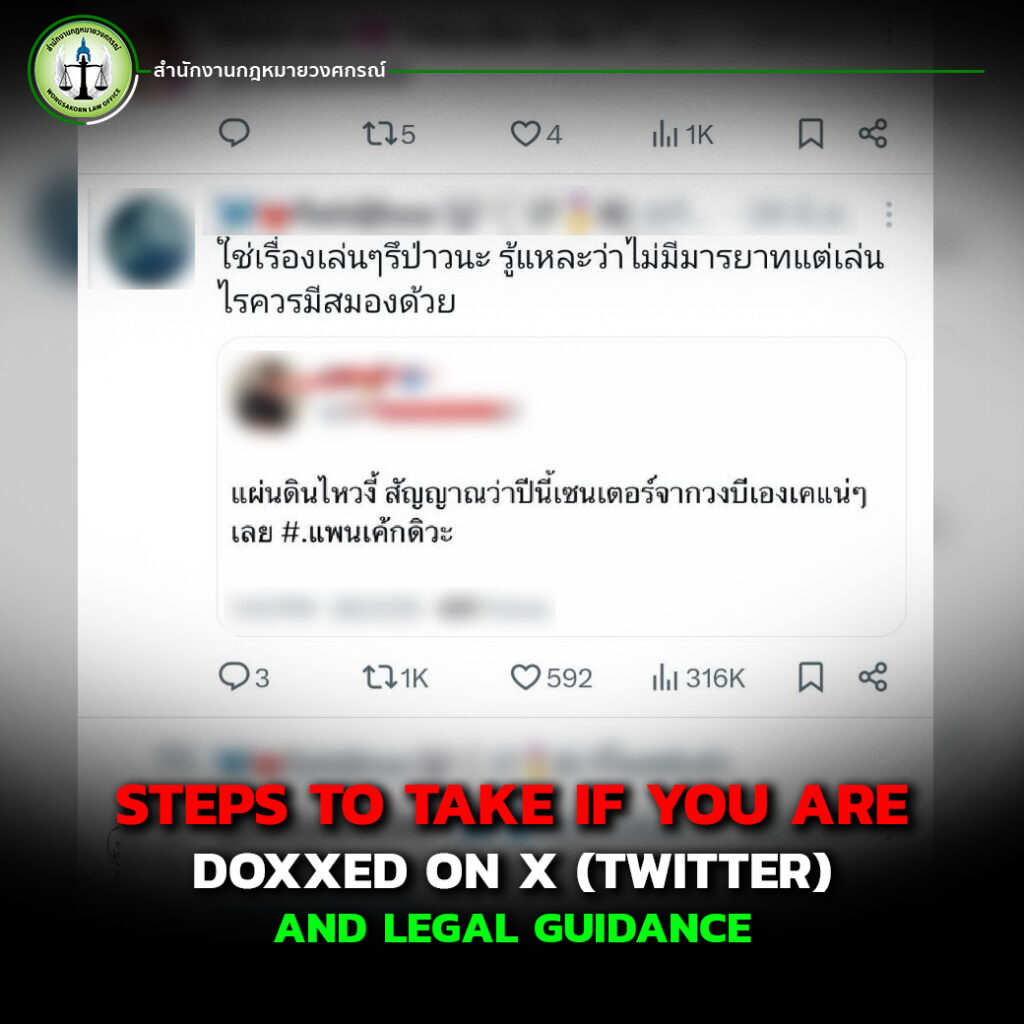
Steps to take If you are Doxxed on X (Twitter) and Legal Guidance

In an era where social media has become the central hub for communication and expression, users can freely post, share, and comment on various topics. However, this online freedom can sometimes turn into an unexpected legal trap. One behavior that has been increasingly discussed and is causing more problems is “doxxing” or exposing someone’s social media account to invite public attacks. This not only damages the victim’s reputation but may also constitute a criminal offense. Today, Wongsakorn Law Firm will help you understand more about “doxxing” on social media and the legal risks that could even lead to imprisonment.

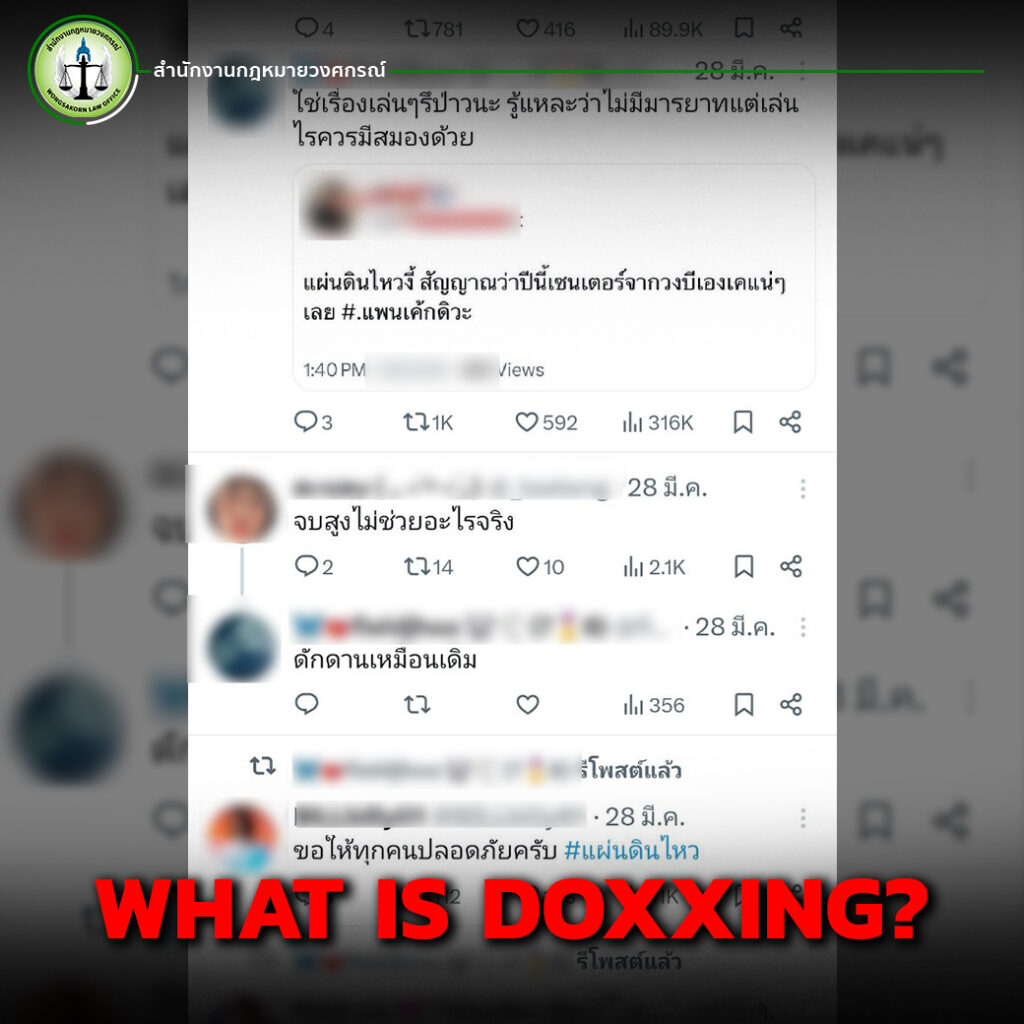
What is Doxxing?

“Doxxing” is an online behavior where someone exposes another person’s social media account, encouraging others to criticize, insult, or even threaten them. This behavior can take various forms, such as:

  • Sharing the target’s posts along with attacking comments.
  • Exposing personal information, such as addresses, phone numbers, or private details.
  • Creating a widespread wave of harassment, even without solid evidence.
  • Encouraging others to join in insulting or sharing the information without verifying the facts.

Such actions can have severe consequences for the victim, affecting their mental well-being, reputation, and career. In some cases, doxxing can lead to legal action, both civil and criminal.

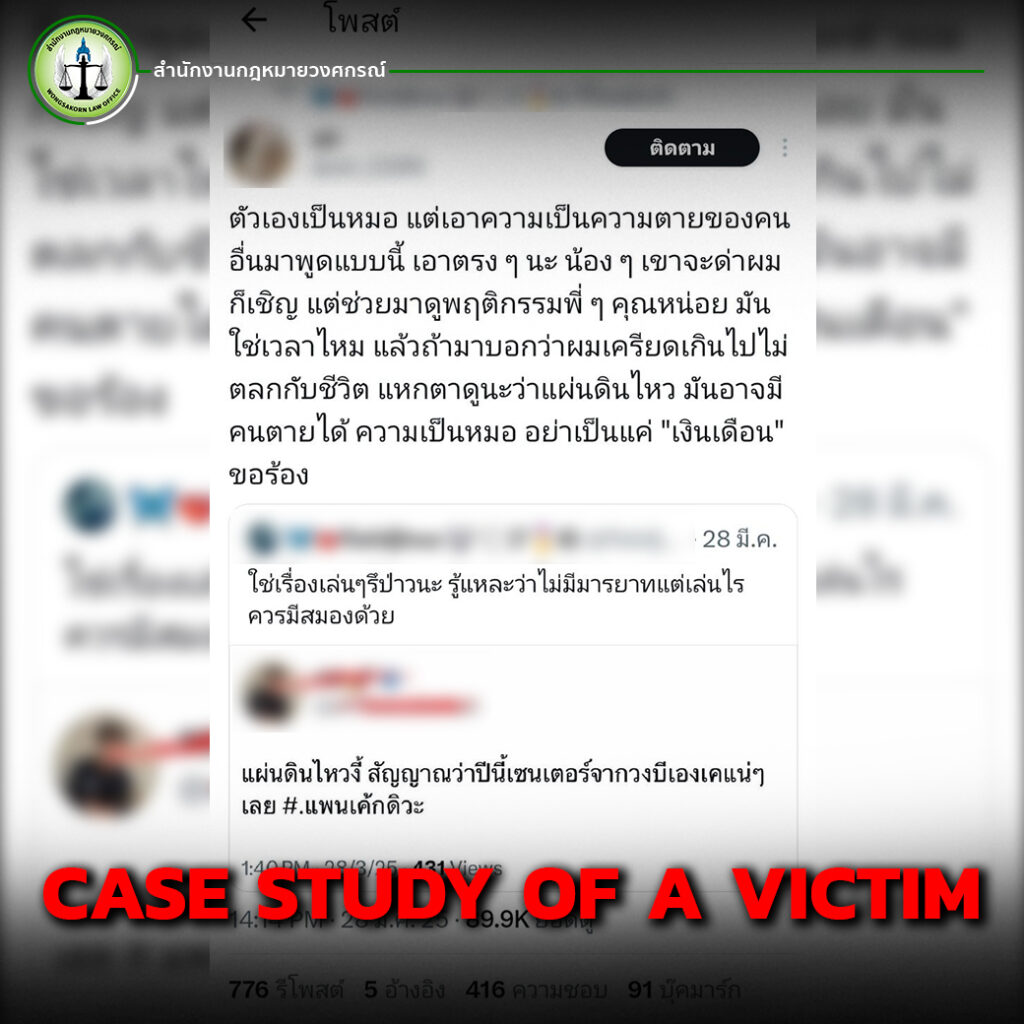
Case Study of a Victim

Wongsakorn Law Office was contacted by a client who suffered from doxxing on Platform X. Someone shared his post, pointing him out as a target and encouraging others to insult, accuse, and attack him online—without verifying the truth behind his original post.

As a result, the victim faced severe online harassment, received threats from strangers, and, most importantly, suffered damage to his reputation and career. In this case, Wongsakorn Law Office provided legal consultation and guidance on taking legal action against those involved.

Insulting Others on Social Media Without Knowing the Facts Could Be a Criminal Offense

Expressing opinions or sharing information online without verifying the facts can lead to legal consequences, including:

  • Criminal Defamation – Making statements that damage someone’s reputation, even if they are personal opinions, can still be considered defamation if they negatively impact another person.
  • Violation of the Computer Crimes Act – Posting or sharing false information that causes harm may constitute an offense under the law.

Anyone who joins in insulting or sharing such content without verifying the facts could also face legal action alongside the original poster.

Impacts on Victims of Doxxing on Social Media

Doxxing is not only a violation of a victim’s privacy but also brings severe consequences, such as:

1.Reputation Damage – Negative information shared online can lead to misunderstandings and harm the victim’s public image.

2.Harassment and Threats – In many cases, victims may receive threatening messages or face harassment both online and offline.

3.Career Consequences – Online attacks can result in lost job opportunities or even termination by employers.

4.Mental Health Effects – Victims of online harassment may suffer from stress, anxiety, or depression.

Laws Related to Publicly Shaming Others on Social Media

1.Criminal Code, Sections 326 and 328

  • Section 326: Defaming another person in the presence of a third party may result in imprisonment for up to one year or a fine of up to 20,000 baht.
  • Section 328: If the defamation is committed through advertising, such as online media, the penalty may be imprisonment for up to two years or a fine of up to 200,000 baht.

2.Computer-Related Crime Act B.E. 2560 (2017), Section 14

o  Importing false information that causes damage to another person may result in imprisonment for up to 5 years, a fine of up to 100,000 baht, or both.

Preventive Measures and How to Respond If You Are Doxxed on Social Media

1.Do not react immediately – Stay calm and avoid engaging in arguments that could escalate the situation.

2.Collect all evidence – Take screenshots of messages, images, or videos that can be used as proof.

3.Report to authorities and consult a lawyer – Before taking legal action, seek advice from a lawyer to determine the best course of action.

4.Exercise your legal rights to claim damages – If you have suffered harm, you may file a lawsuit to seek compensation from the offender.

Get legal advice if you become a victim of doxxing on social media

If you are facing online harassment, defamation, or threats due to doxxing on social media, don’t let the damage continue without protecting your rights. Our team of experienced lawyers at Wongsakorn Law Office is ready to provide legal consultation and take action to safeguard your reputation and legal rights.📌 Don’t let the harm go unchallenged. Contact us for legal consultation today.

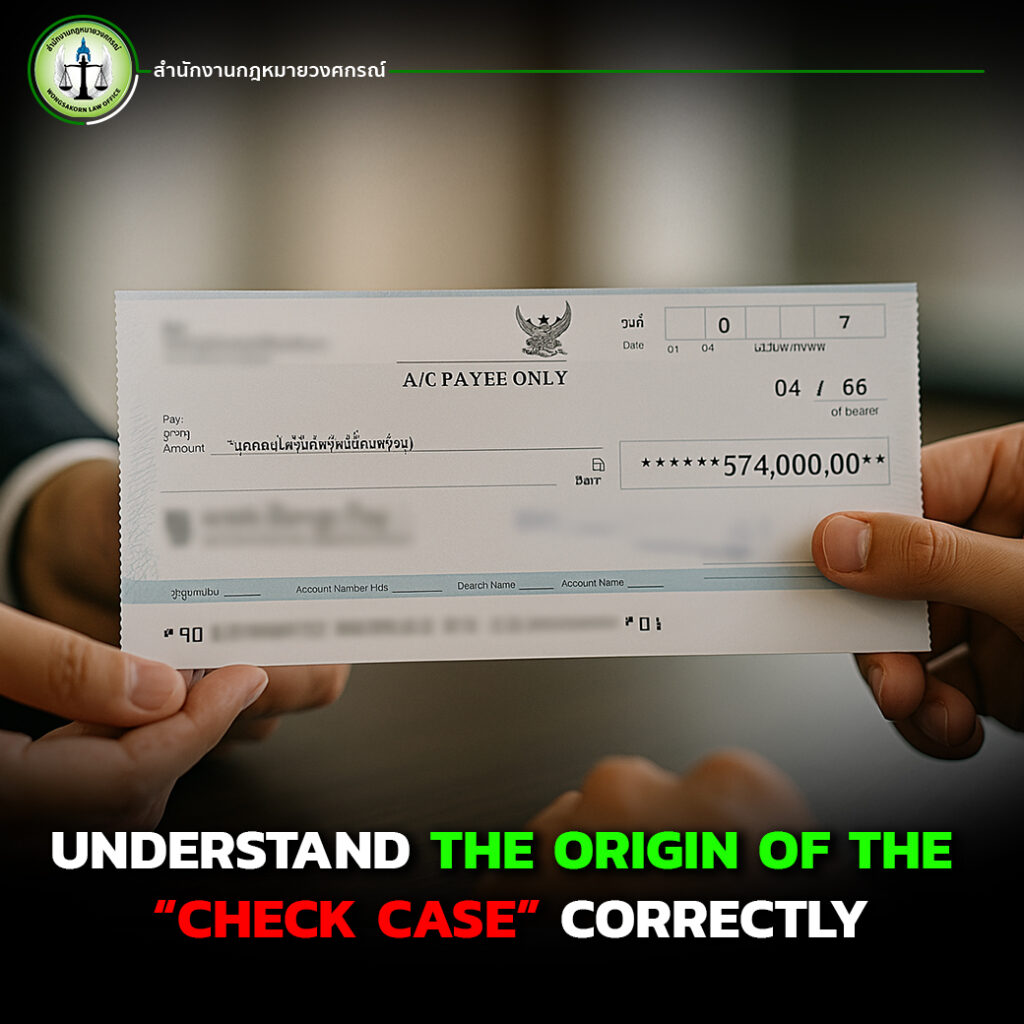
Understand the Origin of the “Check Case” Correctly

“Checks” are one of the financial instruments that are popular in doing business and paying debts. In addition, using checks is an important financial instrument in the business world and various transactions. However, there are still frequent misunderstandings about the locations related to checks, especially the matter of “check cashing locations” and “locations where banks refuse to pay checks”, which many people misunderstand to be the same place, when in fact they are different locations. Today, Wongsakorn Law Office will help you clear up more doubts about checks.

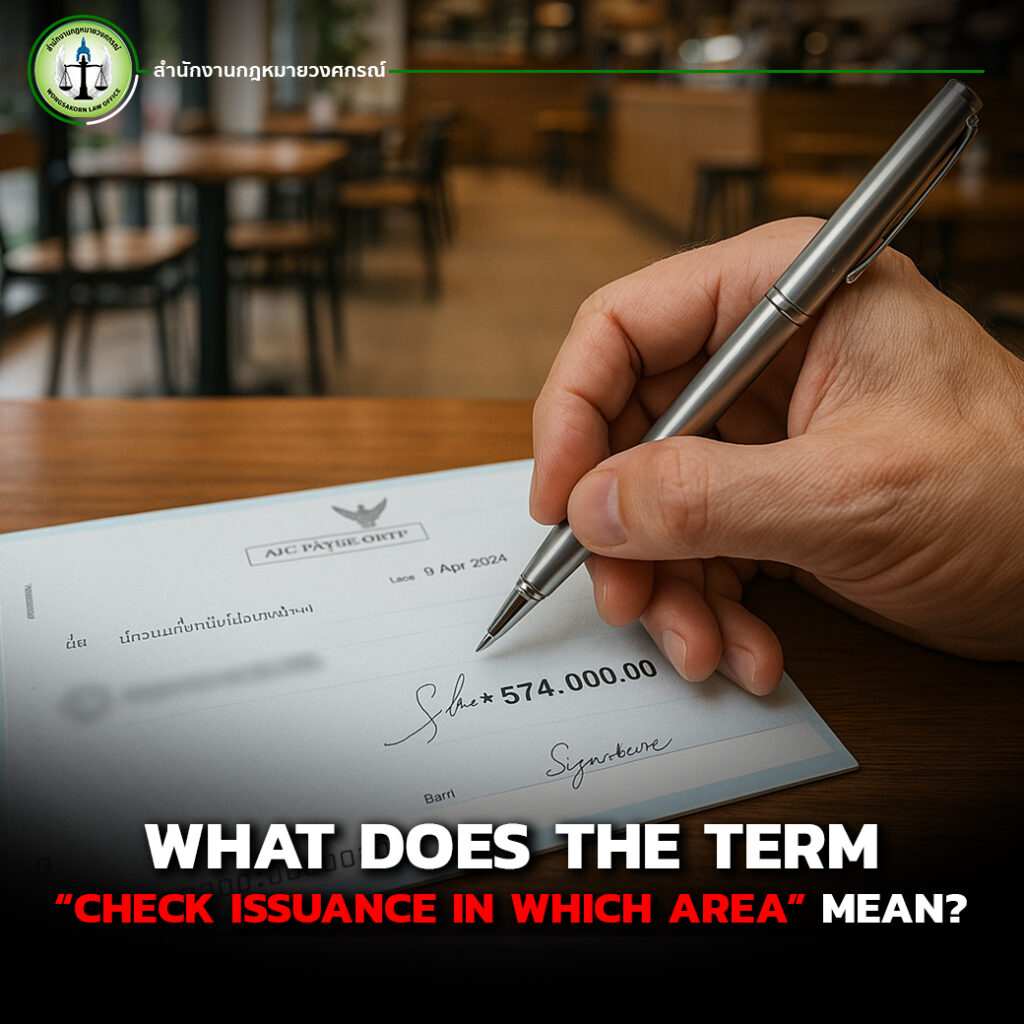
What does the term “check issuance in which area” mean?

The Supreme Court’s decision No. 2070/2543 (abbreviation) states that an offense under Section 4 of the Act on Offenses Relating to the Use of Checks B.E. 2534 (1991), issuing a check in which area is considered a criminal offense committed in that area, which is continuous with the offense in the area where the bank refused to pay.

The defendant issued a check according to the lawsuit in Bang Ban District, which is under the investigation jurisdiction of the investigation officer of Bang Ban Police Station. And the bank that issued the check refused to pay in the area of ​​Phra Nakhon Si Ayutthaya District, which is under the investigation jurisdiction of the investigation officer of Phra Nakhon Si Ayutthaya Police Station. It can be considered that the offense in this case was committed in Bang Ban District, which is a continuation of the offense in Phra Nakhon Si Ayutthaya District, Phra Nakhon Si Ayutthaya Province. The investigation officers of Bang Ban Police Station and Phra Nakhon Si Ayutthaya Police Station have the authority to investigate this case. When the injured party filed a complaint with the investigation officer of Bang Ban Police Station and the investigation officer of Bang Ban Police Station conducted the investigation, this case was properly investigated. The plaintiff has the authority to sue. 

Therefore, according to the Supreme Court Decision No. 2070/2543, the term “issuing a check in which area” means the place where the issuer of the check signed the check and delivered it to the recipient, not the location of the bank to which the check was issued. 

This means that issuing a check has nothing to do with the bank where the account holder opened the account, but depends on the place where the check was signed and delivered to the recipient.

More about “Issuing a Check”

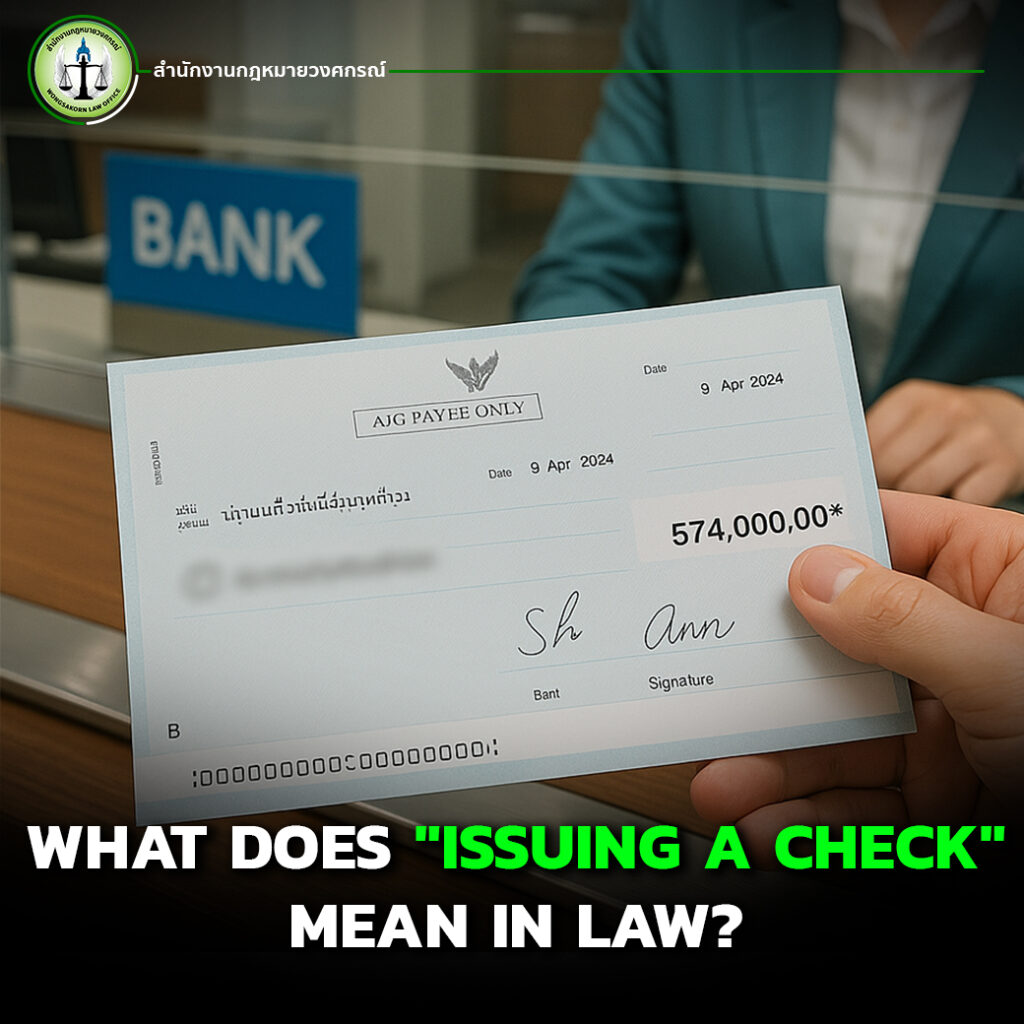
What does “Issuing a Check” mean in law?

“Issuing a Check” means that the drawer (account holder) signs the check and delivers the check to the recipient.

Where is the place considered to be the issue of a check?

The place where the check is signed and delivered to the recipient is not the location of the bank that issued the check (i.e. the bank where the account holder has an account).
For example, if Mr. A signs a check and delivers it to Company B in Bangkok, but Mr. A’s account is at the Phuket branch of the bank, the place of issue of the check is still Bangkok, not Phuket.

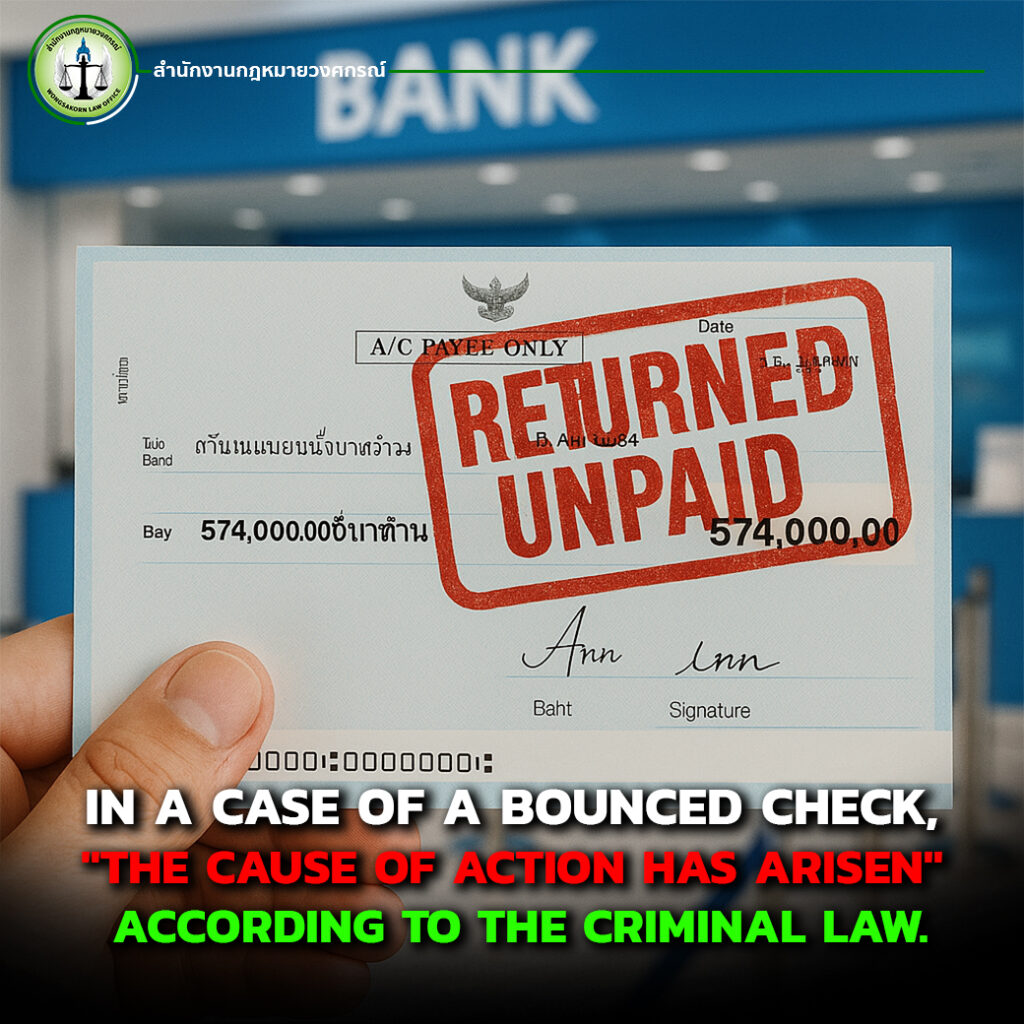
In a case of a bounced check, “the cause of action has arisen” according to the criminal law.

A bounced check case is a criminal offense under the Act on Offenses Arising from the Use of Checks B.E. 2534.

And the place can be determined as “The value of the case” can be in 2 main cases:

1️⃣ Place of issue of the check

Refers to the place where the drawer signs and gives the checks to the recipient

2️⃣ Place of rejection of the check

Refers to the place where the bank refuses to pay when the recipient cashes the check

Therefore, the court with jurisdiction can be

The court in the district where the check was issued

✅ The court in the district where the bank refuses to pay

Examples of common misunderstandings

“The bank where the check was rejected” and “place of cashing” are the same place

✅ Truth: The bank where the check was rejected is the bank from which the check must be collected, not the bank from which the recipient cashes the check

For example,

  • Mr. A opened an account at the Bangkok branch of the bank.
  • Later, Mr. A issued a check to Mr. B and gave it to him in Chiang Mai province.
  • Mr. B cashed the check at a bank in Khon Kaen province.
  • The check must be collected from Mr. A’s account at the Bangkok branch of the bank, but when it was sent for collection, it was rejected.

In this case,

✔️ Place of issue of the check = Chiang Mai

✔️ Place of rejection of the check = Bangkok

❌ Khon Kaen has no part in the trial of the case

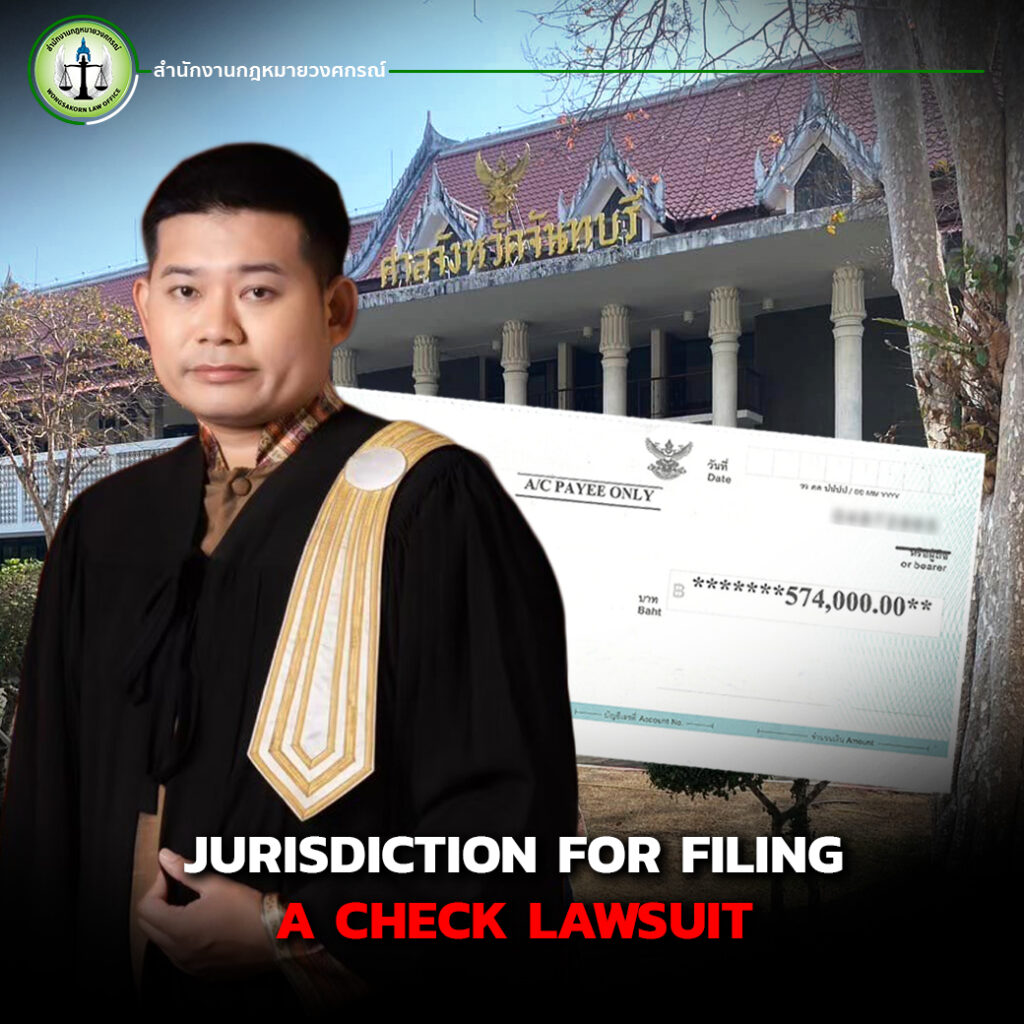
Jurisdiction for filing a check lawsuit

As mentioned, when there is a case of a bounced check Or the check was rejected for payment. The injured party can file a lawsuit in court by considering the location related to the case as follows:

1. Court in the area where the check was issued

📌 is the court in the area where the issuer signed and gave the check to the recipient.

📌 For example, if Mr. A issued a check in Chiang Mai Province, the Chiang Mai Court will have jurisdiction to consider this case.

2. Court in the area where the bank refused to pay.

📌 is the court in the area where the bank that must make payment according to the check is located and where the check was rejected for payment.

📌 For example, if Mr. A has an account at the Bangkok branch of the bank and the bank refuses to pay at the Bangkok branch, the Bangkok Court will have jurisdiction to consider this case.

You cannot file a lawsuit in the court in the area where the recipient of the check cashed if it is not the place where the check was issued or the place where payment was rejected.

Important conclusions

“Where is the check issued” = The place where the issuer signed and gave the check to the recipient.

Not the place where the issuer’s bank is located.

✅ You can file a lawsuit in the court where the check was issued or the court where the check was rejected for payment by the bank.

If you want to use the location of the bank as a cause of action, it should be the case where the check was cashed at that branch of the bank and was rejected for payment in that area.

Wongsakorn Law Office is ready to provide advice on all check cases.

As mentioned above, this is just a legal education. However, there are many problems and cases related to checks, such as bounced checks, check lawsuits, and check collection. This requires a correct understanding of the law and legal process. If you are facing a problem with a check, whether it is a check recipient who has been refused payment or a payer who needs legal advice, Wongsakorn Law Office has expertise in consulting and prosecuting check cases in particular. We are ready to provide legal services to clients to ensure fairness.

Beware! Encountering “sly lawyers” who demand payment until the case reaches the prosecutor’s level. Is this really possible?

Attorney fees and transparency that clients must be aware of !

Nowadays in society, finding a lawyer to provide legal services is important, especially for those who do not understand the law or procedures. But what many people may not expect is being “sly lawyer” or taken advantage of through unfair fee calculations. One of the real cases that was shared by Lawyer Arm‘s clients is when this client hired a lawyer who said that he would charge a fee until the case reached the prosecutor’s office. It sounds reasonable, but when you consider it carefully, you will find that it is a hidden trick.

What does “final” attorney fees mean?

Normally, hiring a lawyer for litigation will have a clear scope of fees, such as:

  • Fee for consulting
  • Fee for litigation at the police level
  • Fee for prosecutors
  • Fee for court cases

However, in this client’s case, the lawyer used the term “collecting fees until the case reaches the prosecutor’s level”, which at first glance may mean until the case is concluded. But in reality, 90% of cases usually end up in court, not at the prosecutor’s level. Therefore, if the client does not understand the justice process, they may misunderstand and think that hiring covers the final stage of the case.

However, when the case goes to court, the lawyer may use the excuse that “the fee charged only covers the prosecutor’s level” and collect more for the court proceedings again, which is considered dishonest with the client.

Attorney Ethics and What Good Lawyers Must Do

According to the code of ethics, lawyers must be honest and treat their clients fairly. This means that good lawyers must not use tricks or tricks to obtain unfair fees.

According to the Lawyers Act B.E. 2528 and the Lawyers Council’s regulations on lawyers’ ethics, the following guidelines are set for lawyers:

Do not charge excessive fees – Lawyers must not charge fees using ambiguous or hidden words to mislead clients.

Be honest and do not use tricks – Using ambiguous language to mislead clients and make them pay more later is considered unethical behavior for lawyers.

Must inform clients directly – Lawyers have a duty to clearly explain the scope of work and fees from the beginning.

Must not seek personal gain improperly – Using clients’ ignorance to make their own profit is considered taking advantage and may be subject to disciplinary action.

Lawyers who violate these ethics may be subject to disciplinary action by the Lawyers Council, which may include reprimand, suspension of license or revocation.

How should transparent pricing be?

Ethical lawyers must disclose details about Clear fees and scope of work. From the beginning, vague words should not be used to mislead clients. Therefore, fair lawyer fees should have the following characteristics:

1. Clear agreement on fees – must state which stages the fees cover, such as police, prosecutor or court.

2. Inform clients about the legal process straightforwardly – clients must know whether their case has a chance to go to court or not.

3. No hidden fees – lawyers should not use ambiguous language to mislead clients into believing that the fees paid cover everything.

Wongsakorn Law Office, a professional legal service provider

To prevent falling victim to tricky lawyers, Wongsakorn Law Office is a law firm that provides transparent, fair services and focuses on honesty with clients. Our service standards are as follows:

Clearly state the fees.

Provide easy-to-understand advice, explain the legal process straightforwardly.

A team of highly experienced lawyers who can provide professional legal services to clients.

Strictly adhere to the code of ethics of lawyers.

We are committed to providing legal services to those who want legal justice without using any tricks to take advantage of clients.

The matter of lawyer fees is an important matter that clients must pay attention to and choose a lawyer who is transparent and does not use ambiguous language to charge additional fees. “Sly Lawyers who demand the most fees” is an example of behavior that clients should be aware of and should choose to use the services of lawyers with ethics. 

If you are looking for a reliable legal advisor, Wongsakorn Law Office is ready to provide professional services. Consult us immediately >>Contact us<<

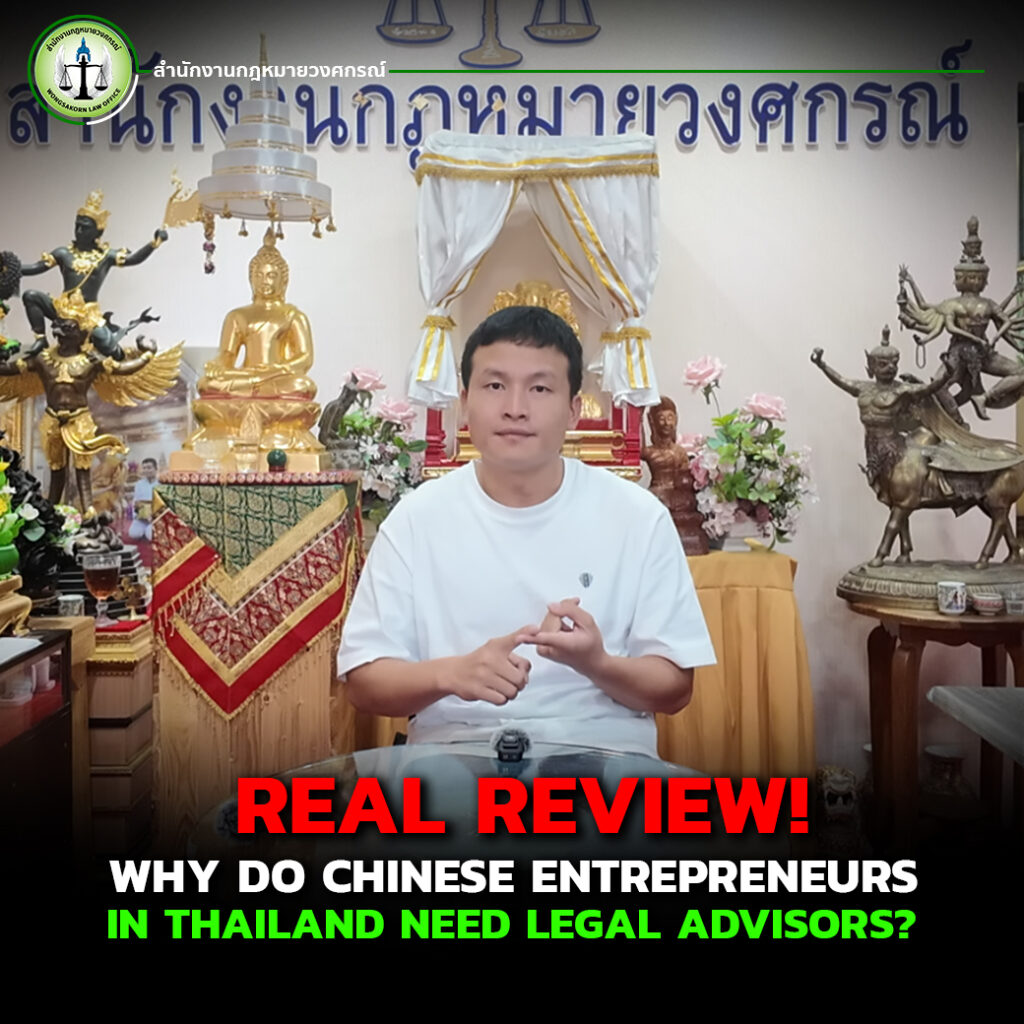
Real Review! Why Do Chinese Entrepreneurs in Thailand Need Legal Advisors?

Interview with Mr. Ali: A Chinese Businessman’s Experience with Legal Services in Thailand 

Chinese Investment in Thailand: Opportunities and Challenges

Thailand is a popular destination for Chinese investors due to its position as an economic hub in Southeast Asia, its abundant natural resources, and its business-friendly legal framework. However, despite Thailand’s openness to foreign investment, the complex legal system and regulations can pose significant challenges for foreign entrepreneurs, especially those unfamiliar with Thai law.

Mr. Ali, a Chinese businessman running a coconut processing business in Thailand, shared his experience of doing business in the country and explained why he decided to seek legal advisory services to ensure smooth and legally compliant business operations.

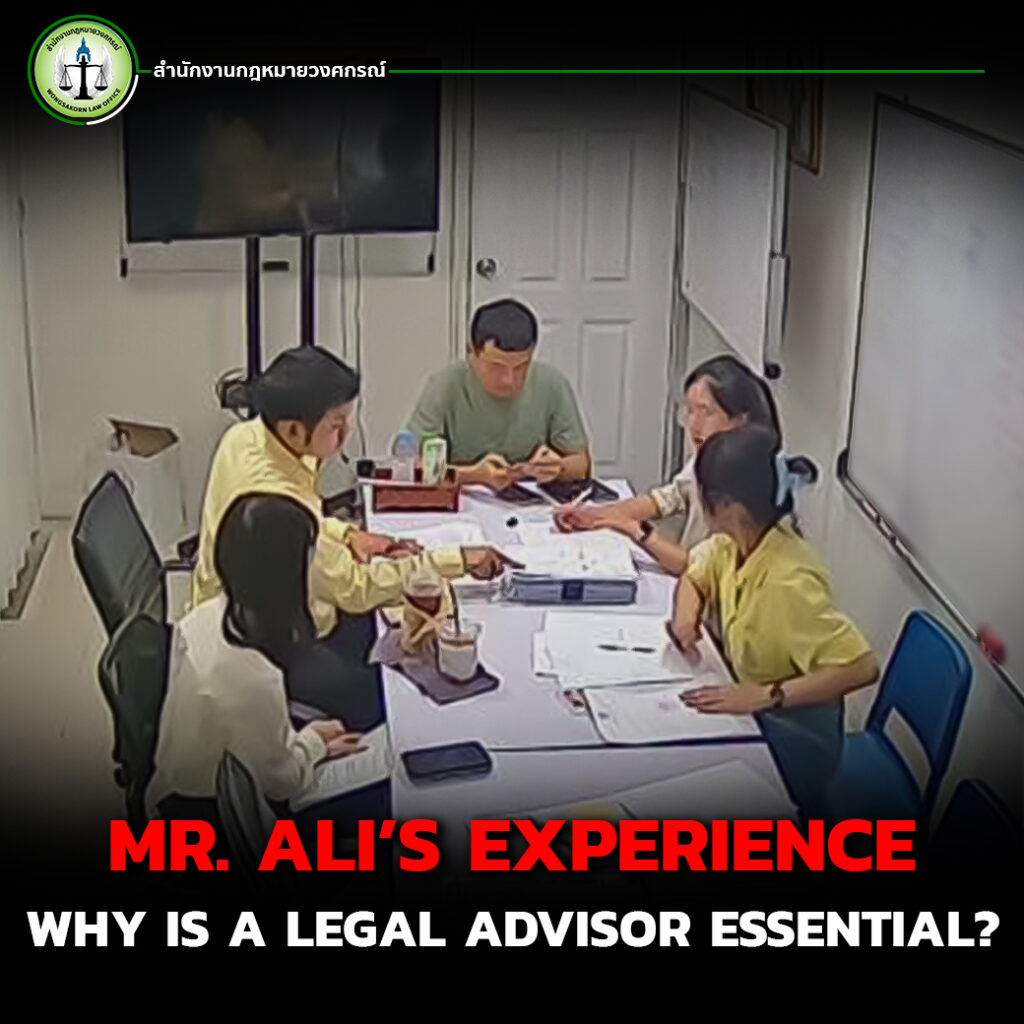
Mr. Ali’s Experience: Why Is a Legal Advisor Essential?

Mr. Ali stated:

“Hello, everyone! Today, I visited a law firm to consult with a lawyer about various legal matters related to running my coconut processing business in Thailand. This includes taxation, labor laws, and other potential legal issues. For Chinese entrepreneurs investing in foreign countries, a major concern is how to operate a business legally in Thailand.”

“Today, I had a consultation with Attorney P’Arm, and it was incredibly helpful. He provided valuable advice and helped me avoid legal mistakes that could negatively impact my business or result in financial losses.”

“Therefore, I strongly encourage all Chinese entrepreneurs looking to invest abroad to consult with a reputable and trustworthy law firm in the respective country. This will help ensure compliance with local laws and a smooth business operation in Thailand. Wishing you all great success!”

Why Chinese Entrepreneurs in Thailand Need a Legal Advisor

1. Differences Between Chinese and Thai Laws

While Thailand welcomes foreign investment, Thai laws differ significantly from Chinese laws. Understanding Thai regulations is crucial for investors. A legal expert can help entrepreneurs navigate these differences and ensure full compliance with local laws.

2. Company Registration and Business Structure

Chinese investors planning to set up a company in Thailand must understand the registration process, shareholding structures, and director requirements under Thai law. A legal advisor can assist in structuring the company properly, reducing risks related to foreign ownership restrictions.

3. Compliance with Tax and Labor Laws

Taxation is a key aspect of doing business in Thailand. Entrepreneurs must comply with Value Added Tax (VAT), corporate tax, and personal income tax regulations, as well as labor laws governing foreign workers. Failure to adhere to these regulations may result in fines or legal actions.

4. Business Contracts and Legal Protection

Contracts with business partners, customers, and employees are essential for smooth operations. A legal advisor can review and draft contracts to ensure compliance with Thai laws and help prevent potential business disputes.

5. Preventing Legal Issues

Foreign investors may encounter legal challenges such as lawsuits, contract breaches, or labor disputes. Having a legal advisor ensures proactive measures are taken to prevent and efficiently resolve such issues.

Legal Services for Chinese Entrepreneurs in Thailand

If you are a Chinese entrepreneur planning to invest in Thailand, having a legal advisor is crucial. Our law firm offers comprehensive legal services for Chinese investors, including:

🔹 Consultation on company registration in Thailand
🔹 Guidance on tax and labor law compliance
🔹 Drafting and reviewing business contracts
🔹 Legal assistance with business disputes
🔹 Advisory services on intellectual property protection

Legal Advisors: A Must-Have for Chinese Entrepreneurs in Thailand

From Mr. Ali’s experience, it is evident that having a legal advisor is essential for Chinese entrepreneurs in Thailand. Regardless of your industry, understanding and complying with local laws is critical to ensuring stable and secure business growth.

If you are a Chinese entrepreneur looking to invest in Thailand, our law firm is here to guide you through every step of the process, ensuring a legally sound and hassle-free business operation.

📌 Contact us today for expert legal advice and investment guidance in Thailand!

Investing in Real Estate with Buy-Back Guarantee Ads: Opportunities and Risks to Consider

The real estate market in Thailand continues to attract both local and foreign investors, particularly condominium projects that offer special promotions such as a “Buy-Back Guarantee.” This marketing strategy entices investors by promising to repurchase the property at a predetermined price after a specified period.

However, before investing in a condominium with a buy-back guarantee, investors should understand both the opportunities and risks involved to ensure that the investment is worthwhile and minimizes long-term risks.

What is Real Estate Investment?

Real estate investment involves purchasing residential properties, commercial buildings, or land with the expectation of generating future profits, whether through rental income or resale at a higher value. Condominiums are a popular choice due to their ease of management and suitability for investors seeking passive income from rentals.

What is a Buy-Back Guarantee in Condominium Advertising?

A Buy-Back Guarantee is a sales promotion by developers, promising to repurchase the condominium from buyers at a set price after a specific period, such as 3, 5, or 10 years.

These offers may come with conditions such as:
✅ The property must be purchased at the developer’s set price.
✅ The investor must hold the property for a specified period.
✅ The guaranteed return may be defined for the holding period.

Advantages of Investing in Condominiums with Buy-Back Guarantees

1. Reduced Investment Risk

A buy-back guarantee provides a safety net for investors, ensuring they can sell the property back to the developer if they are unable to rent it out or resell it on the open market.

2. Guaranteed Returns

Some projects offer fixed returns, such as 5-7% per year for 3-5 years, making them an attractive option for investors seeking steady income.

3. Protection from Market Downturns

If the condominium market declines and there are no buyers or tenants, investors can still rely on the buy-back agreement as outlined in the contract.

Risks and Considerations of Buy-Back Guarantee Ads

1. Uncertain Terms and Conditions

Some projects may have complex conditions, such as a buy-back price lower than the market value or additional fees that reduce the actual returns.

2. Developer Reliability

If the developer encounters financial issues or goes out of business, they may be unable to fulfill the buy-back agreement. Therefore, investors should thoroughly research the developer’s reputation before committing.

3. Restrictions on Resale

Some agreements may prohibit selling the property before the buy-back period ends, limiting potential profits from an open-market sale.

4. Tax and Fee Implications

Investors may be subject to taxes and transfer fees when executing the buy-back agreement, reducing expected profits.

Recommendations Before Investing

Carefully review the contract – Understand all terms, especially the buy-back price and conditions.
Verify the developer’s credibility – Choose reputable projects with a successful track record.
Analyze the location – Even with a buy-back guarantee, selecting a prime location enhances long-term property value.
Compare investment options – Consider alternatives such as rental properties or other types of real estate investments.

Wongsakorn Law Firm: Legal Services for Real Estate Investment

For investors interested in condominiums with buy-back guarantees but concerned about legal terms or contract conditions, Wongsakorn Law Firm provides legal consultation and litigation services, including:

🔹 Contract review and analysis to ensure fair and legal buy-back conditions.
🔹 Guidance on taxes and fees related to buy-back agreements.
🔹 Legal action against developers who fail to honor buy-back agreements.
🔹 Real estate dispute resolution, including ownership transfers, payment defaults, and other legal issues.

Investing in condominiums with buy-back guarantees can be an attractive option for those seeking reduced risk and assured returns. However, investors should thoroughly review contracts and assess potential risks before making a decision.If you need professional legal advice regarding real estate investments or buy-back agreements, Wongsakorn Law Firm is here to protect your rights and help you invest with confidence. Contact us today for a consultation before making your investment decision!

Line @ คลิก! โทรหาเรา คลิก!