


Sexual Harassmen
Sexual harassment has become an issue of increasing concern in Thai society. It may occur in workplaces, educational institutions, public spaces, or online platforms. Behaviors that were once dismissed as jokes or minor issues have now been clearly elevated to criminal offenses under the new law, which aims to protect human dignity, personal safety, and the rights of everyone in society.
Recently, His Majesty the King graciously issued a Royal Command to promulgate the Amendment to the Criminal Code. This legislation introduces significant changes concerning sexual offenses and sexual harassment, marking an important step forward in Thailand’s legal system.
Key Substance of the New Law: Amendments to the Definition of Sexual Offenses

Amendment to the Definition of “Rape”
The new law amends the definition of “rape” under Section 1 (18) of the Criminal Code to make it more comprehensive. “Rape” is defined as an act committed to gratify the sexual desire of the offender, including:
- Penetration of another person’s sexual organ, anus, or mouth with the offender’s sexual organ
- Penetration of another person’s sexual organ or anus with any other body part or object
- Causing another person to perform such acts
This definition also includes sexual organs resulting from surgical procedures.
The amendment reflects the intent of the law to protect people of all genders, ages, and sexual diversity equally.
Defining “Sexual Harassment” as a Direct Criminal Offense
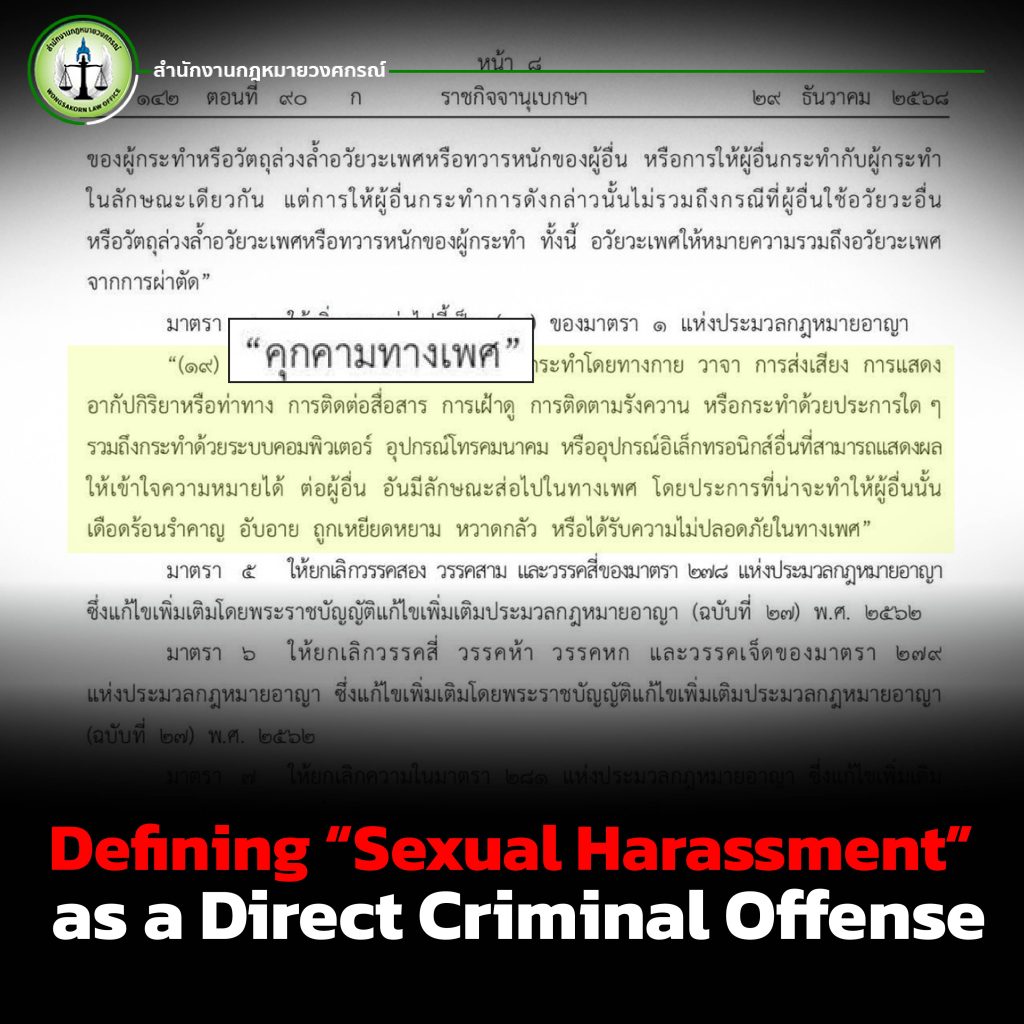
One of the most significant changes under the new law is the introduction of the definition of “sexual harassment” as Section 1 (19) of the Criminal Code. Sexual harassment is defined as any act committed against another person, including:
- Physical acts, verbal expressions, gestures, or behaviors
- Communication, surveillance, stalking, or harassment
- Acts carried out via computer systems, telecommunications, or electronic devices
When such acts are sexual in nature and are likely to cause annoyance, distress, embarrassment, humiliation, fear, or a sense of sexual insecurity to the victim.
This definition clearly shows that sexual harassment is not limited to physical contact but also includes words, gestures, and online conduct.
Examples of Conduct That May Constitute Sexual Harassment Under the New Law

Based on the legal definition, the following behaviors may constitute criminal offenses:
- Making sexual comments about someone’s body, chest, or sexual organs
- Using sexually suggestive or obscene language
- Sending explicit messages, images, or videos
- Posting harassing or sexual comments on social media
- Secretly photographing, watching, or stalking someone
- Using one’s position of authority to exert sexual pressure
Even without physical contact, if the victim feels embarrassed, fearful, or unsafe, the act may still qualify as sexual harassment under the new law.
Sexual Harassment Through Language and Social Media Comments

In the digital era, sexual harassment is no longer limited to face-to-face interactions. It frequently occurs on social media platforms. Under the new law, sexually suggestive language or comments may also constitute an offense. Examples include obscene remarks about someone’s body or appearance, sexually suggestive jokes, excessive sexual teasing, or sending private messages with sexual content without consent.
Even if the offender claims the conduct was merely a joke or personal opinion, if it causes embarrassment, humiliation, fear, or a sense of insecurity, it may be deemed sexual harassment especially when repeated or publicly disseminated, causing severe harm to the victim’s reputation and mental well-being.
Reasons for Enacting the New Sexual Harassment Law
The key reasons for enacting this law include:
- Sexual offenses now occur in many different forms
- Victims include people of all genders, ages, and sexual identities
- Sexual harassment has increased rapidly and become more severe
- Previous laws addressed only minor nuisance offenses, which were inadequate
Therefore, the new law elevates sexual harassment to a direct criminal offense to punish offenders and deter future misconduct.
What Should You Do If You Are Sexually Harassed?
If you experience sexual harassment under the new law, you should:
1.Clearly express your lack of consent
2.Collect evidence such as messages, images, videos, or witnesses
3.Report the incident to relevant authorities or file a police complaint
4.Consult a lawyer to pursue legal action or claim damages
The Online World Is Not Above the Law

The new law explicitly states that sexual harassment can occur through computer systems, telecommunications, or electronic media. The online world is not a lawless space. Every message, comment, or form of communication can serve as legal evidence. Victims may exercise their rights under the law to seek justice and hold offenders accountable. Consulting a lawyer is strongly recommended to assess legal options, plan legal action, and protect one’s rights safely and effectively.