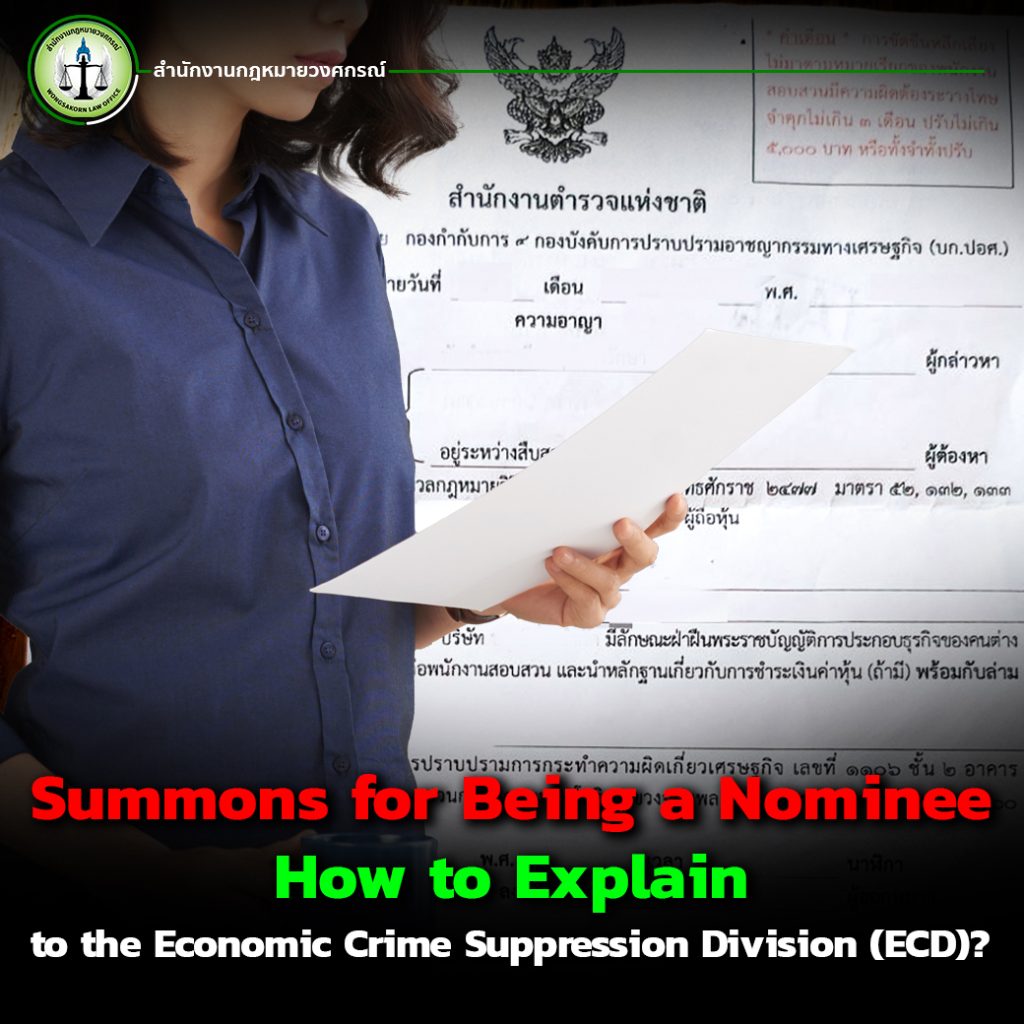
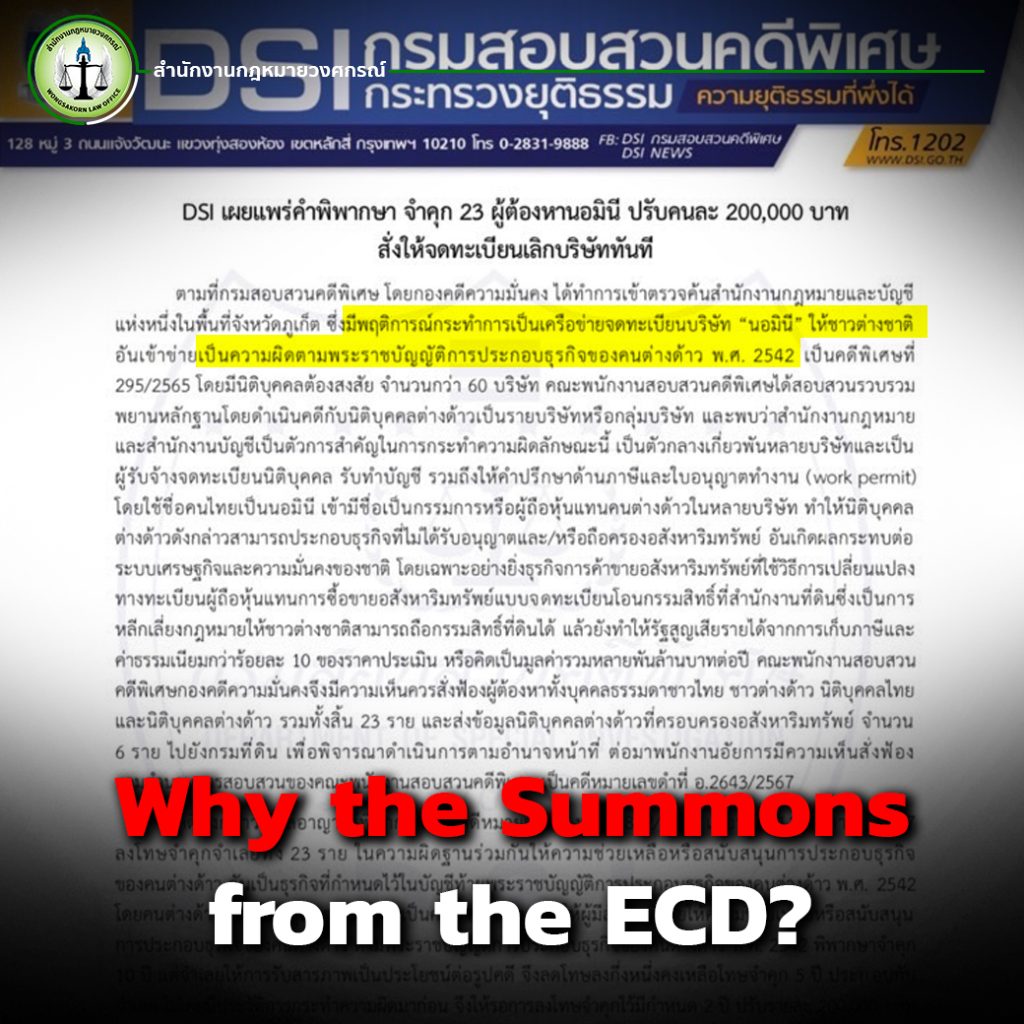
Summoned as a “Nominee”? Don’t Panic – Understand It Correctly Before the Problem Escalates

In recent years, the term Nominee has been increasingly discussed in the fields of business and law, especially in cases involving shareholding on behalf of others or concealing the true controlling person of a company. Many people who have never been directly involved in business are shocked and confused when they receive a “Nominee Summons” from an investigator, wondering how they became involved in such a case.

The most important thing to understand is that being summoned as a Nominee is not the end of your life, nor is it as frightening as many people think. If you clearly understand your legal status and take appropriate action from the beginning, the issue can be properly handled under the law.

What is a Nominee?

Legally, a Nominee refers to a person who allows another person to use their name as a shareholder, director, or authorized person of a business, instead of the true owner. This is commonly found where the beneficial owner cannot legally hold shares or operate the business directly, such as in cases involving foreign ownership restrictions.

In simple terms, a Nominee is a “name holder,” not the real owner, but whose name appears in legal documents.

Why Are You Summoned as a Nominee?

A summons does not mean that you are already guilty. It only means that the authorities need to investigate facts, such as:

  • Your name appears as a shareholder or director of a company
  • Financial transactions are linked to the case
  • There are indications that you may act as a Nominee
  • There has been a complaint or government inspection

In many cases, the summoned person is merely someone whose name appears in documents without actual control or benefit.

Should You Be Worried?

Not necessarily. A summons is only part of the investigation process, not a judgment and not an arrest warrant.

If you had no intention to evade the law and did not engage in fraudulent conduct, providing accurate information with proper evidence can significantly reduce legal risk. Many cases are resolved at the investigation stage without going to court.
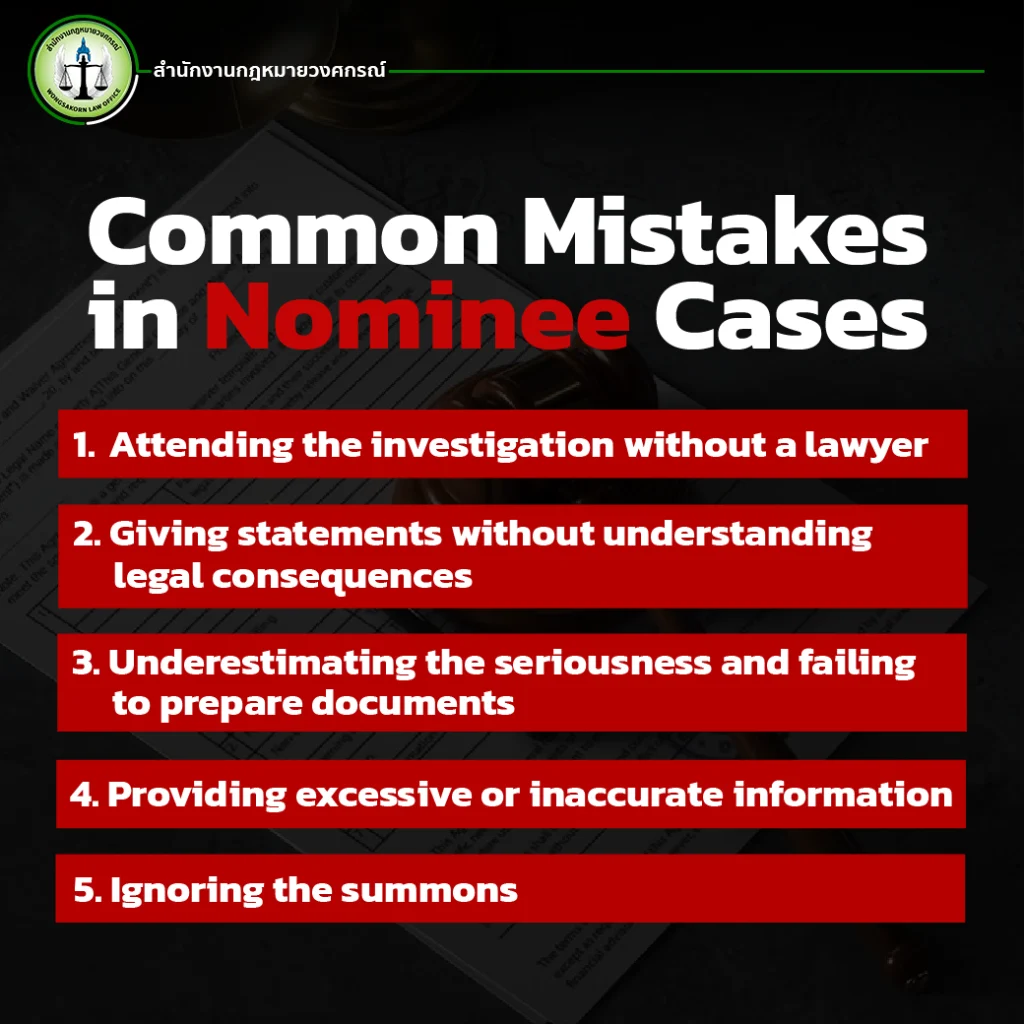
These mistakes may put you at a legal disadvantage unnecessarily.

Is Acting as a Nominee Illegal?

Nominee conduct may violate several laws, such as:

  • Foreign Business Act
  • Company law
  • Anti-Money Laundering law
  • Criminal law regarding false statements

Penalties may include fines and imprisonment, depending on the circumstances.

Proper Steps When Summoned as a Nominee

If you receive a Nominee summons, you should:

1. Do not ignore it

2. Consult a lawyer immediately

3.  Prepare relevant documents (contracts, share certificates, bank records)

4. Provide factual information carefully

5. Do not give unnecessary statements

Early legal representation significantly reduces legal risks.

A Nominee Case Is Not as Scary as You Think

Many people fear the word “Nominee” and believe they will be imprisoned immediately. In reality, many cases can be resolved by clarifying facts and proving your true role. The law aims to punish those who misuse Nominee structures to evade regulations, not innocent individuals.

The Importance of Legal Counsel

A lawyer plays a crucial role in:

  • Analyzing your legal status and risks
  • Preparing appropriate legal strategies and statements
  • Coordinating with investigators
  • Preventing disadvantageous statements
  • Reducing the risk of prosecution

Having legal counsel from the beginning is essential to protect your rights.

Becoming a “Nominee” Without Knowing It – What Should You Do? If Summoned in a Nominee Case, Is There a Way Out?

In Thailand’s business world, the term “Nominee” is widely discussed, especially in cases involving Thais holding shares on behalf of foreigners. Under Thai law, this practice is prohibited as it may constitute an attempt to evade the Foreign Business Act. However, many people unknowingly become nominees, for example, by being asked to hold shares for friends or relatives, receiving small benefits in return, or even signing documents without fully understanding the legal implications.

So, what should you do if you unknowingly become a nominee or receive a summons in a nominee case? Is there a way out, and how can you prevent it?

What is a Nominee and What Are the Legal Consequences?

Generally, a “Nominee” refers to a person whose name is used to hold shares or conduct business on behalf of someone else, especially foreigners who are restricted by law from holding majority shares. According to Thailand’s Foreign Business Act, using Thais as nominees for foreign ownership is considered unlawful and carries both civil and criminal penalties.

Penalties for being a nominee include:

  • Heavy fines, which may amount to hundreds of thousands or even millions of baht.
  • Imprisonment in some cases.
  • Damage to personal reputation and legal record.

Why Do People Become Nominees Without Realizing It?

Common situations that lead people to unknowingly become nominees include:

  • A friend or acquaintance asks them to hold shares “just in name.”
  • Receiving small monthly compensation for the use of their name.
  • Signing contracts or documents without reading carefully.
  • Being assigned as a minor shareholder in a foreign-owned company without proper legal checks.

In many cases, individuals only discover their legal risk when they receive a summons from government authorities.

What Should You Do If You Receive a Summons in a Nominee Case?

Receiving a summons in a nominee case is serious, as it is a criminal matter that can affect both your life and career. The first step should be to consult an experienced lawyer immediately. Recommended actions include:

  1. Do not ignore the summons – Failure to attend may lead to an arrest warrant.
  2. Gather documents and evidence – Such as agreements, shareholder records, financial documents, or messages showing you had no intent to act as a nominee.
  3. Explain the facts to your lawyer – Provide full details of how your name became involved in the business, so the lawyer can plan an effective defense.
  4. Follow legal advice closely – Defending a nominee case is complex and requires proper legal strategies backed by solid evidence.

Is There a Way Out If You Are a Nominee?

Yes, there is. If you can prove that you had no intention to circumvent the law or were not genuinely controlling the business, legal defenses are possible. Early consultation with a lawyer can help you:

  • Demonstrate that you were not the beneficiary of the business.
  • Use evidence to show that your name was used without full knowledge.
  • Reduce the risk of facing severe penalties.

Why Consulting a Lawyer Should Be Your First Step?

Unknowingly becoming a Nominee is extremely risky, as it involves investment law, business law, and criminal law at the same time. Even small mistakes may result in heavy penalties.

An experienced nominee lawyer can help by:

  • Assessing potential risks and penalties.
  • Developing defense strategies.
  • Communicating with authorities or courts on your behalf.
  • Negotiating to minimize legal consequences.

How to Prevent Becoming a Nominee in the First Place?

Prevention is always better than cure. To avoid unknowingly becoming a nominee:

  • Never sign documents you don’t fully understand.
  • Never hold shares for others without proper legal review.
  • Always consult a lawyer if you have doubts about business or investment agreements.

Nominee Cases Are Not Trivial – Seek Legal Counsel Immediately

Unknowingly becoming a Nominee may expose you to criminal charges, heavy fines, or even imprisonment. Ignoring the issue or trying to handle it alone can worsen the situation. The safest solution is to consult an experienced lawyer who specializes in nominee cases to assess, strategize, and find the most appropriate way forward.

👉 If you are facing nominee-related issues or have received a summons in a nominee case
👉 Contact Wongsakorn Law Office today to consult with experienced lawyers.

Summons for Being a Nominee : How to Explain to the Economic Crime Suppression Division (ECD)?

The term “Nominee” is often mentioned in economic crime cases, especially regarding foreign investment and business operations. Many may mistakenly think it is just a normal business arrangement, but in fact, acting as a nominee can be considered illegal under Thai law. If investigated, it may lead to a summons from the Economic Crime Suppression Division (ECD). Understanding its meaning and knowing your rights in giving explanations is therefore essential.

What is a Nominee?

A nominee means allowing one’s name to be used in a business or transaction on behalf of someone else, without being the real investor or decision-maker. Common examples include:

  • A Thai person holding shares on behalf of a foreigner to meet Thai legal requirements.
  • Opening a bank account under a Thai person’s name but used by a foreigner.
  • Holding land in the name of a Thai person for a foreigner’s benefit.

Even if done without bad intent, Thai law treats this as potentially violating the Foreign Business Act B.E. 2542 (1999) or related laws, with penalties of both imprisonment and fines.

Why the Summons from the ECD?

The ECD investigates complex financial and economic crimes. A nominee summons often arises when officials find signs such as:

  1. Thais holding shares on behalf of foreigners.
  2. Suspicious financial flows, e.g., large unclear transactions.
  3. Abnormal company structures inconsistent with actual business.
  4. Complaints or links to “grey businesses.”

When such signs exist, the ECD will issue a summons for clarification. Ignoring the summons can lead to more serious legal consequences.

How to Prepare Before Explaining?

If you receive a nominee summons, do not panic or ignore it. Instead, you should:

  • Review the summons details – who filed, reasons, and meeting schedule.
  • Gather documents – company documents, joint venture contracts, lease agreements, financial records.
  • Reassess your actual role – whether you were genuinely involved or just lending your name.

How to Explain to the ECD?

On the day of meeting the officers, you should:

  1. Stick to facts – Do not exaggerate or conceal information.
  2. Support with documents – Written contracts, financial statements, or minutes of meetings can help prove good faith.
  3. Avoid vague statements – Ambiguous answers may be interpreted as tax evasion or law avoidance.
  4. Have a lawyer assist – A lawyer can communicate legally, making explanations clearer and stronger.

Risks of Inadequate Explanation

Even without bad intent, incomplete or unclear explanations may be interpreted as acting as a nominee. Consequences include:

  • Criminal charges.
  • Heavy fines.
  • Revocation of business or land ownership rights.

Thus, proper and complete explanation is the key to resolving the matter during investigation without going to court.

Key Legal Advice

The first step when receiving a nominee summons should be consulting a lawyer because:

  • A lawyer can assess whether your actions fall under nominee rules.
  • A lawyer can draft explanations that align with the law.
  • A lawyer can represent you before authorities and reduce pressure.

Being a nominee is no small matter. If you receive a summons from the Crime Suppression Division, you must have a lawyer to advise you.

Being summoned as a nominee by the ECD is not trivial. An unclear explanation may lead to severe legal consequences. But with knowledge of your rights, proper documentation, and legal representation, the case can often end at the investigation stage. Since such cases involve economic, criminal, and tax law, having a lawyer is your best safeguard to present explanations that are logical, solid, and legally correct.

👉 If you or someone close to you has received a nominee summons, consulting a lawyer immediately is the safest first step.

Line @ คลิก! โทรหาเรา คลิก!