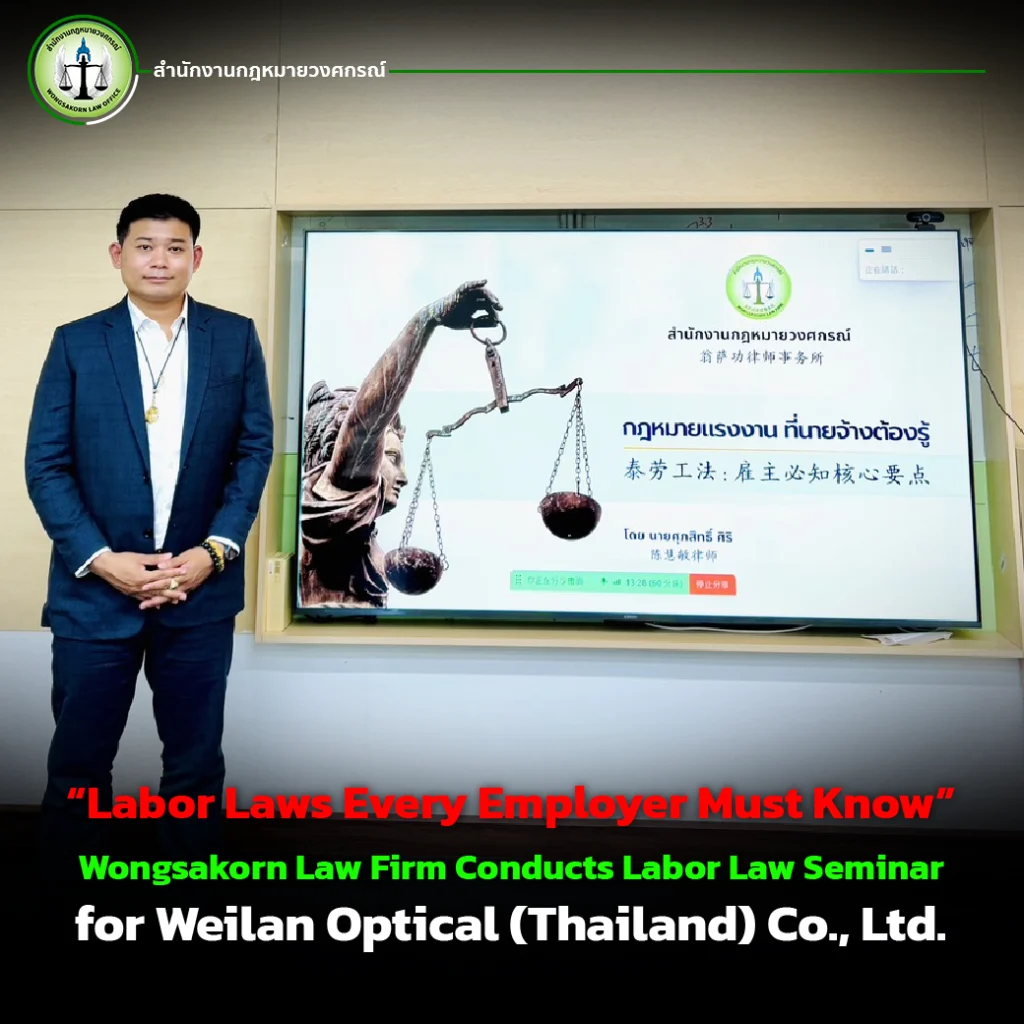
“Labor Laws Every Employer Must Know” Wongsakorn Law Firm Conducts Labor Law Seminar for Weilan Optical (Thailand) Co., Ltd.

On May 28, 2026, Wongsakorn Law Firm was honored by Weilan Optical (Thailand) Co., Ltd. to conduct a seminar on the topic “Labor Laws Every Employer Must Know” in order to enhance understanding of Thai labor laws among the company’s executives and employees. This marks another important mission of Wongsakorn Law Firm in its role as legal advisor to the company.

The seminar was led by Lawyer Arm, Supasit Siri, Head of Wongsakorn Law Firm, together with Mr. Kittithat Limtasiri, Chinese-speaking Legal Assistant, and Mr. Thaniphat Manopak, Legal Assistant and HR Officer of Wongsakorn Law Firm. More than 50 participants attended the session, the majority of whom were Chinese executives and employees of the company.

The atmosphere throughout the event was warm and friendly. Weilan Optical (Thailand) Co., Ltd. warmly welcomed the team from Wongsakorn Law Firm and provided opportunities for attendees to ask detailed questions regarding Thai labor laws, including wages, leave entitlements, holidays, employee rights, employer obligations, and other important labor law matters.

The Q&A session was conducted seriously and directly to the point. Wongsakorn Law Firm carefully explained the relevant legal details to ensure that the company gained a clear and accurate understanding, as we fully understand that labor law is a sensitive and highly complex matter, and one of the most common issues faced by organizations of all sizes from small businesses to international corporations.

From the perspective of Lawyer Arm, Supasit Siri, labor and employee-related issues are problems that “never truly disappear” as long as businesses continue to work with people. Every individual has different thoughts, understandings, and behaviors. This is precisely why companies should have a “legal advisor” or “consulting lawyer” involved from the beginning before problems escalate into labor disputes or complaints filed with the Department of Labour Protection and Welfare.

Lawyer Arm Supasit Siri is considered someone with deep understanding of labor law issues because he has previously experienced life as an “employee” himself and currently serves as both a “lawyer” and a “business executive.” This allows him to understand both employer and employee perspectives very well. He has also personally encountered labor-related challenges in the business world and successfully managed such situations appropriately without suffering legal disadvantages or causing reputational damage to the organization.

Therefore, having legal advisors or a labor law legal team is not merely about solving problems after lawsuits arise, but rather about “preventing problems” before they actually happen, something extremely important for organizations in today’s business environment.

Wongsakorn Law Firm is ready to provide labor law consultation services to companies and organizations of all types, including seminars, training programs, and labor law courses for executives, HR departments, and employees.

We believe that “a proper understanding of labor law” is the key starting point for reducing conflicts within organizations and effectively preventing legal problems in the future.

In addition, Lawyer Arm believes that many companies today may still be “violating labor laws without realizing it,” whether due to misunderstandings or lack of proper legal guidance. As a result, many organizations later face problems when employees file complaints with the Labour Protection and Welfare Office.

If any organization or company is interested in legal consultation services or labor law training courses, please contact Wongsakorn Law Firm directly >> Contact Us <<

Do not allow misunderstandings about labor law to become a ticking time bomb waiting to explode, because in reality, Thai labor law always provides greater protection to employees than employers.

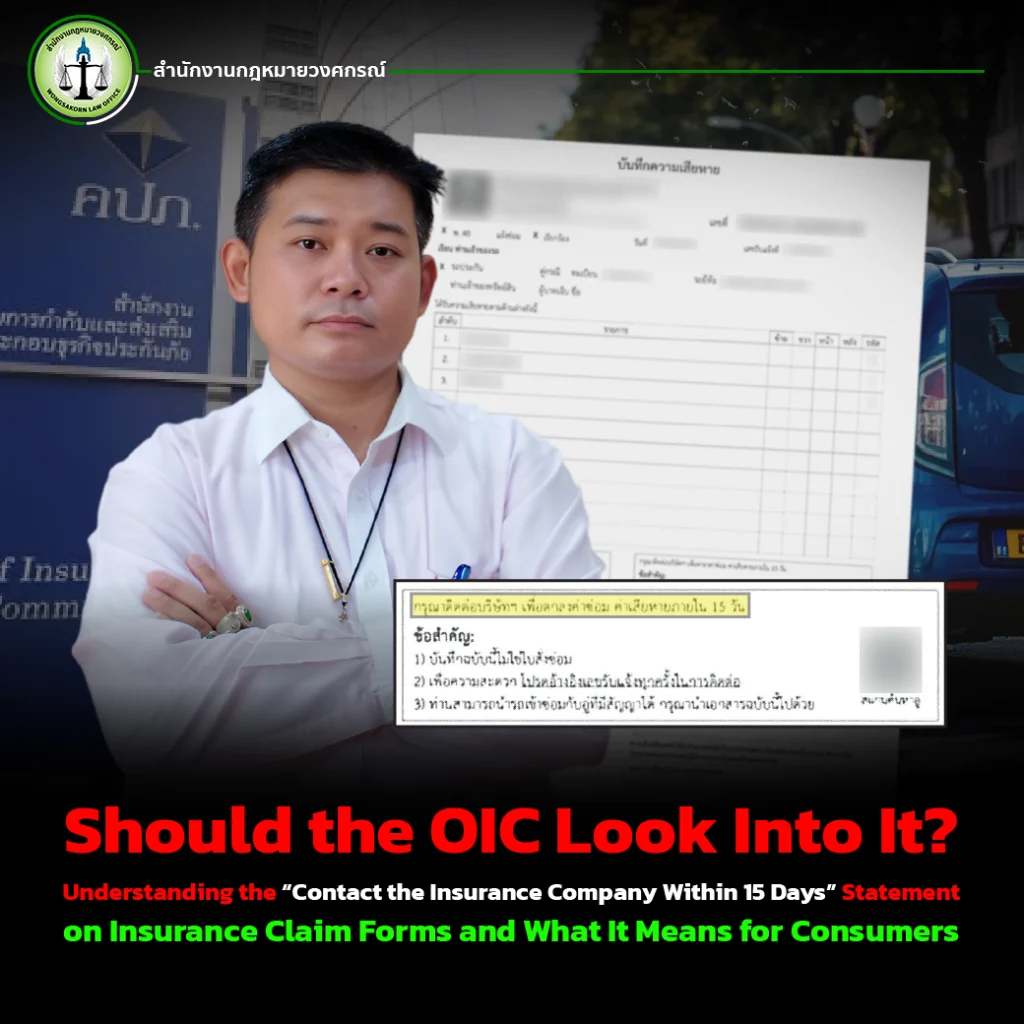
Is the OIC Truly Fast and Fair? Another Perspective from the Real Experience of Lawyer Arm Supasit

Many people who purchase insurance, whether life insurance, health insurance, or motor insurance, are familiar with the “OIC,” or the Office of Insurance Commission, as the agency responsible for regulating the insurance business in Thailand, as well as protecting the rights of consumers who hold all types of insurance policies.
But the important question is:

Is the OIC Truly Fast and Fair?

This is another perspective from Lawyer Arm Supasit of Wongsakorn Law Firm, who would like to reveal facts based on direct experience so that the public can think, analyze, and gain a better understanding of the OIC’s processes before deciding to enter arbitration proceedings.
What Is the OIC? What Are Its Responsibilities?

Many people may still not fully understand that the OIC is the agency responsible for regulating all insurance businesses in Thailand, including:

  • Health insurance
  • Life insurance
  • Motor insurance
  • Accident insurance
  • Property insurance
  • As well as all other types of insurance

The OIC’s main responsibilities are to:

  • Supervise insurance companies
  • Protect consumers
  • Receive complaints
  • Conduct arbitration proceedings in certain cases

At first glance, it may seem like an agency that fully supports and assists the public. However, once people enter the actual process, many begin to question whether it is truly “fast and fair” as promoted.

What Is OIC Arbitration?

When members of the public visit the OIC website, they will find a description of “arbitration” as a process that is:

  • Fast
  • Fair
  • Cost-effective

The phrase “fast and fair” immediately gives many people confidence because the general public naturally understands that if a dispute arises with an insurance company, this process should help them obtain justice quickly.

However, from the perspective of Lawyer Arm Supasit, the following questions are raised:

“What does speed really mean?”

And more importantly:

“Who determines what is fair?”

Even Lawyer Arm Supasit himself believes that the meaning of the word “fair” is something that is very difficult to define in practice.

Revealing the Actual Timeline of a Case at Wongsakorn Law Firm

To help the public see the process more clearly, Lawyer Arm Supasit shared a real case handled by Wongsakorn Law Firm.

Step 1: Submission of the Petition
8 May 2025
The OIC accepted the arbitration petition.

Step 2: First Hearing Appointment
17 June 2025
The first hearing was scheduled.

Many people may ask: Was that fast?

From the perspective of the general public, some people may feel that this already took quite a long time.

From the first hearing to the appointment of the arbitrator, the process took another month.

After 17 June 2025, the parties had to wait until:

18 July 2025

to appoint the arbitrator, or the neutral party who would decide the dispute.

The question is:

Why did appointing the neutral decision-maker alone take almost another full month?

This is one of the observations raised by Lawyer Arm Supasit, who believes that if something is described as “fast,” each person’s standard of what counts as fast may be different.

Preliminary Hearing, Witness Examination, and Waiting for the Award

After the arbitrator was appointed, the next stage was the preliminary hearing, which is the stage used to:

  • Define the disputed issues
  • Determine what evidence the consumer would present
  • Determine what arguments the insurance company would raise in response

After that, the process moved into the witness examination hearing.

However, reaching this stage required waiting until:

8 October 2025

A simple calculation shows that from June to October, the process took approximately four months.

When Was the Arbitration Award Issued?

After the witness examination was completed on 8 October 2025, the arbitration award was issued on:

12 February 2026

Meanwhile, the OIC had already received the arbitration award on:

6 February 2026

When calculating the total period from the submission of the petition to receiving the arbitration award, the process took many months.

The question therefore returns:

Can this truly be considered “fast”?

The Meaning of Speed for the Public and for an Agency May Not Be the Same

From the perspective of the general public, the word “fast” may mean:

  • Not having to wait for several months
  • Not having to spend a long time going through procedures
  • Receiving an answer quickly

However, from the perspective of an institutional process or the arbitration system, there may be a different standard.

Therefore, Lawyer Arm Supasit would like the public to:

  • Analyze it for themselves
  • Compare it for themselves
  • And decide for themselves whether the process is truly fast

The Agency Says It Is Cost-Effective. Is That Really True?

Another phrase that the public often sees is “cost-effective.” However, based on a real case handled by Wongsakorn Law Firm, the total cost came to approximately:

THB 12,800

And simply to begin the process, the party submitting the arbitration petition was required to pay an initial filing fee of:

THB 10,000

This means that the process is not free, as many people may understand.

From the perspective of the general public, the word “fast” may mean:

  • Not having to wait for several months
  • Not having to spend a long time going through procedures
  • Receiving an answer quickly

However, from the perspective of an institutional process or the arbitration system, there may be a different standard.

Therefore, Lawyer Arm Supasit would like the public to:

  • Analyze it for themselves
  • Compare it for themselves
  • And decide for themselves whether the process is truly fast

The Agency Says It Is Cost-Effective. Is That Really True?

Another phrase that the public often sees is “cost-effective.” However, based on a real case handled by Wongsakorn Law Firm, the total cost came to approximately:

THB 12,800

And simply to begin the process, the party submitting the arbitration petition was required to pay an initial filing fee of:

THB 10,000

What Should the Public Do When They Have a Problem with an Insurance Company?

The most important thing is not to make a decision based solely on advertising messages or short descriptions.

Whether it is claims such as:

  • Fast
  • Fair
  • Cost-effective

Because in reality, every case has different details and circumstances.

Why Should You Consult a Lawyer Before Entering the OIC Process?

Many people only consult a lawyer after they have already:

  • Entered the process
  • Paid the fees
  • Spent several months waiting

Even though proper planning from the beginning is extremely important.

Because a lawyer can:

  • Analyze which process is the most appropriate
  • Assess the chances of success in the case
  • Develop the legal strategy for the case
  • Help prevent the client from being placed at a disadvantage

Especially in insurance disputes, where insurance companies often have legal teams involved from the very beginning.

Is the OIC Truly Fast and Fair? Let the Public Decide

This article from Wongsakorn Law Firm is not intended to criticize any agency. Its purpose is to reflect another perspective based on real experience so that the public can gain a better understanding of the OIC process.

Because in the end, the terms:

  • “Fast”
  • “Fair”
  • “Cost-effective”

may carry different meanings depending on each person’s perspective.

Therefore, before entering any insurance-related process, people should carefully study all available information and consult a lawyer with direct experience in this area in order to avoid wasting time, incurring unnecessary expenses, and being placed at a disadvantage in the future.

For consultation with Lawyer Arm Supasit, click >> Contact Us <<

 Does the OIC Really Help the Public? The Truth Policyholders Need to Know About Why Many People Unknowingly End Up at a Disadvantage

When people talk about insurance, most assume that if an accident or damage occurs, the agency responsible for helping the public is the OIC, or the Office of Insurance Commission, which oversees the insurance industry in Thailand.

However, in reality, there are many things that the public may not know, especially regarding the process of filing complaints or claiming compensation from insurance companies. In many cases, policyholders or injured parties unknowingly end up at a disadvantage.

Recently, Lawyer Arm Supasit of Wongsakorn Law Firm shared real stories about the complaint process with the OIC that many people may never have known before. This is important information for everyone who has insurance.

When Filing a Complaint with the OIC but Being Told “The Officer Cannot Make a Decision”

หOne real issue that often occurs is when an injured party or policyholder files a complaint with the OIC, only to be told by the officer that:

“The officer cannot make a decision.”

The officer may then recommend that the person proceed through:

  • arbitration proceedings, or
  • court proceedings.

At first glance, this may seem normal. However, in reality, the issue is far more complex than many people realize.

Lawyer Arm Supasit believes that the public should not immediately believe everything without careful consideration. In some cases, officers may provide accurate information, but in other situations, matters should still be analyzed thoroughly.

The key problem is this: if an ordinary person has no legal knowledge, how can they determine:

  • what should be trusted, and
  • what should be further examined?

This is exactly why many injured parties unknowingly end up at a disadvantage.

Arbitration Proceedings: The Process Many People Believe Will Help

Most insurance policies contain provisions stating that:

the injured party or claimant has the right to choose to proceed through arbitration.

The important question is:

if the law or the insurance contract gives policyholders or injured parties the right to choose this process, why do problems often arise once they actually enter the proceedings?

The Truth Many People Have Never Known

From the experience of Wongsakorn Law Firm in handling client consultations, it has been found that in many cases, injured parties chose to enter arbitration proceedings based on the recommendation of the OIC. However, once the process began, the insurance company submitted a petition to the arbitration panel stating that:

“Requesting that the case be dismissed and that the claimant pursue the matter through court proceedings instead.”

This raises an important question:

if, in the end, the injured party must still return to court anyway,

then why should they first have to:

  • lose time,
  • incur expenses, and
  • pay arbitration-related costs?

In some cases, injured parties may have already spent tens of thousands of baht before discovering that the case had been dismissed from the arbitration process.

What Role Should the OIC Play in Situations Like This?

An important question many people have begun asking is: if this type of situation repeatedly happens to the public, what responsibility or protective role should the OIC have?

Most people believe that 

  • once they enter the process,
  • they will receive assistance,
  • or at least be given a clear path for exercising their legal rights.

However, when reality turns out differently, many injured parties end up feeling disadvantaged in terms of both time and expenses.

The Public Is Often at a Disadvantage Because They Do Not Understand the Law

The biggest issue is that most injured parties are not legal professionals.

As a result, they often do not understand:

  • which legal process is most appropriate,
  • which steps should be taken first, or
  • what rights insurance companies actually have within the process.

And when people lack legal knowledge, it becomes easy for them to misunderstand the process or proceed in the wrong direction.

This is exactly why many people end up at a disadvantage against insurance companies, even when they are genuinely the injured party.

Insurance Companies Have Legal Teams from the Very Beginning

One important thing injured parties must understand is that insurance companies already have:

  • legal teams,
  • lawyers, and
  • case specialists

handling matters from the moment an incident occurs. As a result, if an injured party handles the matter alone without legal counsel to guide the strategy, the chances of being placed at a disadvantage are extremely high.

This is especially true in cases involving:

  • denial of insurance claims,
  • interpretation of policy terms,
  • arbitration proceedings, and
  • court litigation.

Do Not Wait Until Problems Arise Before Looking for a Lawyer

This is something Lawyer Arm Supasit has consistently emphasized. Many injured parties wait until problems occur, wait until the insurance company denies the claim, or wait until they are already at a disadvantage before consulting a lawyer. In reality, establishing the right legal approach from the very beginning is far more important.

Because sometimes, simply:

  • drafting the complaint properly,
  • organizing the facts and supporting information, or
  • choosing the appropriate legal process

can significantly affect the entire direction of the case.

Understanding the OIC and Understanding Insurance Is Important

This article from Wongsakorn Law Firm is not intended to attack any organization. Its purpose is to help the public “stay informed” because in the world of insurance:

  • not every recommendation is suitable for everyone, and
  • not every process will always benefit the injured party.

Therefore, before deciding to enter any legal or insurance-related process, people should always study the information carefully and consult an insurance law specialist first.

Consulting a Lawyer Immediately After an Incident Is the Best Option

Wongsakorn Law Firm, led by Lawyer Arm Supasit, believes that the most important thing after an accident or insurance dispute occurs is:

“to consult a lawyer immediately”

in order to:

  • structure the case properly,
  • analyze the relevant legal issues,
  • assess the appropriate approach for claiming compensation, and
  • prevent being placed at a disadvantage throughout the legal process.

Because if the case is handled incorrectly from the very beginning, the injured party may ultimately lose significant time and incur unnecessary expenses.

Do Not Be Misled by Insurance Companies or the Process Itself

Today, having insurance is not just about purchasing coverage.

Policyholders must also:

  • understand their rights,
  • understand the legal process, and
  • stay informed about legal strategies.

This is especially important when dealing with the OIC, arbitration proceedings, or insurance compensation claims.

If you do not want to be placed at a disadvantage by insurance companies or by the legal process itself, consulting a lawyer from the very beginning is the safest option.

You may consult Lawyer Arm Supasit of Wongsakorn Law Firm today to properly structure your case from the start.

Labor Law: Small Issues Employers Overlook Can Become Major Problems Without Realizing It

Labor law and employment-related issues are among the unavoidable challenges faced by business owners in the world of business. Regardless of whether a business is small or large, once employees are hired, labor law immediately becomes involved.

The key issue is that many employers do not intentionally violate the law, but instead unknowingly make mistakes due to a lack of understanding of legal requirements or the absence of professional legal guidance from the very beginning.

Recently, Lawyer Arm Supasit Siri spoke out about another real issue that frequently occurs in Thai workplaces. This has become an important matter that employers should be aware of, because many business owners engage in these practices every day without realizing that they may be at risk of violating labor law.

Issue No. 1: What Employers Need to Know About Immediate Termination?

One of the most common issues between employers and employees is when an employer orders an employee to “leave the job immediately.” Many employers mistakenly believe that if there is no written employment contract, the individual is not considered an employee, or that the employer is not legally responsible.

However, in reality, under labor law principles, an “employee” relationship is established immediately once there is an agreement for employment.

This means that even without a written employment contract, if there is an agreement for work to be performed and wages are paid, that person is already considered an employee under the law.

Therefore, if an employer orders an employee to leave immediately without lawful grounds, the employer may be required to pay severance compensation, payment in lieu of advance notice, or other damages in accordance with labor law.

Termination Is Not Just About Telling an Employee to Leave

Many companies believe that if they are dissatisfied with an employee, they can immediately ask the employee to stop working. However, legally, the issue is more complicated than many people think, especially regarding the “grounds for termination.” If the employer does not have clear evidence or cannot prove that the employee actually committed serious misconduct, the employer may ultimately become the disadvantaged party in a labor case.

Can an Employer Require an Employee to Leave Immediately?

In practice, if an employer wants an employee to leave immediately, the key is to handle the process properly and in accordance with the legal system.

Lawyer Arm Supasit shared an interesting perspective that employers are able to record in the Social Security system that:

  • the employee’s employment has ended,
  • together with the reason for the termination.

Such information will be recorded in the Social Security system, and in the future, the employee may also look back on or remember these events or employment records as well. For this reason, employers must handle the matter carefully and always remain within the framework of labor law.

Issue No. 2: Is It Illegal If an Employer Does Not Register Daily Employees for Social Security?

Another real case brought to Lawyer Arm involved a company with only five employees hired on a “daily wage” basis. The employer believed that there was no need to register them in the Social Security system. However, in reality, Lawyer Arm Supasit clearly confirmed that this is “against the law.” Under labor law and social security law, once an employee starts working on the very first day, the employer is legally required to register that employee in the Social Security system immediately.

Just Opening a Company or Recently Registering a Business Is Not an Excuse

Many employers often claim that:

  • the business has just started,
  • the company was only recently registered,
  • or the business is still small.

However, legally speaking, these reasons are not exceptions. The moment a person becomes an “employer” and hires an “employee,” legal obligations arise immediately as well.

Labor Problems Often Begin with Small Issues

One concerning reality in labor law is that many labor disputes do not begin with major problems. Instead, they often start from “small issues” that employers overlook, such as:

  • incomplete documentation,
  • failure to register employees for Social Security,
  • incorrect wage payments,
  • terminating employees without understanding the law,
  • or issuing company regulations improperly.

When these issues accumulate over time, they can eventually develop into labor disputes that may cause significant damage to a business.

If You Have Legal Counsel, the Problem May Never Occur

This is one of the key reasons why modern businesses should have legal counsel. A lawyer’s role is not simply to wait until a lawsuit happens, but to help “establish proper systems,” especially in labor law matters.

For example:

  • reviewing employment contracts,
  • establishing company regulations,
  • reviewing Social Security compliance systems,
  • providing legal advice before termination,
  • and setting proper labor management guidelines.

All of these can significantly reduce legal risks.

Having Good Legal Counsel Makes It Easier for Employers to Handle Problems

When problems arise, the most important things are evidence and systems. If a company has managed things properly from the beginning, such as documentation, company regulations, Social Security systems, and recordkeeping, employers will be able to handle labor issues much more easily.

Labor Law Is Not a Distant Issue for Business Owners

Many business owners focus heavily on sales, profit, and marketing, while overlooking labor law. In reality, however, labor law is one of the most important risks within any organization because as long as you have employees, labor-related issues are unavoidable.

A Small Issue Today May Become a Major Case Tomorrow

From the case examples shared by Lawyer Arm Supasit Siri, it is clear that many problems often begin as “small issues” that employers tend to overlook. However, in the context of labor law, these small matters can always develop into major legal disputes.

Therefore, the best solution is to have legal counsel involved from the very beginning.

 Labor Law Attorney: Summoned by the Department of Labour Protection and Welfare—How Should Employers Respond? Key Labor Law Issues Employers Must Know Before It’s Too Late

A labor law attorney becomes essential when a business starts to grow. Along with business expansion and the core issues employers face, “legal problems” inevitably follow—especially labor law issues, which are among the most common challenges that all business owners, employers, and executives must inevitably encounter.

Many employers or business owners mistakenly believe that:

“If the Department of Labour Protection and Welfare summons us, we can just hire a lawyer at that time.”

In reality, this mindset can place employers at a disadvantage from the very beginning. The core principle of labor law is not to wait until problems arise and then fix them, but to have legal counsel from the outset. In particular, when you are a business owner or employer, starting a company does not only involve revenue or profit. It must be acknowledged that “problems” will inevitably follow—and one of the unavoidable issues is labor-related matters.

What Does It Mean to Be Summoned by the Department of Labour Protection and Welfare?

The Department of Labour Protection and Welfare is responsible for monitoring employers’ compliance with labor law, such as:

  • Wage payment
  • Overtime payment
  • Termination of employment
  • Severance pay
  • Employee welfare arrangements
  • Employment contracts

If employees file complaints or if there is an official inspection, employers may be required to “clarify facts,” which is often when business owners begin to feel alarmed.

Do Not Wait Until You Are Summoned Before Hiring a Lawyer

This is a very common mistake. Many business owners tend to:

  • Ignore employee problems
  • Do nothing when complaints are filed
  • Only seek legal counsel when summoned by the labor office

To be direct, by that point, it is already “too late.” In labor cases and labor law matters, the preparation of information, factual strategy, and documentation can significantly affect the direction of the case. Without proper planning from the beginning, the risk of being placed at a serious disadvantage is extremely high.

How Should You Respond to the Department of Labour Protection and Welfare?

The key principles of response are:

1. Rely on facts
Officers will consider evidence and factual circumstances, not the employer’s feelings.

2. Prepare complete documentation, such as:

  • Employment contracts
  • Company regulations
  • Warning letters
  • Time attendance records
  • Payment evidence

3. Do not respond without legal counsel
This is the most important point. Certain statements may later become evidence used against the company.

Therefore, having a labor law attorney involved from the beginning is essential.

Major Business Problems That Never Disappear

The reality of business is that no business is free from problems.

Common issues include at least five major areas:

1. Labor law issues
This is one of the most common problems employers face, such as:

  • Employee lawsuits or complaints
  • Unfair dismissal claims
  • Severance pay disputes
  • Overtime pay (OT) disputes
  • Leave and tardiness issues

Labor law issues are something every employer will inevitably encounter.

2. Contract issues
Every business involves contracts, such as:

  • Employment contracts
  • Lease agreements
  • Sale and purchase agreements
  • Partnership agreements

If contracts are drafted incorrectly or improperly, problems will inevitably follow.

3. Business partner disputes
Business transactions between companies and their partners often involve disputes regarding payment, product delivery, or breach of contract. This is why businesses should have lawyers draft agreements and legal documents, or review and supervise them from the very beginning. 

4. International business issues
If your business involves international trade or foreign transactions, legal issues become even more complex, such as:

  • Foreign laws
  • Contract enforcement
  • Taxation
  • International disputes

5. Internal management issues
For example:

  • Partnership disputes
  • Profit-sharing conflicts
  • Disagreements in decision-making

All of these involve legal dimensions that may require proper legal consultation and targeted solutions to ensure the business can continue operating smoothly in the future.

Starting a Business = Accepting That Problems Will Follow

This is a reality every business owner must understand. A company is not only about sales and profit—it always comes with legal obligations. In particular, as long as you have employees, labor law issues are unavoidable.
The more employees you have, the more problems may arise.
Employee-Related Problems Have No Fixed Formula Because Every Employee Is Different

For example:

  • Tardiness
  • Absenteeism
  • Refusal to follow instructions
  • Sudden resignation
  • Lawsuits or complaints

The greater the amount of labor, the more complex these problems become.

Labor Law Attorneys Are a Protective Shield for Your Business — Consult Us Today

Many people think labor lawyers exist only to solve problems. In reality, their primary role is to “prevent” problems.

Services provided to employers include:

✔ Reviewing labor systems
✔ Drafting company regulations
✔ Reviewing employment contracts
✔ Advising before termination
✔ Planning before labor inspections

All of these significantly reduce business risk.

Perspective from Lawyer Arm Supasit: Having Experienced Both the Roles of “Employee” and “Employer”

From the perspective of Lawyer Arm Supasit Siri, who has been a lawyer, business owner, former employee, and is currently an employer, it must be honestly said that even with a strong understanding of the law, labor law issues are still unavoidable because these problems can arise in every organization.

However, the important thing is that such issues can be successfully managed without being placed at a disadvantage against employees—if proper planning is in place.

Labor Problems Never End, But They Can Be Managed

This is the reality: labor and employment issues never completely disappear, but they can be properly managed through establishing a strong company system from the beginning, preparing accurate and complete documentation, and having reliable legal counsel.

Do Not Wait Until You Are Summoned Before Looking for a Lawyer

If you are a business owner, executive, employer, or HR professional managing employees within your organization:

Do not wait for problems to arise.
Do not wait for complaints to be filed.
Do not wait until the labor office summons you.

Because by that point, you may already be at a disadvantage.

The best approach is to have a labor law attorney or labor law advisor from the very beginning. If you are currently facing labor law issues or want to establish a proper system from the start, you may consult Lawyer Arm Supasit today. Click >> Contact Us <<

Because a stable business must always begin with a strong legal foundation.

Labor Law and Conflict of Interest Why a Company’s Legal Counsel Should Not Also Advise Employees, and Why Employers Need Legal Counsel

Labor Law in Today’s Business World Managing an organization today involves far more than just sales, finance, or marketing. One of the most important matters that executives and business owners must pay close attention to is labor law.

This is because employment-related issues can arise every day, whether involving employment contracts, termination, severance pay, the issuance of company regulations, or disputes between employers and employees.

As a result, one thing that many organizations are placing increasing importance on is having legal counsel on retainer for the company.

But the interesting question is

Why Should a Lawyer Who Serves as Legal Counsel to a Company Not Also Act as Legal Counsel for That Company’s Employees?

More importantly, why should an employer or business owner have legal counsel from the very beginning?

This article will take you through the key issues in labor law that every executive should understand.

Labor Law Is About “Two Sides of Interests”

By its very nature, labor law governs the rights and obligations between the employer and the employee. Both parties have direct and often competing interests, including

-The right to hire

-The right to terminate employment

-Severance pay

-Wages

-Employee benefits

-Workplace discipline

When a dispute arises, the interests of the two parties are almost always on opposite sides.

Why Should a Company’s Legal Counsel Not Also Advise Its Employees?

One of the fundamental principles of the legal profession is the avoidance of conflicts of interest.

This is a core ethical duty of every lawyer.

What Would Happen If a Lawyer Represented Both Sides?

Consider this situation A lawyer serves as legal counsel to Company A, but also provides legal advice to an employee of Company A.

This would immediately create serious concerns. For example, the company’s internal information could become relevant to the employee’s case, a conflict of interest could arise, and the lawyer could risk violating professional ethics.

A Lawyer’s Credibility Begins with Clarity of Role 

For a lawyer serving as legal counsel to a company, the primary role is to protect the interests of the organization.

Therefore, if that lawyer also represents an employee within the same organization, their role becomes unclear and may undermine the company’s trust and confidence.

Why Should a Company Have Legal Counsel?

Many executives believe that they can simply hire a lawyer when a problem arises. In reality, this mindset is often the starting point of much larger problems. Labor law and legal matters in general should not be addressed only after an issue has already occurred.

Legal Counsel Exists to Prevent Problems

This is the key point. Having legal counsel is not merely about waiting to defend a lawsuit; it is about establishing the right systems and safeguards to ensure that disputes never arise in the first place.

Common Mistakes Employers Often Make

-Issuing company regulations improperly

-Drafting employment contracts that are not sufficiently comprehensive

-Issuing warning letters incorrectly

-Terminating employment without following proper procedures

-Miscalculating severance pay

All of these can become the starting point of labor law disputes.

Labor Law Is More Complex Than Many Realize

Many companies rely entirely on their HR departments to handle employment matters. While HR professionals may have extensive experience, this does not necessarily mean they fully understand every aspect of labor law.

Labor law involves highly specialized issues, such as:

-Interpreting what constitutes serious misconduct

-The legal requirements for termination

-Employees’ statutory rights

-Labor Court precedents and judicial interpretations

These are matters that require the expertise of a legal professional.

Benefits of Having Legal Counsel on Retainer for Your Company

1. Reduces Legal Risk
Having a lawyer review every step helps minimize the risk of legal claims and lawsuits.

2. Establishes Proper Employment Systems
Such as employment contracts, company rules and regulations, and disciplinary procedures.

3. Provides Immediate Legal Advice When Problems Arise
There is no need to search for a new lawyer each time an issue occurs. Your legal counsel is already in place and ready to advise.

4. Saves Costs in the Long Run
Preventing legal problems is always less costly than resolving disputes or defending litigation.

Modern Executives Must Address Labor Law from the Start

When employee-related issues arise every day, having legal counsel is the solution.

The reality is this: employees resign every day, employees file claims every day, and disciplinary issues arise every day. None of these are unusual. What is truly risky is operating without proper legal oversight in labor matters.

Wongsakorn Law Firm Labor Law Counsel for Employers and Companies

Wongsakorn Law Firm currently serves as legal counsel to numerous companies and has direct experience in advising clients on labor law matters.

Guided by clear professional principles, once we act as legal counsel for a company, we do not provide legal advice to that company’s employees. This is to prevent conflicts of interest and to uphold the highest standards of professional ethics.

This reflects our unwavering commitment to protecting the interests of our corporate clients.

If you are an employer, do not wait until a dispute arises before seeking legal advice.

Having legal counsel is like building a protective shield around your business—especially in labor law, where the rules are complex and the risks are high.

Whether you are a business owner, executive, employer, or HR professional, if you want to reduce labor-related risks, having legal counsel is the answer.

Labor Law Is Something Executives Must Plan For, Not Merely React To 

Do not wait for an employee to file a claim.
Do not wait for litigation to arise.
Do not wait for your company to suffer damage.

In labor law, prevention is always more important than cure. And having legal counsel is an essential tool for the modern executive.

If you want to establish a proper employment system, reduce risk, and manage your organization with confidence and stability, Wongsakorn Law Firm is ready to serve as your trusted legal advisor starting today.

Click >> Contact Us <<

Can an Employee Really Be Dismissed Immediately for Being Late More Than Five Times? What Employers Need to Know About Labor Law Before Making Such an Agreement

In the business world, employee-related issues are among the challenges that employers inevitably face, especially matters concerning workplace discipline, such as lateness, absenteeism, or failure to comply with company regulations.

When confronted with these problems, many companies often try to find a way to “manage” them by entering into a written agreement with employees to clearly specify disciplinary measures, for example

“If an employee is late more than five times, a warning letter will be issued, and such conduct shall be deemed to have caused serious damage. The company shall have the right to terminate employment without payment of wages, severance pay, or any compensation for termination.”

At first glance, this may seem like an effective solution for employers. However, the crucial question is does such an agreement actually have legal effect?

The answer is that it can be made, but whether it is legally enforceable is another matter altogether. This is precisely the point that many employers misunderstand.

A Written Agreement with an Employee Does Not Necessarily Mean That the Court Will Always Uphold It  

What employers need to understand is that entering into an agreement with an employee does not mean that every provision in that agreement will be fully enforceable.

This is because, under labor law, a fundamental principle is:

Labor Law Exists to Protect Employees 

Therefore, regardless of any contract or written agreement an employer may enter into with an employee, if any provision is contrary to the principles of labor law or unfairly deprives the employee of their rights, the court has the authority to interpret and determine its enforceability.

Is Employee Tardiness Equivalent to Serious Damage?

This is the most important issue. Many companies often believe that if an employee is frequently late, such conduct constitutes serious misconduct and justifies immediate termination. However, from a legal standpoint, that is not always the case.

Tardiness Must Be Proven to Have Caused “Serious Damage”

An employee being late 5 times or even 10 times does not automatically constitute “serious damage.” What is crucial is that the employer must be able to prove that the tardiness actually caused damage, the extent to which such damage is serious, and how it has affected the business.

If this cannot be proven, terminating the employee without severance pay may be deemed unfair dismissal.

Do Not Assume That Having the Employee Sign Means the Matter Is Settled

This is a very common misunderstanding.

Many employers believe that:

“If the employee signs to acknowledge it, then it is enforceable.”

But in reality, even if the employee has signed the agreement, the court still has the authority to consider whether the agreement is fair, whether it is contrary to labor law, and whether it unfairly disadvantages the employee. If the court finds it to be unfair, the agreement may be unenforceable.

What Risks Does an Employer Face If Such an Agreement Is Used Improperly?

Entering into an agreement with an employee without careful consideration can create significant legal and business problems for the company.

1. Labor Lawsuits
If an employer terminates an employee based on an unlawful agreement, the employee may file a labor claim immediately.

2. Liability for Back Severance Pay
Even if the company intended not to pay severance, if the court rules that the termination was unlawful, the company may still be required to pay it in full.

3. Time and Costs of Litigation
Labor disputes require substantial time and resources to resolve, which can directly affect business operations.

Employee Management Must Be Based on Law, Not Emotion

Managing employees is not a matter of feelings; it must be grounded in the law.

For example

-Issuing warning letters must be done properly.

-Disciplinary measures must be appropriate.

-Termination must be supported by valid reasons and sufficient evidence.

Every step must be handled with great care.

Human resources professionals may know a great deal, but that does not necessarily mean their actions are always legally correct.

In many cases, problems arise because HR personnel or executives are overly confident in their own understanding.

For example, they may

-Draft agreements on their own.

-Determine disciplinary measures on their own.

-Make decisions based on personal experience.

However, labor law is highly detailed and involves complex legal principles and requirements.

What may seem correct in practice may, in fact, be legally incorrect.

The Best Solution  Having Legal Counsel

If an employer encounters employee-related issues, the best course of action is not to make decisions without legal counsel.

Let a lawyer assist you by

✔ Reviewing company regulations
✔ Drafting legally compliant written agreements
✔ Establishing an effective employee management system
✔ Providing legal advice before termination
✔ Minimizing the risk of litigation

Employee Problems Never Truly Go Away

This is the reality of every organization. No matter how small or large the business may be, employee-related issues will always arise whether it is lateness, absenteeism, sudden resignation, or violations of company rules and disciplinary policies.

What matters most is not hoping that such problems will never occur, but being fully prepared to handle them effectively.

Wongsakorn Law Firm Stands Ready to Support Employers

If you are currently facing employee-related issues, or if you are uncertain whether the written agreements your company is using are legally valid and enforceable, you may consult Wongsakorn Law Firm at any time.

We understand that labor and employment issues are complex and can arise every day.

Do Not Enter into Risky Agreements with Employees

Although employers are permitted to enter into agreements with employees, the key question is whether such agreements are legally enforceable.

And the answer to that question is not determined by the employer, it is determined by the court.

Therefore, before issuing a warning, terminating an employee, or entering into any agreement with an employee, employers should always consult legal counsel first.

Having legal counsel is the best long-term protection for your business.

Alcohol back calculation  insurance denies first, while the truth is something victims need to know.

Alcohol exceeding 50 milligrams percent while driving becomes a major point of conflict between victims and insurance companies. When a road accident occurs, one of the issues that is always raised for consideration is the “back-calculation of blood alcohol content” of the driver, especially in cases involving insurance claims. Many people may have encountered situations like this.

The key question is: Is this kind of alcohol back-calculation fair to consumers?
This article from Wongsakorn Law Office will take you deeper into the issue of alcohol and insurance, explaining mechanisms that many people may have never known before.

Conditions in insurance contracts regarding alcohol
In general, motor insurance policies clearly state an important condition:
The company will not pay compensation if the driver’s blood alcohol level exceeds 50 milligrams percent “while driving.”

It sounds straightforward, but in practice there is a significant “gap,”
because the term “while driving” cannot be measured in real time.

The starting point of the issue of alcohol back-calculation

In reality, when an accident occurs, alcohol testing usually takes place “after the incident.” This leads to the concept of “alcohol back-calculation,” which is a medical principle used to calculate backward from the level detected at a later time.

So who determines that “back-calculation” should be used?
There are guidelines from regulatory authorities that allow back-calculation in certain cases, such as using the rate of alcohol metabolism in the body.

But the problem is that the general public has little to no knowledge about this.

Why do victims feel they are being “treated unfairly”?
Try to imagine this situation:

  1. You did not feel intoxicated while driving.
    There was no explanation about back-calculation when purchasing the insurance.
    But after the incident, the insurance company uses “back-calculation”
    and concludes that your alcohol level exceeded the limit while driving.

The result is that your claim is immediately denied afterward.

Can this be called “tricky” or “cunning” insurance?

From the victim’s perspective, many people see it as the use of technical or legal loopholes, because it was never explained at the time of purchase that alcohol back-calculation would be applied while driving; it relies on medical principles that are difficult to understand, as not every member of the public can grasp such concepts; and it is often used at the moment of “denying payment.” When it is found that the driver had alcohol in their system while driving, the insurance company uses this approach to immediately deny the claim, in order to protect its own interests, rejecting first in the hope that the victim will believe it. If the victim believes it, the company does not have to pay any compensation.

The truth that must be understood Back-calculation is not a 100% conclusion.

 What is important for victims to know is

Alcohol back-calculation does not mean that at the time of driving, you always had a blood alcohol level exceeding 50 mg.%

Because the level of alcohol in the body
depends on many factors, such as
the time of drinking,
the amount of food in the stomach,
body weight,
and each individual’s metabolism.

Therefore, back-calculation is only an “estimation,” not a 100% fixed fact.

A common strategy used by insurance companies

From experience in many insurance cases, one approach frequently used is

 “Deny first if the victim does not dispute it, the matter ends.”

Why does this strategy work?

 Because most victims do not know the law. Insurance companies use terminology and principles in a way that leads victims to believe they are actually at fault. Most people are reluctant to fight or dispute, as they do not want trouble or to go to court. This becomes a loophole that allows insurance companies to gain an advantage with minimal effort, because in the end, the company does not have to pay any compensation.

Do not immediately believe that you had “excess alcohol” without verification

The most dangerous thing is when a victim “immediately believes” that they are at fault,
when in reality, there may still be many legal arguments available.

Questions you should ask

  • When was the alcohol test conducted?
  • How much time had passed since the incident?
  • How accurate is the back-calculation method?
  • Are there other factors that could affect the measured value?

The best solution consult a lawyer immediately after the incident

If you or someone close to you has been involved in an accident and there is an issue regarding alcohol or alcohol back-calculation,
What you should do immediately is do not wait, do not assume, and do not immediately believe the insurance company.

Why is it necessary to consult a lawyer right away?
Because a case must be “structured” from the very beginning. Certain evidence or information must be collected immediately, and responding requires specialized knowledge.

Because insurance companies already have legal teams
What many people may not know is that insurance companies already have legal teams, litigation approaches, and negotiation strategies to persuade victims to settle, even from “before the incident” occurs.

Therefore, if a victim does not have an expert to handle the compensation claim process, they are clearly at a disadvantage.

Being subjected to alcohol back-calculation is not the end of your rights
Having an issue related to alcohol back-calculation does not mean you “lose your rights” immediately. What matters is that you stay informed and do not allow yourself to be taken advantage of by the insurance company.

If you are facing this problem
If your claim has been denied due to “alcohol back-calculation,”
do not let the matter end easily. In many cases our office has handled, there has not been a single case lost, because we pursued each case to the fullest extent. Victims can fight and claim their rights.

An option for those seeking fairness
Consulting a lawyer who specializes in insurance cases, especially those involving alcohol back-calculation, will help you understand your rights, plan your case correctly, and increase your chances of receiving fair compensation.

Do not let a lack of knowledge cause you to lose your rights.

Insurance companies don’t always pay the full amount. Is that true? Why can’t you claim 700,000–800,000 baht in damages yourself like a lawyer can?

Do insurance companies really not pay in full? This is a very common question when a car accident results in serious injuries. One of the key doubts victims often have is
“Why is it that when I file a claim with the insurance company myself, I don’t receive as much compensation as when a lawyer handles it?”

Many people may have seen cases where compensation reaches 700,000–1,000,000 baht.
But when they deal with the insurance company on their own, they receive only a portion of that amount, or less than expected.

The truth is, this does not depend on the injury alone. Legal factors, strategy, and the method of making the claim all play a significant role.

Why can’t you get full compensation when claiming directly with an insurance company?

From the experience of lawyers who work directly in the insurance field, it must be said honestly that
for an insurance company to pay a large sum such as 700,000–800,000 baht at the general claims stage is “very unlikely.”

It’s not that it’s completely impossible, but in practice, it is considered “very difficult” if the injured party handles the claim on their own.

The main reasons why victims often receive lower compensation when handling claims on their own

1. Lack of legal understanding
Most victims assume that “serious injury = high compensation.”
However, legally, compensation claims involve many elements, such as:

-Medical evidence

-Continuity of treatment

-Future damages

If these are not properly structured, the value of the damages may be “underestimated.”

2. No planning from the beginning
Claiming compensation from an insurance company is not just about submitting documents. It requires “case structuring” from the start. If the process begins incorrectly, the final outcome is often lower than it should be.

3. Lack of understanding of insurance company strategies
It is important to understand that insurance companies are not responsible for “helping victims,”
but for “paying based on provable damages.”

In practice, insurance companies usually have legal teams ready to deny or handle claims. They deal with cases every day, meaning they have extensive negotiation experience and established approaches. Additionally, they have internal strategies for evaluating compensation.

Therefore, it is quite clear that handling a claim alone makes it difficult to obtain a high level of compensation. If the victim lacks sufficient knowledge, they are more likely to be at a disadvantage.

Key technique Don’t wait until you fully recover before making a claim

One of the “biggest mistakes” victims often make is
waiting until they have fully recovered before claiming compensation.

From the perspective of insurance cases, this means being “at a disadvantage from the very beginning.”

Why shouldn’t you wait?

Insurance companies often tell victims to complete their treatment first and then come back later to claim compensation. The question is can you really do that?

In reality, who do those words truly benefit? The longer you wait to fully recover, the more your injuries improve over time until you reach 100% recovery. In some cases, this may take several months, or even years. When the time finally comes to claim compensation from the insurance company, they may say, “You have fully recovered, so this amount of compensation is sufficient.”

This is considered a common strategy used by insurance companies. It often starts with a denial or delay, in case the victim believes it. If the victim does believe it, they will almost certainly receive less compensation than expected.

Therefore, consulting a lawyer from the very beginning after the accident is a way to increase the chances of receiving higher compensation. Importantly, the lawyer should be someone who understands how insurance companies operate.

“Understanding insurance” is the key.

An important piece of advice is
Do not beg the insurance company to pay,
because the insurance system does not operate on sympathy,
but on “law and evidence.”

What should victims do?

-Gather all documents and evidence completely

-Keep a continuous record of injuries and medical treatment

-Assess both short-term and long-term damages

-Plan the claim process systematically

However, these things are “difficult to do on your own” without legal knowledge. Therefore, it is important to “consult a lawyer from the moment the accident happens.”

Why do you need a lawyer from the beginning?
What many people misunderstand is:
“Only look for a lawyer after a problem arises.”

But in reality, for insurance cases, you should have a lawyer even before any dispute occurs.

This is because insurance companies already have legal teams in place before any incident happens. They have systems and strategies ready, including evaluating damages to be “as low as possible.”

Therefore, if a victim wants “fairness,” they must also have a professional to plan and handle the case in the same way.

Don’t be at a disadvantage with insurance because of a wrong start

Claiming compensation from an insurance company is not about “luck,” but about “strategy.”

If:

– You start off wrong
If you make a mistake from the very beginning like buttoning a shirt incorrectly it can cause the whole situation to spiral out of control.

– You misunderstand
Nowadays, on various social media platforms, there are many lawyers or so-called experts who provide incorrect information. Consuming misleading or inaccurate content may cause victims to misunderstand and take the wrong steps, which may ultimately lead to outcomes that fall short of expectations.

– You have no plan
Whether you handle the claim yourself or follow general advice, if you do not have a proper plan or structured process and no lawyer to shape the case the chances of receiving compensation lower than the actual value are very high.

Consult a lawyer starting today, no need to wait until you have fully recovered.

If you or someone close to you has been in an accident and wants to claim fair compensation from an insurance company, our key advice is:
Do not wait until you are fully recovered. Do not be misled by negotiations that put you at a disadvantage.

Most importantly, you should consult a lawyer from the very beginning, because your rights “must be protected.”

The injuries you have suffered are real damages, and you have the right to receive appropriate compensation.

Don’t let a lack of knowledge cause you to lose the rights you deserve.

Start planning today so you won’t be at a disadvantage with insurance companies in the future. Consult a lawyer click >>Contact Us<<

Labor Law 10 Recurring Problems Employers Face and How Legal Advisors Provide Solutions

In the world of business whether SMEs, medium-sized enterprises, or large organizations, labor law is one of the most problematic areas. It often creates issues that repeatedly occur in a “cycle,” to the point where many employers begin to see them as normal.

However, in reality, these problems should not occur in the first place if proper systems are established and a legal advisor is involved from the beginning.

This article from Wongsakorn Law Firm analyzes 10 common labor law problems faced by business owners, identifies their root causes, and provides professional prevention strategies by legal advisors who understand both law and business.


Why Are Labor Law Problems So Difficult to Solve?

Interestingly, labor law issues are not caused solely by “difficult employees.”

In many cases, they stem from employers themselves such as unclear employment contracts, lack of understanding of labor laws, reliance on personal management experience, or the absence of a legal advisor to establish proper systems from the start.

As a result, small issues accumulate over time and eventually turn into major problems.

10 Common Labor Law Problems Employers Face

1. Lack of Proper Employment Contracts

Many businesses rely on verbal agreements or generic templates from the internet, making them ineffective in disputes.

2. Improper Termination Procedures

Employers may terminate employees without valid cause or fail to follow legal procedures, leading to unnecessary compensation payments.

3. Sudden Employee Resignations

Especially in service industries, employees may resign without notice, while contracts lack enforcement provisions.

4. Overtime (OT) Issues

Incorrect calculations or lack of time-tracking systems often result in wage disputes or complaints filed with labor authorities.

5. Lack of Clear Company Regulations

Without written policies on lateness, absenteeism, leave, or discipline, employers cannot enforce rules properly.

6. Non-compliance with Labor Laws

Such as excessive working hours or lack of required benefits, often leading to complaints and disputes.

7. Employee Lawsuits

Employers are often at a disadvantage due to insufficient documentation or lack of legal support.

8. Overpayment of Compensation

Employers may unknowingly pay more than required due to misunderstanding legal obligations.

9. Opportunistic Employees

Some employees exploit legal loopholes or weak contracts to claim excessive benefits.

10. Repeated Unresolved Problems

Problems recur because root causes are never addressed properly.


These Problems Should Not Be “Normal”

Many employers become accustomed to these issues, assuming they are part of doing business.

In reality, every problem has a root cause and can be prevented with proper labor law systems and guidance from a legal advisor.

Legal Advisors The Key to Breaking the Cycle

A legal advisor does more than solve disputes; they prevent problems from happening.

Establish Strong Employment Contracts

  • Tailored contracts for your business
  • Eliminate legal loopholes

Create Clear Company Policies

  • Legally enforceable regulations
  • Clear operational guidelines

Provide Legal Guidance During Issues

  • Correct legal strategies
  • Reduce litigation risks

Help Employers Make Confident Decisions

No guesswork decisions are based on legal principles.

Don’t Wait Until Problems Arise

A common misconception is to hire a lawyer only after issues occur. By then, damages are often unavoidable.

A legal advisor exists to prevent problems, not just fix them.


Sustainable Businesses Manage Risks

Successful businesses are not only good at sales they excel in risk management.

Labor law is one of the most critical risks, and having a legal advisor is essential for long-term stability.


Legal Advisors from Wongsakorn Law Firm

If you are a business owner facing labor law issues or want to prevent them entirely Wongsakorn Law Firm is ready to assist.

Lawyer Arm, both a lawyer and business owner, understands labor challenges deeply because these issues exist in every organization and he has experienced them firsthand.

Why Choose Us?

Focus on prevention rather than correction

Expertise in both legal and business perspectives

Practical solutions not just theoretical advice

Stop Labor Law Problems Before It’s Too Late

Labor law issues are not minor and should not be repeated. Without a legal advisor, the potential damage may exceed expectations.

Start today, build the right system and ensure sustainable business growth.
Click here to contact us

Line @ คลิก! โทรหาเรา คลิก!