A Divorce Agreement Is Extremely Important!  How to Draft a Divorce Settlement That Is Legally Enforceable Without Going to Court

Divorce is a sensitive matter involving legal issues, personal relationships, and the property of both spouses. Many people believe that simply registering a divorce at the district office is enough to complete the process. In reality, however, if there is no clear divorce settlement agreement, disputes may arise later especially regarding property, debts, and child custody.

Therefore, preparing a divorce agreement is an essential step. This document outlines the details of the arrangements between spouses after the divorce. If it is properly drafted in accordance with the law, the agreement can be legally enforceable and significantly reduce the need to file a lawsuit in court in the future.

This article explains what a divorce agreement is, why it is important, and the techniques for drafting one so that it can be effectively enforced without the need for court proceedings.

What Is a Divorce Settlement Agreement?

A divorce settlement agreement is a document in which spouses mutually agree on various conditions following their divorce, such as

  • Division of marital property
  • Allocation of debts
  • Child custody arrangements
  • Child support payments
  • Visitation rights
  • Spousal support (if any)

This document serves as important evidence showing the mutual intention of both parties and how they agreed to handle matters after the divorce. If disputes arise in the future, the court may consider this agreement when making its decision.

However, if the agreement is drafted without careful consideration or contains unclear language, it may create difficulties in enforcement later. In some cases, the parties may need to bring the matter back to court so that a judge can formally determine the rights and obligations of each party.

Why Is a Divorce Agreement Important?

Many people assume that a mutual divorce only requires signing documents at the district office. In reality, registering a divorce alone does not specify the detailed rights and responsibilities of the parties after the divorce.

Without a clear divorce agreement, problems may arise, such as:

  • One party refusing to divide property as previously discussed
  • Failure to pay child support
  • Disputes over child custody
  • One party denying prior verbal agreements

When such issues occur, the parties may have to file a lawsuit in court, which can result in additional time, costs, and increased conflict.

Techniques for Drafting an Enforceable Divorce Agreement
If you want your divorce agreement to be legally enforceable and reduce the risk of future litigation, consider the following important techniques.

1. Clearly Specify All Details

The agreement should clearly describe details such as:

  • Which spouse owns each asset
  • How property will be divided
  • Who is responsible for which debts

For example, instead of writing “the property will be divided equally,” it is better to specify clearly who will receive the house, car, or bank accounts. This helps prevent different interpretations later.

2. Include Comprehensive Terms Regarding Children

If the couple has children, the agreement should clearly address:

  • Legal custody
  • Monthly child support
  • Educational expenses
  • Visitation rights

Clearly defining these conditions helps reduce future disputes and ensures that the child’s welfare is properly maintained.

3. Specify Payment Methods Clearly

If the agreement includes child support or spousal support, it should specify:

  • The exact amount
  • The payment due date
  • The payment method

For example, payments may be transferred to the receiving party’s bank account on a specified date each month. This allows payments to be verified later if necessary.

4. Both Parties Must Sign the Agreement

The agreement carries stronger legal weight when it includes the signatures of both spouses. It is also advisable to have witnesses sign the document to confirm that both parties entered into the agreement voluntarily.

5. Attach the Agreement to the Divorce Registration

An important technique that many people are unaware of is attaching the divorce settlement agreement to the divorce registration at the district office.

When the agreement is recorded as part of the divorce registration, it provides greater clarity and can serve as official evidence if disputes arise in the future.

Common Mistakes in Divorce Agreements

Many post-divorce disputes occur because of mistakes such as

  • Vague or unclear wording
  • No details about property division
  • No agreement on child support
  • No specified payment method
  • No witnesses signing the document

These mistakes may weaken the enforceability of the agreement and could result in the need to take the matter to court for a judicial decision.

Consult a Lawyer Before Drafting a Divorce Agreement to Protect Your Rights

Preparing a legally sound divorce settlement agreement is not simply about writing down general terms. It requires careful consideration of legal provisions, property details, and the rights of each party.

Consulting a lawyer before drafting the agreement can help ensure that it complies with the law, covers all key issues, and minimizes the risk of future disputes. A properly prepared agreement can often be enforced without the need to bring the case to court.

If you are planning a divorce or preparing a divorce settlement agreement, consulting a lawyer who specializes in family law can help make the process smoother and ensure that your rights are properly protected.

Consult a lawyer – Click here >> Contact Us <<
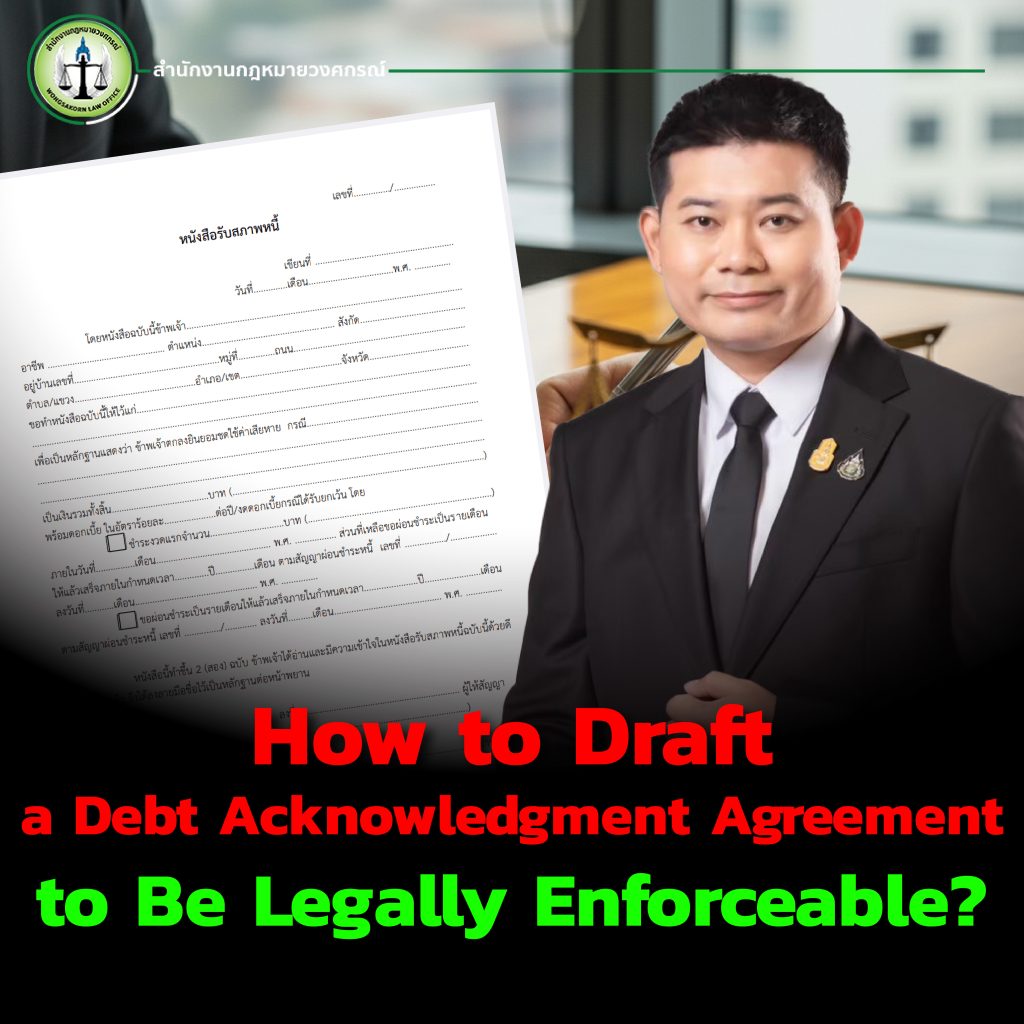
How to Draft a Debt Acknowledgment Agreement to Be Legally Enforceable?

In the world of transactions, whether it is borrowing money, purchasing property, or providing services with outstanding payments, the term “debt” is something frequently encountered. When a debt arises, the most important thing is to have clear documents or evidence to confirm the legal relationship between the debtor and the creditor. One of the most effective tools to safeguard the rights of the creditor is the “Debt Acknowledgment Agreement.”

The question is: how can you draft a Debt Acknowledgment Agreement so that it is truly legally enforceable? This article will explain the key principles, essential components, and precautions, as well as why hiring a lawyer to draft such agreements can provide greater protection of your rights.

What is a Debt Acknowledgment Agreement?

A Debt Acknowledgment Agreement is a document in which the debtor expressly admits that they owe a debt to the creditor and agree to repay it as stipulated. This agreement serves as confirmation of an existing debt, not the creation of a new one. Therefore, having a Debt Acknowledgment Agreement provides the creditor with strong evidence in case legal enforcement in court becomes necessary.

Why is a Debt Acknowledgment Agreement Important?

1. Clear Legal Evidence
In the event of a dispute, the creditor can use the agreement to confirm their right to claim repayment.

2. Reduces the Chance of Debt Denial
Once the debtor signs the acknowledgment, it becomes much harder for them to deny the existence of the debt.

3. Facilitates Litigation
Courts can rely on the agreement as evidence when ruling that the debtor must repay the debt.

Essential Components of a Debt Acknowledgment Agreement

Drafting such an agreement involves more than just writing down numbers and signatures. It must include complete details to be legally enforceable:

1. Details of the Parties – Full names, ID numbers, and addresses of both creditor and debtor.

2. Exact Debt Amount – Clearly state the total debt owed, and specify which contract it originated from (loan, sales, or services).

3. Interest Rate (if applicable) – Must be explicitly stated and within the legal limit (currently not exceeding 15% annually, unless otherwise stipulated by law).

4. Repayment Period – Specify when repayment must be made and the consequences of default (e.g., late interest charges).

5. Method of Repayment – Lump sum, installments, and how payments must be made (e.g., bank transfer).

6. Default Clause – State that in case of default, the creditor may immediately file a lawsuit without further notice.

7. Signatures of Debtor and Witnesses – Having witnesses strengthens the legal weight of the document.

Example of a Debt Acknowledgment Clause

“I, Mr. A, acknowledge that I owe Mr. B the sum of … baht under the Loan Agreement dated … and agree to repay by … date. In case of default, I agree that Mr. B has the right to sue and enforce repayment immediately according to the law.”

This type of wording clearly confirms that the debtor acknowledges the debt and agrees to pay.

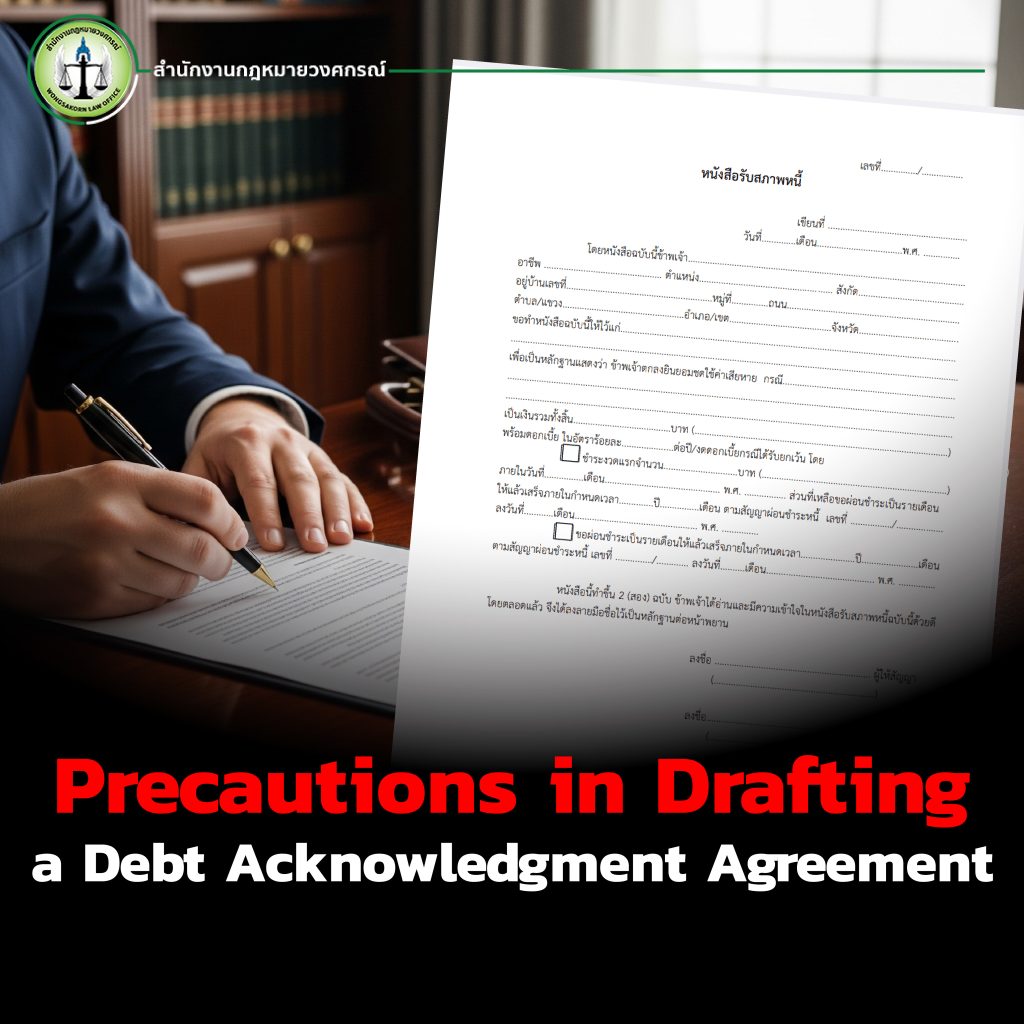
Precautions in Drafting a Debt Acknowledgment Agreement

1. Avoid ambiguous wording – state clearly the origin and amount of the debt.

2. Avoid generic templates – they may miss essential legal details.

3. Check the legality of interest – excessive rates may not be enforceable.

4. Require real signatures – not just typed names.

5. Safely store documents – losing them may result in losing the right to prove the debt.

What if the Debtor Fails to Comply?

If the debtor does not comply with the agreement, the creditor may file a lawsuit using the agreement as strong evidence in court to enforce repayment.

Why Should a Lawyer Draft the Agreement?

Although creditors may draft the agreement themselves, in reality self-drafted agreements often contain flaws, missing information, ambiguous terms, or legally invalid clauses. These shortcomings may result in losing rights during litigation.

Engaging a lawyer or professional law Office ensures that the agreement is comprehensive, legally correct, and minimizes future disputes.

A Debt Acknowledgment Agreement is a crucial tool to protect creditors’ rights by confirming that the debtor owes and agrees to repay. If drafted correctly, it serves as strong evidence in lawsuits and enforcement proceedings.

However, drafting such an agreement is not a simple task. Doing it without legal knowledge may render the agreement unenforceable. Therefore, using the services of Wongsakorn Law Office or engaging a professional lawyer ensures that your documents are accurate, enforceable, and fully protective of your rights.

👉 If you want your Debt Acknowledgment Agreement to be legally enforceable, contact Wongsakorn Law Office for consultation and professional legal services.

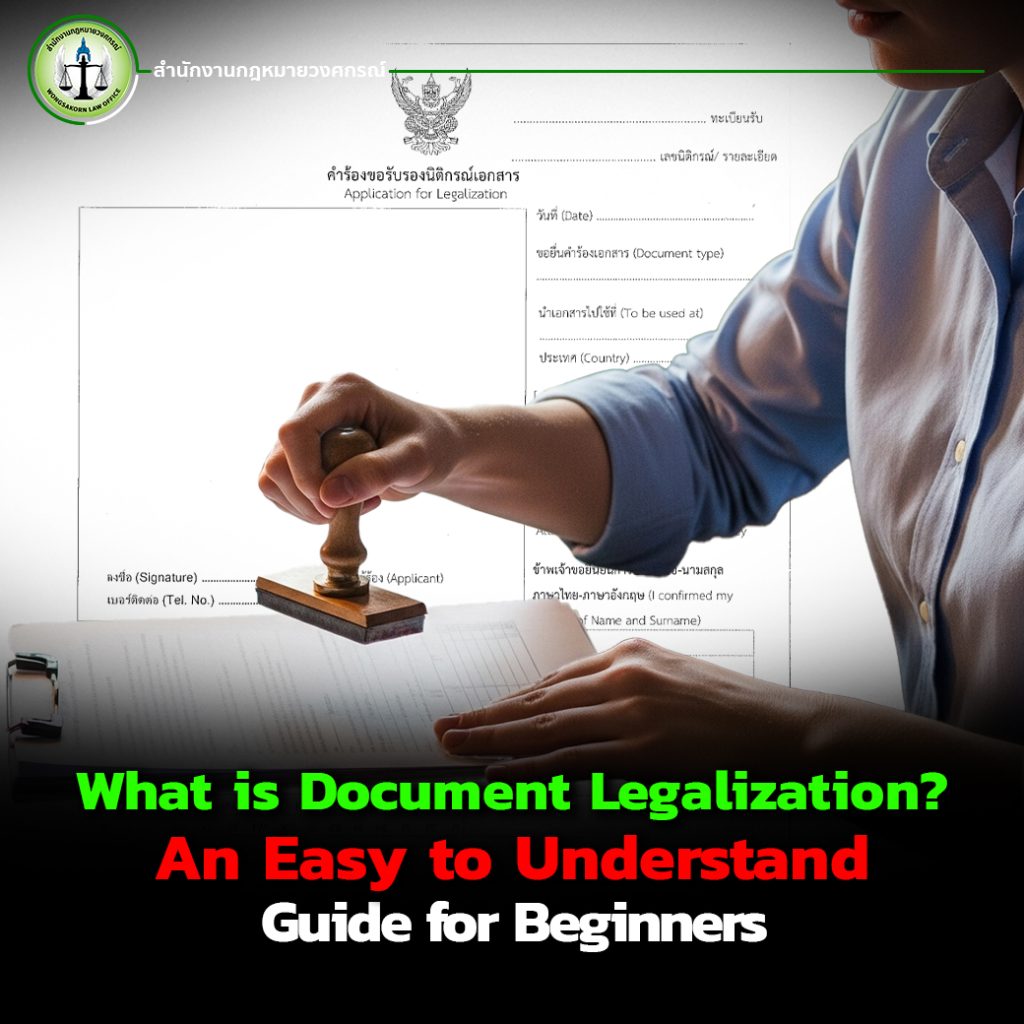
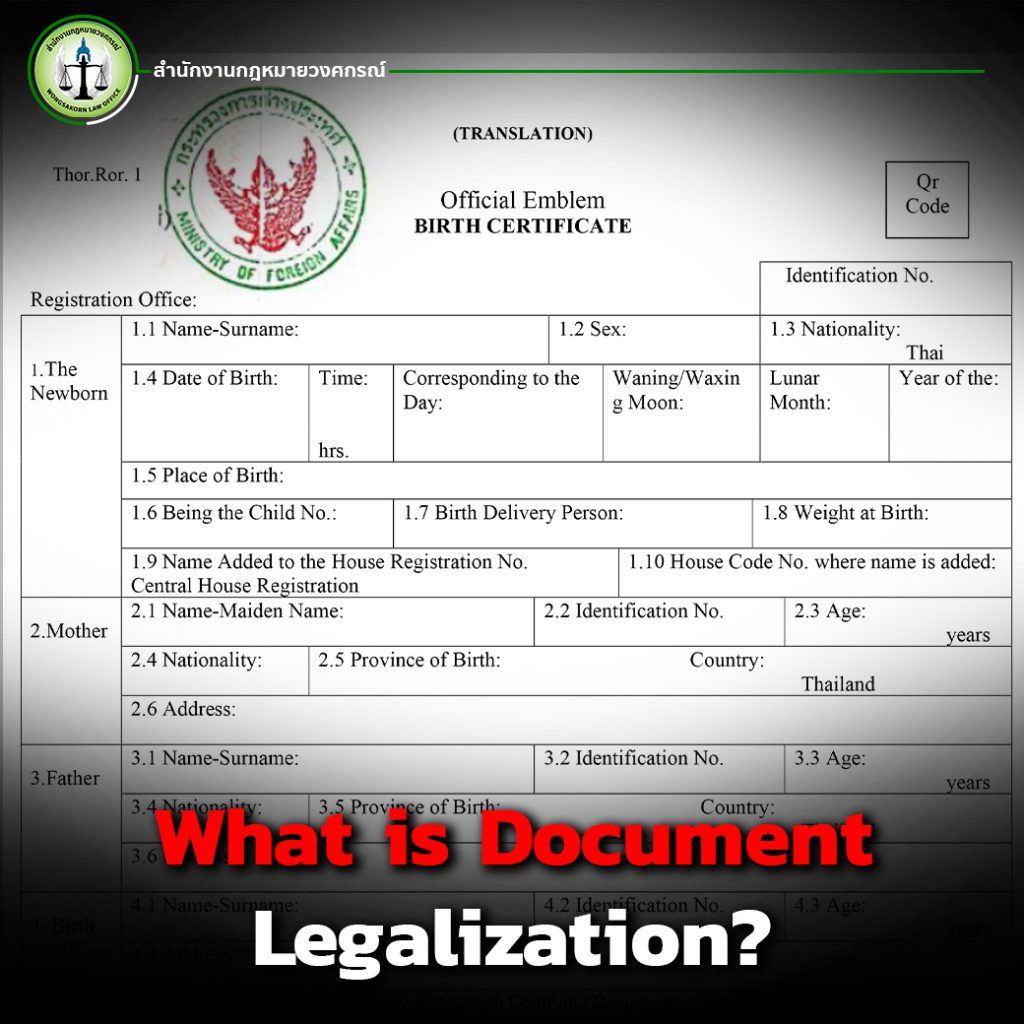
What is Document Legalization? An Easy to Understand Guide for Beginners

In today’s world, where business, education, and career opportunities extend internationally, it is common to use documents issued in one country in another. However, before these documents can be recognized abroad, they must go through a process known as Document Legalization.

This article explains in detail what Legalization is, Why it is important, How to apply for it, what supporting documents are needed, and Why hiring a lawyer can be the most efficient approach.

What is Document Legalization?

Document Legalization is the process of verifying and certifying the authenticity of a document so it can be legally used abroad. This involves confirming that the document was issued by an authorized entity and that the signature or seal on it is genuine.

Examples:

  • You need to submit your degree and transcript from a Thai university to study abroad.
  • A company needs to use its Thai business registration certificate overseas to conduct business.
    In both cases, the documents must undergo the Legalization process before use.

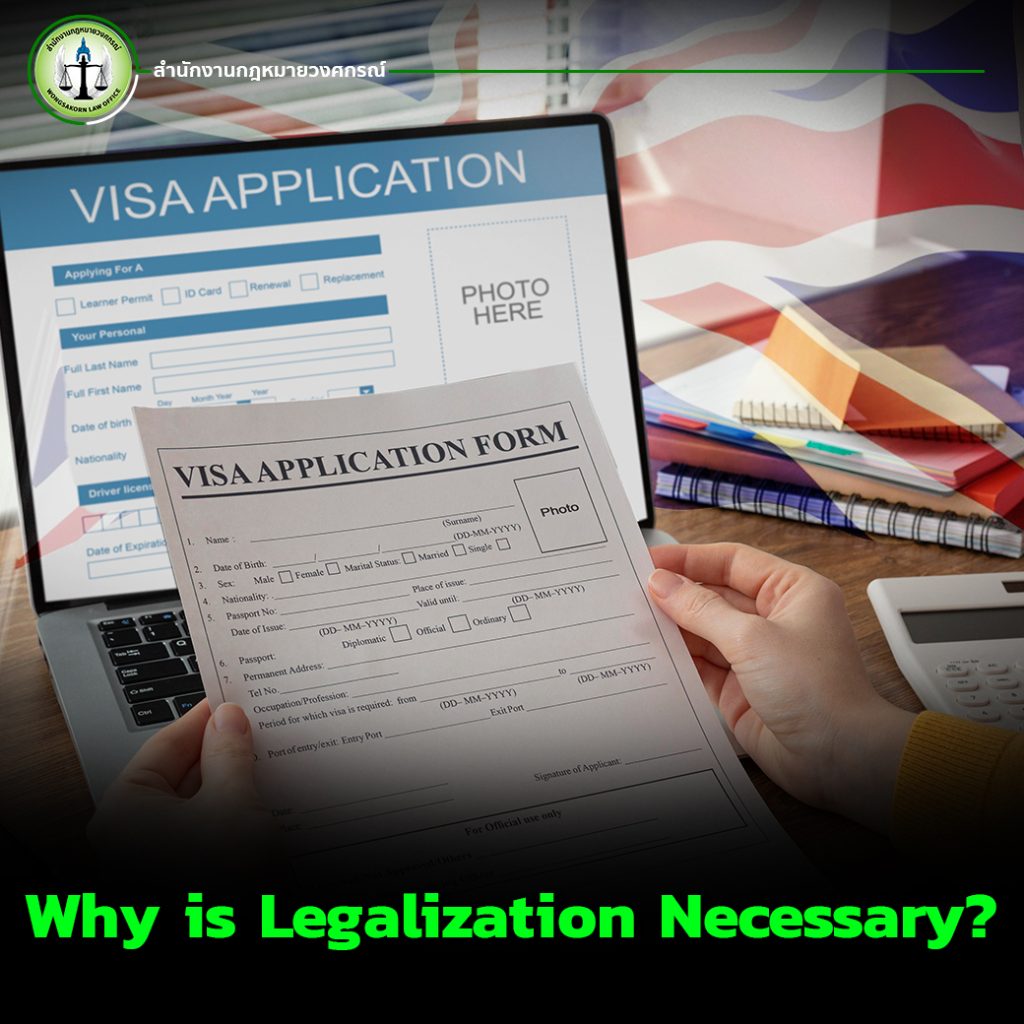
Why is Legalization Necessary?

1.Builds Credibility – Ensures that foreign authorities recognize the document as authentic and issued by the correct authority.

2.Meets Legal Requirements – Many countries require foreign documents to be legalized before acceptance.

3.Avoids Delays and Rejections – Without legalization, processes such as visa applications, school enrollment, or contract signing may be rejected.

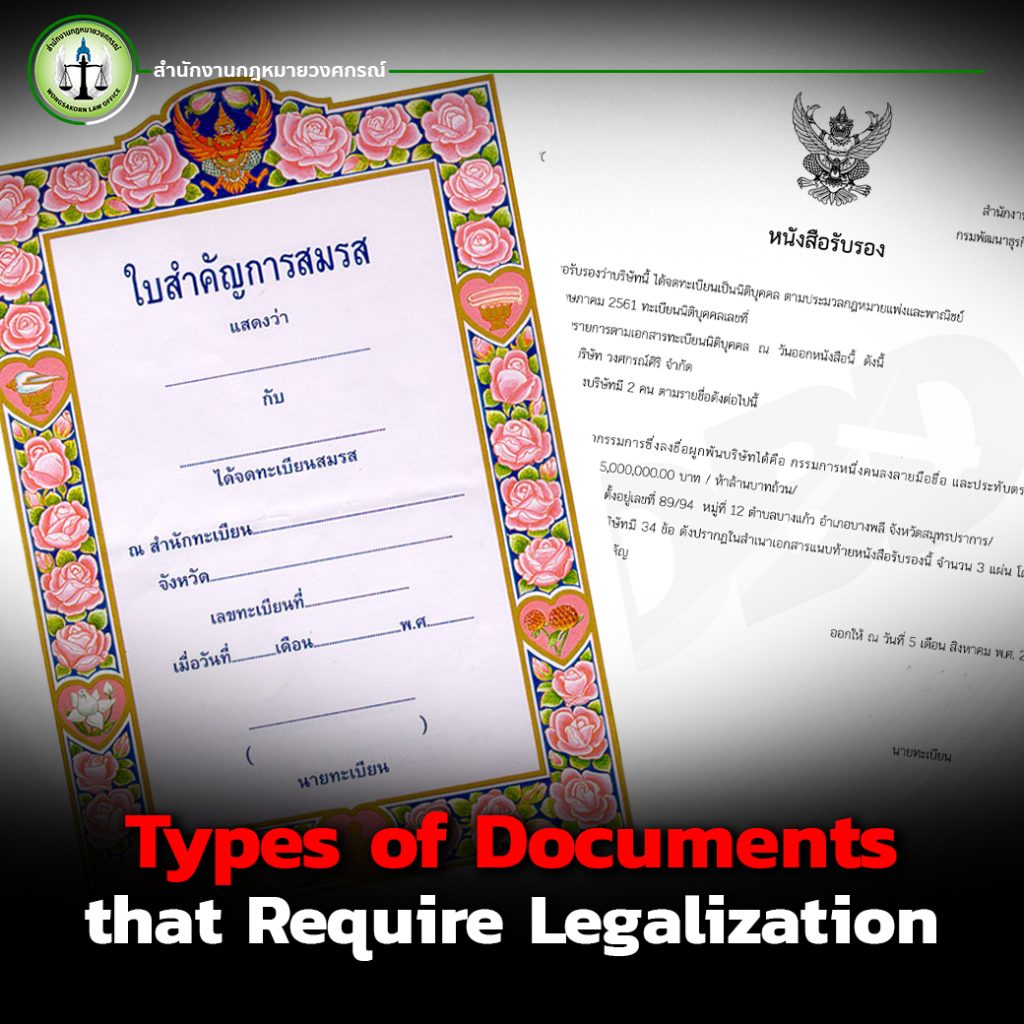
Types of Documents that Require Legalization

  • Educational documents: Degrees, transcripts, graduation certificates.
  • Personal documents: Birth certificates, marriage certificates, divorce decrees, name change certificates.
  • Business documents: Company registration certificates, commercial contracts, powers of attorney.
  • Official documents: Professional licenses, residence certificates.

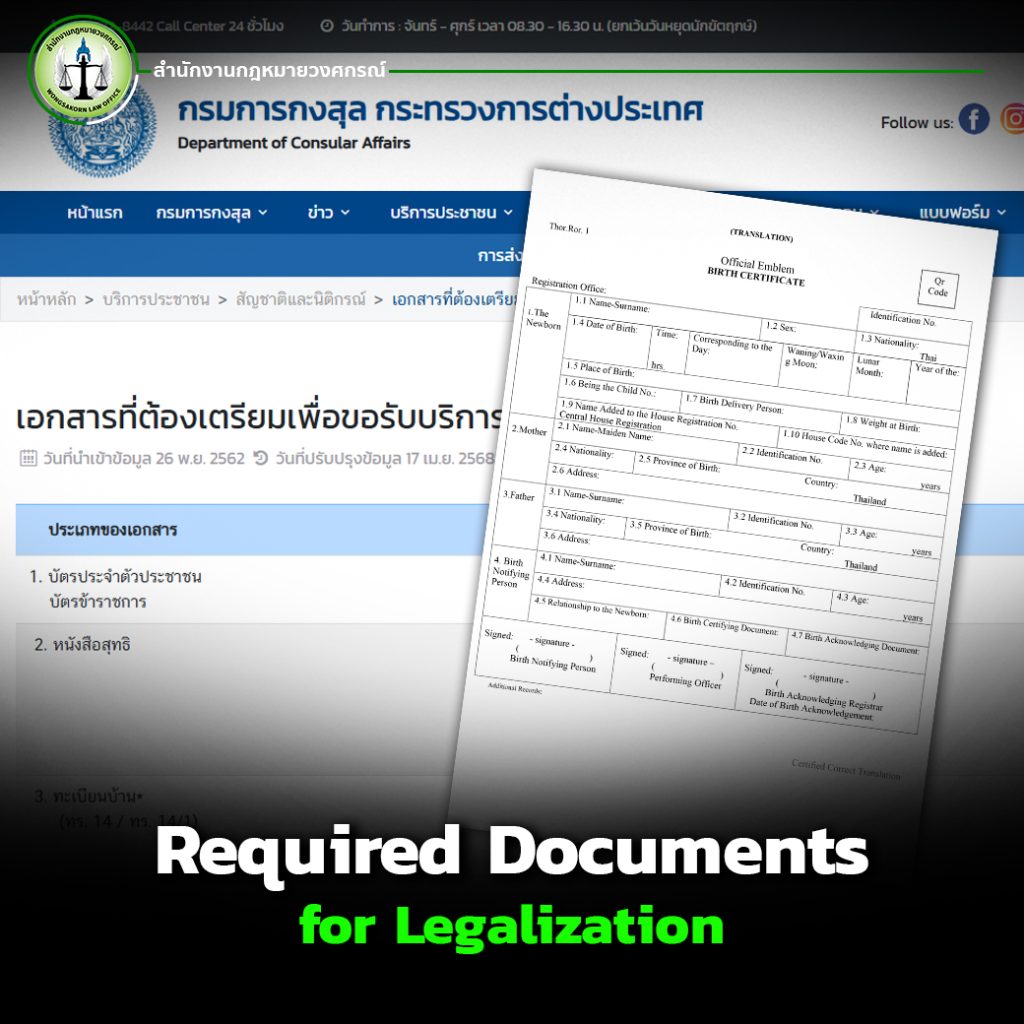
Required Documents for Legalization

Whether you apply yourself or hire a lawyer, prepare the following:

1.Original documents – Official degree, transcript, birth certificate, marriage certificate, company registration, etc. Must be original or certified copies from the issuing authority.

2.Copies of documents – 1–2 sets, signed to certify true copies.

3.Copy of ID or passport – For the document owner or authorized representative.

4.Power of attorney – If someone applies on your behalf; must be signed and stamped with a duty stamp as required by law, plus copies of both parties’ IDs.

5.Payment receipt or proof of payment – If fees are paid online in advance.

6.Certified translations – If the original document is not in the language of the destination country, a certified translation may be required, and in some cases, it must be certified by the Thai Ministry of Foreign Affairs.

💡 Tip: Check with the Ministry of Foreign Affairs or the embassy of the destination country for any additional requirements. Some countries require extra certifications from the Ministry of Education or Ministry of Justice.

Steps for Document Legalization in Thailand

1.Prepare originals and required supporting documents.

2.Translate documents if necessary (by a certified translator).

3.Obtain certification from the issuing authority (e.g., universities, government offices).

4.Submit to the Department of Consular Affairs, Ministry of Foreign Affairs.

5.Submit to the destination country’s embassy (if required).

Legalization vs. Apostille

  • Legalization – Used in countries not part of the Apostille Convention; involves multiple steps such as consular and embassy certification.
  • Apostille – Used in member countries of the Apostille Convention; requires only a single Apostille stamp.

Why Hire a Lawyer for Legalization?

  • Expertise in legal and international procedures.
  • Ensures document completeness before submission, reducing rejection risk.
  • Saves time and effort.
  • Provides end-to-end services: translation, submission, follow-up.

For speed, accuracy, and peace of mind, hiring a lawyer to handle the process from start to finish is the best option.

Legalization is a crucial step to ensure Thai documents can be validly used abroad. Whether for study, work, or business, correct preparation and compliance with procedures make the process smoother and safer. For maximum assurance, entrusting the task to a lawyer is a convenient and worthwhile choice.

Line @ คลิก! โทรหาเรา คลิก!