
Why Should New Business Owners Have a Legal Advisor from the First Step of Investing?

In an era where anyone can enter the world of investment more easily, whether by starting a personal business, expanding an existing enterprise, or investing in real estate, many people tend to focus primarily on “capital.” The common belief is that having sufficient funds alone is enough to generate returns and achieve success. In reality, however, capital is only one essential component. Without a proper legal structure in place from the beginning, the risks involved may be far greater than expected.

For new business owners and first-time investors, having a legal advisor from the very first step of investment is not a luxury, but a crucial foundation for long-term business and investment stability. This article explains why legal advisors play a vital role for new investors and compares the advantages and disadvantages of investing with and without legal counsel.

Hidden Risks in Investments for New Business Owners

Every form of investment carries inherent risks, especially for new investors who lack experience in business and legal matters. Common risks include:

  • Entering into contracts with unclear or unfavorable terms
  • Investing without understanding the legal structure
  • Holding assets or shares without clear legal evidence
  • Joint ventures without written agreements
  • Future disputes with partners, sellers, or contractors

These issues may not be apparent at the initial stage, but once the business grows or conflicts arise, the financial and time-related losses may be difficult to resolve.

The Role of a Legal Advisor in Investment

A legal advisor’s role extends far beyond litigation. Their involvement is crucial even before an investment begins, such as:

  • Analyzing legal risks of investment projects
  • Reviewing and drafting investment contracts
  • Structuring shareholding or joint ventures
  • Providing legal advice on real estate investments
  • Preventing potential future disputes

Having a lawyer from the start is like having an expert who can identify risks that new investors may overlook.

Before Investing: Why Is a Legal Advisor a Key Factor?

Many first-time investors believe that legal advisors are only necessary when disputes or lawsuits arise. In fact, whether or not a legal advisor is involved from the beginning can significantly influence the direction and outcome of an investment. Every investment involves contracts, agreements, and legal obligations that may conceal hidden risks.

Investing with legal guidance is fundamentally different from relying solely on personal understanding or experience. The following sections clearly outline the advantages of having a legal advisor and the disadvantages of investing without one, enabling investors to make informed decisions before stepping into the investment world.

Advantages of Having a Legal Advisor for New Investors

1. Reducing Legal Risks from the Start
Lawyers review contracts and conditions to ensure fairness and prevent legal disadvantages.

2. Systematic Investment Structuring
Whether establishing a company, holding shares, or investing in real estate, legal advisors can recommend structures aligned with investment goals.

3.  Preventing Future Disputes
Clear agreements from the outset reduce the likelihood of litigation and conflicts.

4. Long-Term Cost Savings
Legal consultation costs are far lower than future litigation or corrective expenses.

5. Greater Confidence in Investment Decisions
Investors can make informed decisions knowing legal professionals are safeguarding their interests.

Disadvantages of Investing Without a Legal Advisor

On the other hand, investing without legal counsel may lead to:

  • Signing unfair or disadvantageous contracts
  • Being unaware of hidden legal obligations
  • Being taken advantage of by more experienced parties
  • Costly and time-consuming disputes
  • Business disruption due to legal issues

Many new investors have suffered significant financial losses simply by neglecting legal considerations from the outset.

Why Are Legal Advisors Especially Important in Real Estate Investment?

Real estate investment such as purchasing land, condominiums, or property development often involves high-value transactions and extensive legal documentation. Legal advisors help verify ownership rights, encumbrances, contracts, and conditions to prevent risks such as:

  • Purchasing property with mortgages or disputes
  • Incomplete transfer of ownership
  • Unintentional loss of property rights

Money Alone Is Not Enough for Long-Term Investment Growth

For new business owners and investors, long-term investment success depends not only on capital but also on careful planning especially legal planning. Having a legal advisor from the first step creates a strong protective shield against risks and supports sustainable growth.If you aspire to grow as a successful business owner or investor, do not overlook the role of a legal advisor.

Common Problems Faced by Chinese Nationals in Thailand in 2025

Investment, Tourism, and Legal Solutions When Disputes Arise

In 2025, Thailand will continue to be one of the most popular destinations for Chinese nationals, whether for tourism, business investment, or long-term residence. With its attractive tourist destinations, rich cultural diversity, affordable cost of living, and promising economic opportunities, Thailand remains highly appealing. However, in practice, many Chinese nationals encounter various challenges arising from differences in language, legal systems, cultural norms, and administrative procedures in Thailand.

This article outlines the common problems faced by Chinese nationals when traveling to or investing in Thailand in 2025, covering tourism-related issues, business and investment challenges, and legal risks. It also provides guidance on prevention and proper solutions, concluding with recommendations for consulting lawyers who specialize in legal cases involving Chinese nationals in Thailand through Wongsakorn Law Office.

One of the most common challenges faced by Chinese nationals in Thailand is language barriers. While English or Chinese may be used in major cities, Thai remains the primary language in rural areas, government offices, and official administrative procedures.

Unclear communication may result in:

  • Misinterpretation of legal provisions
  • Signing contracts or legal obligations without fully understanding the content
  • Inability to communicate effectively with authorities such as police officers, hospitals, or banks
  • Being placed at a disadvantage during negotiations or disputes

Due to significant differences between Thai law and the Chinese legal system, as well as differences in enforcement practices, Chinese nationals often face legal challenges in the following areas:

Traffic Regulations and Driving Licenses
Many are unaware that an international driving permit or a Thai driving license is required. Failure to present proper documentation may result in fines or vehicle seizure.

Copyright and Intellectual Property Infringement
Selling counterfeit branded goods or importing infringing products may lead to both criminal and civil liability.

Labor Law Issues
Chinese investors who employ workers may encounter disputes due to a lack of understanding of Thai labor laws, including working hours, employee benefits, and employment contracts.

Thailand attracts many foreign investors, but Chinese investors often face business-related obstacles, including:

Company Registration
There are legal restrictions on foreign shareholding ratios and foreign business regulations that may be misunderstood or improperly applied.

Business Contracts
Signing contracts drafted in Thai without proper legal understanding may lead to unfair terms or unfavorable legal obligations.

Taxation and Financial Compliance
Lack of understanding of VAT, corporate income tax, or Bank of Thailand regulations may result in violations, penalties, or legal accusations.

Differences in culture and working styles may also create difficulties, such as:

  • Different corporate management systems
  • Misunderstandings during negotiations
  • Differing expectations regarding service quality, standards, or timelines

Although these issues may not be purely legal, they can significantly affect business operations and long-term success.

When facing criminal accusations or legal disputes whether criminal, civil, or labor-related many Chinese nationals find themselves in difficult situations due to:

Lack of Understanding of the Thai Legal System
Thailand’s judicial process differs from China’s, and misunderstanding procedural requirements may result in legal disadvantages.

Language Barriers
Without interpreters or lawyers fluent in Chinese and Thai law, critical information may be misunderstood or overlooked.

Arrest and Detention Risks
If an arrest warrant exists or a criminal complaint has been filed, arrest in Thailand may significantly impact bail proceedings and long-term legal outcomes.

Legal Solutions: Consulting Lawyers Specialized in Chinese-Related Cases

When legal issues escalate into disputes or litigation in Thailand, Chinese nationals need not worry. Specialized legal services are available to support Chinese investors and tourists, including:

Pre-Entry Legal Consultation
Advisory services before traveling to or investing in Thailand to minimize legal risks.

Legal Status Verification
Such as checking whether an arrest warrant exists, without the need to travel to Thailand.

Legal Representation in Thailand
Including statements to authorities, filing petitions, initiating lawsuits, and court representation through legal counsel.

Document Translation and Legal Representation
Lawyers experienced in handling cases involving Chinese nationals can provide accurate translations and clear legal explanations.

Thailand remains an attractive destination for Chinese nationals in 2025. However, living, investing, or traveling in Thailand inevitably involves legal risks and challenges that differ from those in China. Verifying legal status, understanding local laws, and engaging experienced legal counsel can help Chinese nationals navigate these challenges with confidence.

If you are a Chinese national facing legal, business, or investment-related issues in Thailand, you may consult lawyers specializing in Chinese-related legal cases at Wongsakorn Law Office, ensuring that your stay, business operations, and activities in Thailand proceed smoothly and lawfully.

What Should Foreign Nationals Do If Arrested in Thailand? Understanding Essential Legal Rights and the Importance of Bail under Thai Law

Thailand welcomes a large number of foreign nationals each year for residence, employment, tourism, and business purposes. However, despite the best precautions, situations may arise in which a foreign national is arrested by Thai authorities, whether in connection with criminal matters, labor disputes, immigration issues, or other legal proceedings under Thai law.

It is important to emphasize that foreign nationals in Thailand are entitled to fundamental legal rights under Thai law, particularly rights within the criminal justice process and the right to apply for bail in order to defend their case fairly. Unfortunately, many foreign nationals are not fully aware of these rights, which may place them at a disadvantage during legal proceedings.

This article provides an overview of the essential rights of foreign nationals when arrested in Thailand and explains how these rights, including the right to bail, can be exercised to ensure proper legal protection.
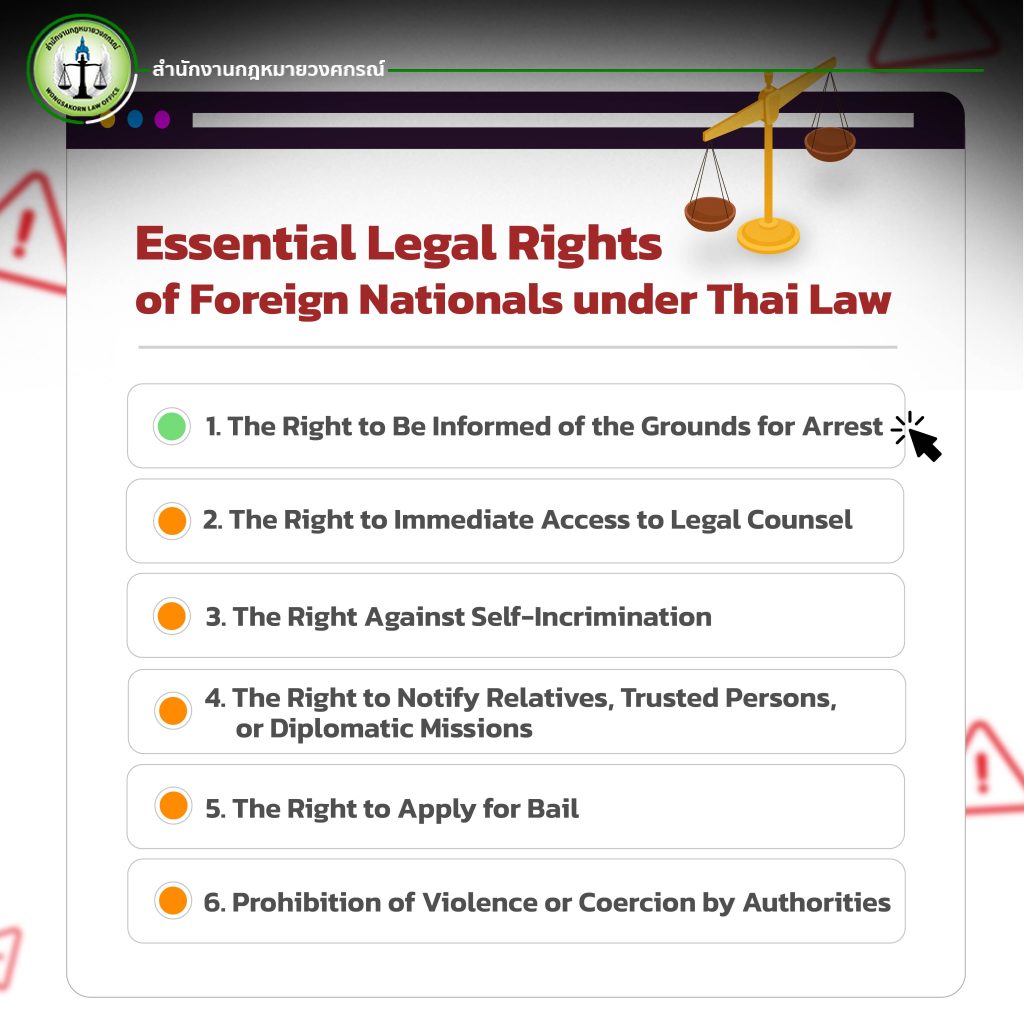
1. The Right to Be Informed of the Grounds for Arrest

One of the most fundamental rights of an arrested person is the right to be informed of the reason for the arrest.

Thai law requires law enforcement officers to clearly inform the arrested person of:

  • The specific charge(s),
  • The factual grounds for the arrest, and
  • The legal provisions relied upon.

Failure to properly inform the arrested person may render the arrest unlawful and may be challenged during the investigation or court proceedings.

2. The Right to Immediate Access to Legal Counsel

A foreign national who has been arrested has the right to consult with a lawyer immediately, either:

  • A lawyer of their own choosing, or
  • A lawyer arranged with the assistance of the authorities.

The arrested person is also entitled to consult with legal counsel privately before providing any statement to investigators. Early legal representation is particularly important in cases involving language barriers, as it helps prevent misunderstandings and protects the individual’s legal interests from the outset.

3. The Right Against Self-Incrimination

Under Thai law, an arrested person has the right to:

  • Remain silent,
  • Decline to answer certain questions, or
  • Wait until legal counsel is present before giving a written statement.

It is important to note that remaining silent does not constitute an offense. Any statement given may later be used as evidence in legal proceedings; therefore, exercising this right carefully and with legal guidance is strongly advised.

4. The Right to Notify Relatives, Trusted Persons, or Diplomatic Missions

A foreign national who has been arrested has the right to request that authorities:

  • Notify a relative or trusted person, and
  • Inform the relevant embassy or consulate.

Notification of the embassy or consulate is particularly significant, as diplomatic missions may assist with communication, coordination, and the protection of their citizen’s fundamental rights.

5. The Right to Apply for Bail

The right to apply for bail is one of the most important procedural rights available to an arrested person.

Where Thai law permits temporary release, a foreign national may submit a bail application at any stage of the proceedings, including:

  • During the police investigation,
  • At the public prosecutor’s stage, or
  • Before the court.

Bail allows the suspect or defendant to prepare their defense effectively, gather evidence, and consult with legal counsel outside of detention. For foreign nationals, bail may be subject to specific conditions, such as financial security, a guarantor, or restrictions on travel outside Thailand. Professional legal representation significantly increases the likelihood of a successful bail application.

6. Prohibition of Violence or Coercion by Authorities

Law enforcement officers are strictly prohibited from using violence, threats, physical force, or coercive measures to compel a confession.

Any evidence obtained through unlawful means may be challenged and may be deemed inadmissible by the court. Arrested persons have the right to file complaints and seek legal remedies if such violations occur.
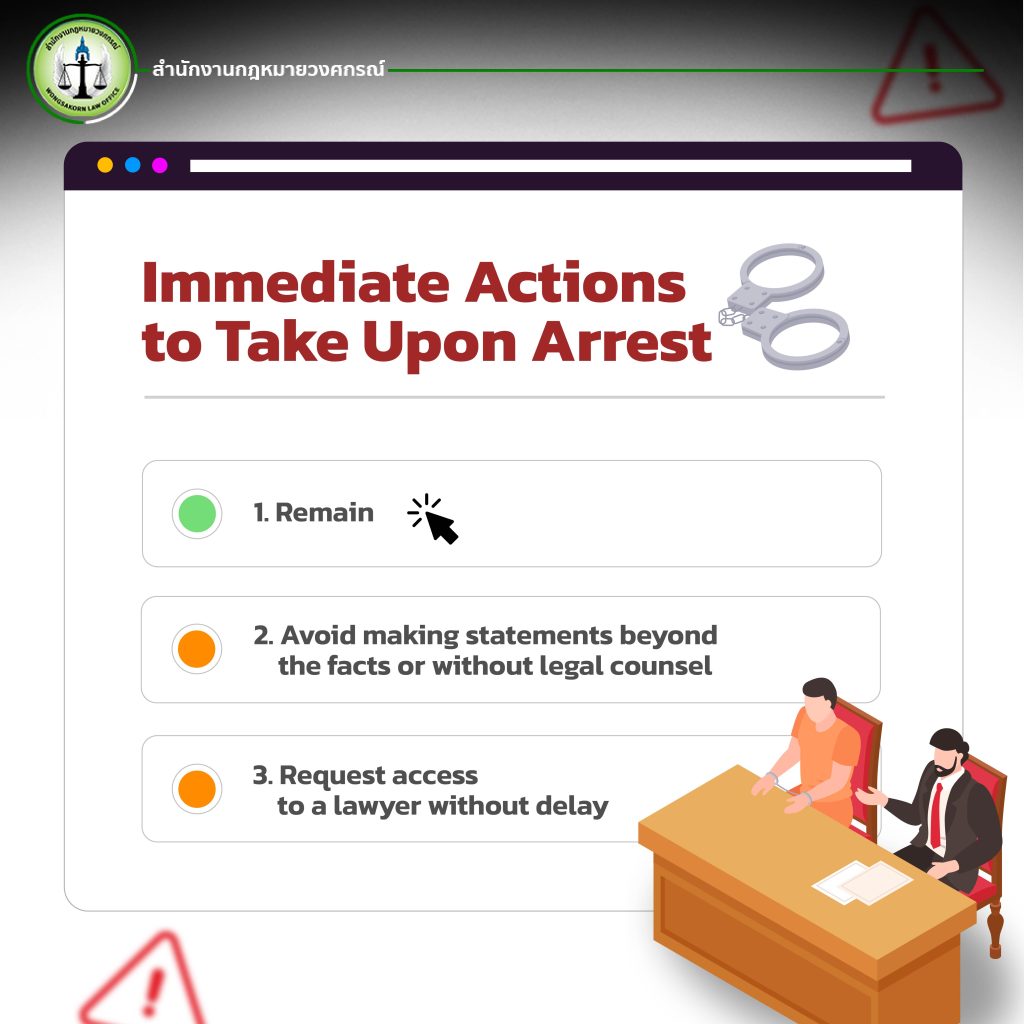
In the event of an arrest, the most critical response is not to hastily explain or justify one’s actions, but to remain calm and exercise one’s legal rights appropriately. Many legal cases are adversely affected by panic, inaccurate statements, or providing testimony without legal counsel.

If you or someone close to you is arrested, the following steps should be taken immediately:

1.  Remain calm

2.  Avoid making statements beyond the facts or without legal counsel

3.  Request access to a lawyer without delay

Every statement may later be used as evidence. Having legal counsel involved from the earliest stage is the most effective way to protect one’s rights.

Foreign Nationals Have Legal Rights  Legal Counsel Is Essential

Regardless of the nature of the arrest, foreign nationals in Thailand are protected by fundamental legal rights, including the right to legal counsel and the right to apply for bail.

If you or someone close to you is a foreign national who has been arrested in Thailand, prompt consultation with an experienced lawyer is strongly recommended. In legal matters, time is critical, and a clear understanding of one’s rights is essential to ensuring fair treatment under the Thai legal system.


Why Do Modern Organizations Need a “Legal Advisor” Before Problems? Arise The Key to Sustainable Growth in 2026 and Beyond

As the world rapidly enters a new era of change, particularly in 2026, businesses are facing both opportunities and challenges from technological advancements and evolving workforce structures to increasingly complex legal regulations. It is undeniable that organizations and companies of all sizes need a legal advisor to provide guidance, legal advice, and risk prevention before problems actually arise.

Many organizations still believe that lawyers are only necessary when disputes or lawsuits occur. In reality, however, the role of a legal advisor is not merely to resolve problems but to prevent legal issues from the outset, which is a highly cost-effective and strategic form of risk management.

Organizational Problems Exist at Every Scale Only the Context Differs

Whether a company is small, medium, or large, internal problems are inevitable. The difference lies only in the form and complexity of those issues. One of the most common and impactful problems organizations face involves personnel or employees.

Based on the experience of Wongsakorn Law Office, led by Lawyer Arm Supasit Siri, who serves as a legal advisor to numerous companies, personnel-related issues are among the most recurring and increasingly severe challenges especially in organizations with a large workforce.

Common examples include:

  • Employees resigning and deleting or destroying important company data
  • Chronic lateness without a clear management system
  • Groups of employees coordinating mass resignations
  • Unlawful termination in violation of labor laws
  • Conflicts between management and employees

These issues negatively affect organizational management, corporate image, and long-term operational costs.

Why Is a Legal Advisor Essential to Organizational Growth?

Having a legal advisor on retainer does not mean an organization is in trouble, it means the organization is planning ahead for stable growth. A legal advisor can support organizational development in several key areas, such as:

1.Preventive Legal Advice
Establishing proper legal frameworks from the outset to reduce future litigation risks.

2.Internal Documentation and Policy Management
Drafting and reviewing employee regulations, employment contracts, and workplace policies in compliance with current labor laws.

3.Proper Management of Employee Issues
Minimizing disputes and providing legal opinions to enable confident executive decision-making.

4.Strategic Advisory for Management
Particularly in business deals, expansion plans, and corporate restructuring.

Graceful Growth Requires Organization-Wide Cooperation

Successful organizations of the future are not those without problems, but those that manage issues systematically and fairly. When executives and employees grow together harmoniously, organizations become stronger, more stable, and better prepared for future change.

A legal advisor is therefore not an external entity, but a core member of the organizational team, contributing to sustainable growth.

Is Your Organization Ready for a Legal Advisor?

In 2026 and beyond, competitive organizations must excel not only in business acumen but also in legal preparedness. Retaining a legal advisor is not an unnecessary expense, it is a long-term investment in organizational stability.

If your company is seeking a legal advisor who truly understands business contexts, provides preventive legal guidance, and partners with your organization’s growth, Wongsakorn Law Office is ready to assist. We offer tailored legal advisory packages suitable for organizations of all sizes.

Why Every Business Deal Needs a “Legal Advisor” Protect Your Company’s Interests Before Signing Any Contract?

In the business world, nothing is more important than accuracy, transparency, and protecting your company’s best interests especially when working with another organization. Whether it’s a sales contract, a long-term business deal, a joint venture, or any agreement involving substantial benefits, having a legal advisor closely supervising the process is essential.

Many organizations assume that “we can handle it ourselves,” “this is a standard contract,” or “the partner is trustworthy,” but the truth in business is often the opposite. A single overlooked clause can cost your company millions, or lead to prolonged disputes that severely damage your reputation and financial performance.

This article from Wongsakorn Law Office explains why every business deal requires a legal advisor, why every contract must be reviewed, and how organizations gain long-term benefits from having a legal team safeguarding their operations.

Legal Advisors Prevent Risks Before Problems Occur

Every step in business involves risk, especially contracts that are legally binding. Without expert review, issues such as the following may arise:

  • Vague or incomplete terms
  • Conditions that benefit only the counterparty
  • Clauses open to multiple interpretations
  • Legal loopholes that can be used against you

A legal advisor identifies risks before any document is signed, closes loopholes, and prevents potential damage far better than trying to fix a dispute later, which is more complex, costly, and time-consuming.

Ensuring Contracts Are Correct, Secure, and Comprehensive

Many companies mistakenly assume that sales contracts are “standard forms” or that long-used agreements need no review. In reality, each contract contains specific details that may cause unexpected harm, such as:

  • Unclear payment terms
  • No warranty or work guarantee
  • Undefined liability for breaches
  • No termination rules
  • Missing exclusions or limitation-of-liability clauses

A legal advisor ensures that a contract truly protects your company not merely a generic agreement, but an effective legal tool for risk control and future dispute prevention.

Long-Term Deals Require Extra Precision

Contracts with long-term commitments such as:

  • Joint Venture agreements
  • Partnership agreements
  • Annual supply or manufacturing contracts
  • High-value service agreements

are far more complex than standard contracts. They involve multiple areas: revenue sharing, intellectual property, responsibilities, and shared risks. A legal advisor helps analyze:

  • How each clause impacts your business
  • Which terms are advantageous or disadvantageous
  • What additional points should be negotiated
  • Which risks must be closed before proceeding

Having a legal team during negotiations provides real-time risk assessment, helping executives make confident and informed decisions.

Gain Stronger Negotiation Power

Most well-prepared business partners already have legal teams. Without your own legal advisor, your company is at a disadvantage from the start.

Benefits of having a legal advisor include:

  • Analyzing proposed contract terms
  • Identifying points that require negotiation
  • Pinpointing risky clauses immediately
  • Suggesting safer contract structures
  • Negotiating legal matters on behalf of the company

The result: stronger negotiation power, clearer information, and protection from unfair terms.

Reduce Disputes and Manage Them Properly When They Occur

Business disputes often stem from:

  • Different interpretations
  • Unclear conditions
  • Unspecified responsibilities
  • Incomplete documentation

A legal advisor designs a contract structure that minimizes these risks. And if disputes do occur, your company has an expert to:

  • Analyze the situation
  • Gather evidence
  • Negotiate with counterparties
  • Provide solutions that minimize business impact

Companies without legal teams often panic, misunderstand procedures, and lose opportunities to protect their rights.

High-Value Deals Require Expert Oversight

Deals involving significant financial value such as:

  • Asset purchases
  • Mergers & Acquisitions (M&A)
  • Joint investments
  • High-value project contracts

require detailed document examination and deep risk assessment, including:

  • Tax risks
  • Regulatory risks
  • Intellectual property risks
  • Counterparty liability risks

A legal advisor ensures that every step is structured, verifiable, and legally secure.

A Legal Advisor Is a Long-Term Investment – Not an Expense

Many companies view hiring a legal advisor as a cost. In reality, it is an investment that significantly reduces risks, such as:

  • Damages from lawsuits
  • Regulatory fines
  • Reputational harm
  • Contract cancellations impacting revenue

From a business perspective, legal advisors provide stability and legal security, which carry immense long-term value.

Every Business Deal Should Have a Legal Advisor

Working with any organization big or small impacts your company’s interests. A legal advisor is a vital shield enabling your business to move forward safely, confidently, and with minimized errors.

Whether it is:
✔ Sales contracts
✔ Long-term project agreements
✔ Joint ventures
✔ Any high-value deal

Contract review by legal experts is the “standard of professional business practice.”

If your company is preparing for an important deal, consulting Wongsakorn Law Office is an effective way to protect your business interests.

Why Modern Organizations Need a “Legal Advisor” and Why Many Companies Choose Wongsakorn Law Office?

In today’s rapidly changing legal landscape, businesses face greater legal risks than ever before whether related to labor law, personal data protection (PDPA), tax regulations, business law, contract law, or requirements from government agencies. Running a business is no longer just about “making sales”; it is equally important to manage legal risks correctly and safely.

This is why many organizations are now seeking legal advisors who can review, guide, and prevent legal issues before they escalate into costly consequences. One of the most trusted firms in this field is Wongsakorn Law Office, known for its responsibility, legal accuracy, and the ability to stand beside companies as a true legal advisor.

What Is a Legal Advisor, and Why Do Businesses Need One?

A legal advisor is a lawyer hired by a company to provide ongoing legal counsel, review documents, and ensure legal compliance. This functions similarly to having an internal legal department, but with more cost efficiency and access to a diverse team of specialists.

Responsibilities of a Legal Advisor include:

Reviewing and drafting contracts
• Providing legal opinions to internal departments
• Advising on labor law and HR management
• Preventing legal issues before they arise
• Negotiating or communicating with opposing parties
• Conducting business risk assessments
• Advising on compliance with new regulations such as PDPA or E-Tax
• Representing the company during government inspections

Having a dedicated legal advisor allows businesses to move forward with confidence, knowing that legal guidance is available immediately without waiting for an emergency to find a lawyer.

Why Companies Choose Wongsakorn Law Office?

1. Comprehensive Legal Opinions — Not Just Surface-Level Answers

Wongsakorn Law Office works meticulously, analyzing real issues and relevant laws. The recommendations are structured, actionable, and designed to support confident decision-making by management.

2. If the Company Follows Our Legal Guidance but Gets Penalized  We Take Responsibility

One of our key strengths is the willingness to take responsibility for our legal opinions.

If a company follows our labor-law recommendations correctly but is still fined by the Department of Labor, Wongsakorn Law Office will take responsibility as the legal advisor.
This reflects our confidence in the accuracy of our advice and demonstrates the trust organizations place in us.

3. A Multi-Specialty Legal Team

Even with a monthly advisory package, clients gain access to an entire legal team, covering:
• Labor law
• Business & contract law
• Civil & criminal litigation
• Consumer disputes
• Insurance law
• Intellectual property
Basic tax law
• Family & asset law

This gives companies comprehensive legal support at a predictable, cost-effective rate.

4. Immediate Legal Responses When Problems Arise

Organizations often face unexpected issues such as:
• Employee complaints
• Labor department inspections
• Customer damage claims
• Employee misconduct
• Contract disputes
• Government document requests

Wongsakorn Law Office Provides immediate legal guidance, Ensuring the company never faces these issues alone.

Examples of How Legal Advisors Protect Organizations

Case 1: Labor Law Issues

Many companies are fined because of:
• Incorrect documentation
• Improper termination procedures
• Miscalculated compensation
• Illegal or missing internal regulations

With a legal advisor reviewing each step, businesses can reduce almost all of these risks.
And if the company follows Wongsakorn Law Office’s recommendations but still gets fined we take responsibility.

Case 2: Contract Review

A single mistake in a contract can cost hundreds of thousands or millions.
Having legal experts review every agreement before signing significantly reduces conflict risk.

Case 3: Reviewing Company Policies Before Announcing Them

Many companies unintentionally issue illegal internal rules, such as:
• Excessive fines
• Employee searches
• PDPA violations
• Unlawful salary deductions

A legal advisor ensures all policies comply with the law.

Case 4: Representing Companies Before Government Agencies

When the Department of Labor or consumer-protection agencies summon a company,
Having a lawyer present prevents miscommunication and helps negotiate the best outcome.

Why a Monthly Legal Advisor Package Is More Cost-Effective?

Handling legal crises after they occur leads to:
• Higher expenses
• Lost time
• Damaged reputation
• Litigation risks
• Severe government penalties

But with a legal advisor, you can:
• Prevent problems early
• Reduce long-term legal costs
• Minimize risks of fines or lawsuits
• Receive immediate legal answers

A business without a legal advisor is like driving without insurance once a problem happens, the costs always follow.

If Your Organization Needs a Legal Advisor  Wongsakorn Law Office Is Ready to Assist

We offer affordable monthly packages with full legal responsibility for our recommendations.
If your company follows our guidance and still faces penalties, we stand by you.
This is our standard of legal service excellence.

📞 Contact: 062-195-1661 Or message our inbox anytime.
Because legal problems never wait  but you can prevent them today with experts from the Wongsakorn Law Office.

Why Having a Legal Advisor During Company Formation Is Essential and How It Covers Every Issue?

Starting a business is not only about having a great “idea” or sufficient “capital.”
One crucial factor that many entrepreneurs often overlook is having a “legal advisor” or a “corporate legal consultant” from the very beginning of the company formation process.
A professional legal advisor helps your business grow sustainably and minimizes potential legal risks in the future.

This article explains why having a legal advisor during company setup is beneficial and how they can help you handle every potential problem before it occurs.

Why is a Legal Advisor Important from the Start?

Many people think lawyers are only needed after problems occur, but in reality, a legal advisor plays a vital role from the earliest stage of business planning.
Company formation involves various legal documents and procedures, such as:

  • Choosing the right business structure (limited company, partnership, public company, etc.)
  • Registering the company with the Department of Business Development
  • Drafting agreements between shareholders or investors
  • Designing internal management and accounting systems

Without proper legal guidance, entrepreneurs may face future conflicts, such as shareholder disputes, unfair benefit sharing, or invalid documents issues that are costly and difficult to correct later.

A successful business begins with a strong foundation and reliable legal advice.

1. Structuring Your Company Correctly from the Beginning

A legal advisor can help design your company’s legal structure to fit your business type, for example:

  • Deciding between a limited company or limited partnership
  • Fair share allocation among investors
  • Defining clear powers between directors and shareholders
  • Drafting Articles of Association and company regulations

Setting the right foundation prevents internal conflicts and ensures smooth long-term operations.

2. Preventing Legal Risks Before They Happen

During company formation, many business owners unintentionally make mistakes such as using a duplicate company name, signing a vague joint venture contract, or signing documents with hidden obligations.

A legal advisor will help you review and prevent legal risks in advance, ensuring that every step complies with the law.

Examples include:

  • Reviewing documents from foreign investors
  • Checking tax agreements
  • Preventing intellectual property infringement (trade names, logos, trademarks)

Without a legal advisor, these small oversights can lead to financial and reputational damage later.

3. Drafting Clear and Fair Contracts

Another essential role of a legal advisor is drafting and reviewing business contracts, including:

  • Shareholder agreements
  • Employment contracts
  • Lease agreements
  • Sales and supplier contracts

Having a legal advisor ensures that every agreement is fair, secure, and legally sound because a contract is not just a piece of paper, but a powerful tool that prevents future disputes.

4. Advising on Tax and Accounting Compliance

New companies often make tax-related mistakes due to lack of knowledge.
A legal advisor can guide you through the correct tax and accounting setup, including:

  • Preparing accurate tax reports
  • Getting ready for Revenue Department audits
  • Implementing a proper documentation system

Having an advisor from the start reduces the risk of unnecessary fines and overpayments.

5. Your Legal Partner and Strategic Advisor

A legal advisor is not just a contract drafter but also a strategic partner who understands both your business and the law.
They can advise on:

  • Business decisions with legal consequences
  • Branch expansion or joint ventures
  • Employment and labor law risks

A good legal advisor doesn’t wait for problems to arise; they analyze, foresee, and prevent them, helping you make informed, confident decisions at every step.

Long-Term Benefits of Having a Corporate Legal Advisor

Even if your company doesn’t face legal problems initially, having a corporate legal advisor as your long-term partner helps you:

  • Prevent partner or client disputes
  • Reduce litigation risks
  • Strengthen credibility in negotiations
  • Manage contracts systematically
  • Stay updated on new laws affecting your business

Simply put, a legal advisor is one of the most valuable assets a business owner can have because law is the framework that keeps your company stable.

A Legal Advisor Is an Investment, Not an Expense

Some may see hiring a legal advisor as an additional cost, but it is actually a long-term investment in your company’s safety and sustainability.

With a trusted advisor, you can be confident that:

  • Every document complies with the law
  • Every agreement is well-structured
  • Every decision is legally secure

A successful business begins with a strong foundation and reliable legal advice.

If you are planning to start your company and need professional legal consultation,
Wongsakorn Law Office has experienced corporate legal advisors ready to guide you through every step. Contact us at +66 62-195-1661 or click >> Contact Us <<

Because “having the right advisor is the first step toward a stable business.”

“Pol. Col. Santipat Prommajul” – A Legendary Commander in Combating Cybercrime, Now Serving as Legal Advisor to Wongsakorn Law Office

Cybercrime: A Digital Age Threat and the Crucial Role of Lawyers in Litigation

In today’s world, where technology and the internet play a central role in daily life, cybercrime has become a silent threat causing damages to individuals, organizations, and society at large. One of the most vital tools in investigating and proving cases of this nature is Computer Traffic Data, which serves as crucial evidence in both investigations and litigation.

What is Computer Traffic Data?

Computer traffic data refers to information that identifies the source, communication path, date and time, usage volume, and nature of computer communications excluding the actual content. Examples include:

  • IP addresses used for connection
  • Date and time of emails or messages sent
  • Website access routes
  • Network access logs

Although such data may appear minor, it can directly link perpetrators to crimes such as hacking, data forgery, or online fraud.

Online Threats of Concern

Cybercrime today has become increasingly complex and widespread, taking various forms such as:

1. Online Scams / Phishing – Fake emails or messages impersonating banks, logistics companies, or platforms to trick victims into disclosing personal data or transferring money.

2. Identity Theft – Criminals misuse national ID numbers, bank account details, or credit card information to commit fraud.

3. Hacking & Cyber Attacks – System breaches, malware installations, or DDoS attacks causing severe harm to businesses and infrastructure.

4. Defamation and Online Rights Violations – Fake accounts, defamatory posts, or unauthorized sharing of personal data.

5. Online Investment Fraud – Ponzi schemes, fake digital assets, or fraudulent investment platforms.

These threats cause financial loss, emotional distress, and reputational harm. Without proper legal action, cybercriminals will only grow bolder.


Why Are Lawyers Essential in Cybercrime Cases?

Victims often attempt to report cybercrimes or collect evidence on their own. However, cybercrime litigation is highly complex, involving specialized laws and digital evidence that must be handled correctly. Mishandling evidence can render it inadmissible in court.

Lawyers play a vital role by:

  • Providing legal consultation and strategy
  • Collecting and preserving digital evidence in compliance with procedures
  • Representing victims in court to claim damages
  • Negotiating settlements to secure faster remedies

Having a lawyer significantly increases the chances of uncovering the truth and obtaining justice.

The Expertise of Pol. Col. Santipat Prommajul – Advisor to Wongsakorn Law Office

One of Thailand’s foremost cybercrime experts is Pol. Col. Santipat Prommajul, former Commander of the Technology Crime Suppression Division.

Currently, he serves as Advisor to Wongsakorn Law Office, offering in-depth guidance on handling cybercrime litigation and overseeing the seizure and analysis of digital evidence, which is central to casework.

In his public lecture on “Electronic Evidence and Digital Forensics” (Faculty of Law, Thammasat University, October 25, 2015), Pol. Col. Santipat outlined international-standard practices in digital evidence seizure and preservation.

General Guidelines for Seizing Digital Evidence

The process must be meticulous to ensure data reliability, including:

1.Securing the Scene – Preventing unauthorized access or data tampering.

2.Evidence Security – Isolating areas with digital devices or storage media.

3.Seizure of Devices – Computers, mobile phones, hard drives, or flash drives.

4.Systematic Documentation & Storage – Recording details, mapping, labeling, and packaging for transport.

5.Forensic Examination – Conducting digital analysis in certified labs.

Cybercrime Can Be Tackled – But Only Professionally

Cybercrime is a danger that anyone may face, from online fraud to data theft or reputational attacks. Addressing such crimes requires specialized knowledge of digital evidence.

With a professional legal team particularly lawyers working alongside experts like Pol. Col. Santipat Prommajul victims can be assured their cases are handled lawfully and effectively, maximizing their chances of obtaining justice and rightful compensation.

Why Should Companies or Organizations Have a Legal Advisor from the Start Instead of Waiting Until Problems Arise?

In today’s business world filled with competition and complex legal frameworks, every company or organization whether small or large inevitably deals with legal matters. These may involve contracts, labor, intellectual property, taxation, or regulatory compliance. All of these directly affect the stability and growth of the business.

If an organization does not have a Legal Advisor from the start, when problems occur, the solutions may come too late resulting in wasted time, high costs, or even damage to the company’s reputation.

This article explains why companies or organizations should appoint a Legal Advisor proactively, rather than waiting until legal disputes arise.

Who Is a Legal Advisor and What Do They Do?

A Legal Advisor is a lawyer or legal professional who provides guidance, analyzes risks, and creates legal strategies for the organization. They may work on a monthly retainer, per project, or on a case-by-case basis.

Unlike lawyers who are hired only after a dispute arises, a Legal Advisor works preventively ensuring that the organization operates correctly from the very beginning.

Key responsibilities include:

  • Reviewing and drafting contracts to prevent future disputes
  • Advising on labor law to prevent conflicts with employees
  • Ensuring business compliance with relevant laws and regulations
  • Handling company registration, mergers, or investments
  • Providing strategies for dispute resolution and litigation

Common Problems Without a Legal Advisor

Many companies try to “save costs” by not having a Legal Advisor, but the consequences are often more expensive. For example:

  • Weak contracts – Using generic templates without legal review often leaves businesses unprotected during disputes.
  • Labor disputes – Employers may unknowingly violate labor laws, such as wrongful termination or unpaid severance, leading to costly lawsuits.
  • Intellectual property violations – Using copyrighted images, software, or content without permission can lead to infringement lawsuits.
  • Tax and compliance issues – Failure to comply with tax or regulatory laws can result in heavy fines and penalties.

Most of these problems arise due to a lack of prevention, which a Legal Advisor could have avoided.

Benefits of Having a Legal Advisor

Hiring a Legal Advisor is not an unnecessary expense but rather an investment in security. Key benefits include:

  • Prevention before problems occur – Legal Advisors identify risks early and prevent costly disputes.
  • Long-term cost savings – Legal retainers are far cheaper than litigation costs, damages, and court fees.
  • Enhanced credibility – Clients, investors, and partners trust organizations with proper legal governance.
  • Stronger compliance and governance – Legal Advisors ensure the company operates within legal frameworks.
  • Emergency support – When sudden issues arise, a Legal Advisor familiar with the business can respond quickly and effectively.

Real Case Examples

  • A small business was sued for breach of contract due to unclear payment terms. The damages amounted to millions. A Legal Advisor could have prevented this by reviewing the contract beforehand.
  • A factory unlawfully terminated employees without paying compensation and was sued in labor court, resulting in heavy financial loss. With a Legal Advisor, they would have been guided on the proper termination process.

Why Start Looking for a Legal Advisor Today?

Running a business today is inseparable from the law. With growing competition and stricter regulations, legal risks are higher than ever. Waiting until a dispute arises is often too late.

Having a Legal Advisor from the beginning is an investment in the future of the business helping the organization move forward with confidence, reduce risks, and build long-term credibility.

Legal Advisors: The Shield for Your Company’s Future

“Prevention is better than cure.” For companies or organizations without a Legal Advisor, appointing one today means building a strong shield for long-term stability.

If you are looking for a Legal Advisor to guide your business with confidence and security, this is the right time to act.

👉 Contact our Legal Advisor at Wongsakorn Law Office
👉 Consult our expert lawyers here

Why Modern Businesses Need an “In-House Legal Advisor” ?

In today’s fast-paced business world, laws evolve continuously, and regulatory criteria can change at any moment. As a result, businesses of all sizes often confront legal risks from contract management and dispute resolution to intellectual property protection and labor compliance. Without legal expertise on hand, a business could suffer unexpected damages. This is why having an in-house legal advisor and a dedicated company counsel has become indispensable for forward-thinking Thai companies.

The Complexity of Thai Law in Modern Business

Thailand enforces a wide range of laws covering taxation, international trade, labor, environmental protection, and consumer rights. Moreover, many government agencies have detailed regulations that change frequently. Companies that don’t truly grasp these regulations risk violating them unintentionally which can lead to lawsuits or hefty penalties. As a business grows, so does its legal exposure: from drafting sales contracts and payment terms to defining breach penalties. Without a legal advisor to review and strategize, companies may unintentionally forfeit significant benefits over time.

Responsibilities of a Dedicated Company Counsel

An in-house legal advisor or company counsel provides comprehensive legal support tailored to business needs. Key responsibilities include:

  • Drafting, reviewing, and amending commercial contracts
  • Advising on labor law issues including hiring and termination
  • Ensuring all legal documents from internal approvals to partner agreements are compliant
  • Implementing legal risk management strategies
  • Acting as negotiator in disputes with partners or employees
  • Supporting legal action when lawsuits arise
    Additionally, a company counsel acts as liaison with government agencies, simplifies complex legal rules for management, and ensures the business operates within legal boundaries at all times.

Comparing Businesses with and without In‑House Legal Counsel

Benefits of Having an In‑House Legal Advisor

1.Reduced legal risk – Counsel anticipates and prevents emerging legal issues.

2.Confident decision-making – Business owners can act decisively with legal insight.

3.Long-term savings – Preventing lawsuits costs less than resolving them later.

4.Stronger negotiation – Contracts drafted strategically prevent disadvantages.

5.Professional image – Legal advice signals credibility to stakeholders.

Drawbacks Without In‑House Legal Support

1.Higher risk of suits or unfair contract terms.

2.Waste of time fixing preventable legal mistakes.

3.Reliance on external counsel who lacks business context.

4.Lack of proactive legal risk planning.

Who Should Have an In‑House Legal Advisor?

  • SME owners entering new contracts or hiring employees
  • Medium to large companies looking to expand or operate across legal domains
  • Foreign investors who require legal assurance in Thailand

Why Choose Wongsakorn Law Office?

Wongsakorn Law Office, led by Lawyer Arm, brings over 10 years of experience in business and contract law. Our legal team specializes in drafting, reviewing, and negotiating agreements, as well as advising on labor, international trade, and intellectual property matters. We serve clients ranging from SMEs and startups to public companies, delivering strategic legal counsel for sustainable growth.

Whether your company is just starting or already established, having an in-house legal advisor ensures you can plan confidently, reduce legal risk, and scale efficiently. If you need professional legal support tailored to your business, Wongsakorn Law Office is here to help.
Contact us to speak with our in-house counsel today.

Line @ คลิก! โทรหาเรา คลิก!