On March 2, 2026, Hi Apaporn Nakhonsawan, a renowned Thai singer and actress, entrusted and appointed Supasit Siri (Lawyer Arm) from Wongsakorn Law Office to serve as her legal advisor. His role is to oversee and handle legal matters related to copyright protection, including taking legal action against individuals who unlawfully use the artist’s media content, such as images, audio, and videos that have been altered or disseminated in ways that cause damage to her reputation.
The issue currently arising involves the unauthorized use of media belonging to well-known public figures on online platforms. In particular, images, audio, or videos of artists are often misused to invite or persuade the public to participate in online gambling websites or lottery platforms. Such content is frequently distributed through various social media platforms. These actions not only constitute copyright infringement but also create public misunderstanding, leading people to believe that the owner of the media is involved in inappropriate activities. This directly affects the artist’s public image, credibility, and reputation that has been built over many years.
For Hi Apaporn Nakhonsawan, who has been a prominent figure in the Thai entertainment industry for a long time, the misuse of her name and image inevitably damages the trust of her fans, as well as employers and followers who have continuously supported her work. Therefore, appointing legal counsel to take legal action is an important step in protecting the artist’s rights and reputation, while also pursuing legal proceedings against those who misuse her media. This effort also aims to prevent further harm to society and to consumers who may be deceived by such false representations.
This action reflects the importance of protecting copyright and reputation in the digital era, where information can spread rapidly across the online world. Having a legal team to oversee and handle such matters systematically will help track down offenders and utilize legal processes to effectively stop rights violations. It also helps establish standards for protecting the works and public image of public figures in online society.
In the digital age, where anyone can easily post, comment, or leave reviews online,online defamation has become one of the most common legal issues. Whether it is posting harsh reviews on Google, public shaming on Facebook, attacking someone on TikTok, or spreading damaging information in messaging groups, all of these actions may constitute defamation under the law.
Many people mistakenly believe that “it’s just a review” or “just expressing feelings” is not illegal. In reality, if a statement causes damage to another person’s reputation, subjects them to contempt, or leads to public hatred, it may immediately fall under defamation. This article explains what online defamation is, what victims can do, whether reviews can be removed, and why consulting a lawyer is an important solution.
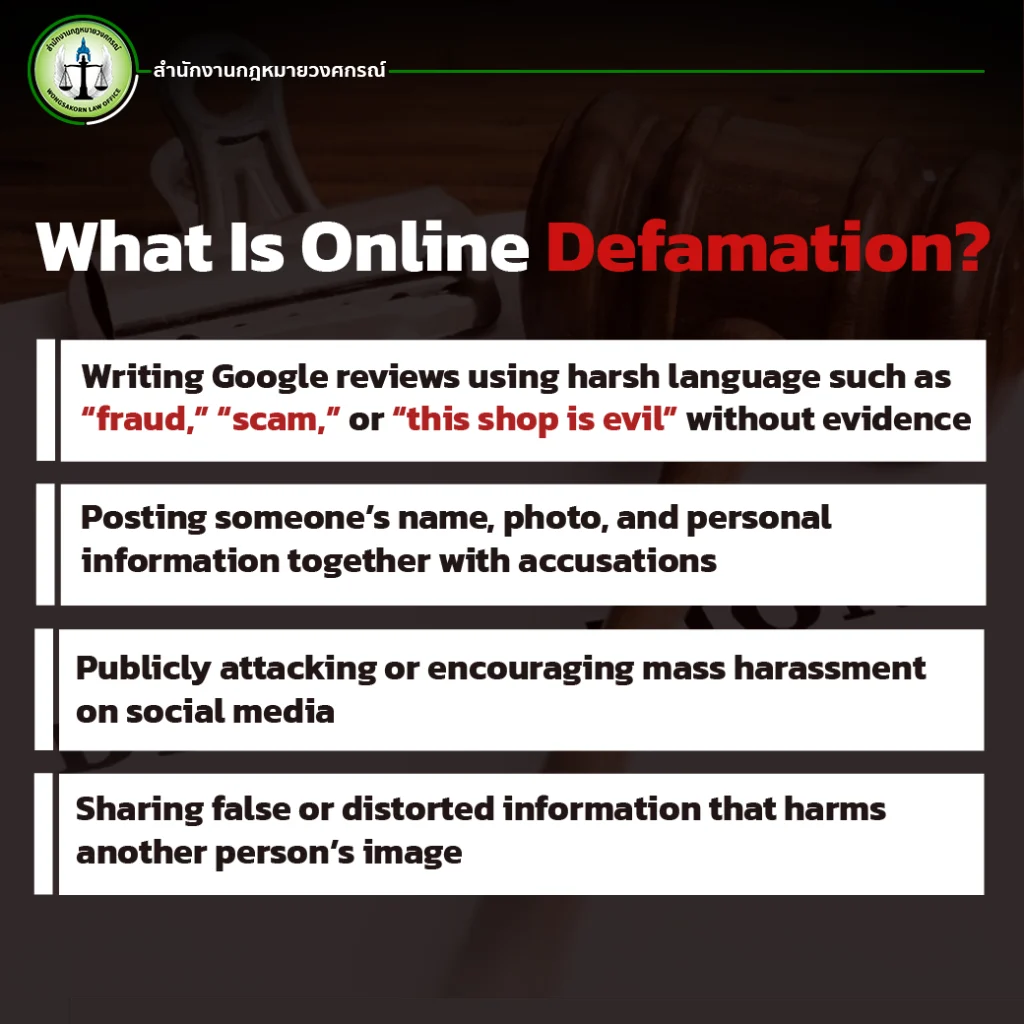
What Is Online Defamation?
Online defamation is the act of making false statements or publishing messages, images, videos, or other content through online platforms in a way that damages another person’s reputation, exposes them to contempt, or causes them to be hated by society. This applies to individuals, business owners, companies, shops, and organizations alike.
Common examples include:
Writing Google reviews using harsh language such as “fraud,” “scam,” or “this shop is evil” without evidence
Posting someone’s name, photo, and personal information together with accusations
Publicly attacking or encouraging mass harassment on social media
Sharing false or distorted information that harms another person’s image
Even if the poster claims it is “personal opinion,” if the message harms another person’s reputation, it can still be considered defamation.
When Does a Google Review Become Defamation?
Posting a business review is not illegal if it is an honest opinion based on real experience, such as slow service, poor food quality, or dissatisfaction with service. However, it becomes defamation when:
Harsh or insulting language is used without evidence
False or misleading information is provided
There is intent to damage reputation or harass
Others are encouraged to attack the business or individual
The line between “honest review” and “defamation” depends mainly on the intent and the content of the statement.
What Should You Do If You Are Defamed Online?
If you become a victim of online defamation, it is important not to react emotionally but to proceed systematically:
1. Collect Evidence Immediately
Such as:
Screenshots of the messages
URLs or links to the posts
Date, time, and account name of the poster
Profile photos or related information
This evidence is crucial for legal proceedings.
2. Consult a Lawyer
A lawyer can help determine:
Whether the content constitutes defamation
Whether to pursue a civil or criminal case
Whether to start with negotiation or file a police report
Having legal guidance from the beginning reduces procedural mistakes and risks.
3. Request Removal of the Post or Review
In many cases, it is possible to:
Report the content to platforms such as Google or Facebook
Send a legal notice or warning letter
Ask the poster to delete or correct the statement
Some disputes can be resolved without going to court.
Can the Offender Be Identified?
Many people believe that using fake accounts or aliases makes them untraceable. In reality, if the case involves defamation, legal procedures can be used to:
Request IP address information
Obtain user data from online platforms
Use investigators and legal authorities to identify the offender
Posting defamatory content online does not exempt anyone from legal responsibility.
Damage Caused by Online Defamation
The impact is not limited to emotions but includes:
Loss of reputation and credibility
Decrease in income or business revenue
Misunderstanding by society
Stress and psychological harm
Escalation of conflicts
In some cases, victims may file civil lawsuits demanding significant compensation.
Why Should You Consult a Lawyer When Defamed?
Consulting a lawyer provides many advantages:
Legal evaluation of the strength of the case
Guidance on lawful content removal
Drafting legal warning letters
Representing victims in legal proceedings
Systematic protection of rights and reputation
Lawyers do not only file lawsuits; they can also seek the most appropriate solution, such as negotiation, mediation, or legal action when necessary.
Defamation Is Not a Minor Issue in the Online Era
In the past, defamation occurred within limited circles. Today, a single post can reach thousands or even tens of thousands of people within minutes. The damage is therefore far more severe.
Both posters and victims should realize that:
Opinions must be expressed honestly and responsibly
Harsh language carries legal risks
Reputation is an asset that must be protected
Online Defamation Has Legal Solutions When the Law Is Used Properly
Whether you are defamed through Google reviews or attacked on social media, you do not have to endure the damage alone. The law provides options to:
Remove unlawful content
Identify the offender
Take legal action to seek justice
Consulting a lawyer from the beginning is the safest and most effective approach.
If you are facing online defamation, do not let a small issue become a major problem. Protecting your reputation means protecting your future in the digital world.
In recent years, Thailand has become one of the most popular destinations for foreign retirees who wish to reside long-term. This is due to its favorable climate, reasonable cost of living, and overall quality of life. Many foreigners therefore decide to invest their life savings in purchasing a house or land to serve as their residence in later years.
However, a major issue that many foreigners do not fully understand is that Thai law does not permit foreigners to directly own land or houses. Purchasing real estate without consulting a lawyer thus poses significant legal and financial risks. This article explains the commonly used arrangements, their advantages and disadvantages, and why consulting a lawyer before purchasing land or holding real estate in Thailand is critically important.
Why Foreigners Cannot Own Land in Thailand?
Under Thai law, foreigners are not permitted to hold ownership of land or houses directly, except in very limited and special circumstances, such as large-scale investments approved by the government, which are rare in practice.
Due to these restrictions, foreigners who wish to own a home in Thailand often use indirect methods, such as:
Having a Thai spouse or partner hold legal ownership of the land
Investing their own money to purchase or build a house, while the title deed is registered in the Thai spouse’s name
At first glance, this approach may seem simple and safe. However, from a legal perspective, it carries significant risks if there is no proper legal structure in place.
Usufruct as a Common Legal Solution for Foreigners
To protect their rights, many foreigners choose to register a lifetime usufruct (right of use) on the land title deed at the Land Department on the same day the ownership is registered.
A usufruct means that:
The foreigner has the right to live in, use, and benefit from the house and land for the rest of their life
Even though the land is legally owned by the Thai spouse, the foreigner cannot be evicted from the property
If the land is to be sold, consent from the usufruct holder is required first
As a result:
The Thai spouse obtains ownership of the land
The foreigner obtains the right to live on and use the property for life
The investment is not given away without legal protection
From one perspective, this method provides security for foreigners. However, it also creates legal and commercial consequences that must be carefully considered.
Disadvantages and Problems Arising from Registering a Usufruct
Although a usufruct protects the foreigner’s rights, it often creates practical problems, especially when family relationships change.
Common issues include:
If disputes or separation occur, the land becomes burdened with legal encumbrances
When the Thai spouse wishes to sell the land, prospective buyers will inspect the title deed and find a “lifetime usufruct” registered on it
Most buyers will be reluctant to purchase because they cannot immediately use or possess the property
The selling price may drop significantly, or the land may not be sellable at all
This is one of the key reasons why many foreigners choose to buy condominiums instead of houses or land. Thai law allows foreigners to directly own condominium units, subject to the legal quota specified by law.
Risks of Buying Land Without Consulting a Lawyer
Many foreigners decide to purchase a house or land based on trust in their spouse or close acquaintances, without seeking advice from legal professionals. The consequences may include:
A large financial investment without proper legal protection
Disputes arising when personal relationships change
Inability to sell or transfer the property
Risk of being considered as indirectly or unlawfully owning land through a nominee arrangement
Exposure to both civil and criminal legal liability
Real estate is a high-value asset. Even a small legal mistake can result in the loss of a lifetime’s savings.
Why You Should Consult a Lawyer Before Buying Land or Real Estate?
Analysis of ownership structures to ensure compliance with Thai law
Drafting legal agreements that protect the foreigner’s rights
Due diligence on title deeds and existing encumbrances
Prevention of future disputes in case of separation or sale
Advice on suitable alternatives, such as purchasing a condominium instead of land
A lawyer is not only someone who resolves problems after disputes arise, but also a professional who helps prevent risks from the very beginning.
Land Is Not Just Property, but Stability for Retired Foreigners
For retired foreigners, a house or land represents their final place of security and comfort in life. A single wrong decision can result in the loss of money, peace of mind, and long-term stability.
Understanding the law and planning correctly from the start is the key to ensuring that life in Thailand remains safe, secure, and sustainable.
Consult a Lawyer Before Buying Land in Thailand
If you or someone close to you is a foreigner planning to purchase a house or land in Thailand, do not make decisions based solely on trust or informal advice from others.
Wongsakorn Law Office is ready to provide legal consultation on real estate ownership for foreigners, including structuring legal rights, reviewing documents, and carefully preventing future legal problems in full compliance with Thai law.
Because buying land is not a small matter. It is an investment in your entire life.
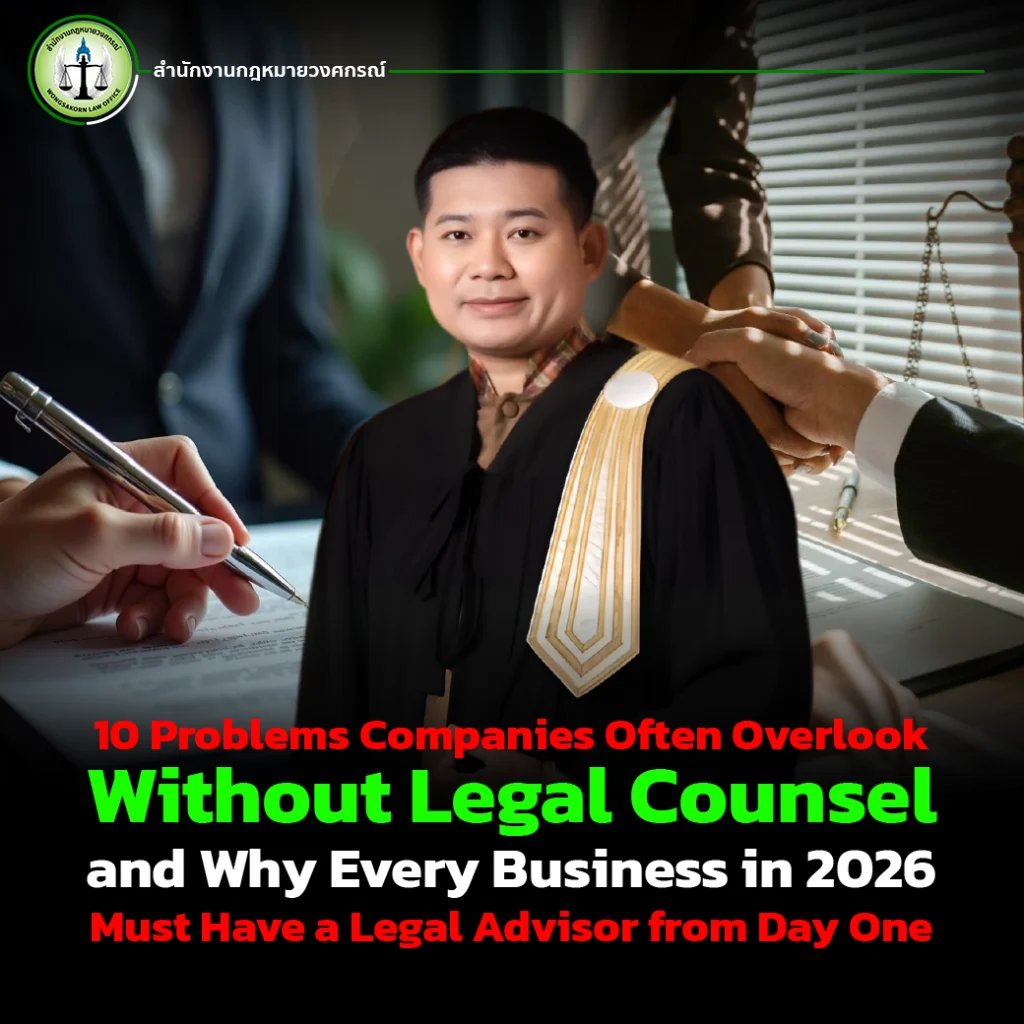
In the business world of 2026, where laws change rapidly covering labor law, personal data protection (PDPA), taxation, and commercial contracts many companies still choose to “wait until a problem arises before hiring a lawyer” instead of appointing a legal advisor from the beginning.
The result is unnecessary loss of money, time, and corporate credibility.This article highlights 10 major problems that many companies face due to the absence of a legal advisor and explains why having legal counsel from the start is a far more cost-effective way to prevent risks than fixing problems later.
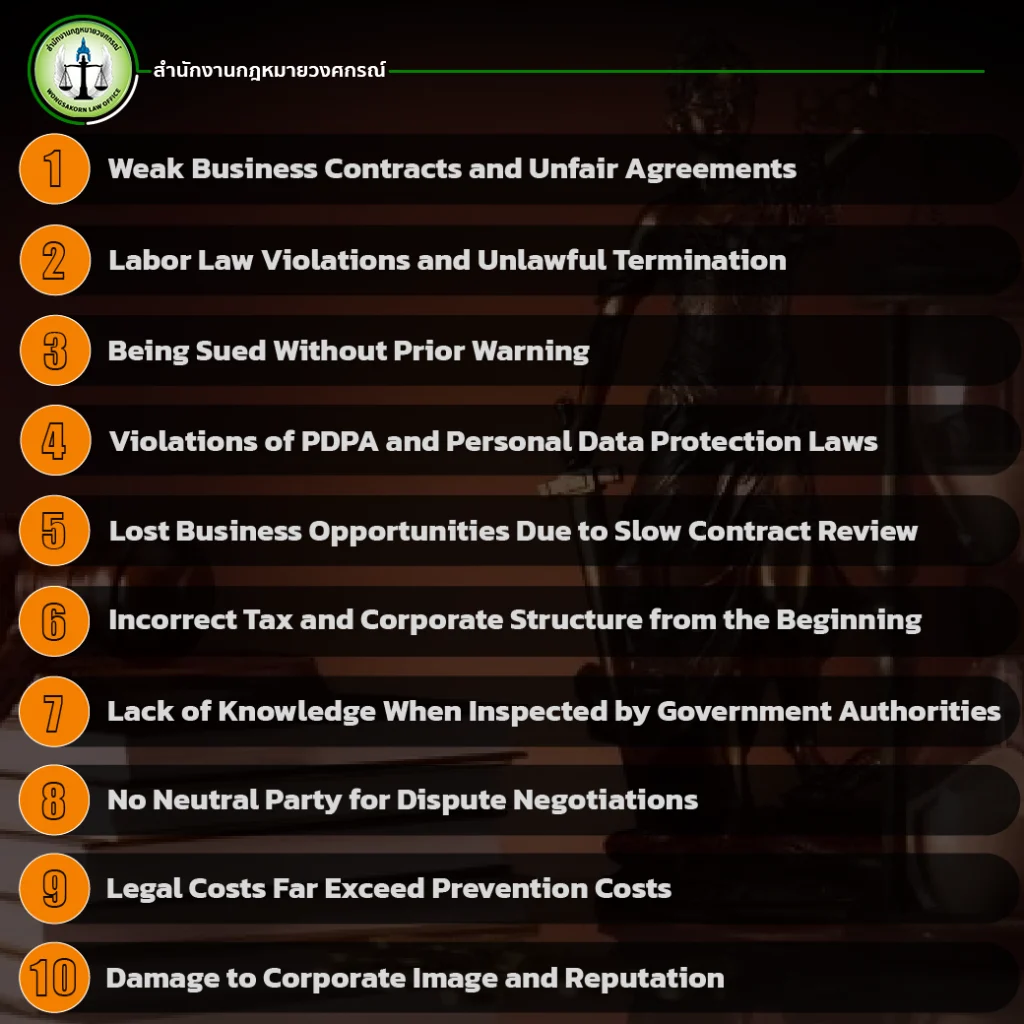
1. Weak Business Contracts and Unfair Agreements
Many companies use contract templates downloaded from the internet or copied from other businesses without review by a legal advisor. This often leads to loopholes such as:
No clauses protecting the company
Unclear penalties and liabilities
Exposure to lawsuits or unfair treatment
A proper contract must be tailored to each business, not based on generic templates.
2. Labor Law Violations and Unlawful Termination
Terminating employees without legal knowledge can result in costly lawsuits, such as:
Failure to pay severance
Unfair dismissal
Improper employment contracts
A legal advisor can design a compliant HR system from the start and reduce the risk of labor disputes that damage the company’s reputation.
3. Being Sued Without Prior Warning
Many companies only discover legal issues when court summons arrive too late to prepare preventive strategies. With a legal advisor, companies can:
Assess risks in advance
Identify potential legal disputes
Negotiate settlements before litigation
4. Violations of PDPA and Personal Data Protection Laws
In the digital era, collecting customer data without understanding data protection laws can lead to heavy fines and loss of customer trust.
A legal advisor can establish proper compliance policies, such as:
Privacy Policies
Consent Forms
Contracts with employees and business partners
5. Lost Business Opportunities Due to Slow Contract Review
Many business deals require fast decisions. Without legal support, companies may:
Sign unfavorable contracts
Accept unnecessary conditions
Assume excessive risks
A legal advisor enables companies to “sign with confidence.”
6. Incorrect Tax and Corporate Structure from the Beginning
Establishing a company without legal consultation can cause:
Poor shareholding structures
Shareholder disputes
Excessive tax burdens
A legal advisor helps design a corporate structure suitable for long-term growth.
7. Lack of Knowledge When Inspected by Government Authorities
When audited by tax authorities, labor offices, or regulators, companies without legal advisors often panic and respond incorrectly, creating self-incriminating evidence.
8. No Neutral Party for Dispute Negotiations
When executives negotiate disputes themselves, emotions may override legal reasoning, turning small issues into major conflicts.
A legal advisor acts as a “legal buffer,” representing the company with professionalism and objectivity.
9. Legal Costs Far Exceed Prevention Costs
Legal fees after a lawsuit can be several times higher than monthly legal advisory fees. Having legal counsel from the start is an investment in damage prevention.
10. Damage to Corporate Image and Reputation
Lawsuits, legal disputes, and regulatory issues directly affect customer and partner confidence.
Having a legal advisor helps build a professional and trustworthy corporate image.
Why Every Company Must Have a Legal Advisor in 2026?
The year 2026 is an era where:
Business competition is intense
Laws are more complex
Online risks are increasing
Customers demand credibility and transparency
A legal advisor is not merely someone who handles lawsuits, but a strategic partner who guides businesses safely through legal challenges.
Prevention Is Better Than Cure: Legal Counsel from Day One Is the Smart Choice
Many organizations believe, “We don’t need a legal advisor yet,” until real problems arise at a much higher cost than prevention.
Having a legal advisor from the beginning helps to:
Reduce risks
Save long-term costs
Increase confidence in decision-making
Strengthen corporate credibility
In 2026, where law is the foundation of sustainable business, companies with legal advisors always have an advantage over those who wait until problems occur.
If you need a legal advisor, click >> Contact Us <<
When a car accident occurs, most people immediately think of repair costs and loss of use compensation, such as rental car expenses during repairs or the inconvenience of being unable to use their vehicle. However, there is another important legal right that many car owners overlook: car depreciation compensation.
Car depreciation is a type of damage that can be claimed under the law, and in many cases, it can amount to hundreds of thousands of baht.
Car depreciation refers to the reduction in a vehicle’s market value after an accident. Even if the car is fully repaired and can be used normally, in the resale market, a “previously damaged car” is worth less than a car that has never been in an accident. No one wants to buy a car with an accident history at the same price as an undamaged one. This is why the law allows victims to claim car depreciation in addition to repair costs and loss of use compensation.
What Is Car Depreciation and Why Is It Important?
Car depreciation means the economic loss caused by the reduction in a vehicle’s value after an accident, even if the car has been repaired and restored to working condition. In practice, a car that has been involved in an accident is perceived as having higher risk, a damage history, and a greater chance of future problems.
For example, a new car worth 1,200,000 baht that has never been in an accident may be resold at a high price. But once it is involved in an accident and repaired, no matter how well it is fixed, its market value may drop to only 1,000,000 baht. The difference of 200,000 baht is the car depreciation, which can be claimed from the party at fault.
Common Problems Victims Face When Claiming Car Depreciation
In practice, claiming car depreciation is not easy. Many people are rejected by insurance companies or told that “it is not covered by the policy” or that “the law does not support such claims.” This causes victims to mistakenly believe that they have no right to claim depreciation compensation.
The main problems include:
Not knowing that car depreciation can be claimed
Not knowing how to calculate and prove the damage
Not understanding legal procedures
Lacking professional guidance to plan an effective legal strategy
As a result, many people accept only repair costs and loss of use compensation and unfortunately miss the opportunity to claim car depreciation.
To Receive a High Car Depreciation Claim, Legal Strategy Is Essential
Successfully claiming a significant amount of car depreciation does not depend on luck, it depends on the skills and legal techniques of a lawyer from the very beginning of the case. This includes:
1. Systematic collection of facts and evidence
2. Accurate assessment of the true value of damages
3. Proper legal planning and strategy
4. Choosing the most effective and time-efficient legal process
5. Avoiding unnecessary negotiations that waste time without results
In many cases, filing a lawsuit directly can be the most effective option, rather than repeatedly negotiating with insurance companies without reaching a clear conclusion.
Real Case Example – Claiming Car Depreciation Worth Hundreds of Thousands
In one case handled by Attorney Arm, the victim consulted a lawyer from the very beginning and explained the incident step by step in detail. The lawyer then gathered the information and prepared the case file systematically.
The key strategy in this case was not wasting time negotiating with the insurance company, but proceeding directly with legal action, as it was clear that negotiation would only delay justice.
The results were:
Car depreciation compensation of 100,000 baht
Loss of use compensation of approximately 99,000 baht
Repair time lasted 142 days
Notably, the car depreciation compensation was higher than the loss of use compensation. This clearly demonstrates that with proper legal strategy, victims can obtain fair and meaningful compensation.
After a Car Accident, Do Not Delay Consult a Lawyer Immediately
Many people wait too long before thinking about claiming car depreciation, which can result in lost evidence or weakened legal positions. Consulting a lawyer from the beginning helps to:
Ensure that your right to claim car depreciation is not overlooked
Develop a careful legal strategy
Increase the chances of receiving higher compensation
Reduce the risk of being taken advantage of by the opposing party or insurance company
No one wants an accident to happen. But once it does, it is crucial not to let a lack of legal knowledge cause you to lose your rightful compensation.
Car Depreciation Can Be Claimed Do Not Let the Opportunity Slip Away
After a car accident, victims are not limited to claiming only repair costs and loss of use compensation. They are also entitled to claim car depreciation, which represents the true financial loss caused by the reduction of the vehicle’s market value.
Whether you receive a high or low depreciation claim depends on your legal strategy and the expertise of your lawyer. If handled properly from the start, your chances of obtaining full and fair compensation increase significantly.
If you have been involved in a car accident, do not let your opportunity to claim car depreciation slip away.
Consulting a lawyer from the beginning is the key to protecting your rights.
Wongsakorn Law Office is ready to provide professional legal consultation and strategic guidance to ensure that you receive appropriate compensation both for loss of use and car depreciation fully and fairly.
Car accident? Do not wait and lose your opportunity.
In the digital era where social media communication is part of everyday life, problems involving leaked clips and leaked photos have become a serious threat to personal privacy. This is especially true when former partners or ill-intentioned individuals use private images or videos as tools to threaten or blackmail victims in order to demand money or force them to do things against their will.
Many victims choose to remain silent out of shame, fear of reputational damage, or uncertainty about whether the law can truly protect them. In reality, Thai law clearly provides legal protection for victims, and consulting a lawyer is the most important first step in putting an end to such harassment.
Leaked Clips and Blackmail Are Criminal Offenses Under the Law
Distributing, threatening to release, or using another person’s images or videos as leverage to demand benefits is not a private matter. It constitutes criminal offenses under several laws, including:
Extortion and coercion offenses
Criminal law violations
Computer-related crimes
Violations of personal privacy rights
Even if the images or videos were created with consent during a previous relationship, once they are used for threats or disclosed without consent, such actions immediately become illegal.
The Impact of Being Threatened with Leaked Clips
Victims of blackmail involving leaked clips or photos often suffer both psychological and social consequences, such as:
Stress and anxiety
Loss of self-confidence
Damage to reputation and credibility
Negative effects on education or employment
Fear of repeated disclosure
If the problem is allowed to continue, the offender may become more aggressive and continue the threats indefinitely without an end.
Why You Should Consult a Lawyer When Being Blackmailed?
Many people mistakenly believe that seeing a lawyer or reporting the matter to the police will only make the situation worse. In truth, consulting a lawyer from the beginning is the safest and most effective solution.
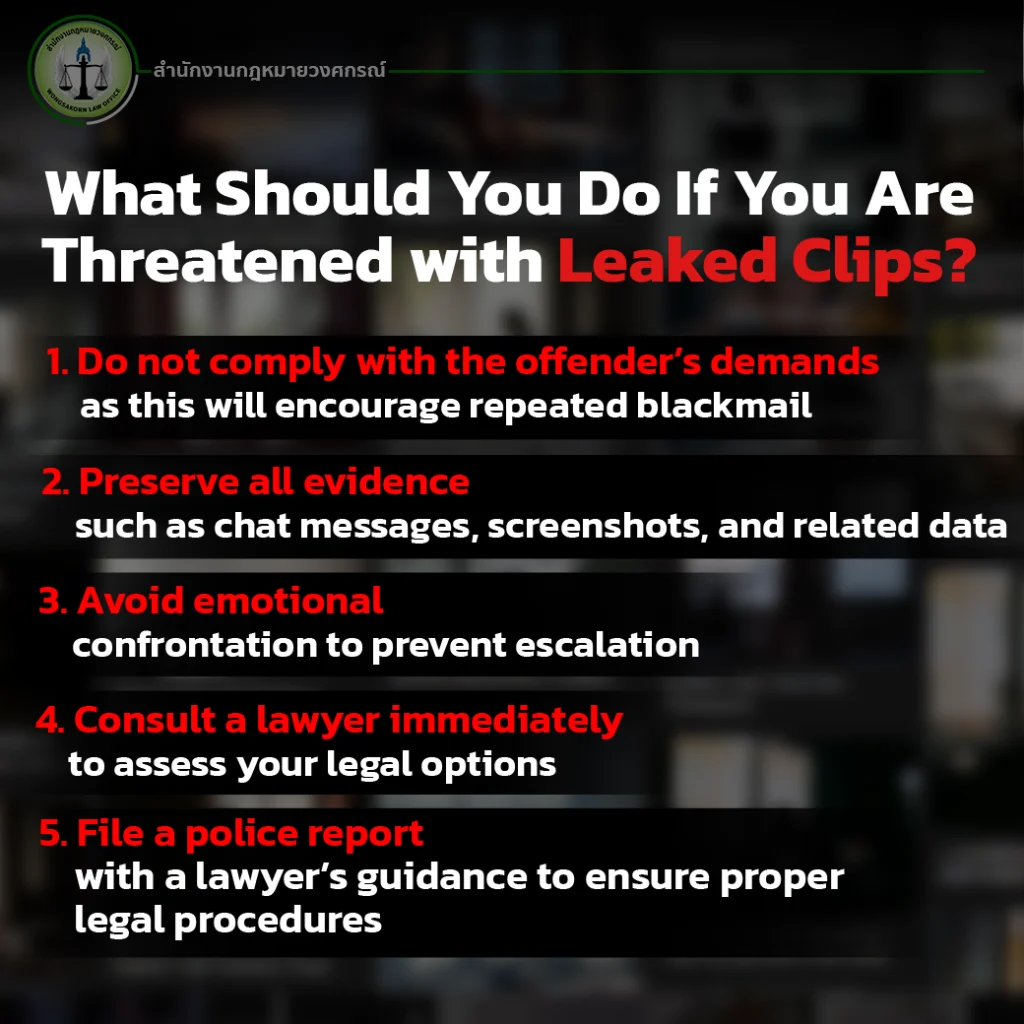
A lawyer can assist victims in many ways, including:
1. Analyzing which legal offenses the perpetrator has committed
2. Advising on how to properly collect and preserve evidence according to the law
3. Planning legal actions with the victim’s safety as a priority
4. Coordinating with relevant authorities to reduce or prevent further distribution
5. Protecting the victim’s rights and interests in a systematic manner
Most importantly, lawyers are bound by confidentiality. Victims can seek legal advice without worrying that their personal information will be disclosed.
Taking organized and timely action from the beginning can stop the harassment and increase the chances of bringing the offender to justice.
Leaked Clips Are Not the End, but the Beginning of Protecting Your Rights
Many victims believe that once a clip is leaked, their lives can never return to normal. In reality, with early guidance from legal professionals, this problem can be controlled and resolved.
The law exists to protect the innocent, not to protect those who harass others. Seeking help is not a sign of weakness, but a sign of strength in standing up for and protecting your own rights.
Being threatened with leaked clips or photos is a problem that anyone may face in the digital age. However, fear should not force you to live under constant harassment with no way out.
Leaked clips and leaked photos can be stopped by law.
All it takes is the courage to consult a lawyer and take proper legal action.
Having a legal professional by your side will help you to:
Understand your legal rights
Stop threats and further distribution
Protect your reputation and dignity
Bring offenders into the justice system
If you or someone close to you is facing problems with leaked clips, threats, or blackmail, do not let fear destroy your life.
Wongsakorn Law Office is ready to provide confidential legal consultation and case management. We are prepared to guide you through safe, careful, and lawful legal procedures to stop harassment and fully protect your rights.
In recent years, Thailand has remained one of the most attractive destinations for real estate investment for both Thai and foreign investors. This is due to various factors such as economic stability, tourism potential, quality of life, and relatively reasonable investment costs compared to many countries in the region.
However, although real estate in Thailand is highly attractive, for foreigners who wish to purchase property either for investment purposes or for personal residence, having a correct understanding of Thai law and consulting a lawyer before making a purchase decision is extremely important. Even a small legal mistake can turn an investment into long-term legal risk.
Why Is Real Estate in Thailand Attractive for Investment?
Thailand continues to draw strong interest from both domestic and international investors in the real estate sector due to several factors that support long-term asset value growth. These include its strategic geographic location, tourism potential, government infrastructure development, and competitive investment costs compared to developed countries in Asia.
From an economic and business perspective, real estate in Thailand is not only a form of housing but also an investment asset capable of generating returns through both capital appreciation and rental income, particularly in major cities and key tourist destinations.
The main factors that make real estate in Thailand attractive to investors can be summarized as follows:
1. Competitive Prices Compared to Other Countries
Real estate prices in Thailand, especially condominiums in Bangkok and major tourist cities such as Phuket, Chiang Mai, and Pattaya, remain significantly lower than those in many large Asian cities such as Singapore, Hong Kong, or Tokyo. This creates strong opportunities for long-term returns on investment.
2. Tourism and Rental Potential
Thailand is one of the world’s leading tourist destinations. As a result, condominiums and vacation homes are easy to rent out, both for short-term and long-term stays.
3. Infrastructure Development and Urban Growth
New mass transit systems, airports, and infrastructure projects continue to increase property values in many areas across the country.
4. Stability of the Real Estate Market
Despite economic fluctuations, real estate remains a relatively stable asset and suitable for long-term ownership.
Can Foreigners Purchase Real Estate in Thailand?
Under Thai law, foreigners are not permitted to own land directly. However, they may purchase property in forms permitted by law, such as:
Purchasing condominium units up to 49% of the total saleable area of the building
Leasing land or houses under long-term lease agreements (Leasehold) for up to 30 years, with renewal options subject to contract terms
Purchasing through a company registered in Thailand (with caution regarding nominee structures)
These legal limitations are critical issues that foreigners must clearly understand before investing in real estate in Thailand.
What Should Foreigners Know Before Buying Property in Thailand?
1. Ownership Structure
Foreign buyers must verify whether the property can be legally owned and whether it is Freehold or Leasehold, and ensure that the ownership structure complies with Thai law.
2. Source of Investment Funds
Thai law requires that funds used to purchase condominiums be transferred from abroad in foreign currency and supported by bank documentation (Foreign Exchange Transaction Form).
3. Land and Building Title Documents
Buyers must verify land title deeds, construction permits, subdivision approvals, and the legal status of the project.
4. Legal Encumbrances
Such as mortgages, leases, seizures, or unresolved legal disputes.
5. Taxes and Fees
Including transfer fees, withholding tax, stamp duty, or specific business tax.
Why Is Consulting a Lawyer Before Buying Real Estate Important?
Purchasing real estate is not merely a matter of price negotiation and ownership transfer; it is a complex legal process involving many legal details. If foreigners do not understand the Thai legal system, they may face risks such as:
Purchasing property that cannot be legally registered
Signing unfair or invalid contracts
Transferring funds without adequate legal protection
Being deceived or unknowingly engaging in nominee ownership structures
A lawyer can assist in critical areas such as:
1. Conducting legal due diligence on the property
2. Drafting and reviewing sale and purchase agreements in compliance with Thai law
3. Advising on lawful ownership structures for foreign buyers
4. Assessing legal risks and future legal consequences
5. Handling ownership transfer procedures and tax matters comprehensively
Why Are Lawyers Essential to Real Estate Investment in Thailand?
Real estate investment is a long-term investment involving significant capital. Making decisions without legal consultation may lead to serious consequences that are difficult to resolve later, such as revocation of ownership rights or future legal disputes.
A lawyer’s role extends beyond document review. Lawyers provide strategic legal planning to ensure that property purchases are lawful, secure, and aligned with the buyer’s objectives, whether for personal residence or investment purposes.
Lawyers = The Key to Secure Real Estate Investment in Thailand for Foreigners
Real estate in Thailand remains a highly promising investment opportunity for both Thai and foreign investors. However, for foreigners, understanding Thai law and proper legal procedures is the foundation of successful investment.
Consulting a lawyer before purchasing real estate is not an unnecessary expense; it is a long-term investment in legal security. It reduces risks, prevents costly mistakes, and builds confidence that property ownership in Thailand will be lawful and stable.
Because real estate is not merely property it is the foundation of life and investment. Having a lawyer who understands both Thai law and the specific circumstances of foreign buyers is the key to success in Thailand’s real estate market.
In 2026, the business world no longer competes solely in terms of products and services. Competition has inevitably expanded into the areas of law and legal risk management. More and more organizations, companies, and startups are realizing that having a legal advisor is not a luxury, but an essential tool for preventing problems and ensuring long-term business stability.
Modern laws have become increasingly complex, including business law, labor law, tax law, personal data protection law (PDPA), and regulations related to online transactions. Without sufficient legal knowledge, entrepreneurs may unknowingly expose their businesses to serious risks. A legal advisor therefore acts as an “early warning system” for the organization.
Businesses in 2026 Face Greater Legal Risks Than Ever Before
In the past, many companies believed that legal problems only arose when lawsuits occurred. In reality, legal issues often begin with small matters such as:
Unclear or poorly drafted contracts
Employment practices that violate labor laws
Improper use of customer data under PDPA
Advertising that may violate consumer protection laws
These issues can escalate into serious disputes that cause financial loss and reputational damage. Having a legal advisor from the beginning allows an organization to review each step of its business operations and reduce risks before they become major problems.
A Legal Advisor Helps Build the Proper Business Structure
For new companies and startups, establishing the correct legal and business structure from the outset is crucial, including:
Company registration
Shareholding structure
Relationships among co-founders
Profit-sharing arrangements
Contracts with business partners
Without a legal advisor, businesses may rely on generic contract templates from the internet, which may not suit their actual business model and could create loopholes for future disputes.
A legal advisor can design contracts and legal structures tailored specifically to each business, rather than using standard templates that may not cover all risks.
Reducing Long-Term Litigation Costs
Many organizations mistakenly believe that hiring a legal advisor is an unnecessary expense. In reality, not having one often leads to much higher costs.
Monthly or annual legal advisory fees are usually far lower than litigation expenses. Once a lawsuit occurs, a company may suffer:
Attorney’s fees
Loss of time
Loss of business opportunities
Damage to corporate reputation
A legal advisor is therefore not a cost, but an investment in preventing future losses.
In 2026, businesses are inseparable from technology, such as:
E-commerce
Online platforms
AI and personal data
Digital marketing
Smart contracts
These activities involve specific legal risks, including personal data breaches, copyright infringement, and violations of consumer protection laws. Legal advisors must understand both the law and modern business models in order to provide accurate and practical guidance.
Enhancing Corporate Credibility
Having an in-house or dedicated legal advisor enhances an organization’s credibility in the eyes of:
Investors
Business partners
Customers
Government authorities
When an organization operates in compliance with the law, maintains clear contracts, and manages legal risks effectively, partners are more willing to collaborate and investors are more confident in providing funding.
A Legal Advisor as Support in Urgent Situations
When problems arise such as being sued, audited, requested to submit documents, or facing disputes with partners, organizations without legal advisors may make critical mistakes due to lack of legal knowledge, such as providing unnecessary information or signing unfavorable documents.
With a legal advisor, the organization can seek immediate guidance, plan an appropriate response, and minimize damage from emergency situations.
In 2026, Legal Advisors Are Strategic Business Partners
The role of legal advisors today goes beyond dispute resolution. It also includes strategic business planning, such as:
International expansion
Mergers and acquisitions
Investment planning
Long-term contracts
Risk management
A good legal advisor enables businesses to grow lawfully and sustainably.
Legal Advisors as a Business Advantage in 2026
In 2026, businesses face more legal complexity than ever before. Organizations, companies, and startups that wish to grow sustainably must include legal advisors as part of their management team, rather than waiting for problems to arise before seeking legal help.
Legal advisors help prevent risks, structure businesses properly, reduce litigation costs, and enhance organizational credibility.
In the modern business world:
“Legal knowledge is a business advantage.” and “A legal advisor is the long-term shield of your business.”
If your organization, company, or startup seeks stable growth in 2026, having a legal advisor from today is the first step toward future business security.
In an era where anyone can enter the world of investment more easily, whether by starting a personal business, expanding an existing enterprise, or investing in real estate, many people tend to focus primarily on “capital.” The common belief is that having sufficient funds alone is enough to generate returns and achieve success. In reality, however, capital is only one essential component. Without a proper legal structure in place from the beginning, the risks involved may be far greater than expected.
For new business owners and first-time investors, having a legal advisor from the very first step of investment is not a luxury, but a crucial foundation for long-term business and investment stability. This article explains why legal advisors play a vital role for new investors and compares the advantages and disadvantages of investing with and without legal counsel.
Hidden Risks in Investments for New Business Owners
Every form of investment carries inherent risks, especially for new investors who lack experience in business and legal matters. Common risks include:
Entering into contracts with unclear or unfavorable terms
Investing without understanding the legal structure
Holding assets or shares without clear legal evidence
Joint ventures without written agreements
Future disputes with partners, sellers, or contractors
These issues may not be apparent at the initial stage, but once the business grows or conflicts arise, the financial and time-related losses may be difficult to resolve.
The Role of a Legal Advisor in Investment
A legal advisor’s role extends far beyond litigation. Their involvement is crucial even before an investment begins, such as:
Analyzing legal risks of investment projects
Reviewing and drafting investment contracts
Structuring shareholding or joint ventures
Providing legal advice on real estate investments
Preventing potential future disputes
Having a lawyer from the start is like having an expert who can identify risks that new investors may overlook.
Before Investing: Why Is a Legal Advisor a Key Factor?
Many first-time investors believe that legal advisors are only necessary when disputes or lawsuits arise. In fact, whether or not a legal advisor is involved from the beginning can significantly influence the direction and outcome of an investment. Every investment involves contracts, agreements, and legal obligations that may conceal hidden risks.
Investing with legal guidance is fundamentally different from relying solely on personal understanding or experience. The following sections clearly outline the advantages of having a legal advisor and the disadvantages of investing without one, enabling investors to make informed decisions before stepping into the investment world.
Advantages of Having a Legal Advisor for New Investors
1.Reducing Legal Risks from the Start Lawyers review contracts and conditions to ensure fairness and prevent legal disadvantages.
2.Systematic Investment Structuring Whether establishing a company, holding shares, or investing in real estate, legal advisors can recommend structures aligned with investment goals.
3.Preventing Future Disputes Clear agreements from the outset reduce the likelihood of litigation and conflicts.
4.Long-Term Cost Savings Legal consultation costs are far lower than future litigation or corrective expenses.
5.Greater Confidence in Investment Decisions Investors can make informed decisions knowing legal professionals are safeguarding their interests.
Disadvantages of Investing Without a Legal Advisor
On the other hand, investing without legal counsel may lead to:
Signing unfair or disadvantageous contracts
Being unaware of hidden legal obligations
Being taken advantage of by more experienced parties
Costly and time-consuming disputes
Business disruption due to legal issues
Many new investors have suffered significant financial losses simply by neglecting legal considerations from the outset.
Why Are Legal Advisors Especially Important in Real Estate Investment?
Real estate investment such as purchasing land, condominiums, or property development often involves high-value transactions and extensive legal documentation. Legal advisors help verify ownership rights, encumbrances, contracts, and conditions to prevent risks such as:
Purchasing property with mortgages or disputes
Incomplete transfer of ownership
Unintentional loss of property rights
Money Alone Is Not Enough for Long-Term Investment Growth
For new business owners and investors, long-term investment success depends not only on capital but also on careful planning especially legal planning. Having a legal advisor from the first step creates a strong protective shield against risks and supports sustainable growth.If you aspire to grow as a successful business owner or investor, do not overlook the role of a legal advisor.
Investment, Tourism, and Legal Solutions When Disputes Arise
In 2025, Thailand will continue to be one of the most popular destinations for Chinese nationals, whether for tourism, business investment, or long-term residence. With its attractive tourist destinations, rich cultural diversity, affordable cost of living, and promising economic opportunities, Thailand remains highly appealing. However, in practice, many Chinese nationals encounter various challenges arising from differences in language, legal systems, cultural norms, and administrative procedures in Thailand.
This article outlines the common problems faced by Chinese nationals when traveling to or investing in Thailand in 2025, covering tourism-related issues, business and investment challenges, and legal risks. It also provides guidance on prevention and proper solutions, concluding with recommendations for consulting lawyers who specialize in legal cases involving Chinese nationals in Thailand through Wongsakorn Law Office.
One of the most common challenges faced by Chinese nationals in Thailand is language barriers. While English or Chinese may be used in major cities, Thai remains the primary language in rural areas, government offices, and official administrative procedures.
Unclear communication may result in:
Misinterpretation of legal provisions
Signing contracts or legal obligations without fully understanding the content
Inability to communicate effectively with authorities such as police officers, hospitals, or banks
Being placed at a disadvantage during negotiations or disputes
Due to significant differences between Thai law and the Chinese legal system, as well as differences in enforcement practices, Chinese nationals often face legal challenges in the following areas:
Traffic Regulations and Driving Licenses Many are unaware that an international driving permit or a Thai driving license is required. Failure to present proper documentation may result in fines or vehicle seizure.
Copyright and Intellectual Property Infringement Selling counterfeit branded goods or importing infringing products may lead to both criminal and civil liability.
Labor Law Issues Chinese investors who employ workers may encounter disputes due to a lack of understanding of Thai labor laws, including working hours, employee benefits, and employment contracts.
Thailand attracts many foreign investors, but Chinese investors often face business-related obstacles, including:
Company Registration There are legal restrictions on foreign shareholding ratios and foreign business regulations that may be misunderstood or improperly applied.
Business Contracts Signing contracts drafted in Thai without proper legal understanding may lead to unfair terms or unfavorable legal obligations.
Taxation and Financial Compliance Lack of understanding of VAT, corporate income tax, or Bank of Thailand regulations may result in violations, penalties, or legal accusations.
Differences in culture and working styles may also create difficulties, such as:
Different corporate management systems
Misunderstandings during negotiations
Differing expectations regarding service quality, standards, or timelines
Although these issues may not be purely legal, they can significantly affect business operations and long-term success.
When facing criminal accusations or legal disputes whether criminal, civil, or labor-related many Chinese nationals find themselves in difficult situations due to:
Lack of Understanding of the Thai Legal System Thailand’s judicial process differs from China’s, and misunderstanding procedural requirements may result in legal disadvantages.
Language Barriers Without interpreters or lawyers fluent in Chinese and Thai law, critical information may be misunderstood or overlooked.
Arrest and Detention Risks If an arrest warrant exists or a criminal complaint has been filed, arrest in Thailand may significantly impact bail proceedings and long-term legal outcomes.
Legal Solutions: Consulting Lawyers Specialized in Chinese-Related Cases
When legal issues escalate into disputes or litigation in Thailand, Chinese nationals need not worry. Specialized legal services are available to support Chinese investors and tourists, including:
Pre-Entry Legal Consultation Advisory services before traveling to or investing in Thailand to minimize legal risks.
Legal Status Verification Such as checking whether an arrest warrant exists, without the need to travel to Thailand.
Legal Representation in Thailand Including statements to authorities, filing petitions, initiating lawsuits, and court representation through legal counsel.
Document Translation and Legal Representation Lawyers experienced in handling cases involving Chinese nationals can provide accurate translations and clear legal explanations.
Thailand remains an attractive destination for Chinese nationals in 2025. However, living, investing, or traveling in Thailand inevitably involves legal risks and challenges that differ from those in China. Verifying legal status, understanding local laws, and engaging experienced legal counsel can help Chinese nationals navigate these challenges with confidence.
If you are a Chinese national facing legal, business, or investment-related issues in Thailand, you may consult lawyers specializing in Chinese-related legal cases at Wongsakorn Law Office, ensuring that your stay, business operations, and activities in Thailand proceed smoothly and lawfully.