


If you are a company owner or a shareholder of a private limited company, take a moment to ask yourself: “Have you ever seen your company’s share certificate?”
Many people may answer no, while others may not even realize that after a company is incorporated, it is legally required to maintain share certificates and a register of shareholders.
Based on the experience of Lawyer Arm, Supasit Siri of Wongsakorn Law Firm, a considerable number of companies have been operating for many years without issuing share certificates to their shareholders and without properly maintaining a register of shareholders.
This issue may appear insignificant while the business is operating normally. However, when disputes arise, shares are transferred, shareholders change, or government authorities request the company’s corporate records for inspection, the company may encounter unexpected legal complications.
What Is a Share Certificate?
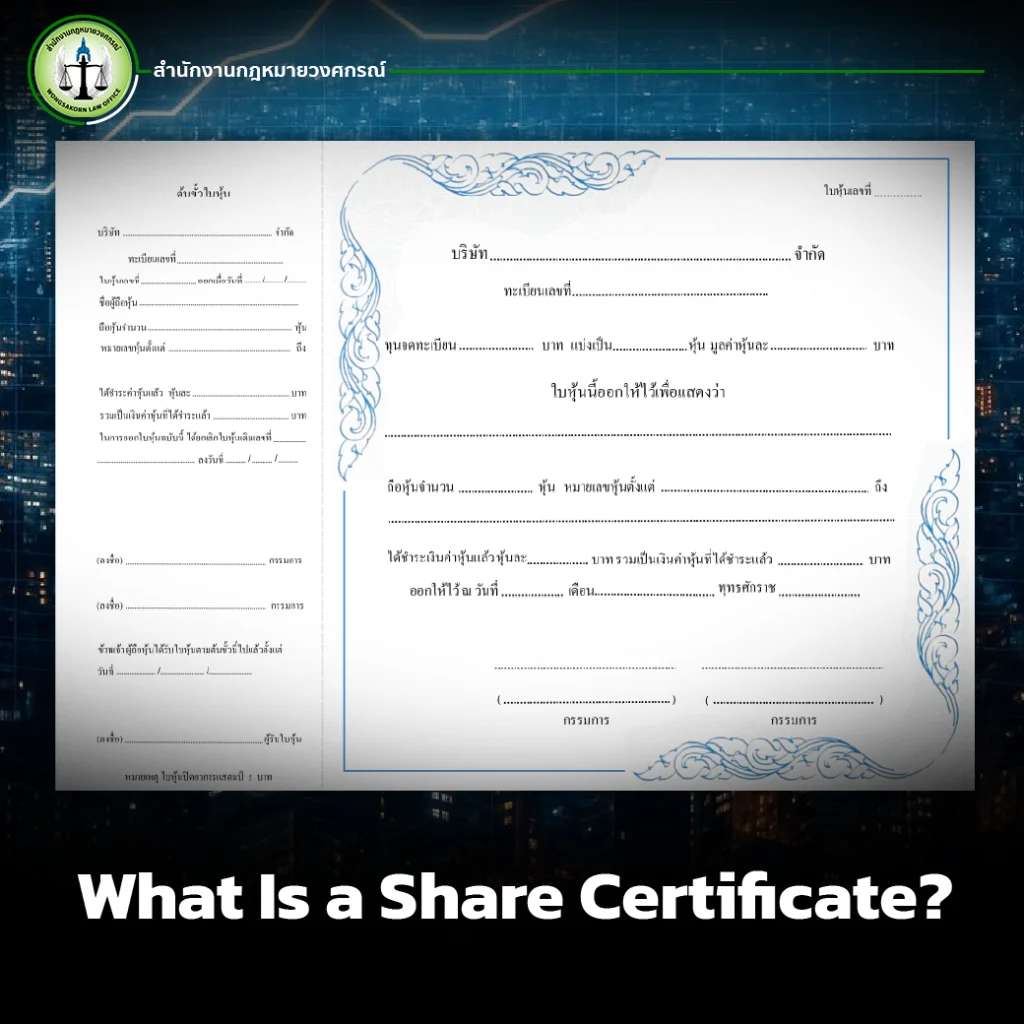
A share certificate is an important document issued by a company to a shareholder as evidence of ownership of shares in the company.
Simply put, when a person acquires shares in a company, the company has a duty to issue a share certificate confirming that such person is a shareholder holding the specified number of shares.
Important information commonly contained in a share certificate includes:
- Company name
- Juristic person registration number
- Shareholder’s name
- Number of shares
- Share value
- Share certificate number
- Signature of the authorized director
A share certificate is therefore an important document that serves as direct evidence of a shareholder’s ownership rights in the company.
The Register of Shareholders Is Just as Important as a Share Certificate
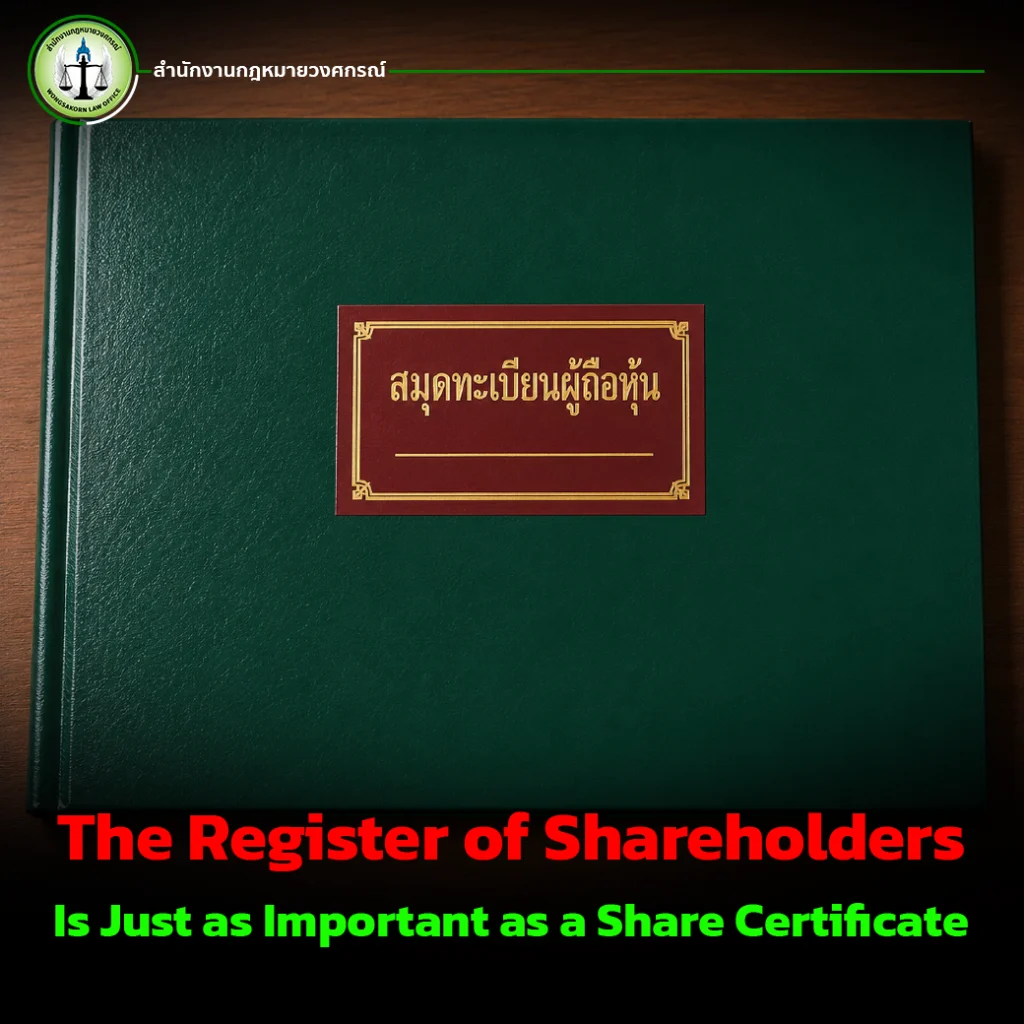
In addition to share certificates, the law also requires a company to maintain a Register of Shareholders.
A Register of Shareholders is a document used to record the details of all shareholders in the company, including the number of shares held by each shareholder and any history of changes in share ownership.
This document is highly important because it serves as the company’s internal record for verifying the status of shareholders at any given time.
In practice, if a company does not maintain a Register of Shareholders, or if the register is not properly prepared and maintained, it may adversely affect the company’s management and the ability to establish shareholders’ rights in the future.
Why Do Many Companies Not Have Share Certificates?
One common issue is that business owners assume that once they receive the company registration documents or the company affidavit from the Department of Business Development, the company incorporation process is fully completed.
In reality, however, company registration and the preparation of the company’s internal corporate documents are two separate matters.
In many cases, when business owners consult company incorporation service providers or accounting firms, they are often told:
“No one ever uses share certificates.”
or
“The shareholder list (Bor.Or.Jor. 5) is sufficient.”
Such misunderstandings may cause company owners to have an incorrect understanding of the purpose and legal significance of each type of corporate document.
Can Bor.Or.Jor. 5 Be Used in Place of a Share Certificate?
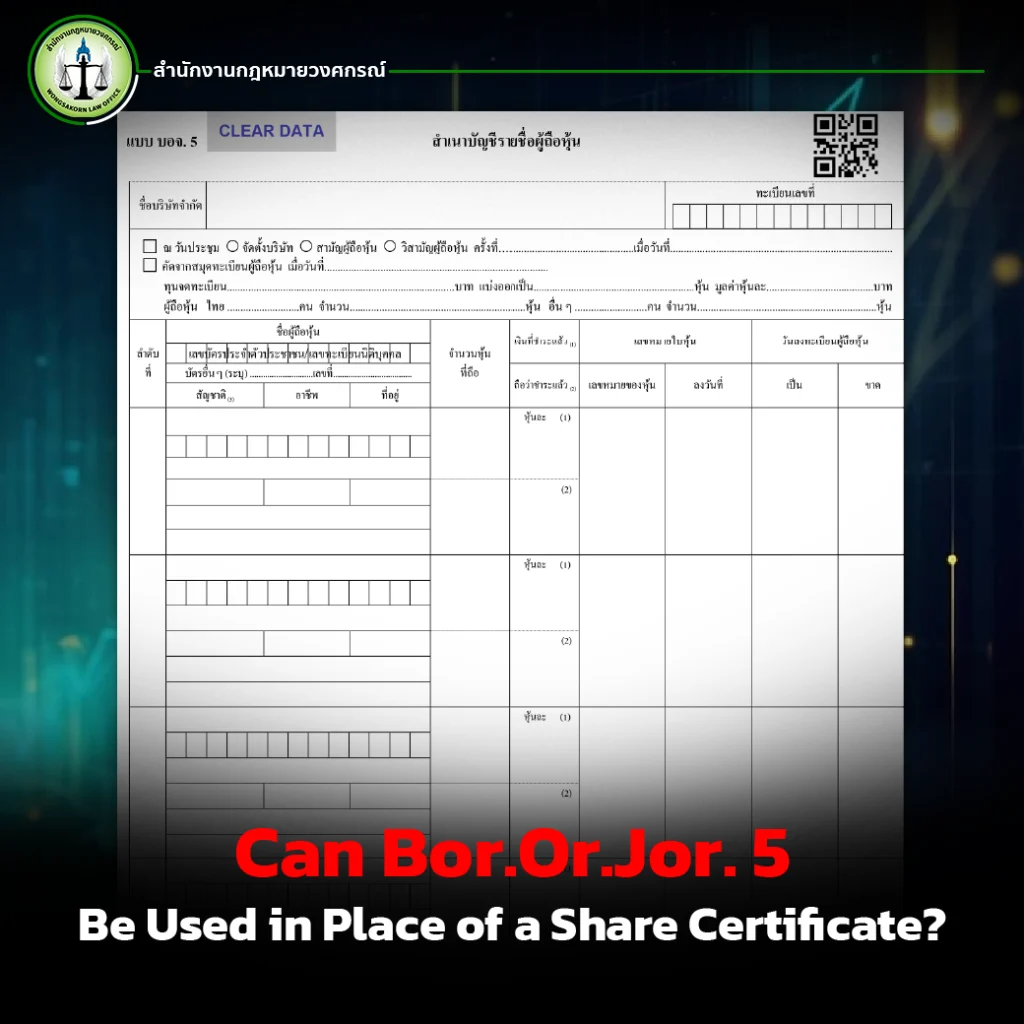
The answer is no.
Form Bor.Or.Jor. 5 is merely a document relating to shareholder information that is filed with the Department of Business Development for the purpose of notifying the relevant government authority of such information.
However, Bor.Or.Jor. 5 is not a share certificate, nor is it an original document that directly certifies ownership rights in shares.
Therefore, if a dispute arises concerning share ownership, or if shares are transferred between shareholders, having only Form Bor.Or.Jor. 5 may not be sufficient to establish and prove the rights of each party.
What Risks Arise When Shares Are Sold Without a Share Certificate?

Under the law, the transfer of shares in a private limited company is not completed merely by entering into a share purchase agreement.
As a general rule, the transferor should deliver the share certificate to the transferee, and the company should properly record the change of share ownership in the Register of Shareholders.
If no share certificate has been issued from the outset, proving who the true owner of the shares is may become a matter of dispute in the future.
This is particularly problematic in cases involving disputes among shareholders, business partners, or the heirs of a shareholder.
These Documents Become Critical the Moment a Dispute or Legal Issue Arises
Many companies pay little attention to share certificates or the Register of Shareholders until a legal issue arises.
Examples include:
- Shareholder disputes
- Share transfers or share sale transactions
- Changes in directors
- Government inspections or regulatory reviews
- Civil or criminal proceedings
When such situations occur, company owners often begin searching for the corporate documents that should have been prepared from the very first day of the company’s incorporation. However, in some cases, they discover that these documents were never prepared at all.
Should You Have a Legal Advisor Before Incorporating a Company?
Based on the experience of Wongsakorn Law Firm, company incorporation is not merely a matter of completing the registration process.
It also requires proper legal structuring and the preparation of all necessary internal corporate documents in accordance with the law.
Having a lawyer as a legal advisor from the outset can help determine whether:
- Share certificates have been properly issued;
- A Register of Shareholders has been properly prepared and maintained;
- The company’s internal corporate documents comply with legal requirements; and
- Future share transfers can be carried out safely and effectively.
These matters may appear to be minor details today, but they can significantly reduce the risk of disputes and prevent substantial business losses in the future.
Wongsakorn Law Firm Is Ready to Provide Corporate Legal Consultation
If you are in the process of incorporating a company, reviewing shareholder documents, or have questions regarding share certificates, the Register of Shareholders, or share transfers in a private limited company, Wongsakorn Law Firm is ready to provide comprehensive legal consultation and corporate document review services. Click >> Contact Us <<
Because having the proper documents in place from the very first day is always better than attempting to resolve legal issues after a dispute arises. Proper legal documentation also helps ensure that a business can operate smoothly and securely in compliance with applicable laws.