Thailand Amid U.S.-China Tensions: Legal Impacts and Perspectives

In recent years, tensions between the United States and China have intensified, stemming from a wide range of issues—from trade wars and technological rivalry to geopolitical disputes in the Indo-Pacific region. These conflicts are not confined to the two superpowers alone but have reverberated across the globe, especially in Southeast Asia, where countries face the challenge of maintaining a delicate balance between the interests of both sides.

As a developing country with strong economic, diplomatic, and security ties to both the United States and China, Thailand finds itself inevitably affected by the strategic confrontation between these two powers. The resulting changes have impacted not only the domestic economy but also extended to dimensions such as foreign policy, law, national security, and long-term development structures.

🏦 Economic Impacts: Trade and Investment

Thailand is a highly trade-dependent country, with the value of international trade accounting for over 80% of its Gross Domestic Product (GDP). This highlights the critical role that exports and imports play in the Thai economy.

One of the key maritime routes for Thailand’s international trade is the South China Sea, a major shipping corridor connecting Thailand to global markets—particularly in Northeast Asia (including China, Japan, South Korea, and Taiwan), as well as to the United States and Europe.

However, China’s increasingly assertive actions in the South China Sea—such as the construction of artificial islands, installation of military equipment, and claims of sovereignty over disputed areas—have raised international concerns, especially regarding the principle of freedom of navigation, which is fundamental to global trade.

Potential impacts on Thailand include:

  • Higher logistics costs: If maritime routes become unsafe or are dominated by China, shipping companies may be forced to reroute through longer, more expensive paths.
  • Investment uncertainty: Foreign investors, particularly from the U.S. and its Western allies, may delay or reconsider investment in Thailand if the country is perceived as being too close to geopolitical flashpoints.
  • Indirect economic pressure: Thailand faces the complex task of maintaining good relations with both China and the United States. Economic pressures may arise, for instance, when Thailand must choose between competing technologies or exclusive trade arrangements aligned with one side or the other.

As a result, the U.S.-China tensions not only directly affect Thailand’s trade routes but also influence the broader investment climate and long-term economic trajectory of the country.

🤝Geopolitical Impacts: Security and International Relations

Thailand occupies a strategic position in Southeast Asia and maintains deep ties with both China and the United States across diplomacy, economics, and defense. China is Thailand’s largest trading partner, while the U.S. remains a key military ally, exemplified by longstanding joint exercises such as “Cobra Gold.”

However, China’s expanding strategic activities in the region—including in the Gulf of Thailand—have raised concerns over regional stability. Some notable large-scale projects proposed or speculated include:

  • The Funan Techo Canal (a conceptual project similar to the Thai Canal), which, if realized, would link the Andaman Sea to the Gulf of Thailand. This would significantly alter maritime logistics and potentially give strategic control over a major regional shipping route.
  • Darasakor Airport, which has raised suspicions that it could be part of China’s broader strategy to expand its military reach. There are concerns that such infrastructure projects could be repurposed for military use in the future.
China’s growing footprint in Thailand and the broader region has prompted the United States to consider countermeasures. These may include deepening security cooperation with ASEAN allies or even the potential deployment of military assets in strategic locations within or near Thailand—such as areas close to the Strait of Malacca or the southern Gulf of Thailand—should tensions escalate.

Consequences for Thailand may include:

  • A precarious balancing act, where Thailand must manage its relationships with both superpowers with heightened sensitivity and caution.
  • Risk of becoming a battleground for influence, as strategic competition between China and the U.S. could turn parts of Thailand into geopolitical flashpoints.
  • Strategic alignment pressures, where Thailand may be forced to make choices about whether to join competing military or economic blocs—such as the U.S.-led Indo-Pacific Economic Framework (IPEF) or China’s Belt and Road Initiative (BRI).

Overall, the intensifying U.S.-China rivalry is pressuring Thailand to carefully craft its foreign policy strategy in order to safeguard national interests amid a shifting global power dynamic.

✅What Thailand Can Do Amid U.S.-China Tensions

To navigate this complex geopolitical landscape, Thailand can adopt several strategies to safeguard its national interests and maintain regional stability:

1. Strengthening Diplomatic Neutrality

Thailand can continue to position itself as a neutral player, advocating for diplomacy, dialogue, and peaceful conflict resolution. By maintaining balanced relations with both China and the U.S., Thailand can act as a mediator or facilitator for dialogue in regional forums such as ASEAN, the East Asia Summit, and the Asia-Pacific Economic Cooperation (APEC). This diplomatic neutrality could strengthen Thailand’s role as a bridge between the two superpowers while protecting its sovereignty and economic interests.

2. Diversifying Trade and Investment Partnerships

To reduce dependency on any single country, Thailand can diversify its trade and investment sources. This includes exploring new markets and strengthening ties with other global players such as the European Union, Japan, India, and Australia. By reducing overreliance on China and the U.S., Thailand can protect its economy from external shocks and geopolitical risks.

3. Enhancing Regional Security Cooperation

Thailand should continue to bolster its security alliances, both within ASEAN and with external powers. While maintaining its historical military cooperation with the U.S., Thailand can also enhance its defense and security relationships with China, especially in areas such as counterterrorism, disaster response, and maritime security. This could help ensure that Thailand remains secure amidst regional power shifts.

4. Promoting Economic Resilience and Innovation

In addition to balancing political relationships, Thailand should focus on building economic resilience. This involves investing in key sectors such as technology, innovation, and green energy to reduce dependence on external political dynamics. Strengthening domestic industries and fostering local entrepreneurship can help Thailand weather economic disruptions caused by global tensions.

5. Promoting Regional Economic Integration

Thailand can also take an active role in regional economic initiatives like the Regional Comprehensive Economic Partnership (RCEP) and Indo-Pacific Economic Framework (IPEF) to enhance trade opportunities within the region while ensuring that it does not become caught in the crossfire between China and the U.S. Regional integration can help create a more stable and cooperative economic environment in Southeast Asia, reducing the potential for conflict spillover.

💢Legal Perspective: The Role of Lawyer Amid U.S.-China Tensions

Lawyers—particularly those specializing in international law, international trade law, and security law—play a vital role in helping both the Thai public and private sectors respond effectively to geopolitical tensions between the United States and China.

🔎 1. Strategic Legal Advisory

Legal experts can provide strategic guidance by interpreting and applying key international frameworks, including:

  • The United Nations Convention on the Law of the Sea (UNCLOS)
    Especially relevant in maritime disputes involving freedom of navigation and territorial claims.
  • World Trade Organization (WTO) regulations
    For advising on trade measures, tariffs, and dispute resolution under multilateral rules.
  • Participation in regional or global economic blocs
    Such as the Indo-Pacific Economic Framework (IPEF) or the Regional Comprehensive Economic Partnership (RCEP), which carry legal implications for trade and investment.

⚖️ 2. Legal Risk Management for the Private Sector

Amid growing global uncertainty, law firms can help companies navigate cross-border legal complexities by:

  • Reviewing and negotiating international contracts to address force majeure, dispute resolution clauses, and compliance with shifting regulations.
  • Adjusting trade practices to align with emerging restrictions or policy shifts related to sanctions, export controls, or national security.
  • Advising on sanctions compliance, ensuring businesses do not violate international embargoes or blacklists imposed by either power or their allies.

🕊️ 3. Dispute Resolution and International Mediation

Should territorial, economic, or maritime resource disputes arise, Thailand may need to rely on international dispute resolution mechanisms such as arbitration or negotiation under UN frameworks. Legal professionals with expertise in these areas can:

  • Represent Thailand in international legal forums or tribunals.
  • Prepare legal documentation and evidence to support the nation’s legal positions.
  • Negotiate settlements to reduce tension and avoid escalation of conflicts.

At Wongsakorn Law Office, we believe that rising tensions between global powers necessitate comprehensive legal preparedness—especially in areas such as international business, contract management, and long-term legal strategy to mitigate future risks. Both public agencies and private enterprises are encouraged to seek legal counsel on matters involving trade disputes, foreign investment, and laws tied to foreign policy and national interest.

Moreover, in cases where current or anticipated events may impact a business or organization’s interests, our firm is ready to provide timely legal guidance and appropriate strategic responses.

Reference :  มติชนออนไลน์thac.or.th+3The 101+3มติชนออนไลน์+3

Written by : Wararat Wongpothisarn (Internship Student in Chinese Language)

“Thai Passport for Sale?” Sparks Outrage Online After Chinese Billboard Promotes Fast-Track Citizenship in Bangkok

A social media storm erupted after users shared images of a Chinese-language billboard spotted at the Huai Khwang intersection in Bangkok. The advertisement, when translated, read:

“Urgent migration passport purchase. 100% legal citizenship in 30 days. Safe. Confidential. Act first, pay later.”

The message shocked many and raised serious concerns over the integrity and security of Thailand’s nationality system. Many netizens questioned whether Thai citizenship could truly be obtained through such means.

In response, the Immigration Bureau swiftly removed the sign and launched an investigation. Authorities are currently probing whether the advertisement was part of a scam or linked to an organized operation involving illegal nationality conversion.

One Billboard, Many Questions

The billboard doesn’t just cast a shadow over Thailand’s international image—it has also ignited a wave of public concern over deeper issues, including:

  • Why was such a sensitive and clandestine advertisement allowed in a prominent public space in the heart of Bangkok?
  • Does the claim “Act first, pay later” point to a scam, or is there an actual network operating behind the scenes?
  • Does the assertion of “100% legal citizenship” reveal loopholes in the bureaucratic and nationality systems?

Adding to the controversy, the advertisement was written entirely in Chinese and featured a QR code linking to contact channels via popular Chinese apps such as WeChat and Douyin (the Chinese version of TikTok). This clearly indicates that the ad was targeting Chinese nationals residing in or attempting to migrate to Thailand.

Huai Khwang: Bangkok’s New Economic Hub—or a Shadow Operations Base?

The Huai Khwang area—now home to a growing Chinese population and often dubbed Bangkok’s “New Chinatown”—has once again drawn attention from national security observers.

Local sources report signs of increased activity by certain foreign business groups allegedly trying to establish a foothold in Thailand through various means, including real estate acquisitions, company registrations, and even the suspected misuse of official documents.

“The message on that billboard isn’t just about tricking people into wiring money. It shows that they dare to act—because they believe there’s a way.”
— Immigration Policy Expert

The situation raises deeper concerns about whether this district is becoming a strategic entry point for illicit operations disguised as legal activity, especially with the area’s rapid transformation into a commercial and residential zone favored by foreign nationals.

Why Do Some Chinese Nationals Seek a Thai Passport?

While Thai citizenship is not considered a “golden passport” like those offered by some European countries, it still holds several attractive advantages for certain foreign nationals, including:

  • Visa-free or visa-on-arrival access to many countries
  • Access to Thailand’s widely respected public healthcare system
  • Legal ownership of land and the ability to register a business under a Thai name
  • Strategic positioning within ASEAN, making Thailand a convenient base or gateway to the region

Despite the allure, acquiring Thai nationality is far from easy. Even foreign nationals who are legally married to Thai citizens often face years-long waits and complex procedures.

“Getting citizenship in 30 days? That’s simply not realistic. Even those married to Thais have to wait years,”
— Official from the Department of Provincial Administration

This stark contrast between the billboard’s claims and the actual legal process adds weight to growing concerns that such offers are not only misleading but could be masking deeper illegal activities.

Voices from Social Media and Lawyer Perspectives

Many users on platforms such as X (formerly Twitter), Facebook, and TikTok have expressed outrage over the incident, raising questions about immigration controls and the use of public spaces to openly advertise “citizenship conversion.”

At the same time, several human rights lawyers and legal experts have voiced concern from a different angle. They noted that while falsely advertising the ability to obtain Thai citizenship is illegal, the response to such incidents must not infringe on the rights of legal residents in Thailand or be used as a pretext to “stigmatize” all foreign nationals.

“Thai law does not allow the purchase of citizenship as some other countries might. At the same time, we must be cautious not to use this case as grounds for discrimination against foreign residents who live here lawfully.”

Wongsakorn Law Office has taken a firm stance against the sale of passports and the fraudulent promotion of illegal citizenship processes. Such actions undermine the rule of law and national security.

We are ready to offer legal advice to anyone affected by such incidents — whether they are victims of fraud, foreigners seeking accurate legal guidance, or Thai nationals whose rights or reputations may be impacted. Contact us for justice and protection against deceptive practices.

Reference :   มองการเข้ามาของคนจีนผ่านข่าว “การซื้อพาสปอร์ต” ที่ห้วยขวาง – สถาบันเอเชียศึกษา 

Written by : Wararat Wongpothisarn (Internship Student in Chinese Language)

Unmasking Chinese Mafia in Thailand: The Grey Influence Embedded in State Structures

In recent years, Thailand has faced a rising phenomenon of so-called “grey Chinese capital”—a type of investment that goes beyond legal business ventures and stealthily infiltrates the government and state apparatus. The case of “Tu Hao” (Chaiyuth Chirawatworakul), arrested in 2022, serves as a chilling reminder of how transnational crime is no longer confined to the underground. It can now hide in the very shadows of state power.

These grey capital networks exploit legal loopholes, weak law enforcement, and the complicity of corrupt officials to open pathways for money laundering, arms and drug trafficking, and even the acquisition of legal privileges such as residency and citizenship. These aren’t just threats to the economy—they slowly corrode the state structure and the rule of law from within.

When grey capital seeks not just profit but power, combating the Chinese mafia in Thailand becomes more than just a police or judicial matter. It demands systemic cleansing—in policy, politics, and transparency. This is a pressing issue Thai society can no longer afford to ignore.

🔍 Tu Hao: A Shadowy Tycoon in Thai Tourism

The 2022 arrest of “Tu Hao” marked a watershed moment in exposing entrenched grey Chinese capital in Thailand. Tu Hao built a business empire in real estate, resorts, and entertainment by cultivating close ties with government officials, police, and local politicians. He used “donations” and lobbying tactics to evade scrutiny.

  • Laundered money through clubs and resorts across major provinces, including Bangkok, Pattaya, and Chiang Mai.
  • Maintained ties with drug and human trafficking rings, often employing undocumented foreign workers in grey businesses and online operations like gambling and call-center scams.
  • His case was not just about one man—it exposed how deeply grey capital has infiltrated Thailand’s power structure.

🧾 The Chinese Mafia’s Infiltration Playbook

This form of infiltration is no accident. It is a carefully engineered operation that is difficult to trace. Tactics include:

✅ Marrying Thai nationals to legally own property and mask investments
✅ Supporting local politicians in exchange for policy favors
✅ Establishing front businesses—clubs, gyms, restaurants—to launder money or hide illegal operations
✅ Paying “monthly protection fees” to local officials to avoid raids or arrests

🧩 How Thai Citizens Are Affected

1. Distorting Business Competition
Grey capital often enters through tourism, hospitality, or underground gambling. These businesses use below-market prices, tax evasion, and Thai nominees (proxy owners), making it impossible for legitimate Thai businesses to compete. Many end up closing down.

2. Depressing Wages and Taking Jobs
These operations employ undocumented or low-cost foreign labor, driving down industry wages and displacing Thai workers—especially in construction, services, and food industries.

3. Driving Up Property Prices
Grey capital has been aggressively purchasing condos, homes, and land in economic hotspots through proxies, causing property prices to soar beyond the reach of working Thais.

4. Undermining State Integrity and Law Enforcement
The grey economy extends its influence into politics and bureaucracy, where some officials have overlapping interests or even active involvement. This weakens the legal system and public trust.

5. Eroding Social Stability and Quality of Life
Grey businesses are often linked to drugs, gambling, and money laundering, which correlate with rising crime, violence, and community decay. They also tarnish Thailand’s image on the international stage.

⚖️ Lawyers: Defenders and Watchdogs Against Chinese Grey Mafia

Despite facing pressure from dark influences and even physical threats, lawyers in Thailand have proven that the law is not merely a tool of the powerful—it can serve as a shield for society and a sword to cut through entrenched criminal networks. You don’t need to be a journalist or a detective to question what’s happening around you. By simply observing and exercising your legal rights as a citizen, you can request investigations—especially when supported by a professional lawyer.

If you or your community notice something suspicious, such as:

  • A business suddenly emerging and expanding at an unusually rapid pace
  • Foreign nationals owning land under Thai proxies
  • Under-the-table payments being made to local officials

A lawyer can help by:

🔍 Filing complaints with relevant agencies such as AMLO (Anti-Money Laundering Office), the Revenue Department, or the NACC (National Anti-Corruption Commission)

🔍 Exposing money laundering paths
Some lawyers work with investigative journalists and anti-corruption NGOs to trace illicit financial flows. Tools such as formal complaints and requests for information under the Official Information Act can be used to uncover the truth behind front businesses and their links to transnational networks.

🔍 Filing lawsuits against complicit officials
People’s lawyers play a critical role in holding state officials accountable—especially those who unlawfully issue licenses or intentionally neglect their duties to protect grey capital interests.

🔍 Driving policy and legal reforms
Some legal groups collaborate with academics and civil society organizations to push for new legislation targeting foreign nominees and closing loopholes that allow hidden foreign control of Thai businesses.

The infiltration of grey Chinese capital into Thai institutions is a wake-up call. If allowed to persist, Thailand could lose its justice system permanently. It’s time for the state to choose sides—stand with the people, or protect the mafia.

At Wongsakorn Law Office, we firmly believe:

“The best weapons are not guns or cameras—but knowledge, law, and brave people.”

In a society where money and power are often used to bend justice, knowledge and law are the only pillars that ordinary citizens can rely on to protect their rights. And courageous individuals are the ones who make justice more than just words on paper—they make it real and transformative.

So, if your business is being affected by foreign capital or Chinese mafia networks, do not remain silent. Report to the relevant authorities immediately. These transnational groups exploit legal loopholes to prey on Thai society for profit, and silence only gives them room to grow stronger.

If you’re unsure whether your case involves illegal activity, consult with a lawyer for professional advice. Taking early action is the key to stopping exploitation before it spreads and harms others in your community.

Reference :  https://www.bbc.com/thai/articles/cp9jdrpv3ezo 

Written by : Wararat Wongpothisarn (Internship Student in Chinese Language)

Being “Named and Shamed” on X ( Twitter) Can Be Defamation — Legal Action Can Be Taken Immediately

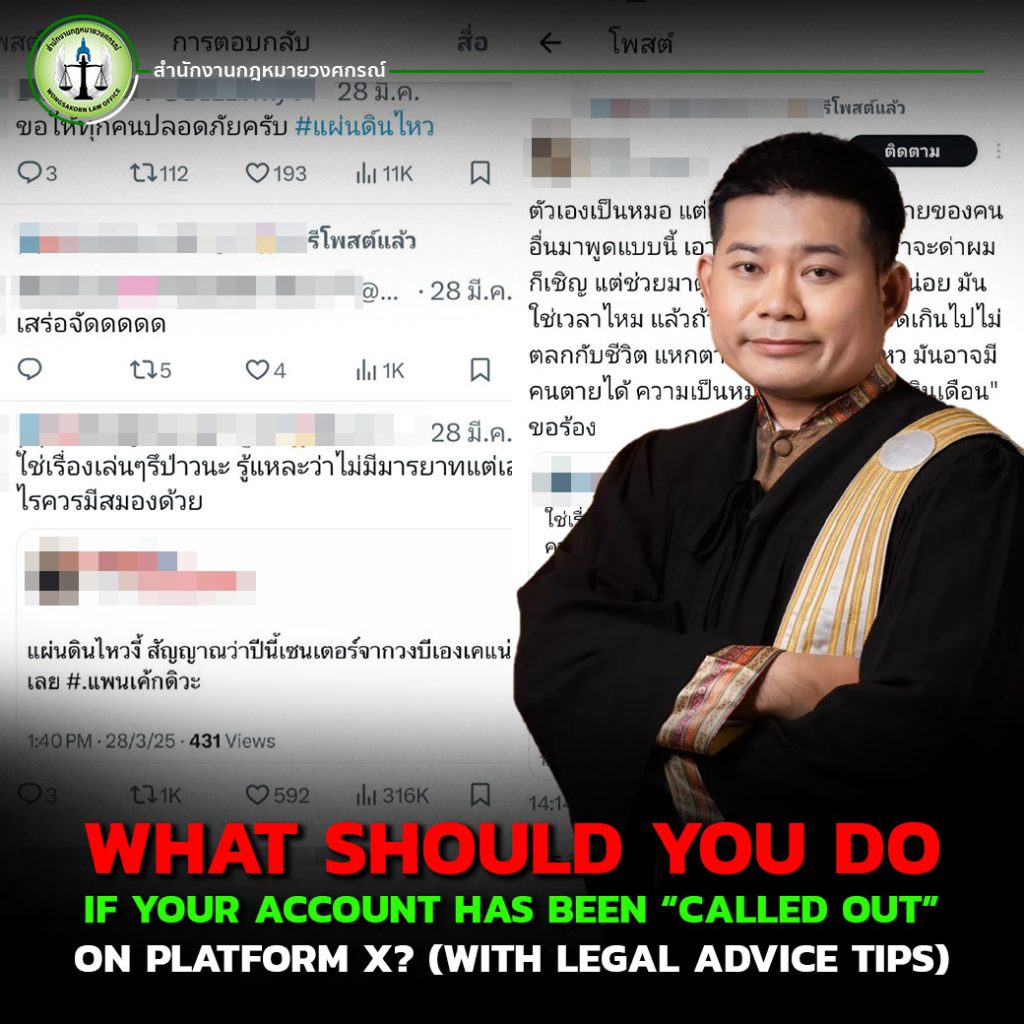
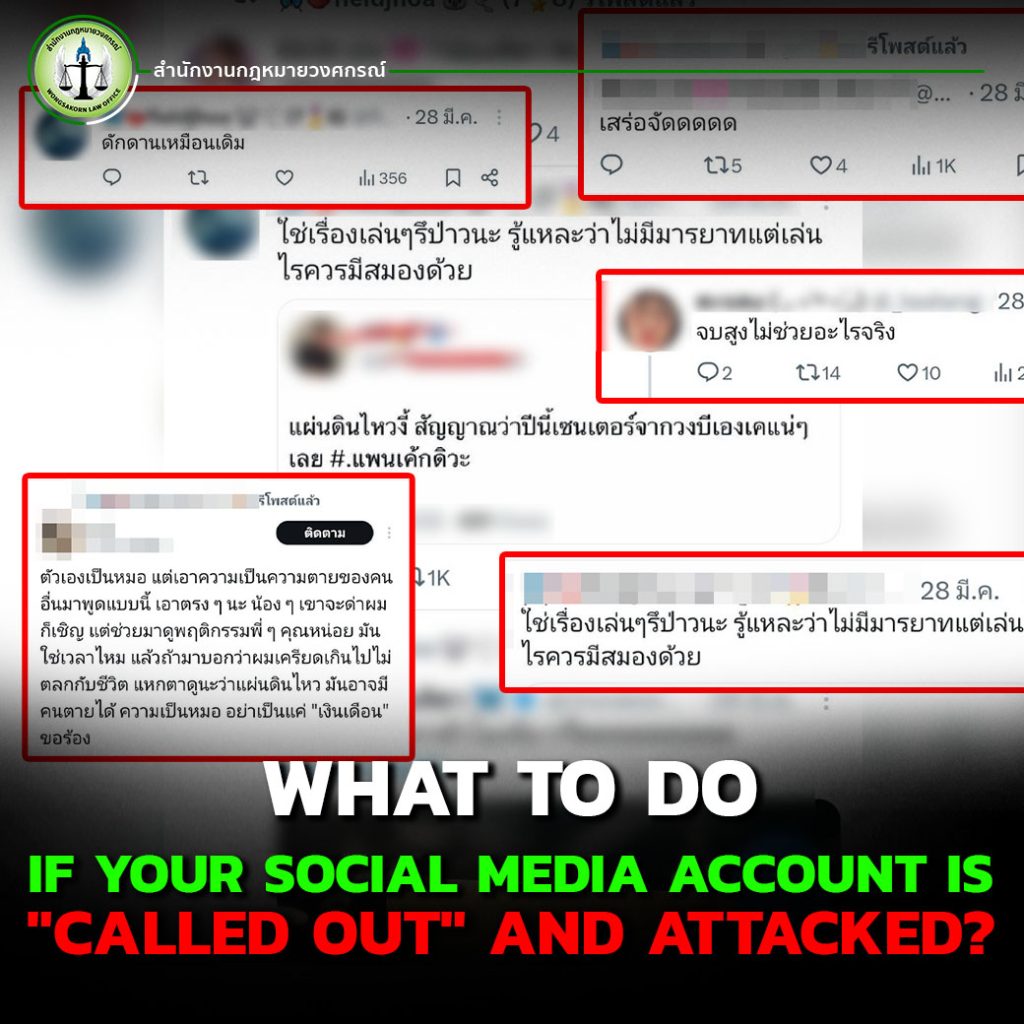
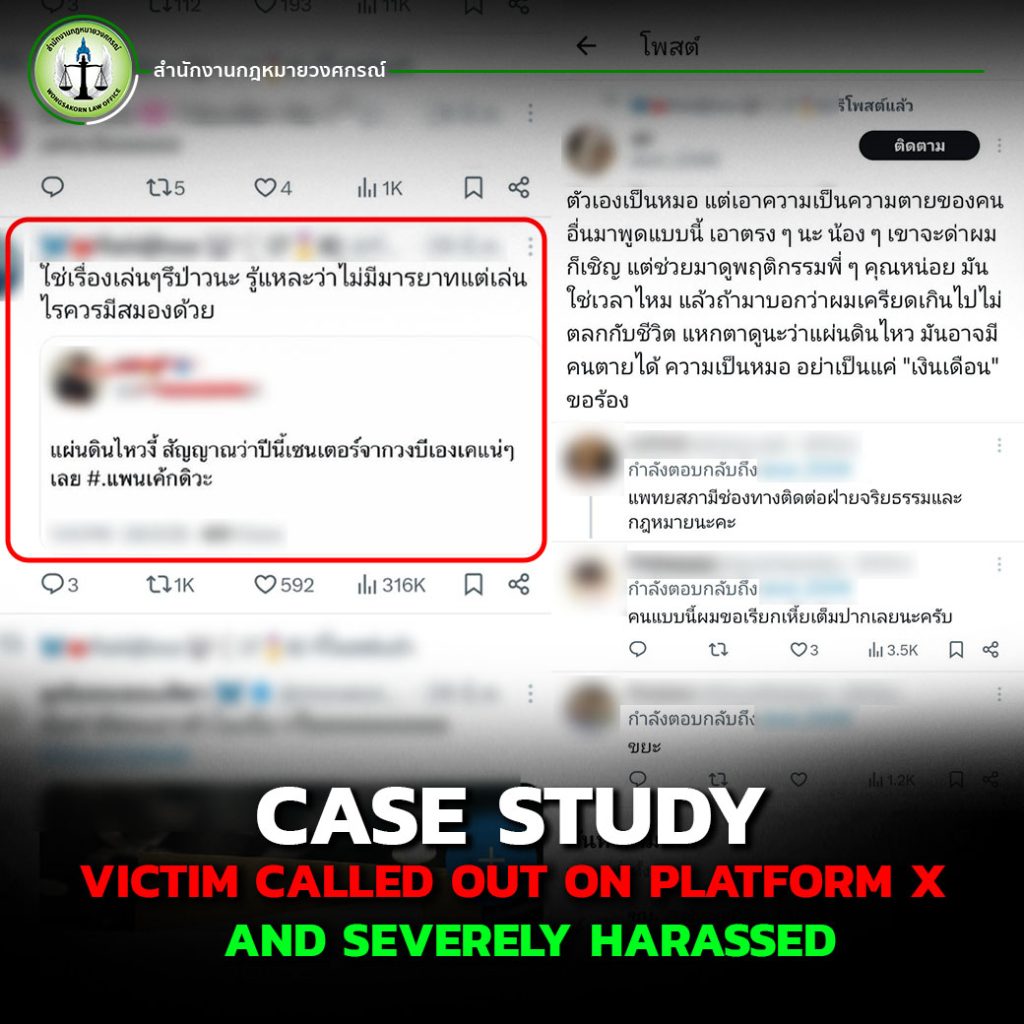
In today’s world dominated by social media—especially the platform X, formerly known as Twitter—a few lines of text can have unexpectedly serious consequences. This is particularly true when a post explicitly refers to a specific individual, potentially damaging their reputation and public image.

One recent case has drawn significant public attention: an individual was publicly “named and shamed” in a post on X, with their real name and surname tagged. The post led many viewers to form negative opinions of the person, resulting in widespread public ridicule and misunderstanding.

The incident had a severe emotional and reputational impact on the victim. Unable to bear the consequences, they quickly consulted a lawyer and proceeded with a criminal defamation lawsuit. The victim stated clearly that they had no intention of negotiating or settling, as the situation had already spiraled out of control. Delaying legal action could allow the post to be shared or re-posted by others, causing even greater damage.

What Is Defamation by Publication? Know This Before It’s Too Late

According to Section 326 of the Thai Criminal Code, anyone who makes a defamatory statement about another person to a third party—whether in a way that harms their reputation, subjects them to contempt, or incites hatred—commits the offense of defamation, which carries a penalty of up to one year in prison, a fine of up to 20,000 Baht, or both.

If such an act occurs on social media platforms such as Facebook, X (formerly Twitter), TikTok, or Instagram, it falls under the more serious offense of defamation by means of publication as stated in Section 328. This carries a harsher penalty of up to two years in prison, a fine of up to 200,000 Baht, or both.

In a recent case involving X, the incident clearly constituted defamation by publication. The offender tagged the victim’s full name in a public post, which resulted in significant reputational damage and widespread misunderstanding. As the post was made available to the general public, this qualifies as defamation by publication beyond any doubt.

What Kind of Posts Can Get You Sued for Defamation?

Not every social media post is illegal—but certain characteristics may expose you to a defamation lawsuit, especially if your content includes:

  • Accusations or false information about another person
  • Mention of someone’s full name or clearly identifiable personal details
  • Sarcastic, mocking, or misleading language that may cause public misunderstanding
  • Wide sharing or reposting of the defamatory content to a large audience
  • Use of images or added context to make the accusation seem more credible

In this particular case, the poster deliberately defamed the victim, tagged their real name, and shared the content widely. These elements fulfill the legal criteria for defamation by means of publication, and the victim can immediately use the post as evidence to file a police complaint.ามารถใช้โพสต์ดังกล่าวเป็นพยานหลักฐานในการแจ้งความได้ทันที

How to File a Defamation Lawsuit for Online Offenses

If you become a victim of online defamation, don’t ignore it. Failing to take action could allow the offender to repeat the behavior or target others in the future. Here’s how to begin the legal process:

1. Collect Evidence Immediately
Take screenshots of the post, message, or image in question. Make sure to include the date, time, and the username or profile of the poster.

2. Contact a Legal Professional
Consult a lawyer who specializes in defamation or cybercrime. They will guide you through the process and help you prepare the necessary documents.

3. File a Report at the Police Station
Inform the officers that you wish to press charges for defamation by publication, and submit all collected evidence.

4. Consider Filing a Civil Lawsuit (if applicable)
If the defamation has caused damage to your reputation or business, you may be eligible to claim monetary compensation through a civil case in addition to the criminal charges.

Pursuing legal action for defamation is not only a way to protect your rights—it also helps set a social standard that encourages responsible online behavior and the respectful use of free speech.

Don’t Hesitate to Exercise Your Legal Rights — Consult a Lawyer to Protect Your Reputation

Many people who experience online defamation choose to stay silent, hoping the issue will fade on its own. But in reality, the longer you wait, the harder it becomes to assert your legal rights and hold the offender accountable. In today’s digital age, a single post can go viral within hours — thousands of retweets or shares can permanently damage your name and reputation.

If you or someone close to you has experienced online defamation, do not delay. Contact a lawyer immediately to take legal action and defend your reputation and dignity to the fullest extent of the law.

WongsaKorn Law Office — Specialists in All Types of Online Defamation Cases

At WongsaKorn Law Office, we specialize in handling defamation cases across all social media platforms, including Facebook, X (formerly Twitter), TikTok, and others. Our legal team provides clear, professional advice and will guide you through the legal process to ensure justice is served.

Whether you are facing false accusations, harmful public posts, or targeted harassment, we’re here to help. Contact WongsaKorn Law Office today for trusted legal support — our team is ready to assist you with professionalism and genuine care.

New Forms of Chinese Human Trafficking Operations in Thailand

Today, human trafficking remains a tragic and deeply rooted issue in many parts of the world. Many people still believe that “human trafficking” refers only to forced prostitution or labor in heavy industries. In reality, however, modern human trafficking has evolved into more complex and harder-to-detect forms, often using technology as a tool. A significant number of victims are now being forced to work “online,” in ways that are nearly invisible to outsiders.

Today, Wongsakorn Law Office will take you through a new form of human trafficking that many may not have imagined or encountered before. This information aims to help you protect yourself and those around you from situations that could lead to human trafficking.

⚠️ What Is the New Form of Human Trafficking in Thailand?

In the past, when people spoke of “human trafficking,” they often thought of forced prostitution, labor in fishing factories, or child abduction—usually involving physical violence and illegal cross-border movement.

However, today’s trafficking operations have evolved into “new forms” that focus on forcing victims to work in the online world, characterized by the following:

📌 1. Victims are lured willingly
Traffickers commonly use social media or job websites to deceive victims, advertising “well-paid online jobs abroad” or “travel opportunities with side gigs.”
Once the victims arrive in Thailand (often with valid visas), their passports are confiscated, preventing them from returning home.

📌 2. No factories, no brothels — but call centers or ‘online scam farms’
Victims are forced to engage in illegal online activities such as:

  • Pig butchering scams (romance/investment fraud)
  • Fake app promotion / crypto schemes / pyramid scams
  • Investment scams via chat platforms
    They work under strict 24-hour surveillance, with CCTV monitoring and constant orders from trafficking leaders.

📌 3. Victims are made to “blend in” to avoid suspicion
Some are trained to speak Thai or English.
They open Thai bank accounts (or use mule accounts), use Thai SIM cards, and dress like students or office workers.
There is often forgery of documents like work permits or migrant labor ID cards.

📌 4. Victims are often treated as ‘offenders’ instead of ‘victims’
Because they enter on tourist visas or work without permits, some authorities mistakenly treat them as illegal workers and deport them.
As a result, they do not receive protection under Thailand’s Anti-Human Trafficking Act.

📌 Victims Silenced: Fear, Shame, and the Inability to Speak Out

Although they are victims of human trafficking, many individuals are unable—or unwilling—to seek help or even tell anyone that they’ve been coerced or deceived. The primary reason is fear—fear of being arrested for engaging in illegal activities they were forced into, such as running call center scams, online fraud, or possessing forged passports. They also fear retaliation from traffickers, who often threaten harm to the victims and their families.

Another major factor is shame, particularly in Thai society, where victims are often stigmatized as being “naive” or “greedy” for falling into such traps. In cases where victims were tricked into taking part in online crimes—such as pretending to be a romantic partner to scam money or chatting with other victims—many feel that they are not worthy of help, or believe they deserve punishment.

There are also language and cultural barriers, especially for migrant workers or those deceived from rural areas, who often do not understand legal procedures, don’t know where to turn for help, or distrust government authorities. As a result, trafficking operations continue in silence—because the victims themselves stay silent.

All of this shows that helping these victims is not just about law enforcement or arrests, but also about creating safe spaces, both physically and emotionally, where survivors feel empowered to speak out, ask for help, and not feel like criminals.

⚖️ Legal Gaps Mean Opportunities for Criminals

Although Thailand has the Anti-Trafficking in Persons Act B.E. 2551 (2008), which provides legal protections and preventive measures against human trafficking, the law still primarily focuses on traditional forms of trafficking—such as prostitution, child labor, or forced labor in agriculture and industry. Meanwhile, new forms of trafficking in the digital age—such as forced online labor, romance scams, fraudulent call centers, or virtual money laundering—are not clearly or adequately addressed in the legislation, making it difficult to effectively prosecute perpetrators.

In addition, inter-agency cooperation remains weak, and international collaboration is limited, especially in cases involving transnational crime networks. For example, a Chinese group might run operations from Cambodia, lure victims in Thailand, and use bank accounts in the Philippines. These legal and jurisdictional loopholes create obstacles for prosecution, often requiring lengthy extradition requests or making it impossible to obtain crucial digital evidence in time.

Most critically, law enforcement in border regions and cyberspace remains underpowered, as officers often lack the necessary technological tools or access to platforms used by trafficking networks. This enables traffickers to continue operating with little to no interference.

⚖️ From Victims to Survivors : Lawyers Against Human Trafficking

🔹 1. Proving That the Victim Is Not a Criminal
In many cases, victims are forced to commit illegal acts, such as:

  • Online scams or fraud
  • Using forged documents
  • Entering a country illegally

A lawyer can clarify whether someone acted under coercion or deception, helping courts see them as a victim, not a criminal.

🔹 2. Providing Legal Advice and Clarifying Rights
Most victims are unaware of their legal rights, including:

  • The right to apply for asylum or temporary protection
  • The right to state assistance and services
  • The right to remain silent without a lawyer present

A lawyer can explain these rights clearly, and communicate on behalf of the victim with the police, prosecutors, or the courts.

🔹 3. Representing the Victim in Legal Proceedings or Compensation Claims
In criminal proceedings against trafficking networks, a lawyer can:

  • File a petition for the victim to be formally recognized as an “injured party”
  • Seek civil compensation (e.g. for medical costs or forced labor damages)
  • Protect the victim during court questioning to prevent retraumatization or intimidation

🔹 4. Coordinating with Other Agencies
Lawyers often collaborate with:

  • Social welfare officers
  • NGOs
  • Embassies (in cases involving foreign victims)

This ensures the victim’s safety and supports their recovery and reintegration, including safe shelter, psychological care, and a dignified return home.

Although escaping from a trafficking network can be incredibly difficult, victims still have the chance to stand up for their rights—especially with the guidance of knowledgeable and compassionate legal professionals. A lawyer plays a critical role in explaining rights, navigating the complex justice system, and advocating for humane treatment. They also act as a bridge to connect victims with essential support services and prevent them from being prosecuted for actions committed under coercion.

Ultimately, having a lawyer by your side is not a weakness—it is a vital step toward protection, dignity, and justice. At Wongsakorn Law Office, we are committed to standing against human trafficking and all forms of exploitation. We are here to support you every step of the way—with compassion, professionalism, and unwavering dedication to your rights.
Don’t face injustice alone—contact us for a confidential consultation. Our legal team is ready to help.

Reference :   https://doe.go.th/prd/assets/upload/files/ipd_th/e88a724796b3526a3034d9495a8f168a.pdf 

Written by : Wararat Wongpothisarn (Internship Student in Chinese Language)

If the parents were not legally married and the father dies, does the mother have inheritance rights?

When a loss occurs in the family, one of the most frequently asked questions is about inheritance, especially in cases where family relationships do not conform to the legal framework—such as when the parents were not legally married. In such a case, if the father passes away, does the mother have the right to inherit his estate? This issue is important because it directly relates to individual rights and the distribution of property.

Legal Status of Husband and Wife

Before discussing inheritance, it is essential to understand the legal status of a husband and wife under Thai law. According to the Thai Civil and Commercial Code, a man and a woman living together without registering their marriage are not considered legally married.

Even if they have lived together for a long time, have children, or refer to each other as husband and wife in public, such a relationship has no legal effect concerning property or inheritance matters.

In other words, the woman in this case does not have the status of a lawful wife, and therefore, when the man passes away, she is not considered a statutory heir under the law.

Statutory Heirs under Thai Law

According to Section 1629 of the Thai Civil and Commercial Code, there are six classes of statutory heirs, ranked in order of priority as follows:

  1. Descendants (e.g., children, grandchildren, great-grandchildren)
  2. Parents
  3. Full siblings (same father and mother)
  4. Half-siblings (same father or same mother)
  5. Grandparents (paternal and maternal)
  6. Uncles, aunts (paternal and maternal)

In addition, if the deceased had a legally registered spouse, that spouse is also entitled to a share of the inheritance along with the above heirs.

Therefore, if a man and woman lived together without registering their marriage, and the man passes away, the woman has no legal right to inherit under Thai law. unless…Unless there is a will

If the man had made a will clearly stating that he wished to leave part or all of his property to the woman, even though they were not legally married, the will can be legally enforced according to the testator’s intent.
In such a case, the woman would receive the inheritance as a legatee under the will, not as a statutory heir.

Rights of a Child Born to Unmarried Parents

For the child, even if the parents were not legally married, the child can still be a statutory heir of the father if the child is legally acknowledged. This can be done through:

  • The father being listed as the parent on the child’s birth certificate
  • The father filing a petition to the court to acknowledge the child
  • Legal evidence or a court judgment confirming paternity

In such cases, the child has the right to inherit from the father, unlike the mother, who has no legal status.

In the absence of children and a will

If the man dies without children and has not made a will, his assets will be passed on to the next class of statutory heirs, such as his parents or siblings, in accordance with the legal order.

This illustrates that a woman who lived with the man without registering their marriage has no legal right to inherit, unless she can prove her right to certain assets—for example, property she contributed to acquiring or assets that were jointly purchased.

In the case of jointly purchased property

n practice, if the woman has evidence that she contributed to purchasing certain assets, such as a house, car, or business, even if the property is under the man’s name, she may be able to sue for a share of the property as a joint owner, not as an heir.

In such cases, a lawyer plays a crucial role in collecting evidence and filing a claim for joint property rights. This may be the only avenue for the woman to receive some benefit from the deceased’s assets.

For situations like this, consulting a lawyer is very important, especially when there is a dispute over property rights or multiple parties claiming a share of the inheritance.

Summary: Living Together Does Not Equal Legal Rights

Even if a couple has lived together for a long time, has children, and shares emotional bonds, without a legally registered marriage, it carries no legal effect regarding inheritance. The woman has no right to inherit as a statutory heir unless there is a will or she can prove joint ownership of property.

To avoid such complications, legal planning—such as making a will or legally acknowledging a child—should not be overlooked. If there are any doubts about one’s legal rights, it is essential to consult an experienced lawyer promptly to protect those rights properly.

Written by : Kannikar Charoenweerawong (Internship Student in Chinese Language)

Chinese Adopting Thai Citizens: Inheritance Rights and Hidden Legal Challenges

In today’s borderless world, cross-national relationships have become increasingly common — whether in marriage, business partnerships, or even adoption. But what happens when a Chinese citizen wishes to adopt a Thai national? Can it legally be done? And if the adoptive parent later passes away, does the Thai adoptee have any legal right to inheritance?

Today, Wongsakorn Law Office dives deep into these pressing questions, unpacking the relevant legal frameworks in both Thailand and China, with exclusive insights from family law experts.

🔹 1. Can a Chinese National Adopt a Thai Citizen?

The answer is “yes”, but it comes with strict and complex legal requirements due to the cross-border nature of the case. The adoption must be recognized and processed in accordance with the laws of both Thailand and China.

▶️ In Thailand:

According to the Adoption Act B.E. 2522 (1979) and Sections 1598/19 to 1598/41 of the Thai Civil and Commercial Code, the adoption process must go through the Department of Children and Youth (DCY) under the Ministry of Social Development and Human Security.

Key requirements include:

  • The adoptive parent must be at least 25 years old, and at least 15 years older than the adoptee.
  • Proof of sufficient income and ability to care for the child must be provided.
  • In the case of foreign nationals, thorough background checks and assessments are conducted.
  • The adoption must be officially registered at a district office or local authority (amphur) to be legally valid.

▶️ In China:

Under the Adoption Law of the People’s Republic of China (1991, revised 1998), the following conditions apply:

  • The adoptive parent must be at least 30 years old.
  • Generally, they must have no biological children, or if they do, they must provide clear justification for the adoption.
  • The adoption must be registered with the local Civil Affairs Bureau.

For international adoptions involving a foreign national (such as a Thai citizen), the case may require approval from a higher-level ministry or be processed under a bilateral treaty or international agreement.

🔹 2. Does an Adopted Child Have Inheritance Rights?

If the adoption is legally recognized in both Thailand and China, the adopted child is entitled to inheritance rights equal to those of a biological child, including assets located in either country.

▶️ Relevant Thai Law:

According to Section 1627 of the Thai Civil and Commercial Code:

“An adopted child shall be a statutory heir in the same class as a legitimate child.”

This means that once the adoption is legally registered in Thailand, the adopted child has the same legal standing as a biological child when it comes to inheritance, whether or not there is a will.

▶️ Relevant Chinese Law:

Under the Civil Code of the People’s Republic of China, Book VI – Inheritance Law (2021):

“A legally registered adopted child shall enjoy inheritance rights on par with a biological child.”

As long as the adoption has been properly registered and recognized by the relevant Civil Affairs Bureau, the adopted individual has full legal status to claim inheritance in China.

However, inheritance rights depend heavily on proper legal registration. If there are discrepancies in documentation, or if the adoption was not formally recognized by one of the countries involved, the adopted child may be disqualified from inheritance.This is why cross-border legal compliance is critical, especially in international adoptions involving assets or family rights across two jurisdictions.

🔹 3. Challenges of Cross-Border Adoption

While cross-border adoption is legally possible, the practical process is often complicated and filled with challenges, including:

  • Legal discrepancies between Thai and Chinese systems
  • Language barriers and the need for certified translations of legal documents
  • Lengthy and strict background checks required by both countries
  • Bureaucratic hurdles in international registration, with the risk that one country may refuse to recognize documents from the other

In such complex cases, lacking the guidance of a legal expert — particularly someone well-versed in international family law and inheritance law — could result in legal gaps that render the adoption ineffective or unenforceable.

🔹 4. Don’t underestimate a lawyer — they can make complex issues much easier to handle.

International adoptions — especially between citizens of two different nationalities such as Chinese and Thai — involve multiple layers of legal systems, cross-border regulations, and document authentication. Lawyers who specialize in this area play an essential role at every stage.

✅ How Lawyers Can Help:

  • Provide legal advice in both jurisdictions (Thailand and China)
  • Translate and certify documents, ensuring legal standards are met
  • Verify adoption registration to protect future rights, including inheritance
  • Coordinate with government agencies, including Thailand’s Department of Children and Youth, the Ministry of Foreign Affairs, and the Chinese Embassy
  • Handle inheritance cases in court, in the event of the adoptive parent’s death

Cross-border adoption isn’t impossible, but it does require deep legal knowledge and cross-agency cooperation. When done correctly, even adopted children of different nationalities can be fully recognized — both within the family and under the law.”

In complicated cases like this, many believe they can handle the process themselves — but even a single missed step can cause the adopted child to lose their legal rights forever. 

Wongsakorn Law Office is highly experienced in family and inheritance law.
Our team — including both attorneys and legal assistants — is well-versed in handling a wide variety of family and estate-related cases, each with its own unique circumstances. Whether your case involves adoption, succession, or inheritance disputes, you can trust us to manage it with professionalism and care.

We also provide legal consultation for consumer protection cases, ensuring that your rights are upheld and that you receive the maximum benefit under the law.

👉 Contact us today to discuss your legal needs — we’re here to help.

Reference :  หลักเกณฑ์การรับบุตรบุญธรรม – Closelawyer

Written by : Wararat Wongpothisarn (Internship Student in Chinese Language)

Buying insurance is like buying a lawyer. Don’t forget about it when problems arise.

In an era where risks can happen every day, having “insurance” is an essential shield that helps reduce burdens and anxiety when unexpected events occur. Many people believe that buying insurance is simply transferring financial responsibility to the insurance company. However, if you look deeper, buying insurance with a lawyer as your legal advisor is like purchasing peace of mind regarding legal matters in advance.

Simply buying insurance may not be enough in situations where disputes arise, such as when the insurance company refuses to pay or there are disputes regarding the terms of the policy. This is why buying insurance along with a lawyer is more important than you think.

Why is it important to have a lawyer to consult in times of need?

Having a lawyer as an advisor when you first purchase “insurance” provides confidence even before an incident occurs. It is better to have legal planning in place from the beginning rather than wait until a problem arises and then scramble for a lawyer. Sometimes, a lack of proper legal planning can put you at a disadvantage from the start.

A lawyer with experience and expertise in insurance-related cases can assist you in the following ways:

  • When you suspect that the policy terms are unfair, a lawyer can review the terms and highlight any unfair provisions or loopholes.
  • Provide initial advice on how to act if an incident occurs to protect your rights.
  • In the event of an accident, the lawyer will act as a representative in legal matters with the insurance company.
  • Follow up on the case and ensure you receive the compensation you are entitled to.

Why is it important to have a lawyer immediately after an accident?

When an accident occurs or when we need to claim compensation, some insurance companies may interpret the terms differently from what we expect. In some cases, they may deny liability or fail to provide full compensation as per the contract. This is where the role of a lawyer becomes extremely important. Having a lawyer who understands the insurance policy by your side ensures that your rights are not violated and that you can make your claim correctly according to the law. Whether it involves negotiation, filing a complaint with the Consumer Protection Office, or taking legal action in court, a lawyer helps navigate these processes properly.

Why is it better to purchase insurance with a lawyer?

Many people may think that buying “insurance” from any provider is the same, but choosing an insurance policy that includes “legal assistance” changes everything. In addition to the coverage provided by the insurance policy, you will also receive full legal support.

For example, if problems arise such as a claim denial, delays in processing, or misinterpretation of the terms, the lawyer will be able to provide immediate advice or services. You won’t have to waste time finding a new lawyer during a crisis situation.

Having a personal legal advisor from the start also helps reduce the chances of losing your rights, as the lawyer will remind you of crucial details such as the time limits for reporting incidents, filing complaints, and special terms that could affect your compensation.

Don’t forget when you need help

Purchasing “insurance” is like laying the foundation for protecting your life and assets, but having a lawyer who is ready to assist, provide advice, and fight for your rights when necessary is an added layer of protection.

Don’t wait until problems arise before thinking of a lawyer. By then, the situation might escalate to a point where it’s hard to resolve. Having a personal lawyer from the moment you purchase insurance is a worthwhile investment that brings peace of mind throughout the process.

Wongsakorn Law Office – Comprehensive Legal Services

Wongsakorn Law Office specializes in providing advice on “insurance” and handling related legal cases, with a team of professional lawyers who are ready to assist clients from the day they purchase insurance to fighting in court if necessary.

We are committed to being a reliable support for all our clients, ensuring that when problems arise, you won’t face them alone. We’ll stand by your side every step of the way.

Whether it’s car insurance, condo insurance, life insurance, or any other type of insurance, our team of lawyers is ready to analyze contracts, offer advice, and take full action to protect your rights.

Remember, “purchasing insurance is like buying a lawyer” alongside it. By choosing wisely and selecting a company that truly understands insurance law, your life will be protected both financially and legally.

Whenever problems arise, you can consult with us immediately. Whether it’s a dispute, claim, or legal action, we are ready to provide advice and guidance to ensure you receive the utmost fairness.

If you’re interested in consulting or learning more about insurance and legal services, feel free to contact Wongsakorn Law Office anytime. We are here to professionally take care of you.

Is It Considered “Fraud” if You Take an Event Planning Job and Fail to Pay?

In today’s world, with the rise of freelance work and event planning, the event planning industry has become a widespread service sector, including organizing weddings, product launches, and seminars. However, when the job is taken and payment is withheld, it becomes a major headache for the creditor and service provider. Some may think it’s just a “civil case,” where suing won’t result in payment, but in reality, if the intent to withhold payment is clear, it could potentially be classified as “fraud.”

Is It Illegal to Accept an Event Planning Job and Not Pay?

In cases where the client hires an event planner to perform tasks as agreed, and the event planner completes the work as per the contract, but the client refuses to pay or keeps postponing the payment without a valid reason, the question arises: Can this be considered “fraud”?                      

The answer is “It could be.” If it can be proven that the client had the intention to deceive from the beginning, such as:

  • Hiring with no intention of paying.
  • Using false documents.
  • The contract contains suspicious terms.
  • When asked for payment, the client avoids contact or disappears entirely.

In cases like this, a fraud charge can be filed, which is different from situations where the client intended to pay but encountered financial issues, in which case it would be considered a “contract debt” or “civil case.”

What Are the Penalties for Fraud?

If a person is found guilty of fraud under Section 341 of the Criminal Code, they may face imprisonment for up to 3 years, a fine not exceeding 60,000 Baht, or both imprisonment and a fine.

If the fraud involves impersonating another person or using forged documents, the penalties are more severe under Section 342, with imprisonment for up to 5 years and a fine not exceeding 100,000 Baht.

Therefore, filing a fraud charge serves as a “legal pressure tool” to make the debtor feel the serious legal consequences, which differs from civil cases that tend to take longer and do not carry initial imprisonment penalties.

How to Know if You Are a Creditor?

Many people wonder how they can know if they are a “creditor” with the right to file a lawsuit. The answer lies in the following evidence:

  1. Written Contract or Agreement
    If there are documents showing the intention to hire the services, such as quotes, contracts, or even chat messages, these can be used as evidence.
  2. Evidence of Work Done
    This includes photos taken on-site, expense reports, receipts issued, or confirmation from relevant staff members.
  3. Written Demands
    Emails, chat messages, or demand letters help demonstrate that you have made a request but the debtor has ignored it.

If you have all of the above documents, you can confirm your status as a “creditor” and have the right to file a lawsuit for damages.

What to Do if It’s Not Fraud?

In cases where the debtor does not have clear fraudulent behavior, such as admitting to owing money but requesting to delay the payment or showing financial difficulties, this will be considered a “civil debt.” In such cases, the following steps can be taken:

  1. Send an Official Demand Letter
  2. If the Payment is Not Made Within the Set Time, File a Lawsuit in Civil Court
  3. If You Win the Case but the Debtor Still Doesn’t Pay, File a Request to Enforce the Judgment, such as Seizing Bank Accounts or Property

However, civil litigation can take time and incur costs. Therefore, consulting with a legal advisor is crucial in helping you plan the process correctly.

Consulting with a Legal Advisor for a Better Legal Strategy

In situations like this, having a legal advisor like Wongsakorn Law Office will help you understand the situation and choose the strategy with the highest chance of success. To file a case for “fraud,” careful planning is essential, which includes gathering solid evidence to ensure that the police or prosecutor will accept the case.

If you choose a civil route, it’s crucial to analyze the clarity of the debt, the chances of winning the case, and whether there are any assets that can be seized. Having an expert lawyer evaluate everything from the beginning will help reduce the risks of wasting time and unnecessary expenses.

Why Choose Wongsakorn Law Office?

Wongsakorn Law Office offers comprehensive legal services, specializing in fraud cases, civil lawsuits, and business disputes. We focus on strategic planning before filing a lawsuit, ensuring that clients have viable options and can make well-informed decisions.

Whether you’re an event organizer who has been cheated out of payment or a business owner defrauded through a contract, Wongsakorn Law Office is here to assist you every step of the way. From initial consultation to full litigation, we are ready to help.

Accepting event organizer work and not being paid might not just be a regular business issue; it could also be classified as “fraud,” which carries more severe penalties than regular civil cases. If you find that you’ve been defrauded, don’t let the matter go silent. You should immediately consult a professional legal advisor or lawyer to find the appropriate legal solution and fully claim your rights. Consult with a lawyer now >>Contact Us<<

How to Choose a Trusted Legal Advisor? Why Foreign Clients Trust Wongsakorn Law Office

In an era where doing business or living abroad involves numerous legal risks, having a trusted and knowledgeable “legal advisor” who understands the legal system of the country is essential. This is why many foreigners place their trust in Wongsakorn Law Office.

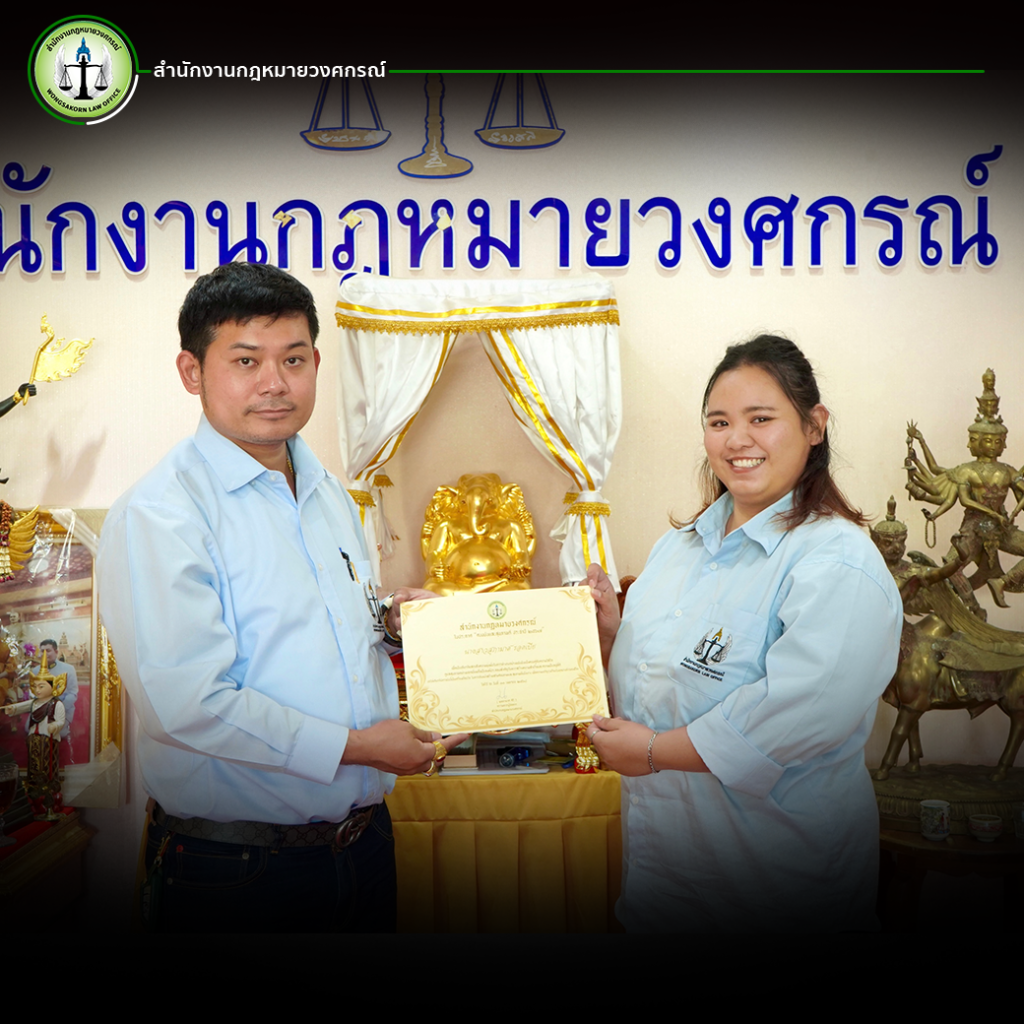
On April 25, 2025, our office had the honor of assisting a foreign client who came to us for legal advice as soon as they encountered a legal issue in Thailand. The client did not contact any other law firms beforehand. This reflects the trust in our expertise and reputation as a professional legal advisor, ready to handle all of our clients’ legal challenges with dedication.

A Legal Advisor Is Not Just Someone Who Solves Problems, But Someone Who Plans to Prevent Them for You.

Many people often think that a lawyer’s role is limited to handling legal matters when a lawsuit is filed or conducting proceedings in court. However, the truth is that a “legal advisor” plays an even more crucial role. We are here to provide legal services to help you avoid legal mistakes, plan for risks, and establish a legally sound approach to life or business from the very beginning.

In the case of the foreign client who consulted us, the issue could have escalated and caused significant damage if they had not sought advice right from the start. This is why we always emphasize that “The sooner you consult a lawyer, the quicker you can achieve justice or resolve your issues.”

Why Choose a Legal Advisor from Wongsakorn Law Office?

  1. Experience and Expertise
    Our lawyers have extensive experience in civil, criminal, business, family law, and international cases. We understand the context of both Thai and foreign clients.
  2. Straightforward Advice
    We prioritize transparency, honesty, and providing accurate information, whether the issue is big or small.
  3. Clear Communication
    Especially in cases involving foreign clients, we have a team that can communicate in multiple languages and explain complex legal matters in an easily understandable way.
  4. Trust from Clients
    Foreign clients who consult us directly, without referrals or contacting other firms first, demonstrate the genuine trust that Wongsakorn Law Office has earned.

Legal Advisors Are Essential for Everyone, Not Just for Those with Problems

Whether you’re a business owner, an individual, or even a foreigner living or working in Thailand, having a personal “legal advisor” is an investment in the stability of your life and business.

  • Want to sign a condo lease or buy/sell property? A lawyer can review the terms to ensure you’re not at a disadvantage.
  • Running a business in Thailand and unsure if all your documents are in order? Consult a lawyer before you need to make corrections later.
  • Facing a lawsuit or legal dispute? The sooner you have a lawyer who knows you, the quicker and more efficiently the issue can be resolved.

Confidence Begins with the Right Decision

Wongsakorn Law Office not only provides legal advice, but we are also committed to being the “trusted legal service provider” you can rely on in any situation. Whether you are Thai or a foreigner, if you are looking for a legal advisor who is by your side every step of the way in life and business, we are always here to welcome you.

Wongsakorn Law Office – Your Trusted Legal Advisor

In a world that is complex and rapidly changing, having a “legal advisor” who understands you, knows the law, and is ready to provide legal services immediately when issues arise is just as important as having a personal doctor.

If you are looking for a “legal advisor” who is ready to care for you with sincerity and professionalism, whether it’s for legal cases, business matters, or personal issues, contact us today at Wongsakorn Law Office. You will understand why many clients trust us without hesitation.

Line @ คลิก! โทรหาเรา คลิก!