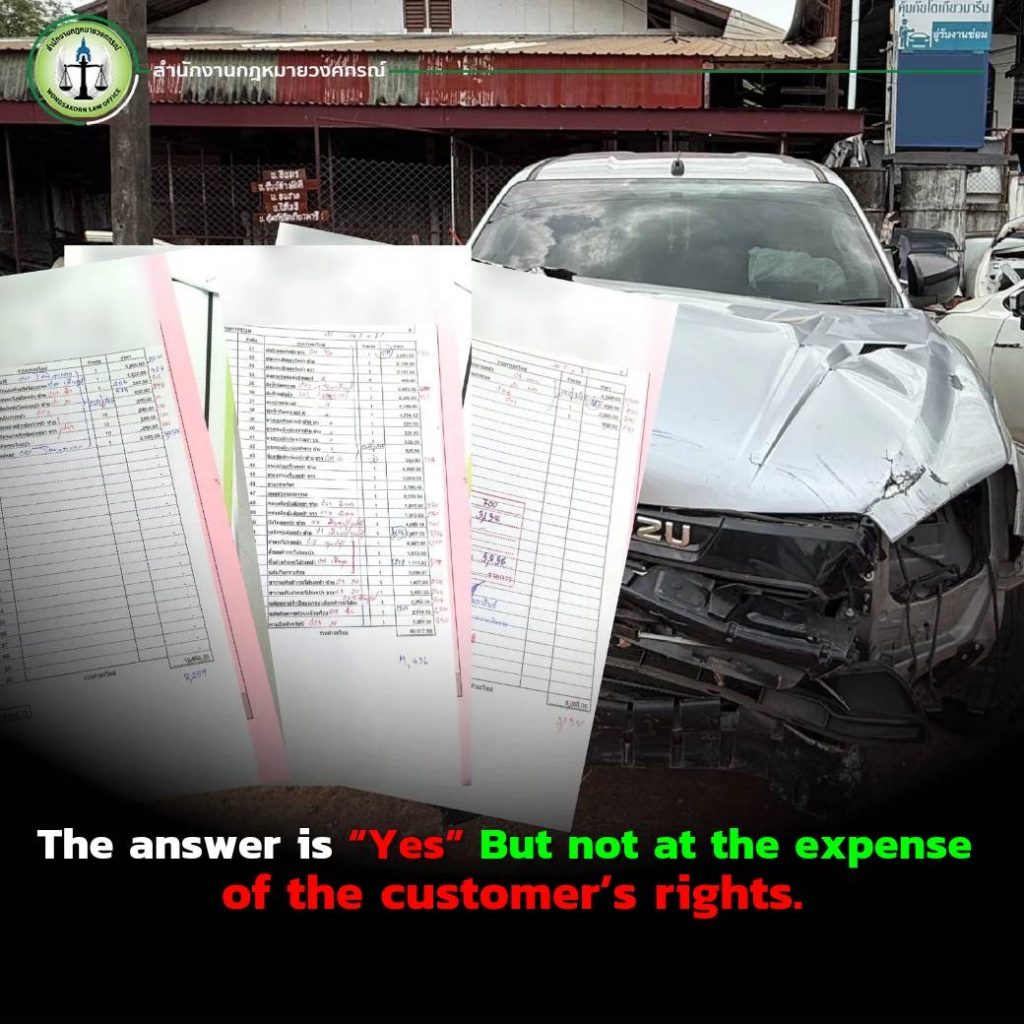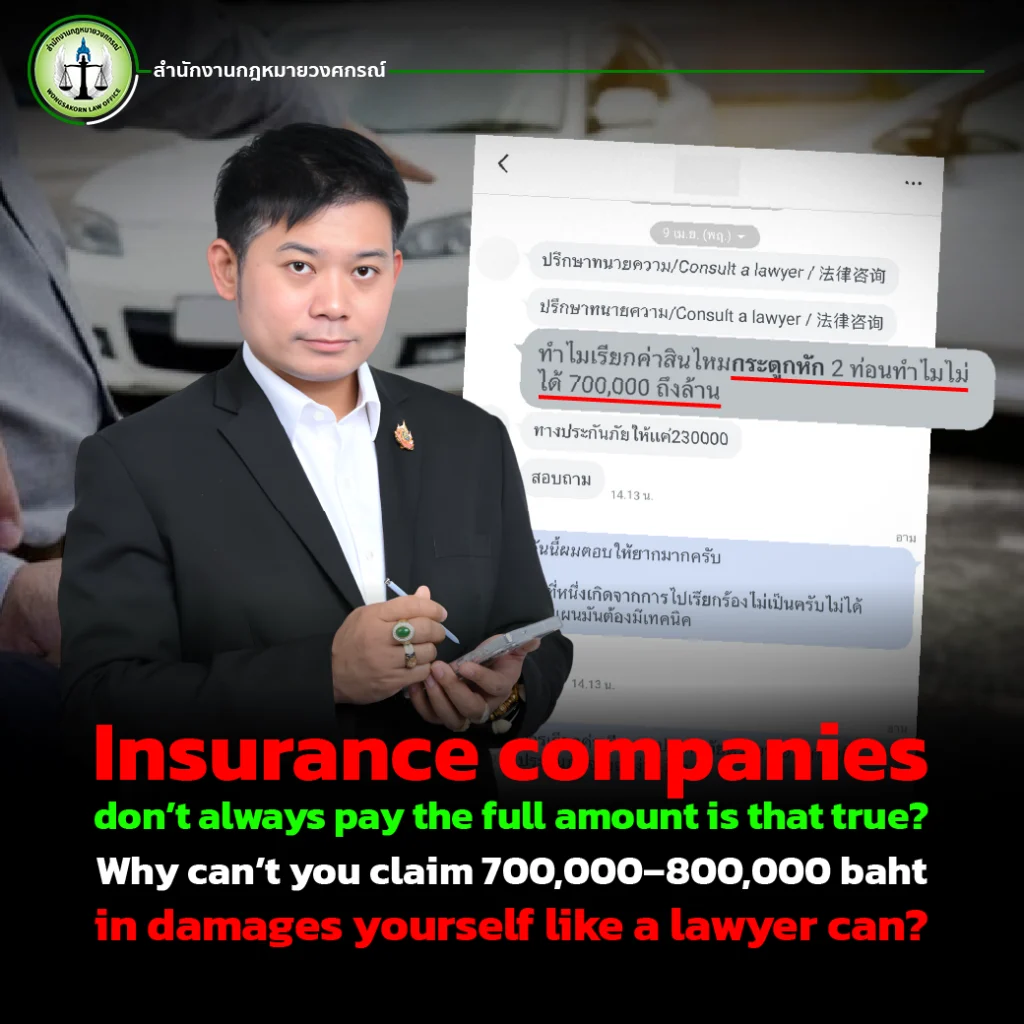
Do insurance companies really not pay in full? This is a very common question when a car accident results in serious injuries. One of the key doubts victims often have is
“Why is it that when I file a claim with the insurance company myself, I don’t receive as much compensation as when a lawyer handles it?”
Many people may have seen cases where compensation reaches 700,000–1,000,000 baht.
But when they deal with the insurance company on their own, they receive only a portion of that amount, or less than expected.
The truth is, this does not depend on the injury alone. Legal factors, strategy, and the method of making the claim all play a significant role.
Why can’t you get full compensation when claiming directly with an insurance company?
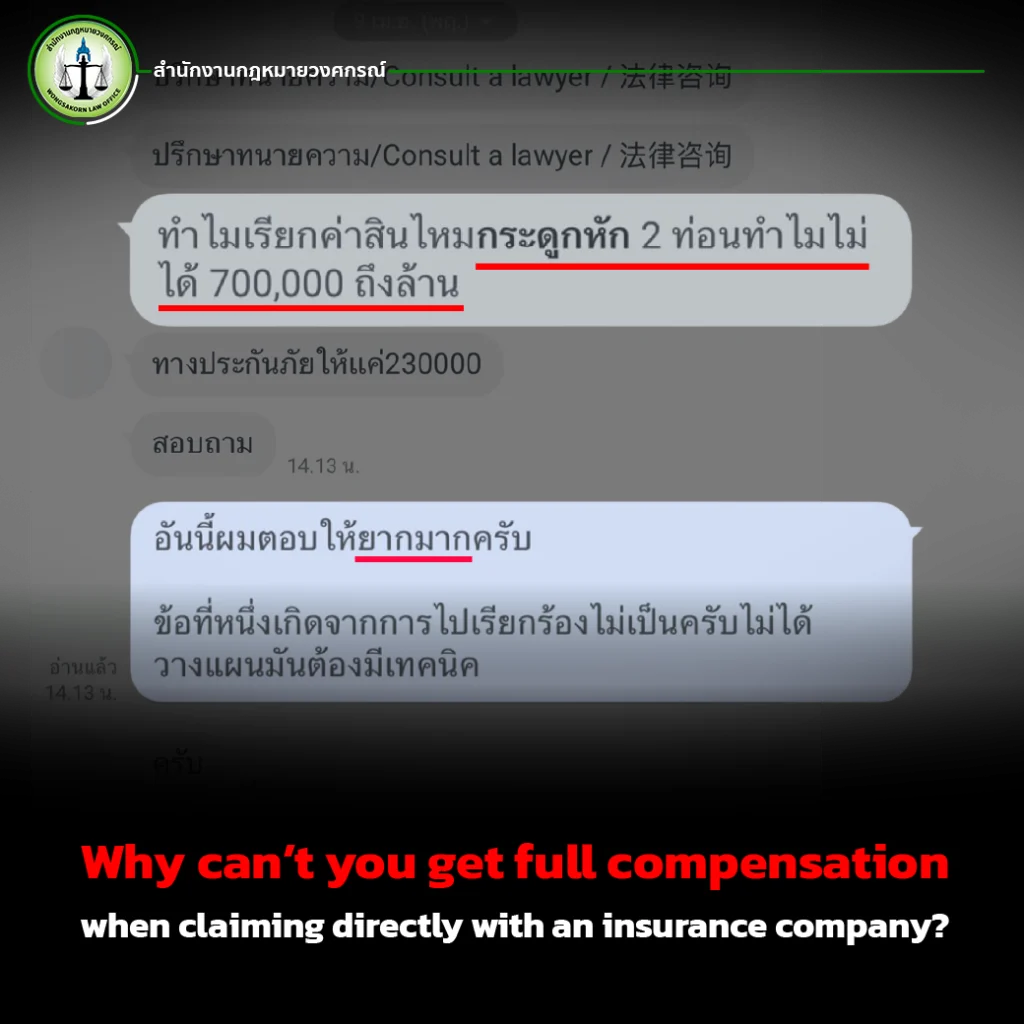
From the experience of lawyers who work directly in the insurance field, it must be said honestly that
for an insurance company to pay a large sum such as 700,000–800,000 baht at the general claims stage is “very unlikely.”
It’s not that it’s completely impossible, but in practice, it is considered “very difficult” if the injured party handles the claim on their own.
The main reasons why victims often receive lower compensation when handling claims on their own
1. Lack of legal understanding
Most victims assume that “serious injury = high compensation.”
However, legally, compensation claims involve many elements, such as:
-Medical evidence
-Continuity of treatment
-Future damages
If these are not properly structured, the value of the damages may be “underestimated.”
2. No planning from the beginning
Claiming compensation from an insurance company is not just about submitting documents. It requires “case structuring” from the start. If the process begins incorrectly, the final outcome is often lower than it should be.
3. Lack of understanding of insurance company strategies
It is important to understand that insurance companies are not responsible for “helping victims,”
but for “paying based on provable damages.”
In practice, insurance companies usually have legal teams ready to deny or handle claims. They deal with cases every day, meaning they have extensive negotiation experience and established approaches. Additionally, they have internal strategies for evaluating compensation.
Therefore, it is quite clear that handling a claim alone makes it difficult to obtain a high level of compensation. If the victim lacks sufficient knowledge, they are more likely to be at a disadvantage.
Key technique Don’t wait until you fully recover before making a claim

One of the “biggest mistakes” victims often make is
waiting until they have fully recovered before claiming compensation.
From the perspective of insurance cases, this means being “at a disadvantage from the very beginning.”
Why shouldn’t you wait?
Insurance companies often tell victims to complete their treatment first and then come back later to claim compensation. The question is can you really do that?
In reality, who do those words truly benefit? The longer you wait to fully recover, the more your injuries improve over time until you reach 100% recovery. In some cases, this may take several months, or even years. When the time finally comes to claim compensation from the insurance company, they may say, “You have fully recovered, so this amount of compensation is sufficient.”
This is considered a common strategy used by insurance companies. It often starts with a denial or delay, in case the victim believes it. If the victim does believe it, they will almost certainly receive less compensation than expected.
Therefore, consulting a lawyer from the very beginning after the accident is a way to increase the chances of receiving higher compensation. Importantly, the lawyer should be someone who understands how insurance companies operate.
“Understanding insurance” is the key.
An important piece of advice is
Do not beg the insurance company to pay,
because the insurance system does not operate on sympathy,
but on “law and evidence.”
What should victims do?
-Gather all documents and evidence completely
-Keep a continuous record of injuries and medical treatment
-Assess both short-term and long-term damages
-Plan the claim process systematically
However, these things are “difficult to do on your own” without legal knowledge. Therefore, it is important to “consult a lawyer from the moment the accident happens.”
Why do you need a lawyer from the beginning?
What many people misunderstand is:
“Only look for a lawyer after a problem arises.”
But in reality, for insurance cases, you should have a lawyer even before any dispute occurs.
This is because insurance companies already have legal teams in place before any incident happens. They have systems and strategies ready, including evaluating damages to be “as low as possible.”
Therefore, if a victim wants “fairness,” they must also have a professional to plan and handle the case in the same way.
Don’t be at a disadvantage with insurance because of a wrong start
Claiming compensation from an insurance company is not about “luck,” but about “strategy.”
If:
– You start off wrong
If you make a mistake from the very beginning like buttoning a shirt incorrectly it can cause the whole situation to spiral out of control.
– You misunderstand
Nowadays, on various social media platforms, there are many lawyers or so-called experts who provide incorrect information. Consuming misleading or inaccurate content may cause victims to misunderstand and take the wrong steps, which may ultimately lead to outcomes that fall short of expectations.
– You have no plan
Whether you handle the claim yourself or follow general advice, if you do not have a proper plan or structured process and no lawyer to shape the case the chances of receiving compensation lower than the actual value are very high.
Consult a lawyer starting today, no need to wait until you have fully recovered.

If you or someone close to you has been in an accident and wants to claim fair compensation from an insurance company, our key advice is:
Do not wait until you are fully recovered. Do not be misled by negotiations that put you at a disadvantage.
The injuries you have suffered are real damages, and you have the right to receive appropriate compensation.
Don’t let a lack of knowledge cause you to lose the rights you deserve.

Start planning today so you won’t be at a disadvantage with insurance companies in the future. Consult a lawyer click >>Contact Us<<