When Your “Photo” Is Used Without Permission – Can You Sue?

Today, a “photo” is not just an ordinary image, it’s a form of digital property that carries both personal and commercial value. Many people share their photos online whether it’s selfies on social media or product images for business but a recurring issue is the unauthorized use of photos, especially in harmful or illegal ways, such as:

  • Using your picture to promote online gambling websites
  • Using your image in product advertisements without consent
  • Editing or manipulating your photo to cause defamation or misunderstanding

These acts are not trivial. They constitute a violation of image rights (Right of Publicity / Right of Image) and may even fall under criminal offenses.

Your Right to Your Own Image

Under Thai law, any photograph that clearly shows your face or likeness is considered personal data and part of your right to privacy.
No one can legally publish or use it without your consent whether for commercial purposes (advertisements, endorsements) or public display (websites, social media posts, etc.).

If someone uses your image without permission, especially in a way that harms your reputation, such as appearing on a gambling website or being linked to offensive content you are legally entitled to sue for damages under both civil and criminal law.

Relevant Laws When Someone Uses Your Photo Without Consent

1. Civil and Commercial Code, Section 420

“Whoever willfully or negligently causes damage to another person by an unlawful act shall compensate for the injury caused.”

This means if someone uses your photo and it damages your reputation, job opportunities, or emotional well-being for example, people mistakenly believe you’re associated with a gambling site you may file a lawsuit for damages as a civil tort.

2. Personal Data Protection Act (PDPA)
Any photo that identifies a person is considered personal data. Using or sharing it without consent violates the PDPA, which carries civil, administrative, and even criminal penalties.

3. Criminal Code, Sections 326 & 328 (Defamation)
If your image is used in a way that makes people despise or ridicule you such as being edited inappropriately or linked with immoral or illegal content the perpetrator may be prosecuted for defamation by publication, punishable by up to 2 years in prison or a fine up to 200,000 baht, or both.

4. Computer Crime Act, Section 14
Uploading or distributing your photo online with false or misleading information that damages your reputation may result in up to 5 years imprisonment, a fine up to 100,000 baht, or both.

What Should You Do If You Discover Your Photo Was Used Without Consent?

1. Collect Evidence Immediately
Take screenshots of the website, post, or ad that used your image including date, time, URL, and context for use as evidence in police or court proceedings.

2. Request Content Removal
Contact the website owner or platform (Facebook, Instagram, TikTok, Google, etc.) to request content removal. Provide proof that you own the image, such as the original file or post.

3. File a Police Report
You can report the violation to your local police or the Technology Crime Suppression Division (TCSD). Possible charges include violations of the Computer Crime Act or defamation.

4. Consult a Lawyer for Civil Action
If the incident caused financial loss, emotional distress, or reputational harm, your lawyer can assess damages and file a civil lawsuit for compensation.

Don’t Underestimate “Just One Photo”

In the digital age, a photo represents your identity, credibility, and social image.
If someone uses your image for illegal advertising or defamation, it not only ruins your reputation but can also lead to serious misunderstanding or criminal implication.

Do not ignore or try to handle it yourself missteps could lead to lost legal rights or missing evidence.

Consult a Lawyer to Protect Your Image Rights

If you find out that your photo has been used on gambling websites, online ads, or manipulated in harmful ways, don’t act alone.
Each case may involve different legal areas criminal, civil, and data protection.

Consulting a lawyer early helps you:

  • Identify which laws apply to your case
  • Prepare proper evidence
  • File for compensation or press charges effectively and lawfully

Wongsakorn Law Office

We have a team of expert lawyers specializing in technology and tort law, ready to assist you in cases involving unauthorized photo use.
Our goal is to ensure you receive justice and full protection of your image rights.

 Don’t let your photo become a weapon against you, let us legally defend your right to your image.

Employee Damages Company Systems: How Can Employers Sue Under Section 12/1? What Are Their Rights?

In today’s digital era, every business relies heavily on computer systems, databases, and technology. Damage caused by data loss or system destruction doesn’t just interrupt day-to-day operations it can result in severe business consequences, including the loss of major clients, the collapse of multi-million-baht deals, or long-term reputational harm.

But what if this damage is caused by the company’s own employee? Particularly in cases where a disgruntled employee deliberately damages the system, what legal actions can the employer take?
And how can the employer file a case that falls under Section 12/1 of the Computer Crime Act B.E. 2550 (2007)?

When an Employee Damages the Company’s Computer System?

Suppose Mr. A, an IT staff member responsible for managing the company’s client database, becomes dissatisfied after a dispute with management. Out of anger, he uses his authorized system access to delete the entire client database and changes the login password to lock everyone else out.
The result: all customer data is lost, multi-million-baht business deals collapse, and company operations come to a halt. This isn’t merely a case of “data loss” , it’s a severe blow to the company’s reputation and credibility.

Such an act constitutes a computer-related offense committed by an employee, falling directly under Section 12/1 of the Computer Crime Act.

Understanding Section 12/1 Before Filing a Lawsuit

Reference: Computer Crime Act (No. 2) B.E. 2560 (2017)

Section 12:
If any offense under Section 5, Section 6, Section 7, Section 8, or Section 11 is committed against computer data or a computer system related to the national security, public safety, economic stability of the country, or any critical public infrastructure,
the offender shall be liable to imprisonment for a term of one to seven years and a fine of twenty thousand to one hundred and forty thousand baht.

If the offense under the first paragraph causes damage to such computer data or computer system,
the offender shall be liable to imprisonment for a term of one to ten years and a fine of twenty thousand to two hundred thousand baht.

If the offense under Section 9 or Section 10 is committed against computer data or a computer system as mentioned in the first paragraph,
the offender shall be liable to imprisonment for a term of three to fifteen years and a fine of sixty thousand to three hundred thousand baht.

What Can the Employer Do?

Employers can pursue both criminal and civil actions as follows:

1.File a Criminal Complaint Under Section 12/1
The employer can report the case to the police, supported by evidence such as:

o    System access logs

o    Proof of data deletion or alteration

o    Witness statements or written communications showing intent

The offender may face up to 5 years’ imprisonment, a fine up to 100,000 baht, or both.

2.File a Civil Lawsuit for Damages
The employer can also claim compensation for:

o    Loss of business opportunities

o    Costs to repair or recover data

o    Reputational damage

The employer must prove that the damages were directly caused by the employee’s intentional act.

3.Take Disciplinary Action
If the employee is still under employment, the company may terminate without compensation, under Section 119 of the Labour Protection Act B.E. 2541, which allows dismissal for serious misconduct causing employer’s damage.

Proving “Intent” Is Key

The court will focus on the employee’s intent.
If the damage was accidental for instance, due to technical error it may not fall under Section 12/1.
However, deliberate actions such as:

  • Deleting critical data,
  • Blocking system access, or
  • Corrupting important files
    clearly demonstrate intent to cause harm and are punishable under the law.

What Employers Must Be Careful About?

Even if the damage is serious, all actions against employees must comply with labor laws.
Wrongful dismissal without sufficient evidence can result in counterclaims.
Also, unauthorized access to an employee’s private accounts could violate personal data protection laws.
Therefore, it is crucial to let a qualified lawyer handle evidence collection and procedural steps from the start.

Why Should Employers Consult a Lawyer Early?

This type of case involves three areas of law:

  • Criminal law (computer-related offenses),
  • Civil law (claims for damages), and
  • Labor law (employee rights).

If handled incorrectly, employers might lose legal advantage or face additional lawsuits.
A lawyer ensures the case aligns properly with Section 12/1 and maximizes the employer’s legal protection.

Don’t Handle It Alone-Consult a Lawyer First

When an employee causes damage to your company’s computer system whether intentionally or in a moment of anger do not attempt to handle it on your own.
These cases are legally complex, and employees remain protected under labor law.

Consulting an experienced lawyer helps determine:

  • The proper legal charge,
  • How to preserve evidence, and
  • How to file effectively under Section 12/1.

Wongsakorn Law Office offers legal consultation and representation for employers and companies harmed by employee misconduct.
Our team of experts specializes in labor law and computer-related cases ensuring your rights and your company’s interests are fully protected.

👉 Consult our lawyers before taking any action to protect your company’s future.

Should You Claim Compensation from the Insurance Company or the Other Driver After a Car Accident?

A Legal Perspective from Lawyer Arm Knowing Where to Start to Get Fair Compensation

Road accidents can happen anytime, whether you’re driving a short or long distance. The resulting damages go beyond just vehicle repairs or property loss; they also include physical and emotional injuries that victims are legally entitled to claim. However, when it’s time to actually make a claim, many people are unsure: Should I claim from the insurance company or from the other driver directly?

According to Lawyer Arm from Wongsakorn Law Office, who has extensive experience handling car accident compensation cases, claiming from the insurance company is often the more practical choice. It is usually faster, more reliable, and more likely to result in fair compensation.

Who is Responsible for the Damages?

After an accident, the first step is to report the incident to the police to record the details and determine fault. Then, check whether the other party has insurance.

If they do, the insurance company will be responsible for covering the damages within the limits of the insurance policy, such as:

  • Repair costs for your car
  • Medical expenses
  • Lost income during recovery
  • Compensation for serious injury or death
  • Other related damages

In these cases, the insurance company must pay compensation on behalf of the insured driver within the coverage limits.

Can You Claim Directly from the Other Driver?

Legally, yes, you can. The person at fault must pay for all damages caused. If the other driver has no insurance or insufficient coverage, you can sue them directly.

However, in practice, this is rarely easy.
You may face challenges like:

  • The other driver denying fault
  • Inability to contact them or lack of assets to enforce judgment
  • Long court procedures to prove the claim amount
  • Even if you win, you may still not get paid if the driver has no money

So, while claiming directly from the other party is possible, it’s often slow and uncertain.

Why Is Claiming from the Insurance Company Better?

Lawyer Arm emphasizes:

“Claiming from the insurance company isn’t necessarily easier, but it’s more reliable because the company is legally obliged to pay and has the financial capacity to do so.”

Insurance companies, especially large, publicly listed ones have legal obligations and reserve funds to handle claims. While documentation and review steps may take time, victims are more likely to receive proper compensation.

Additionally, dealing with a professional insurance claim department makes negotiation smoother, compared to individuals who might avoid responsibility.

What Should You Do Right After the Accident?

When the accident happens, remember this key step:

“Ask which insurance company the other driver uses.”

This information is crucial for filing a proper claim. Then:

1. Get a police report or official record.

2. Notify the at-fault driver’s insurance company that you intend to claim as a victim.

3. Gather documents: repair receipts, medical certificates, bills, photos, and evidence of loss.

4. Negotiate with the insurer’s claim department.

5. If the insurer denies responsibility, you may pursue legal action with an attorney’s help.

Set a Clear Goal: How Much to Claim and From Whom?

Before making a claim, Attorney Arm advises:

“Be clear about how much you want to claim and who is responsible for paying it.”

This clarity helps you plan properly and avoid confusion. For example:

  • Property damage → claim from voluntary insurance (if applicable)
  • Medical costs → may be claimed from both the insurer and compulsory motor insurance (P.A.)
  • Lost income or extra compensation → may require negotiation or litigation

Evidence and Understanding Are the Keys to Successful Claims

Compensation claims rely on both complete documentation and knowledge of legal procedures. If you’re unsure how to proceed, consult an experienced lawyer in insurance and accident cases to help verify coverage, negotiate with the insurer, or file a lawsuit if needed.

The Keys to Successful Claims Talk to a Lawyer Early

“Don’t rush to blame anyone after an accident. First, identify who’s responsible for paying and the best way to claim fair compensation.”

Claiming from the insurance company might take time and paperwork, but it’s the safest and most reliable way to receive compensation. Insurance companies are legally required to pay and have the resources to do so.

Important: Always ask, “Which insurance company is the other driver insured with?” it might be the key to receiving full and timely compensation.

Wongsakorn Law Office provides expert legal services for insurance and accident claims, handled by experienced attorneys who specialize in compensation law.

 Consult our legal team today. Click [Contact Us]

What Is a Notary Public and Why Is It Important in Law?

In today’s globalized world where business, travel, and cross-border transactions are increasingly common, documents play a crucial role in confirming rights, duties, and credibility between individuals or organizations.
However, for these documents to be legally recognized across countries, they must be authenticated by an authorized official. In Thailand, that official is known as a Notary Public.

You may have heard of this term when applying for visas, certifying translations, or preparing documents for use abroad. But who exactly is a Notary Public, what do they do, and why are their services essential?
This article will explain in simple terms and introduce the Notary Public service from Wongsakorn Law Office, available across Bangkok and nearby provinces, providing certified documents within one day.

What Is a Notary Public?

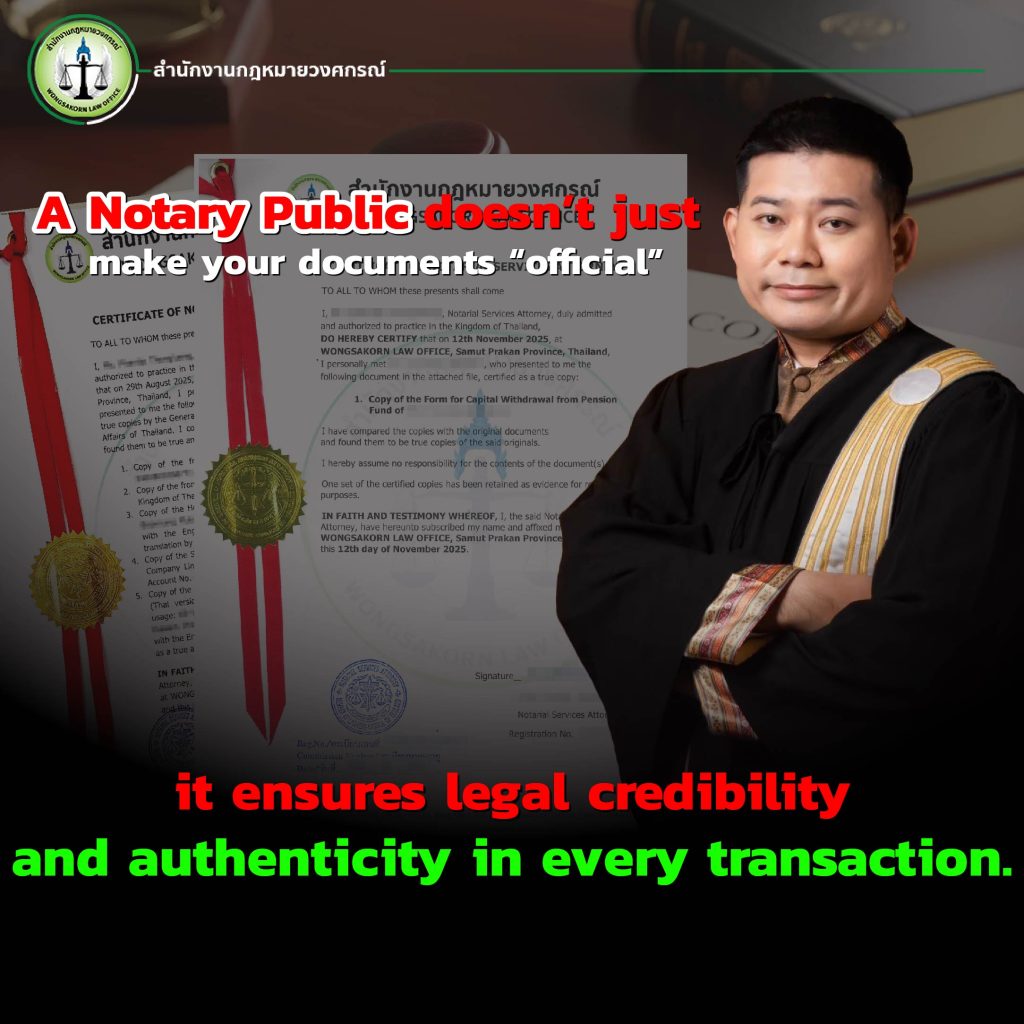
Notary Public in Thailand refers to a licensed lawyer authorized by the Lawyers Council of Thailand to certify documents and signatures for international legal use.

Their role is governed by the Regulations of the Lawyers Council on Document and Signature Certification (B.E. 2557), which allows only trained and certified lawyers to sign and seal documents as Notary Publics.

Main Duties of a Notary Public

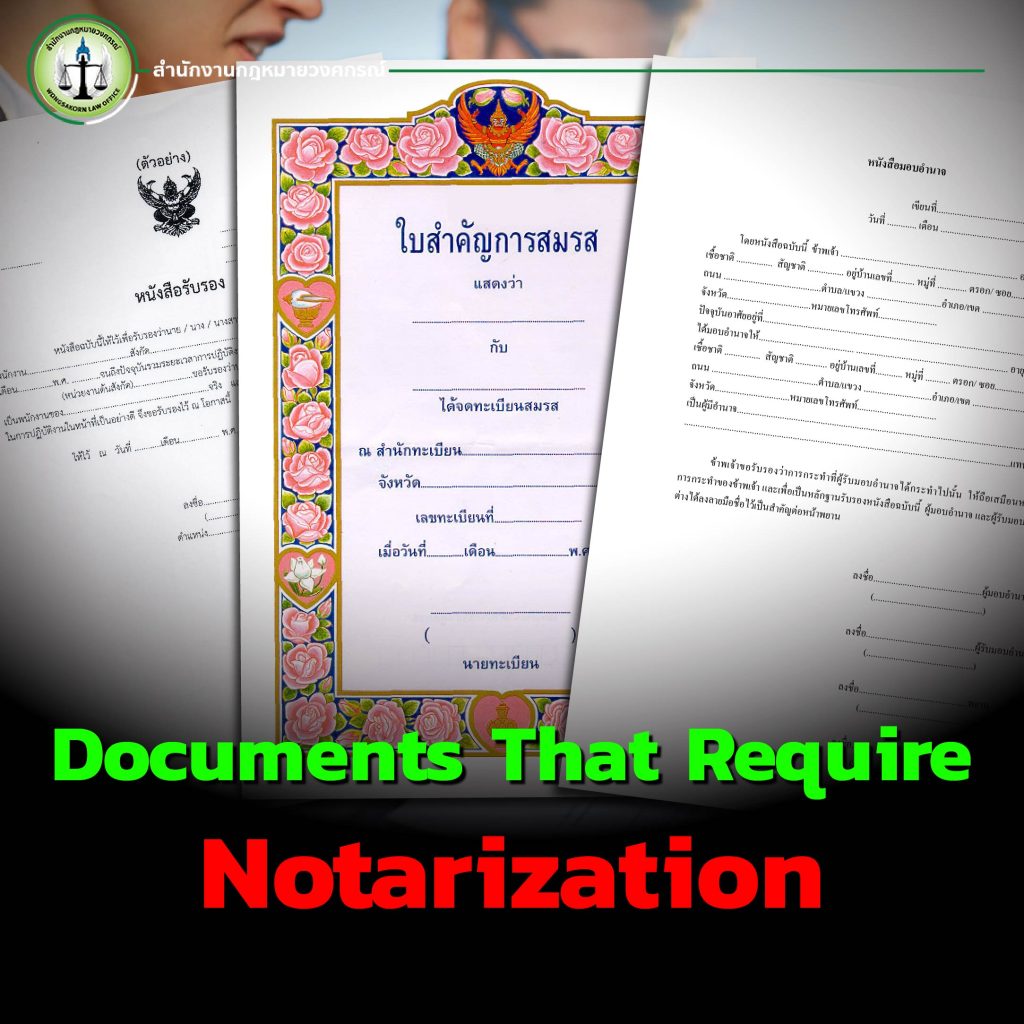
A Notary Public is responsible for authenticating various legal documents, including:

1.Signature Certification – Verifying that the person signing is the true owner of the signature, such as for contracts, power of attorney, employment certificates, or invitation letters.

2.Certified True Copies – Confirming that a copy matches the original document (e.g., passport, ID card, house registration, company certificate, or official record).

3.Translation Certification – Certifying that an official translation (e.g., marriage certificate, academic transcript, or contract) is accurate for embassy or foreign use.

4.Power of Attorney Certification – Used when someone abroad authorizes another person to act on their behalf in Thailand (e.g., property transactions, government filings, or banking matters).

5.Affidavit or Declaration Certification – Used in some cases for submission to foreign courts or international organizations.

Why Do You Need a Notary Public?

A Notary Public’s certification confirms the authenticity and legitimacy of both the document and the signer under Thai law making it valid for use abroad.

Without a Notary Public’s endorsement, foreign agencies or embassies may reject or invalidate your document, causing unnecessary delays and expenses.

Common situations requiring Notary Public certification include:

  • Visa or nationality applications
  • Study or work abroad
  • Banking or investment transactions with foreign institutions
  • Cross-border property purchases
  • Overseas company registration or contracts with foreign investors

Difference Between Notary Public and Government Certification

While government agencies such as the Ministry of Foreign Affairs (MFA) also provide document authentication, their process can be lengthy and complex.

Notary Public, on the other hand, can complete certification within one day, and their endorsement is accepted by most embassies, multinational companies, and international organizations especially before applying for an Apostille or further legalization at the MFA.

In short, a Notary Public is the first essential step to ensure your Thai documents are legally recognized overseas.

How to Choose a Reliable Notary Public

Since unauthorized individuals sometimes pose as Notary Publics, you should always verify that:

  • The certifier is a licensed lawyer authorized by the Lawyers Council of Thailand.
  • The seal includes the lawyer’s full name, registration number, and Notary Public license number.
  • The document is signed and formatted according to legal standards.

Proper certification prevents embassy rejection or document delays.

Wongsakorn Law Office  One-Day Notary Public Service in Bangkok and Metropolitan Areas

Wongsakorn Law Office provides Notary Public services by lawyers officially licensed by the Lawyers Council of Thailand.

Our comprehensive services cover:

  • Signature, document, and translation certification
  • Power of attorney and business document notarization
  • Embassy and international submission certification

We understand that time is crucial for clients using documents abroad.
Simply bring your original documents and ID (or passport) to our office, and you’ll receive Notary-certified documents within one day.

Our legal team will guide you through every step from reviewing your documents and formatting them correctly to preparing for embassy or foreign submissions.

A Notary Public is the key to ensuring your documents are “valid worldwide.”

Whether for business, study, or work overseas, notarization guarantees credibility and international acceptance.

If you’re in Bangkok or nearby provinces and need fast, lawful notarization Wongsakorn Law Office is ready to assist you with complete, accurate, and one-day service.

Which Court Has Jurisdiction? Thailand or China When Foreign Partners Dispute Company Shares?

Registering a business partnership isn’t just about completing paperwork. From a legal standpoint, when business partners are from different countries such as a Chinese and a Thai national one key question often arises:
“If a dispute occurs, which country’s court has the authority to decide the case?”
This article explains the issue in simple terms, with real-world examples that often occur in international business operations.

Case Example: Thai–Chinese Partners with a Company in Thailand but Contract Signed in China

Mr. A, a Chinese citizen, and Mr. B, a Thai citizen, entered into a business contract in China. Later, Mr. A established a company in Thailand and allowed Mr. B to hold some shares, making him a business partner in the Thai company.
As the business grew, Mr. A, the real owner, decided that he should hold all the shares and wanted to sue to reclaim the shares from Mr. B.

This raises the question:
Should the lawsuit be filed in a Thai court or a Chinese court?
The answer depends on legal principles governing company registration and jurisdiction in each country.

Legal Principle: Jurisdiction (“Which Court Has Authority”)

The first issue to consider is which country the dispute directly concerns. For example:

  • If the dispute relates to the business contract made in China, such as profit sharing or investment terms, then the case falls under Chinese jurisdiction.
  • But if the dispute concerns shares in a company registered in Thailand, regardless of who the shareholders are, it must be filed in a Thai court, as it concerns a Thai legal entity governed by Thai law.

Therefore, if the shares in question belong to a company registered in Thailand, even if the agreement originated in China, the case should be brought before a Thai court.

Importance of Proper Company Registration

This case highlights how proper company or partnership registration directly affects jurisdiction and shareholder rights.

If Mr. A and Mr. B had clearly specified the governing law and jurisdiction clause in their initial contract for instance, naming which court would handle disputes the matter would have been simpler.
However, many business partners overlook this step, forcing courts to later determine where the dispute arose and which court has jurisdiction.

That’s why, when registering a company or partnership, especially one involving foreign investors, it’s essential to have a lawyer experienced in international law review the agreement to prevent future conflicts over jurisdiction and shareholder rights.

Filing a Lawsuit to Reclaim Shares in a Thai Company

In the above case, since the company is registered in Thailand, a lawsuit to reclaim the shares must be filed in a Thai civil court, such as:

  • A petition to remove an unlawfully listed shareholder,
  • A lawsuit to transfer the shares back, or
  • A claim to recover dividends or benefits derived from the shares.

The Thai court will consider the case under the Civil and Commercial Code, along with corporate documents such as the company’s Articles of Association, shareholder list (Bor Chor 5), and proof of share payment.

If Mr. A also claims that the original contract made in China was breached, he may file a separate lawsuit in China, though its judgment will not directly affect the Thai share registry unless formally recognized by a Thai court, a process that can be complex and time-consuming.

Understanding “Two Legal Systems” in Cross-Border Business

International business partnerships require understanding both countries’ legal systems.
For example, if a Chinese national invests in Thailand, Chinese law may impose restrictions on foreign investment or currency transfers. Therefore, having a legal team familiar with both Thai and Chinese law is crucial to structuring the business properly and avoiding legal risks.

Wongsakorn Law Office Your Legal Partner in Thailand and China

If you or your company are facing disputes involving foreign shareholders or shares in a Thai-registered company, consult with a lawyer experienced in company registration and international business law.

Wongsakorn Law Office has a team of experts in both Thai and foreign law including Chinese lawyers based in our firm  who can handle and coordinate cases both in Thailand and China professionally.

Whether your case involves company registration, share transfer, or shareholder disputes,
We’re ready to represent and assist you across both Thailand and China.

Company Partnership Registration Why You Should Consult a Lawyer from the Start?

Because most legal problems begin with the wrong foundation.

In an era where more people are starting their own businesses, whether family enterprises, startups, or ventures between friends, “company partnership registration” marks a crucial starting point for every business. It establishes the company’s legal status and defines the rights, duties, and relationships among all “partners” or “shareholders” within the organization.

However, many people still view company registration as merely a “paperwork process” that they can handle themselves or delegate to a general accounting firm without consulting a lawyer. In truth, this is the most critical stage where legal risks often begin, sometimes silently, with long-term consequences.

Registering a Partnership Company Is Not Just Paperwork It Defines Your Power Structure

Many believe that company registration is simply filling out forms, declaring registered capital, and naming directors according to the Department of Business Development’s requirements. In reality, it is the process of designing the company’s legal framework, which will bind every stakeholder for years to come.

Those documents
• the company’s objectives,
• shareholding ratios,
• directors’ powers,
• voting conditions,
• and even share transfer rules
all carry legal implications that can “grant authority” or “strip rights” from certain partners without them realizing it.

For example, one partner may sign papers allowing another to be the sole authorized director without any limitations. Later, in case of conflict, the other partners may have no access to the company’s bank accounts or essential documents because the Articles of Association legally grant full authority to that single director.

A Wrong Start = Problems That Are Hard to Undo

Business lawyers frequently encounter the same problems when clients come for advice after issues arise often because they began without proper legal guidance. Common examples include:

1. Disputes among partners over profit distribution or management power  because the roles, capital contributions, and decision-making rights were never clearly defined at the beginning.

2. Inability to change partners due to poorly written or legally invalid agreements that prevent share transfers.

3. Unnecessary taxes and fees caused by registering under an unsuitable entity type, e.g., registering as a limited partnership instead of a limited company.

4. Repeated amendments to the company’s Articles due to poor initial planning.

Most importantly, when a dispute arises, everything goes back to what was written during registration. If the contracts or documents were vague or flawed, they could easily become legal disadvantages in court.

Why Should You Have a Lawyer Involved from the Start?

1.Deeper legal and structural insight — Lawyers can analyze your business type and suggest the most suitable structure (e.g., limited company vs. limited partnership), ensuring compliance with tax laws and long-term goals.

2.Drafting a Shareholders’ Agreement — This internal agreement governs share transfers, management decisions, capital increases, director appointments, and exit procedures. Without it, resolving future disputes becomes extremely difficult.

3.Legal document review and compliance — Ensuring your company name, objectives, and all filings meet legal requirements and government policies.

4.Tax and legal risk prevention — Lawyers can design proper shareholding and financing structures, ensuring compliance with both civil and tax laws.

5.Enhanced business credibility — Properly registered companies with lawyer-drafted documents appear more trustworthy to investors, partners, and financial institutions.

Waiting Until Problems Arise Costs More Time and Money

Many entrepreneurs only consult a lawyer when a dispute arises, a partner withdraws, a lawsuit is filed, or tax problems occur. But by that time, it is often too late. Registration documents cannot always be amended retroactively.

Having a lawyer from the beginning is an investment in prevention, not just problem-solving. Every document you sign from day one becomes the legal foundation of your company. A correct beginning saves you from costly corrections or lawsuits later.

Let Wongsakorn Law Office Handle Your Company Partnership Registration

Wongsakorn Law Office provides comprehensive legal services for company partnership registration and business structuring.

Our services include:
• Shareholder and director structure consultation
• Drafting Shareholders’ Agreements
• Preparing and reviewing Articles of Association
• Company and partnership registration
Ongoing tax and business legal consultation

Our experienced lawyers specialize in domestic and international business law, taxation, and registration procedures ensuring that your business begins on a solid, lawful, and secure foundation.

“Company partnership registration” is not just the start of a business  it is the foundation of its legal identity.

 Don’t wait for conflicts to arise before consulting a lawyer.
Let Wongsakorn Law Office guide you from the very beginning to ensure your business starts right, safe, and strong. >> Contact us today <<

Draft Your Contract Right the First Time  Why Business Owners Should Let Professional Lawyers Handle English Contract Drafting?

In today’s complex and competitive business world, a contract is the heart of every agreement whether it’s an investment deal, an international trade, an employment contract, or a partnership.
Therefore, contract drafting is not something that just anyone can do. Even a slight misuse of words or inaccurate legal terminology can lead to serious financial or legal consequences in the future.

Many companies, especially small and medium-sized enterprises often start by letting “someone in the company” or the “administrative department” draft the contract themselves, citing reasons such as “saving time and costs.” However, what usually follows is that these contracts become a ticking time bomb, causing problems later when disputes arise, or when the terms are unclear, incomplete, or legally unenforceable.

Why Is In-house Contract Drafting Risky?

1. Incorrect Use of Legal Language
English or foreign-language contracts often contain legal terms that seem simple but have very specific meanings in law such as “Shall,” “May,” “Best Efforts,” or “Time is of the essence.” A single misused word can completely change the obligations of the parties.

2. Lack of Legal Implication Analysis
Drafting a contract is not merely translating from Thai into English; it requires understanding different legal systems. For example, Thai Civil and Commercial Law differs from English or U.S. law. A lawyer ensures that the contract aligns with both legal frameworks so that it is valid and enforceable across jurisdictions.

3. Failure to Cover Possible Scenarios
Non-lawyers tend to write contracts based on “what they want to happen.” Lawyers, however, draft based on “what could happen” such as breach of contract, early termination, late delivery, or non-payment to minimize future risks.

4. Costly Corrections Later
Many organizations that try to draft contracts internally end up consulting lawyers later for “review” or “revision.” Unfortunately, once the damage is done such as unclear terms or missing clauses it cannot be easily fixed. Drafting correctly from the start saves time and long-term legal costs.

Common Real-world Problems from Poorly Drafted Contracts

  • International sale contracts that fail to specify governing law leading to cross-border litigation and huge expenses.
  • Employment contracts with foreigners mistakenly labeling workers as “Contractors” instead of “Employees,” resulting in lost labor protection.
  • Joint venture contracts that fail to define profit-sharing or decision-making authority, causing shareholder disputes.

All these issues stem from contracts not reviewed or drafted by lawyers, and the cost to fix them later is often several times higher than doing it right the first time.

Why Should You Let a Lawyer Draft Your Contract?

1. Fluent in Both Language and Law
Professional lawyers who specialize in English contracts understand legal language and business context ensuring precise communication of both parties’ intentions.

2. Minimize Legal Risks
Lawyers consider all legal aspects, including regulatory compliance and judicial interpretation, ensuring contracts are watertight and enforceable.

3. Enhance Business Credibility
Foreign partners have more confidence when they see that contracts are drafted by a reputable law firm, reflecting professionalism and mutual respect.

4. Tailored to Your Business
Lawyers can customize contracts to fit your business model whether supply agreements, franchise contracts, or service agreements ensuring they reflect real operations.

Draft Now or Fix Later A Lesson for Many Entrepreneurs

Many companies start by drafting contracts themselves, only to encounter disputes later unpaid invoices, conflicts with partners, or claims from employees under loosely written terms. Eventually, those contracts end up in the lawyer’s hands for review or amendment anyway.

Rather than wasting time fixing problems later, having a lawyer draft the contract from the beginning is the smarter choice. It allows your business to move forward with confidence and peace of mind.

Don’t Wait Until Problems Arise  Let Wongsakorn Law Office Handle It from the Start

Wongsakorn Law Office provides professional contract drafting services in:

  • Thai, English, and Chinese languages
  • All types of business contracts: sales, services, joint ventures, leases, foreign employment, and more
  • Contract review and amendment services
  • Comprehensive business legal advisory

Our team of expert business and international lawyers understands both Thai and foreign legal systems and can communicate fluently in English and Chinese ensuring your contract is accurate, complete, and legally enforceable in any jurisdiction.

A well-drafted contract isn’t just paperwork, it’s your company’s first layer of protection.
If you want your business to grow with stability, transparency, and legal confidence, let Wongsakorn Law Office draft your contract right from the start.

Why Are Accident Scene Maps Important in Car Accident Cases? And How Can Drone Technology Enhance Their Accuracy?

When a road accident occurs whether it involves a private car, motorcycle, truck, or even public transportation one of the most critical pieces of evidence required by all parties, including the police, courts, lawyers, and insurance companies, is the accident scene map.

This map is not merely a rough sketch of the collision site; rather, it is an essential tool used to prove facts and illustrate the sequence of events systematically, which can directly affect the judgment of who is at fault.

Importance of Accident Scene Maps in Car Accident Cases

Accident scene maps are vital documents frequently included in investigation reports and court proceedings because they serve to:

  • Verify the positions of vehicles and persons involved: Showing where each vehicle was at the time of the incident.
  • Indicate directions of movement: Helping determine which driver may have been negligent.
  • Record surrounding conditions: Such as traffic signals, road markings, signage, pedestrian crossings, or obstacles.
  • Serve as legal evidence: Courts and lawyers rely on accident maps to explain and present cases before judges.

Many car accident cases have been overturned or weakened simply because the accident map was incomplete or lacked crucial details, preventing victims from fully proving their rights. Therefore, preparing an accurate accident map is a process that must not be overlooked.

Why Are Drones Important for Creating Accident Scene Maps?

Traditionally, accident maps were drawn by hand or based on ground-level photographs, which often lacked clarity and detail. With the advent of drone technology, accident scene mapping has become more precise and effective.

1.Aerial Perspective
Drones capture images from above, providing a clear overview of the accident site. This includes roads, collision points, traffic signals, and surrounding environments all in a single frame greatly improving analysis accuracy.

2.High Resolution and Precision
Drone imagery can capture details down to the centimeter level. This is invaluable for verifying collision points, brake marks, or skid traces that may not be visible from the ground. These images can also be processed into digital maps for legal use.

3.3D Mapping
Modern technology allows drone footage to be processed into 3D maps that realistically illustrate the accident scene. This helps courts and lawyers understand the sequence of events more easily and can even support accident re-enactments.

4.Reducing On-Site Risks
Accident sites are sometimes dangerous or congested. Using drones eliminates the need for ground personnel to measure or record details directly, thereby reducing risk.

The Lawyer’s Role in Using Drone-Based Accident Maps

Having an accurate accident scene map serves as a critical legal weapon in litigation. With drone data, lawyers can:

  • Analyze the driving behaviors of all parties in detail.
  • Present clear and indisputable evidence in court, rather than relying solely on testimonies.
  • Increase credibility when negotiating compensation with insurance companies.

In other words, drone-based accident maps are not just photographs; they are tools that enhance the victim’s chances of obtaining justice.

Comparison: Graphic Maps vs. Drone-Based Maps

1.Accuracy

o Graphic: Manually drawn, often prone to errors, especially with small details (brake marks, distances, collision angles).

o Drone: Provides actual aerial images with precise data, reducing misinterpretation.

2.Completeness of Perspective

o Graphic: Usually limited to 2D diagrams, giving only a rough overview.

o Drone: Offers a full aerial view and can be developed into 3D models.

3.Credibility in Court

o Graphic: May be questioned for accuracy since it is a reconstruction.

o Drone: Supported by real photographic evidence, highly credible.

4.Convenience

o Graphic: Time-consuming, requiring manual measurements and sketches.

o Drone: Captures complete images within minutes and processes them into usable maps.

5.Cost

o Graphic: Cheaper but less reliable.

o Drone: Slightly more expensive, but well worth the quality and legal strength it provides.

Conclusion: Drone-based accident maps surpass graphic maps in accuracy, reliability, and completeness, making them ideal for car accident cases where solid evidence is essential.

Drone Accident Mapping Services by Wongsakorn Law Office

To ensure that victims receive true justice, Wongsakorn Law Office has established a specialized team providing drone mapping services for road accident cases. The team is led by Pol. Lt. Pisuth Ritkajorn, Deputy Inspector of Planning Division 3, Office of the Commissioner-General, Royal Thai Police, together with certified drone aviation experts. All team members have been officially accredited by the Civil Aviation Authority of Thailand (CAAT), ensuring legality, safety, and the highest quality of work.

With extensive experience in both litigation and using drone-based evidence, we provide professional support whether you are a victim seeking compensation or a defendant proving your innocence.

Accident scene maps are decisive evidence in car accident trials. Using drones ensures fact-finding is accurate, complete, and credible compared to traditional methods.

👉 If you are facing a car accident case and need strong evidence, choosing Wongsakorn Law Office’s Drone Accident Mapping Service is the key to confidently achieving justice.

“Pol. Col. Santipat Prommajul” – A Legendary Commander in Combating Cybercrime, Now Serving as Legal Advisor to Wongsakorn Law Office

Cybercrime: A Digital Age Threat and the Crucial Role of Lawyers in Litigation

In today’s world, where technology and the internet play a central role in daily life, cybercrime has become a silent threat causing damages to individuals, organizations, and society at large. One of the most vital tools in investigating and proving cases of this nature is Computer Traffic Data, which serves as crucial evidence in both investigations and litigation.

What is Computer Traffic Data?

Computer traffic data refers to information that identifies the source, communication path, date and time, usage volume, and nature of computer communications excluding the actual content. Examples include:

  • IP addresses used for connection
  • Date and time of emails or messages sent
  • Website access routes
  • Network access logs

Although such data may appear minor, it can directly link perpetrators to crimes such as hacking, data forgery, or online fraud.

Online Threats of Concern

Cybercrime today has become increasingly complex and widespread, taking various forms such as:

1. Online Scams / Phishing – Fake emails or messages impersonating banks, logistics companies, or platforms to trick victims into disclosing personal data or transferring money.

2. Identity Theft – Criminals misuse national ID numbers, bank account details, or credit card information to commit fraud.

3. Hacking & Cyber Attacks – System breaches, malware installations, or DDoS attacks causing severe harm to businesses and infrastructure.

4. Defamation and Online Rights Violations – Fake accounts, defamatory posts, or unauthorized sharing of personal data.

5. Online Investment Fraud – Ponzi schemes, fake digital assets, or fraudulent investment platforms.

These threats cause financial loss, emotional distress, and reputational harm. Without proper legal action, cybercriminals will only grow bolder.

Why Are Lawyers Essential in Cybercrime Cases?

Victims often attempt to report cybercrimes or collect evidence on their own. However, cybercrime litigation is highly complex, involving specialized laws and digital evidence that must be handled correctly. Mishandling evidence can render it inadmissible in court.

Lawyers play a vital role by:

  • Providing legal consultation and strategy
  • Collecting and preserving digital evidence in compliance with procedures
  • Representing victims in court to claim damages
  • Negotiating settlements to secure faster remedies

Having a lawyer significantly increases the chances of uncovering the truth and obtaining justice.

The Expertise of Pol. Col. Santipat Prommajul – Advisor to Wongsakorn Law Office

One of Thailand’s foremost cybercrime experts is Pol. Col. Santipat Prommajul, former Commander of the Technology Crime Suppression Division.

Currently, he serves as Advisor to Wongsakorn Law Office, offering in-depth guidance on handling cybercrime litigation and overseeing the seizure and analysis of digital evidence, which is central to casework.

In his public lecture on “Electronic Evidence and Digital Forensics” (Faculty of Law, Thammasat University, October 25, 2015), Pol. Col. Santipat outlined international-standard practices in digital evidence seizure and preservation.

General Guidelines for Seizing Digital Evidence

The process must be meticulous to ensure data reliability, including:

1.Securing the Scene – Preventing unauthorized access or data tampering.

2.Evidence Security – Isolating areas with digital devices or storage media.

3.Seizure of Devices – Computers, mobile phones, hard drives, or flash drives.

4.Systematic Documentation & Storage – Recording details, mapping, labeling, and packaging for transport.

5.Forensic Examination – Conducting digital analysis in certified labs.

Cybercrime Can Be Tackled – But Only Professionally

Cybercrime is a danger that anyone may face, from online fraud to data theft or reputational attacks. Addressing such crimes requires specialized knowledge of digital evidence.

With a professional legal team particularly lawyers working alongside experts like Pol. Col. Santipat Prommajul victims can be assured their cases are handled lawfully and effectively, maximizing their chances of obtaining justice and rightful compensation.

Can Foreigners Who Invest and Contribute to Thailand Obtain Thai Citizenship?

Obtaining Thai citizenship is a dream for many foreigners who come to live, work, or invest in Thailand. The country offers stability, convenience, rich natural resources, and cultural heritage that attract people from all over the world. A common question is: if a foreigner invests and contributes positively to Thailand, are they entitled to apply for Thai citizenship?

This article clarifies the legal framework, conditions, and procedures for applying for Thai citizenship, giving accurate and complete information for those interested.

General Principles of Acquiring Thai Citizenship

Thai law provides three main pathways to acquire Thai citizenship:

1. By Birth – A child born in Thailand to a Thai parent, or a child born abroad to a Thai parent, is eligible for Thai citizenship by birth.

2. By Marriage – Foreigners married to Thai citizens who meet the legal requirements can apply for naturalization.

3. By Naturalization – Foreigners residing in Thailand continuously and meeting the statutory conditions can apply for naturalization as Thai citizens.

Naturalization for Foreigners

For foreigners who invest, run businesses, or conduct professional activities in Thailand, acquiring Thai citizenship typically falls under naturalization. Key requirements include:

  • Be at least 18 years old and legally competent under Thai law.
  • Reside continuously in Thailand for at least five years prior to application (with possible exceptions for those who have contributed significantly to the nation).
  • Have good conduct with no serious criminal record.
  • Have stable employment and income. Foreign investors must prove genuine business operations and lawful income.
  • Demonstrate knowledge of Thai language – speaking, reading, and comprehension.
  • Pay taxes lawfully for several consecutive years.

Investment and Contributions to Thailand

Many wonder if simply investing or doing good deeds in Thailand grants automatic Thai citizenship. The answer is no  but such actions serve as strong supporting factors.

Examples:

  • Foreign investors who establish companies, create jobs, generate income, and pay taxes are viewed as contributing to the nation.
  • Individuals who contribute to Thai society, such as donating to public causes, supporting community projects, or engaging in social welfare, may be considered for special approval.

However, investment or good deeds alone do not guarantee citizenship. They increase the weight and chances of approval during the application process.

Steps to Apply for Thai Citizenship

1. Prepare Documents – Passport, work permit, residency evidence, tax records, marriage certificate (if any), and proof of income.

2. Submit Application – At the Department of Provincial Administration, Ministry of Interior.

3. Pay Fees – Currently, fees amount to tens of thousands of baht, depending on the case (general foreigner or spouse of a Thai citizen).

4. Attend Interview – Questions cover Thai language skills, personal history, and cultural understanding.

5.  Await Decision – The process can take months to years, involving multi-level checks before official publication in the Royal Gazette.

Key Points and Precautions

  • Even large investments in Thailand do not guarantee Thai citizenship. Approval rests entirely with government authorities.
  • Contributions such as donations or community service can support the application but cannot substitute for the legal requirements.
  • Consulting a lawyer or legal expert in nationality law increases accuracy and the chance of success.

Legal Consultation on Thai Citizenship for Foreigners – Wongsakorn Law Office

Foreigners who invest and contribute positively to Thailand can apply for Thai citizenship but not solely based on investment or good deeds. Applicants must still meet all statutory requirements and undergo thorough government review.

If you are a foreigner seeking Thai citizenship, you should prepare in advance: proper documentation, continuous residence, lawful tax compliance, and proof of value to Thai society. Having a legal advisor ensures a smoother process and higher chances of approval.

At Wongsakorn Law Office, our team of lawyers and experts in immigration and nationality law are ready to provide consultation and guide you through every step of the application from eligibility checks and document preparation to submission with relevant authorities.

If you or someone you know plans to apply for Thai citizenship, feel free to contact Wongsakorn Law Office for professional legal advice and accurate guidance. “Your rights, we are here to protect.”

Line @ คลิก! โทรหาเรา คลิก!