What Foreigners Need to Know Before Opening a Company in Thailand? Conditions, Restrictions, and the Importance of a Legal Advisor

Thailand is one of the top destinations for foreigners looking to invest or start a business, whether in tourism, services, real estate, or manufacturing. Thanks to its strategic location in Southeast Asia, skilled labor force, competitive business costs, and high market potential, the country attracts investors worldwide. However, when foreigners open a company in Thailand, they cannot operate as freely as Thai nationals. They must comply with clearly defined legal conditions and restrictions.

This article explains what foreigners must know before opening a company in Thailand, the key conditions and limitations, why having a legal advisor is essential, and how to choose the right law firm to ensure long-term business success.

Key Conditions for Foreigners Opening a Company in Thailand

1.      Shareholding Structure

  • A Thai limited company must have at least three shareholders.
  • If foreigners hold more than 50% of the shares, the company falls under the “foreign business” category according to the Foreign Business Act (FBA), which imposes further restrictions.
  • If operating in restricted business categories under the FBA, a Foreign Business License (FBL) or Foreign Business Certificate is required.

2.      Minimum Registered Capital

  • Foreign business companies must have a minimum registered capital of THB 2 million per business.
  • For restricted businesses, the minimum rises to THB 3 million.
  • If the company does not fall under the FBA (e.g., majority Thai shareholders), registered capital can start at a standard level.

3.      Restricted Business Categories
 The Foreign Business Act (1999) prohibits or restricts certain activities, such as:

  • Retail and wholesale businesses with low capital requirements
  • Professional services like legal and accounting work
  • Real estate and agricultural activities

Foreigners must carefully verify whether their intended business falls into restricted categories and plan the company structure accordingly.

4. Work Permits and Visas

  • Foreigners working in their own company need a Work Permit and a Non-B Business Visa.
  • The company must employ Thai nationals according to legal ratios to support work permit applications.

Restrictions Foreigners Should Be Aware Of

1.Land Ownership – Foreigners generally cannot own land directly in Thailand (with limited exceptions under specific laws). Long-term leases are commonly used in real estate investments.

2.Labor Restrictions – Certain occupations are reserved exclusively for Thai nationals, such as sales, driving, and skilled trades.

3.Complex Approval Processes – Obtaining a Foreign Business License or BOI (Board of Investment) promotion can be time-consuming and subject to strict conditions.

4.Legal Risks – If the company structure is not compliant, such as using nominee shareholders, it may lead to prosecution and revocation of rights.

Why Having a Legal Advisor Is Crucial?

When foreigners open a company in Thailand, they must navigate multiple laws, including business law, labor law, tax law, and immigration law. Having a legal advisor is essential for the following reasons:

1.Accurate Legal Guidance – Prevents unintentional violations, such as entering prohibited business categories or mismanaging shareholder structures.

2. Document Preparation & Review – Ensures contracts, company bylaws, and commercial agreements are properly drafted to reduce future risks.

3.Licenses and Visas – Lawyers can prepare documentation and liaise with authorities to ensure compliance.

4.Dispute Prevention – Legal advisors can handle disputes to protect company interests.

5.Tax and Business Structure Planning – Helps optimize efficiency and reduce tax burdens.

Choosing the Right Law Office

Foreigners opening a company in Thailand should select a law firm with direct experience in handling foreign clients, expertise in business law, labor law, and immigration law.

Wongsakorn Law Office is a trusted choice for both Thais and foreigners. Our team of lawyers and legal consultants specializes in assisting foreigners opening companies in Thailand from business structure planning and company registration to license applications, visa renewals, work permits, and dispute prevention.

Building a Stable Business in Thailand with the Right Legal Support

Foreigners opening a company in Thailand is achievable but requires strict compliance with legal conditions and restrictions. Understanding the law, preparing complete documentation, and having a dedicated legal advisor ensures smooth, safe, and lawful operations.

If you are a foreigner planning to open a company in Thailand or already running a business and wish to reduce legal risks, you can consult the Wongsakorn Law Office. We provide end-to-end guidance to help your business grow securely and sustainably in Thailand.

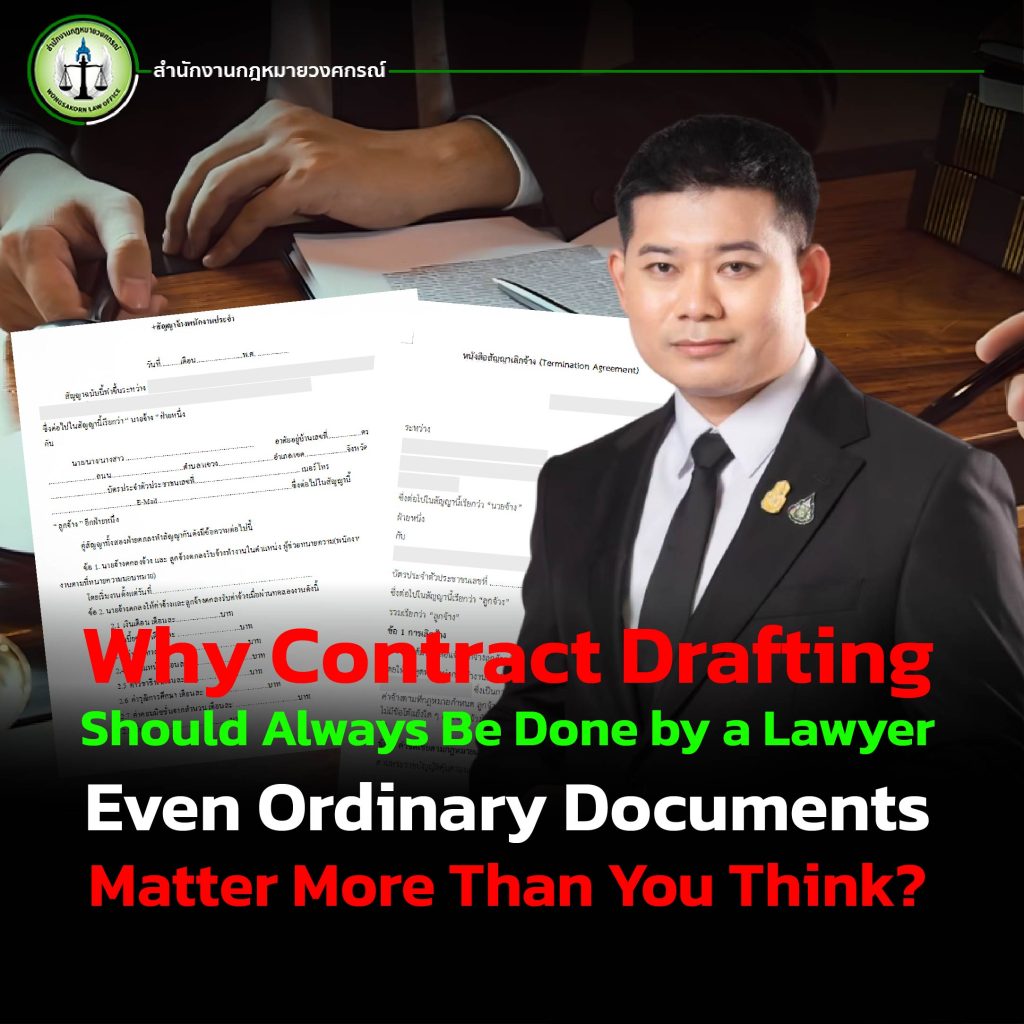
Drafting Legal Documents: Using Online Templates vs. Hiring a Lawyer – Which Is Better?

In today’s business world, the term “contract” or “legal document” is no longer something distant. Whether you are doing business, buying or selling, investing, or even signing agreements with partners and employees, one essential part is drafting legal documents that clearly define the rights, duties, and responsibilities of each party.

However, many people are uncertain whether they should rely on ready-made templates available online, or invest in hiring a lawyer to draft documents tailored to their needs. Which option is more worthwhile and safer? This article will compare the differences between these two approaches to help you make a well-informed decision.

Drafting Documents with Online Templates: Pros and Limitations

Pros

1.Convenient and Fast – Within minutes of searching, you can download a template and start using it right away.

2.Low Cost – Many sample templates are free or cost only a fraction of hiring a lawyer.

3.Sufficient for Simple Matters – If the agreement is not complex or high in value, an online template may be sufficient.

Limitations

1.Not Tailored to Your Context – Online forms are generic and not designed for the specific details of your transaction.

2.Risk of Misinterpretation – Legal language in templates can be vague, leading to multiple interpretations. In disputes, courts rely strictly on the document’s wording.

3.Possibly Outdated – Laws change frequently, and online templates may no longer comply with current Thai law.

4.Lack of Credibility – Using generic templates may not inspire trust, especially with business partners or larger organizations.

Why Hiring a Lawyer to Draft Documents Is Better?

When it comes to drafting legal documents, many may opt for the cheapest and easiest route using online templates. But the reality is that contracts govern critical rights and obligations. Even small mistakes could result in disputes or costly disadvantages.

Hiring a lawyer to draft documents is therefore the safer choice, offering more than just legal correctness. It enhances credibility and reduces risks in the long run. Here’s why:

Advantages

1.Tailored to Your Needs – Lawyers draft based on your specific requirements, ensuring complete and relevant details.

2.Clear Legal Wording – With expertise, lawyers use precise language that avoids ambiguity.

3.Reduced Legal Risks – Lawyers anticipate loopholes and include clauses to prevent disputes.

4.Enhanced Credibility – A contract drafted by a lawyer builds confidence and trust with the other party.

5.Advisor in Case of Disputes – If conflicts arise, the lawyer who drafted your document already understands it thoroughly and can represent you immediately.

Disadvantage

  • Higher Cost – While it costs more than online templates, the expense is worth avoiding future financial losses or lawsuits.

Which Option Should You Choose?

The answer depends on the importance and value of the transaction. For minor matters, free templates may suffice. But for high-value or complex business dealings, hiring a lawyer is an investment in safety and long-term security.

After all, the cost of litigation from an unclear or faulty document could far exceed the lawyer’s fee.

Draft Documents with Confidence – Consult Wongsakorn Law Office

Drafting legal documents is more than just putting words on paper. It defines rights, obligations, and even the future of the contracting parties. If you’re unsure whether to use an online form or hire a lawyer, the safer and more credible choice is clear.

👉 Wongsakorn Law Office offers professional drafting services for all types of contracts and legal documents. Our experienced lawyers ensure every detail is correct, protecting your interests and minimizing risks in every transaction.

Employee Resigns and Deletes LINE Groups / LINE Official or Company Data – What Can Employers Do?

In today’s digital-driven business environment, communication and operations rely heavily on online platforms. A problem that many companies increasingly face is that after resigning, employees may not only submit their resignation and hand over tasks as required, but in some cases, they go further deleting work-related LINE groups, removing the company’s LINE Official account, or even erasing crucial computer data. Such actions can cause serious harm to the organization.

The key question for many employers is: “What can the company do if this happens?”
This article explains the employer’s legal rights, possible courses of action, and why consulting a lawyer is essential.

Employee Duties and Responsibilities Toward the Company

Employees are not only responsible for performing assigned tasks but also for safeguarding the employer’s interests, including protecting information, assets, and tools used for work such as computers, LINE Official accounts, and client-related documents.

Upon resignation, employees still have the duty to properly hand over work and avoid causing damage to the company. Failure to do so gives employers the right to pursue legal remedies.

How Does Deleting LINE Groups, LINE Official, or Company Data Cause Damage?

With businesses relying on digital platforms for communication, customer contact, and data storage, these tools are valuable assets comparable to physical property. Thus, when a disgruntled employee resigns and deletes a LINE group, LINE Official, or company computer data, it directly causes operational, reputational, and financial losses.

Examples of potential damage include:

1.Deleting LINE work groups – Often used for internal communication, deletion can erase important records and disrupt workflow tracking.

2.Deleting LINE Official – For many businesses, LINE Official is a primary customer communication channel. Deletion or access denial can result in customer loss, damaged credibility, and revenue decline.

3.Deleting computer data – Removing client files or key documents is equivalent to destroying the company’s digital assets, directly impacting business operations.

What Legal Actions Can Employers Take?

1. Civil Proceedings
Employers can sue employees for damages if the deletion of data or LINE Official leads to financial loss, such as losing clients, revenue, or incurring recovery costs.

2.Criminal Proceedings
Under Thailand’s Computer Crime Act B.E. 2550 (2007), amended B.E. 2560 (2017), unauthorized deletion or destruction of computer data can constitute a criminal offense.

oSection 9: Destroying or altering computer data belonging to others is punishable by fine and imprisonment.

oSection 10: Damaging computer systems also carries penalties.
Employers can also file criminal charges if a LINE Official account considered a business asset is deleted.

3. Labor Law Measures
If the misconduct occurs before the employee’s termination takes effect (e.g., during the notice period), employers may terminate employment without severance or claim compensation under the employment contract.

Risks of Inaction by Employers

Failure to respond may result in:

  • Loss of customer base and business opportunities
  • Loss of vital strategic data
  • Damage to corporate reputation and credibility

Why Should Employers Consult a Lawyer?

While employers have legal rights, handling cases alone can be complex. Lawyers provide critical support by:

1.Assessing the case – Determining whether civil, criminal, or labor remedies apply.

2.Gathering evidence – Ensuring proper collection of chat records, screenshots, or computer logs admissible in court.

3.Filing lawsuits systematically – Lawyers streamline proceedings and reduce employer burden.4.Minimizing risks – Proper legal interpretation prevents costly mistakes.

Preventive Measures to Avoid Recurrence

  • Establish clear policies on the use of LINE Official and company data.
  • Limit access rights to essential personnel.
  • Regularly back up important data.
  • Include employment contract clauses requiring proper handover and prohibiting data destruction.

Protect Your Business with Confidence – Consult Wongsakorn Law Office

When employees resign and delete LINE groups, LINE Official, or company data, the act may constitute civil and criminal wrongdoing. Employers have the right to claim damages and pursue legal proceedings.

👉 If you are an employer facing such an issue, don’t let your company suffer unnecessary loss. Consulting an expert lawyer is the safest and most effective solution. Contact Wongsakorn Law Office for legal advice and protection today.

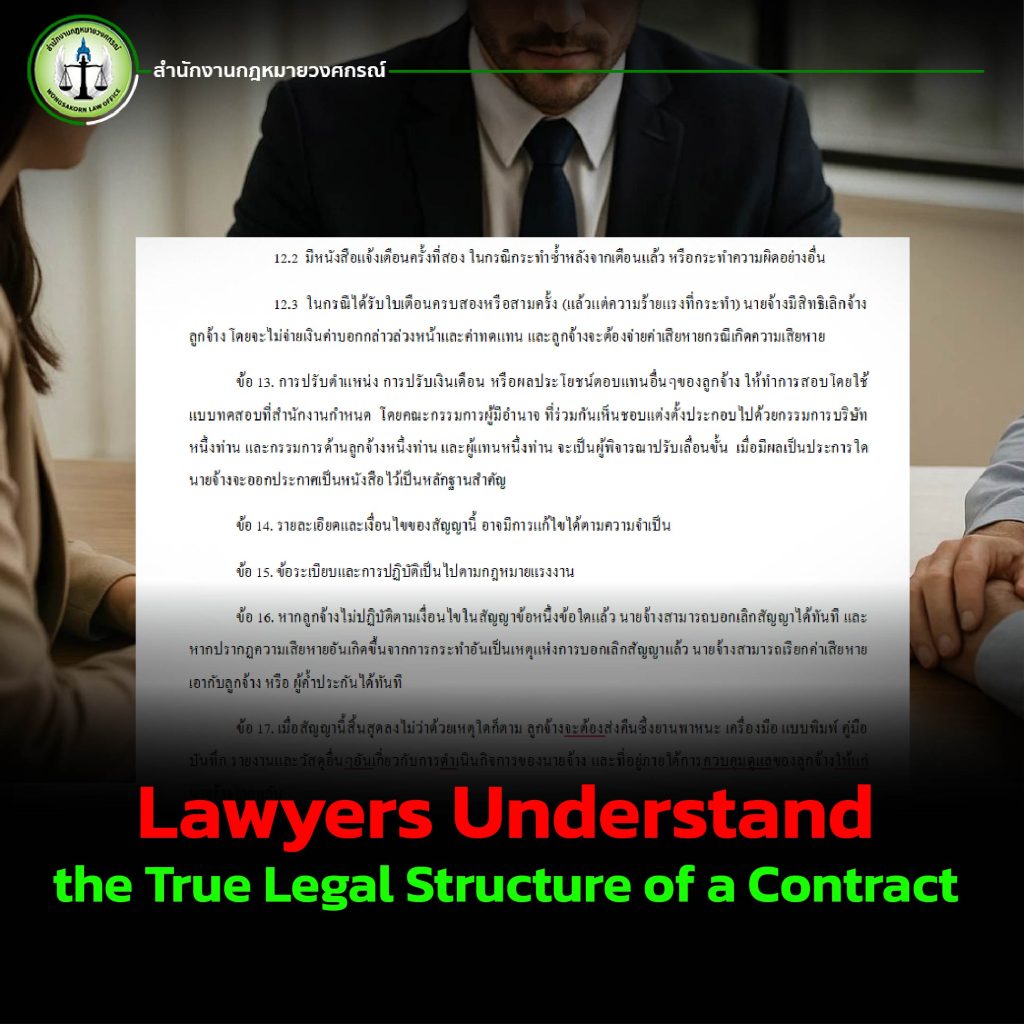
“Contract Review” with Wongsakorn Law Office – Why It Is Essential Before Signing High-Value Business or Sales Agreements

In the business world, every agreement usually ends with a “contract.” Whether it involves business partnerships, investments, sales transactions, or collaborations of various kinds, a contract serves as a vital document that defines the rights, duties, and responsibilities of both parties. But the key question is: how can you be sure the contract you are about to sign is truly safe and fair for you?

This is where contract review by legal professionals becomes an essential step that should never be overlooked. Even though a contract may appear formal and credible, that does not guarantee it is airtight, risk-free, or adequately protects your rights. Skipping contract review could expose you to serious risks and consequences in the future.

Why should you review contracts before signing?

1. Reduce legal risks – Contracts often contain complex legal language, details, and exceptions. Without review by an experienced lawyer, you might miss critical clauses that leave you disadvantaged or unenforceable in court.

2. Prevent unfair terms – Contracts are often drafted by the party with stronger bargaining power and may contain one-sided clauses, such as limiting liability or forcing acceptance of imbalanced conditions. Without review, you could end up bound by unfair obligations.

3. Ensure coverage of key issues – A professional review ensures all vital details are included, such as payment methods, delivery obligations, termination rights, and dispute resolution. Missing even one element could trigger major conflicts later.

4. Increase credibility and confidence – Having your contract reviewed by a law office enhances trust between parties, reduces potential loopholes, and builds confidence for smoother business cooperation.

Risks of not reviewing contracts before signing

Neglecting contract review can result in severe problems, such as:

  • Investment deals: Investors sign without thorough review, later discovering unclear profit-sharing terms leading to costly lawsuits and missed business opportunities.
  • High-value sales contracts: Homebuyers or real estate investors overlook review, only to find payment terms are unfair or lack quality guarantees causing significant financial loss.
  • SME transactions: Business owners sign international trade contracts without jurisdiction or dispute resolution clauses later forced into foreign litigation with high costs and delays.

These examples illustrate how failing to review contracts can damage your finances, time, and business reputation.

Our Contract Review Service

At Wongsakorn Law Office, we understand that every contract carries weight in your life and business. Our team of experienced lawyers and legal specialists provides thorough contract reviews, covering:

  • Legal compliance – Ensuring the contract aligns with current laws and is enforceable.
  • Fairness of terms – Evaluating whether terms are balanced and not overly favorable to one side.
  • Hidden loopholes – Identifying weaknesses that could be exploited against you.
  • Dispute prevention – Confirming clear clauses on dispute resolution, court jurisdiction, or arbitration.
  • Tailored advice – Offering recommendations for revisions or negotiations to safeguard your best interests.

Why review contracts with Wongsakorn Law Office?

Contract review is not just about reading terms, it’s about understanding legal language, interpreting clauses, and spotting hidden risks. Choosing an expert with real experience is essential to protect your rights.

At Wongsakorn Law Office, our services go beyond paperwork. We provide deep insights from both legal and business perspectives, ensuring your contract is practical, secure, and enforceable in your situation.

Key reasons to choose us:

1. Real case experience – Our lawyers have handled numerous contract disputes, giving us insight into real-world risks.

2. Comprehensive perspective – We review not only legal terms but also their business impact.

3. Customized service – Every contract is unique, so our reviews are tailored to your specific needs and context.

4. Risk reduction and confidence – With expert review, you can sign with peace of mind, prepared for all scenarios.

Secure Your Future with Expert Contract Review

Contract review is not optional, it is a vital safeguard. Contracts legally bind your long-term business relationships. Without proper review, they may expose you to serious harm.

👉 If you are about to sign a business agreement, a sales deal, or any high-value transaction, don’t let hidden risks undermine your interests. Consult Wongsakorn Law Office for professional contract review services protecting your rights every step of the way.

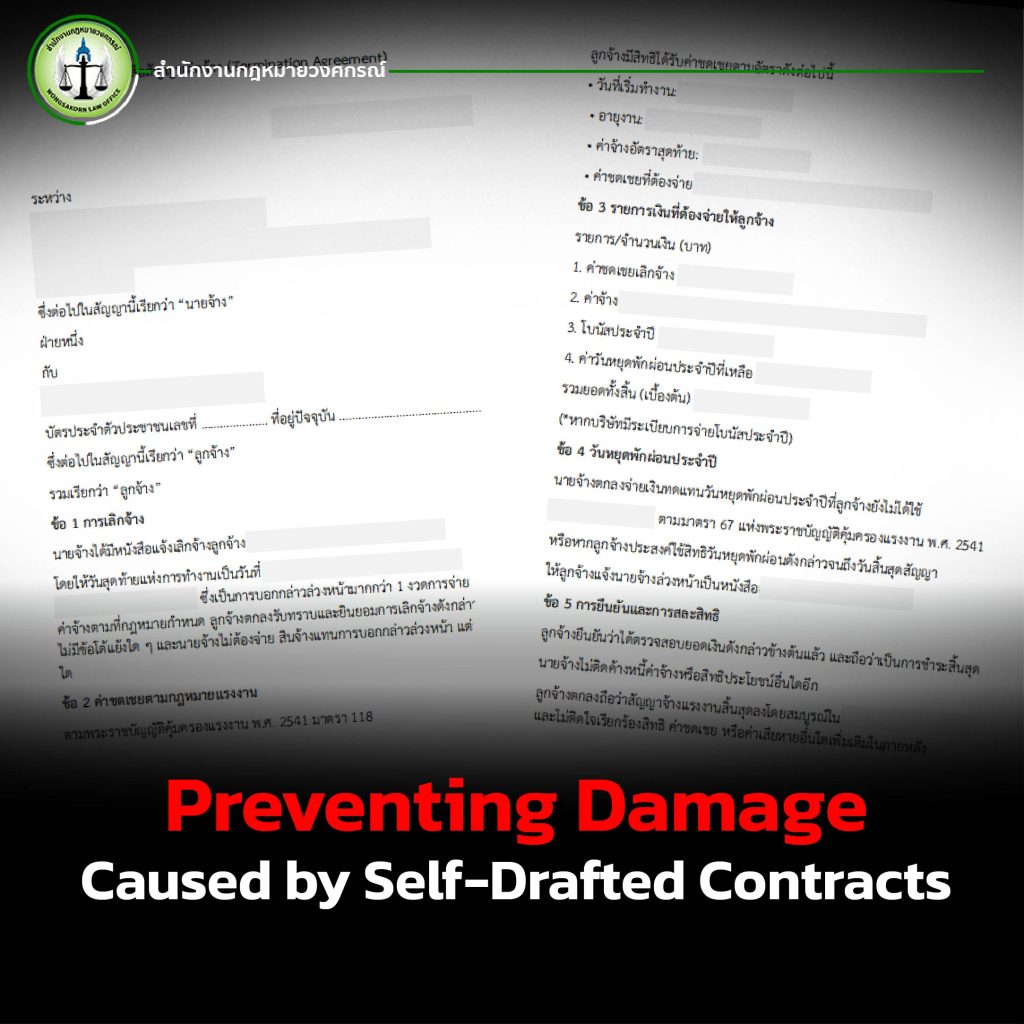
Drafting an Agreement: Why You Shouldn’t Do It Yourself and What Risks It Brings?

In the world of business and collaboration whether between individuals, companies, or organizations one of the most important tools is the agreement contract. An agreement serves as written evidence that clearly specifies the rights, duties, and responsibilities of both parties. Without a well-prepared agreement, disputes may easily arise in the future.

A common problem is that many people choose to draft an agreement on their own, using templates from the internet or adapting old documents. While this may seem to save time and money, in reality, drafting an agreement without legal knowledge can create enormous risks ranging from incomplete legal coverage, vague provisions, to conditions that fail to adequately protect your rights.

Why is self-drafting an agreement risky?

Many people think that “drafting an agreement” is simple, just find a sample online and adjust it. But in truth, an agreement is not just a piece of paper recording details; it is a legally binding document that defines rights, duties, liabilities, and can be enforced in court. If not drafted carefully, disputes may arise, putting you at a disadvantage.

Here are 4 major risks of drafting agreements on your own:

1. Lack of legal expertise – Laws contain many details and exceptions. Without legal training, you may unknowingly include unenforceable provisions or leave loopholes for the other party.

2. Over-reliance on templates – Online contracts are only samples and not tailored to your specific situation, often missing crucial details such as termination clauses, liability, or payment terms.

3. Risk of misinterpretation – Legal language is complex. Ambiguous wording may be interpreted against you in court.

4. Weak dispute resolution clauses – Many self-drafted agreements omit jurisdiction or arbitration clauses, which are critical in case of conflict.

Real-life examples of poorly drafted agreements

  • A company used an online joint investment contract that lacked clear profit-sharing terms. Later disputes led to costly litigation.
  • A landlord used a simple rental agreement without specifying termination procedures. When the tenant defaulted, damages could not be fully recovered.
  • An SME signed an international trade contract without specifying jurisdiction. The dispute had to be litigated abroad, costing time and money.

Why should you let a lawyer draft your agreement?

1.Legal accuracy – Lawyers ensure every clause complies with current laws and is enforceable.

2.Risk prevention – Professional lawyers close loopholes and protect against unfair interpretations.

3.Tailored to your case – A lawyer drafts a contract specifically suited to your business or transaction.

4.Credibility – A lawyer-drafted contract increases trust and reduces disputes.

5.Cost-saving in the long run – Legal fees are far cheaper than litigation expenses.

Choosing the right lawyer

  • Look for expertise in your type of contract (business, trade, commercial).
  • Review experience and past work.
  • Clearly communicate your needs to ensure the contract reflects your objectives.

Confidence in every agreement starts with professional legal drafting.

👉 If you want certainty in your contracts, consult a lawyer or engage Wongsakorn Law Office (翁萨功律师事务所) to draft your agreements with professionalism, safety, and minimized risks.

Borrowed Money Not Returned: What Can Creditors Do?

In today’s society, the problem of borrowing money and not repaying it occurs frequently. Sometimes the borrower is a close friend, relative, or even a colleague. Many lenders feel uncomfortable pressing for repayment, hoping the money will be returned soon. However, in the end, this often becomes a stressful problem, damaging relationships and resulting in a financial loss with no repayment.

When money is borrowed but not repaid, many people do not know what to do. Some try to collect on their own, leading to conflict, while others give up because they think it’s too troublesome. In reality, Thai law provides clear avenues for creditors to assert their rights. One of the most effective solutions is to let a lawyer handle the lawsuit.

Is Failing to Repay Borrowed Money Against the Law?

According to Section 653 of the Thai Civil and Commercial Code, a loan agreement is a contract in which one party (the lender) delivers money to another (the borrower), and the borrower is obliged to return the same amount of money as agreed. If the borrower fails to repay as promised, it is a breach of contract, giving the lender the right to take legal action.

Evidence such as written contracts, chat messages, bank transfer records, or even audio recordings can be submitted in court, as long as they prove that a genuine loan transaction took place.

Initial Steps to Claim Money Back

1. Ask for repayment directly
Begin with verbal or written requests, giving the borrower a chance to pay without conflict.

2. Send a written demand letter
A formal letter serves as evidence and can support a future lawsuit.

3. Negotiate repayment terms
If the borrower cannot pay in one lump sum, negotiate installments—but make sure to put the agreement in writing for protection.

If the borrower still refuses to pay, taking legal action through the court is the most appropriate option.

Filing a Lawsuit on Your Own

If the borrower does not repay, the lender can file a civil lawsuit to enforce payment. The main steps are:

1.Filing the complaint
While creditors can file lawsuits themselves, lack of legal knowledge may cause errors or delays. Having a lawyer draft the complaint is a safer choice.

2.Court proceedings
The court will attempt mediation first. If unsuccessful, the case will proceed to trial, requiring evidence such as contracts, chats, or bank records.

3.Judgment and enforcement
If the court orders repayment but the borrower still refuses, the lender can request enforcement measures such as asset seizure, wage garnishment, or bank account garnishment.

Why It’s Better to Let a Lawyer Handle the Case?

Although creditors can file lawsuits on their own, legal proceedings are complex. Mistakes are easy to make, which can waste time and weaken the case. Having a lawyer greatly improves efficiency and success. Key benefits include:

1.Correct procedures and documents
Lawyers know how to draft accurate complaints to avoid dismissal or delays.

2.Negotiation and mediation skills
A lawyer can negotiate on your behalf, reducing stress and conflict.

3.Higher chance of success
With experience in presenting evidence, lawyers increase the likelihood of recovering money.

4.Professional enforcement of judgments
Even after winning a case, enforcement is crucial. Lawyers can handle seizure or garnishment properly.

Preparing Evidence Before Filing

If you decide to have a lawyer file the case, prepare the following:

  • Copy of the loan agreement (if available)
  • Bank transfer slips or account records
  • Chat messages or other communications
  • Copies of demand letters sent to the borrower
  • Any other proof showing that money was lent

The more complete the evidence, the stronger the case.

Don’t Waste Time Arguing Let Lawyers Handle It

Being owed money is not a trivial matter. It causes financial loss, emotional stress, and strains relationships. If the borrower ignores or avoids repayment, creditors have the right to sue. Most importantly, having a lawyer manage the lawsuit ensures every step is correct, efficient, and increases the chance of recovery.

Many creditors, out of anger, resort to posting on social media or publicly insulting borrowers. However, such actions can backfire, exposing creditors to defamation claims. Instead of wasting time and risking legal consequences, the smarter choice is to let a lawyer file the case through proper legal channels. This way, you protect your rights while maximizing your chance of actually getting your money back.

So, if you are facing the problem of unpaid debt, do not let it drag on. Consult a lawyer immediately to find the best solution and safeguard your legal rights.

How to Draft a Debt Acknowledgment Agreement to Be Legally Enforceable?

In the world of transactions, whether it is borrowing money, purchasing property, or providing services with outstanding payments, the term “debt” is something frequently encountered. When a debt arises, the most important thing is to have clear documents or evidence to confirm the legal relationship between the debtor and the creditor. One of the most effective tools to safeguard the rights of the creditor is the “Debt Acknowledgment Agreement.”

The question is: how can you draft a Debt Acknowledgment Agreement so that it is truly legally enforceable? This article will explain the key principles, essential components, and precautions, as well as why hiring a lawyer to draft such agreements can provide greater protection of your rights.

What is a Debt Acknowledgment Agreement?

A Debt Acknowledgment Agreement is a document in which the debtor expressly admits that they owe a debt to the creditor and agree to repay it as stipulated. This agreement serves as confirmation of an existing debt, not the creation of a new one. Therefore, having a Debt Acknowledgment Agreement provides the creditor with strong evidence in case legal enforcement in court becomes necessary.

Why is a Debt Acknowledgment Agreement Important?

1. Clear Legal Evidence
In the event of a dispute, the creditor can use the agreement to confirm their right to claim repayment.

2. Reduces the Chance of Debt Denial
Once the debtor signs the acknowledgment, it becomes much harder for them to deny the existence of the debt.

3. Facilitates Litigation
Courts can rely on the agreement as evidence when ruling that the debtor must repay the debt.

Essential Components of a Debt Acknowledgment Agreement

Drafting such an agreement involves more than just writing down numbers and signatures. It must include complete details to be legally enforceable:

1. Details of the Parties – Full names, ID numbers, and addresses of both creditor and debtor.

2. Exact Debt Amount – Clearly state the total debt owed, and specify which contract it originated from (loan, sales, or services).

3. Interest Rate (if applicable) – Must be explicitly stated and within the legal limit (currently not exceeding 15% annually, unless otherwise stipulated by law).

4. Repayment Period – Specify when repayment must be made and the consequences of default (e.g., late interest charges).

5. Method of Repayment – Lump sum, installments, and how payments must be made (e.g., bank transfer).

6. Default Clause – State that in case of default, the creditor may immediately file a lawsuit without further notice.

7. Signatures of Debtor and Witnesses – Having witnesses strengthens the legal weight of the document.

Example of a Debt Acknowledgment Clause

“I, Mr. A, acknowledge that I owe Mr. B the sum of … baht under the Loan Agreement dated … and agree to repay by … date. In case of default, I agree that Mr. B has the right to sue and enforce repayment immediately according to the law.”

This type of wording clearly confirms that the debtor acknowledges the debt and agrees to pay.

Precautions in Drafting a Debt Acknowledgment Agreement

1. Avoid ambiguous wording – state clearly the origin and amount of the debt.

2. Avoid generic templates – they may miss essential legal details.

3. Check the legality of interest – excessive rates may not be enforceable.

4. Require real signatures – not just typed names.

5. Safely store documents – losing them may result in losing the right to prove the debt.

What if the Debtor Fails to Comply?

If the debtor does not comply with the agreement, the creditor may file a lawsuit using the agreement as strong evidence in court to enforce repayment.

Why Should a Lawyer Draft the Agreement?

Although creditors may draft the agreement themselves, in reality self-drafted agreements often contain flaws, missing information, ambiguous terms, or legally invalid clauses. These shortcomings may result in losing rights during litigation.

Engaging a lawyer or professional law Office ensures that the agreement is comprehensive, legally correct, and minimizes future disputes.

A Debt Acknowledgment Agreement is a crucial tool to protect creditors’ rights by confirming that the debtor owes and agrees to repay. If drafted correctly, it serves as strong evidence in lawsuits and enforcement proceedings.

However, drafting such an agreement is not a simple task. Doing it without legal knowledge may render the agreement unenforceable. Therefore, using the services of Wongsakorn Law Office or engaging a professional lawyer ensures that your documents are accurate, enforceable, and fully protective of your rights.

👉 If you want your Debt Acknowledgment Agreement to be legally enforceable, contact Wongsakorn Law Office for consultation and professional legal services.

Investigation and Tracing Services for Those Who “Insult” You on Facebook and Online

In today’s digital era, where anyone can type, comment, or post with just a click, many people have encountered offensive or defamatory remarks on Facebook and other social media platforms. Whether it’s a public post, a comment, or even a share, such actions can cause serious harm to the reputation, dignity, and business of the person being targeted.

Many who insult others often think that deleting the post afterward or using a fake account will keep them safe. In reality, once legal action is taken, tracing the identity of the person who insults others online is not as difficult as they might imagine.

Is insulting others online against the law?

Although the word “insult” may sound trivial, when it happens on public platforms like Facebook or TikTok, it can constitute a clear legal offense:

  • Criminal Code, Section 326 (Defamation)
    Anyone who makes a statement about another person before a third party in a way likely to damage their reputation, expose them to hatred, or contempt is guilty of defamation, punishable by imprisonment and/or fine.
  • Computer Crime Act B.E. 2560 (2017)
    Uploading false information or content that damages another person’s reputation or exposes them to contempt online is an offense under this Act, carrying heavier penalties than ordinary speech.

Thus, insulting others online is not merely expressing an opinion it can become a criminal act with real legal consequences.

Don’t assume that insulting others on Facebook or online can’t be traced!

Today, social media platforms such as Facebook, Instagram, Twitter (X), and TikTok have become public spaces for sharing and commenting freely. Unfortunately, many misuse these platforms by insulting others with abusive words, accusations, or harmful posts, thinking “it will just fade away” or “nobody can track me if I use a fake account.”

This is a serious misconception. Online insults don’t end with the comment or post; they can become lawsuits, carry legal consequences, and the perpetrators can always be traced.

Even if the offender uses a fake account or alias, legal experts and authorities can request information from the platform and trace IP addresses and digital evidence to identify the real individual.

What should you do if you are insulted online?

If you are insulted online and it affects your reputation or business, follow the correct legal procedures:

1. Collect evidence immediately
Take screenshots of the post, comment, or share, including the date, time, and link. Even if the offender deletes it later, you will still have proof.

2. Do not retaliate with insults
Insulting back may make you legally liable as well. The best way is to handle it legally.

3. Consult a lawyer
A legal expert can guide you, gather evidence, and take the right steps to protect your rights while minimizing mistakes.

Wongsakorn Law Office Services: Tracing Those Who Insult You

Wongsakorn Law Office has a team of lawyers and IT legal experts ready to investigate and trace individuals who insult or defame you online. Our services include:

  • Proper collection and preservation of digital evidence
  • Technical investigations (e.g., IP addresses, platform data)
  • Legal evaluation under defamation and Computer Crime laws
  • Filing complaints with investigators and managing court proceedings

Why should a lawyer handle this instead of you?

Trying to handle an online insult case by yourself may cause you to miss critical steps, allowing the offender to escape liability. A lawyer ensures:

  • Correct legal procedures are followed
  • Reduced risk of being countersued
  • Stronger complaints and higher chance of success in court
  • Professional legal advice tailored to your case

Don’t let online insults damage your reputation act now!

Online insults are not trivial; they can destroy reputations and have real legal consequences. Offenders cannot hide forever behind fake accounts, as every digital action leaves a trace.

👉 If you are facing this problem, don’t let the damage escalate. Consult Wongsakorn Law Office. Our expert legal team is ready to investigate, trace, and take legal action against those who insult you on Facebook and social media to protect your rights and reputation.

Sales Contract and Commercial Agreement Between Companies or Across Borders: Why Should a Professional Lawyer Draft It?

In today’s business world, whether small enterprises, medium-sized companies, or multinational corporations, a sales contract is a crucial document. It sets forth the rights, duties, and obligations of the contracting parties. Conducting transactions without a proper contract or with a poorly drafted one often leads to disputes, financial losses, and sometimes even damages long-term business relationships.

The key questions are: “How should a sales contract be drafted so that it is legally enforceable?” and “Why should a lawyer draft the contract instead of writing it yourself?”

What is a Sales Contract?

A sales contract is a legal document made between a buyer and a seller to outline the essential terms of the sale of goods, services, or even intellectual property. A well-drafted sales contract must clearly state the details of the parties, the goods/services, the price, payment methods, delivery conditions, and liability in case of breach.

Moreover, sales contracts can extend to inter-company trade agreements and international trade contracts, which are more complex as they involve multiple legal systems, tax obligations, international shipping rules (Incoterms), and potential disputes that may fall under foreign courts or arbitration bodies.

Importance of a Sales Contract

  • Legal evidence – In case of disputes, the sales contract serves as primary evidence in court or arbitration.
  • Reduced interpretation risks – Written agreements minimize misunderstandings compared to oral transactions.
  • Clear rights and obligations – Such as delivery deadlines, payment methods, and penalties for non-performance.
  • Business confidence – Both parties feel more secure when a fair and enforceable contract is in place.

Domestic vs. International Sales Contracts

  • Domestic Sales Contracts – Governed by Thai law and usually involve parties within the same country.
  • International Sales Contracts – More complex, requiring clarity on applicable law, international payment methods (such as Letters of Credit), shipping and insurance, and dispute resolution through foreign courts or international arbitration (e.g., ICC, SIAC, HKIAC).

Without expert legal review, companies may easily be disadvantaged in international transactions.

Risks of Drafting a Contract by Yourself

Many companies download templates online or use generic contracts without adapting them to their transactions. This can cause:

  • Incomplete or missing clauses.
  • Ambiguous wording leading to multiple interpretations.
  • Terms inconsistent with Thai or foreign laws.
  • No clear dispute resolution mechanism.
  • Unclear payment and delivery terms.

Such weak contracts often result in losing legal rights when real disputes arise.

Why Should a Professional Lawyer Draft Your Sales Contract?

  • Legal compliance – Lawyers ensure the contract complies with Thai and international laws.
  • Comprehensive clauses – Covering not just price and delivery, but also breach terms, liability exemptions, and dispute resolution.
  • Reduced risks of unfair terms – Ensuring balance and protection of your interests.
  • Industry-specific tailoring – Adjusted for particular industries like tech, logistics, or manufacturing.
  • Enforceability – Drafted to serve as solid evidence in future litigation or arbitration.

Key Clauses in a Sales Contract

  • Party details (names, addresses, registration numbers)
  • Goods/services description (type, quantity, quality standards)
  • Price and payment terms
  • Delivery conditions (time, place, method)
  • Transfer of ownership and risk
  • Warranty provisions
  • Penalties for breach (fines, interest, etc.)
  • Dispute resolution method (Thai courts or international arbitration)

Consult Wongsakorn Law Office for a Reliable Sales Contract

A sales contract, whether domestic or international, is always important and complex. Drafting one without legal knowledge may result in loopholes and unenforceability.

The safest and most strategic choice is to engage a professional lawyer or Wongsakorn Law Office, experienced in drafting sales contracts for both domestic and international transactions. This ensures your contract is legally valid, comprehensive, and truly safeguards your business interests.

👉 If you want a sales contract that is legally enforceable and protects your business, contact Wongsakorn Law Office today for expert legal services.

Becoming a “Nominee” Without Knowing It – What Should You Do? If Summoned in a Nominee Case, Is There a Way Out?

In Thailand’s business world, the term “Nominee” is widely discussed, especially in cases involving Thais holding shares on behalf of foreigners. Under Thai law, this practice is prohibited as it may constitute an attempt to evade the Foreign Business Act. However, many people unknowingly become nominees, for example, by being asked to hold shares for friends or relatives, receiving small benefits in return, or even signing documents without fully understanding the legal implications.

So, what should you do if you unknowingly become a nominee or receive a summons in a nominee case? Is there a way out, and how can you prevent it?

What is a Nominee and What Are the Legal Consequences?

Generally, a “Nominee” refers to a person whose name is used to hold shares or conduct business on behalf of someone else, especially foreigners who are restricted by law from holding majority shares. According to Thailand’s Foreign Business Act, using Thais as nominees for foreign ownership is considered unlawful and carries both civil and criminal penalties.

Penalties for being a nominee include:

  • Heavy fines, which may amount to hundreds of thousands or even millions of baht.
  • Imprisonment in some cases.
  • Damage to personal reputation and legal record.

Why Do People Become Nominees Without Realizing It?

Common situations that lead people to unknowingly become nominees include:

  • A friend or acquaintance asks them to hold shares “just in name.”
  • Receiving small monthly compensation for the use of their name.
  • Signing contracts or documents without reading carefully.
  • Being assigned as a minor shareholder in a foreign-owned company without proper legal checks.

In many cases, individuals only discover their legal risk when they receive a summons from government authorities.

What Should You Do If You Receive a Summons in a Nominee Case?

Receiving a summons in a nominee case is serious, as it is a criminal matter that can affect both your life and career. The first step should be to consult an experienced lawyer immediately. Recommended actions include:

  1. Do not ignore the summons – Failure to attend may lead to an arrest warrant.
  2. Gather documents and evidence – Such as agreements, shareholder records, financial documents, or messages showing you had no intent to act as a nominee.
  3. Explain the facts to your lawyer – Provide full details of how your name became involved in the business, so the lawyer can plan an effective defense.
  4. Follow legal advice closely – Defending a nominee case is complex and requires proper legal strategies backed by solid evidence.

Is There a Way Out If You Are a Nominee?

Yes, there is. If you can prove that you had no intention to circumvent the law or were not genuinely controlling the business, legal defenses are possible. Early consultation with a lawyer can help you:

  • Demonstrate that you were not the beneficiary of the business.
  • Use evidence to show that your name was used without full knowledge.
  • Reduce the risk of facing severe penalties.

Why Consulting a Lawyer Should Be Your First Step?

Unknowingly becoming a Nominee is extremely risky, as it involves investment law, business law, and criminal law at the same time. Even small mistakes may result in heavy penalties.

An experienced nominee lawyer can help by:

  • Assessing potential risks and penalties.
  • Developing defense strategies.
  • Communicating with authorities or courts on your behalf.
  • Negotiating to minimize legal consequences.

How to Prevent Becoming a Nominee in the First Place?

Prevention is always better than cure. To avoid unknowingly becoming a nominee:

  • Never sign documents you don’t fully understand.
  • Never hold shares for others without proper legal review.
  • Always consult a lawyer if you have doubts about business or investment agreements.

Nominee Cases Are Not Trivial – Seek Legal Counsel Immediately

Unknowingly becoming a Nominee may expose you to criminal charges, heavy fines, or even imprisonment. Ignoring the issue or trying to handle it alone can worsen the situation. The safest solution is to consult an experienced lawyer who specializes in nominee cases to assess, strategize, and find the most appropriate way forward.

👉 If you are facing nominee-related issues or have received a summons in a nominee case
👉 Contact Wongsakorn Law Office today to consult with experienced lawyers.

Line @ คลิก! โทรหาเรา คลิก!