In an era where doing business or living abroad involves numerous legal risks, having a trusted and knowledgeable “legal advisor” who understands the legal system of the country is essential. This is why many foreigners place their trust in Wongsakorn Law Office.
On April 25, 2025, our office had the honor of assisting a foreign client who came to us for legal advice as soon as they encountered a legal issue in Thailand. The client did not contact any other law firms beforehand. This reflects the trust in our expertise and reputation as a professionallegal advisor, ready to handle all of our clients’ legal challenges with dedication.
A Legal Advisor Is Not Just Someone Who Solves Problems, But Someone Who Plans to Prevent Them for You.
Many people often think that a lawyer’s role is limited to handling legal matters when a lawsuit is filed or conducting proceedings in court. However, the truth is that a “legal advisor” plays an even more crucial role. We are here to provide legal services to help you avoid legal mistakes, plan for risks, and establish a legally sound approach to life or business from the very beginning.
In the case of the foreign client who consulted us, the issue could have escalated and caused significant damage if they had not sought advice right from the start. This is why we always emphasize that “The sooner you consult a lawyer, the quicker you can achieve justice or resolve your issues.”
Why Choose a Legal Advisor from Wongsakorn Law Office?
Experience and Expertise Our lawyers have extensive experience in civil, criminal, business, family law, and international cases. We understand the context of both Thai and foreign clients.
Straightforward Advice We prioritize transparency, honesty, and providing accurate information, whether the issue is big or small.
Clear Communication Especially in cases involving foreign clients, we have a team that can communicate in multiple languages and explain complex legal matters in an easily understandable way.
Trust from Clients Foreign clients who consult us directly, without referrals or contacting other firms first, demonstrate the genuine trust that Wongsakorn Law Office has earned.
Legal Advisors Are Essential for Everyone, Not Just for Those with Problems
Whether you’re a business owner, an individual, or even a foreigner living or working in Thailand, having a personal “legal advisor” is an investment in the stability of your life and business.
Want to sign a condo lease or buy/sell property? A lawyer can review the terms to ensure you’re not at a disadvantage.
Running a business in Thailand and unsure if all your documents are in order? Consult a lawyer before you need to make corrections later.
Facing a lawsuit or legal dispute? The sooner you have a lawyer who knows you, the quicker and more efficiently the issue can be resolved.
Confidence Begins with the Right Decision
Wongsakorn Law Office not only provides legal advice, but we are also committed to being the “trusted legal service provider” you can rely on in any situation. Whether you are Thai or a foreigner, if you are looking for a legal advisor who is by your side every step of the way in life and business, we are always here to welcome you.
Wongsakorn Law Office – Your Trusted Legal Advisor
In a world that is complex and rapidly changing, having a “legal advisor” who understands you, knows the law, and is ready to provide legal services immediately when issues arise is just as important as having a personal doctor.
If you are looking for a “legal advisor” who is ready to care for you with sincerity and professionalism, whether it’s for legal cases, business matters, or personal issues, contact us today at Wongsakorn Law Office. You will understand why many clients trust us without hesitation.
In an era where online transactions are increasingly popular, an ID card is essential for identity verification across various platforms—from opening a bank account and applying for loan apps to registering a mobile SIM. But did you know that if your ID card is lost, it could become a gateway for criminals to impersonate you and commit crimes using your personal information? This is especially true in cases of identity theft, which can cause far more legal and reputational damage than you might expect.
Real Case: Lost ID Card Turns into a Massive Debt
Many people may think losing a national ID card is a minor issue. However, there are numerous cases where victims discovered that their ID cards had been used without their knowledge to open mule bank accounts or apply for online loans. One such case involved a university student in Bangkok who lost her ID card on the way back to her dormitory. Less than a month later, she received a debt collection notice from an online lending company for over 50,000 baht.
An investigation revealed that someone had used a photo of her ID card to apply for loans from multiple apps. The fraudsters used deepfake technology to alter the face in the video verification process to resemble the victim. As a result, the loan applications were approved without detecting the impersonation. When the time came to collect the debt, it was the person whose name appeared on the ID card who was held responsible.
What is Identity Theft?
Identity theft occurs when someone uses your personal information—such as your full name, ID number, date of birth, or even your photo—without your permission. This information may be used for various purposes, including applying for loans, opening bank accounts, subscribing to services, or even committing crimes. The consequences of these actions ultimately fall on the real owner of the identity.
The Loopholes in a Cashless Society
As more services shift to online platforms, convenience increases—but so do the risks. Many systems rely solely on ID card images and selfie videos for identity verification, or sometimes just a copy of a document. This creates an opportunity for criminals to commit fraud using documents found on social media or from lost ID cards.
Laws Concerning Document Forgery
Using someone else’s ID card information without permission may be considered a criminal offense under Section 265 of the Thai Criminal Code, which states: “Whoever forges an official document issued by an authority, such as an ID card or driver’s license, shall be liable to imprisonment from six months to five years and a fine from 10,000 to 100,000 baht.”
If the forged document is used and causes damage, further penalties may apply under Section 268 concerning the use of forged documents. Additionally, if the information is used to deceive or defraud others, it may also fall under the offense of public fraud according to Section 343.
What to Do If Your ID Card Is Lost
File a police report immediately to have legal proof that the document was stolen or lost.
Apply for a new ID card at your district office, bringing the police report as supporting documentation. Notify banks and relevant companies if you are concerned that someone might misuse your ID to open accounts or commit fraud.
Check your credit report to ensure there are no unknown debts registered under your name.
Report the incident through online systems provided by authorities such as the Anti-Money Laundering Office (AMLO) or the Bank of Thailand, which have specific channels for such cases.
When a person becomes a victim of identity theft, they may face both civil lawsuits (such as being sued for unpaid debts) and criminal charges (such as being accused of operating mule accounts or money laundering). In such situations, the role of a lawyer becomes critically important — from investigating the facts and collecting evidence to proving that the victim was not involved in the wrongdoing. Lawyers can also negotiate with financial institutions or companies involved in the dispute.
In addition, a lawyer can assist in filing a countersuit if the identity of the fraudster can be identified — for example, when there is evidence of forged documents being used or money being transferred through accounts clearly linked to the perpetrator.
Prevention is better than cure
While we cannot control every risk, being cautious about not exposing your ID card on social media, avoiding sending copies of documents to strangers unnecessarily, and regularly checking your financial records can significantly reduce the risk of identity theft.
Remember, in the digital age, your personal data is extremely valuable and can be misused in an instant. Having a lawyer who understands the law and serves as your legal advisor is not a luxury — it’s a proactive way to protect yourself from risks that can arise at any time.
Written by : Kannikar Charoenweerawong (Internship Student in Chinese Language)
In recent years, the expansion of Chinese businesses in Thailand—particularly in key tourist destinations such as Chiang Mai, Phuket, and Pattaya—has raised growing concern among Thai citizens. The issue extends beyond just the widespread use of Chinese language on store signs and service menus; troubling reports have surfaced regarding tax evasion practices by Chinese investors, which could have long-term impacts on Thailand’s economy and tax revenue.
According to reports from provincial revenue department officials, some businesses are operating under so-called “nominee” structures, where Thai nationals are listed as shareholders in name only, while all actual management and funding come from Chinese nationals. This has been observed in restaurants, tour companies, and certain real estate ventures.
Additionally, authorities have found that some of these businesses underreport their income or fail to register for Value-Added Tax (VAT), despite serving large numbers of customers—especially Chinese tourists—who often pay in cash or through Chinese payment apps like Alipay and WeChat Pay. These methods bypass Thailand’s financial system, making government oversight and tax enforcement more difficult.
Economic experts have warned that such practices could result in hundreds of millions of baht in lost tax revenue annually, while also creating unfair competition for legitimate Thai businesses that comply with tax laws.
Today, Wongsakorn Law Office highlights the potential legal consequences for Chinese investors engaging in tax evasion. Thailand’s Department of Business Development and Customs Department have begun monitoring suspicious transactions more closely in several regions. They are also preparing to tighten nominee scrutiny measures and collaborate with financial authorities to trace international capital flows.
Forms of Tax Evasion by Chinese Businesses in Thailand
Use of Thai Nominees as Shareholders Some Chinese businesses in Thailand utilize Thai nationals as nominal shareholders in order to circumvent foreign ownership restrictions, such as those outlined in the Foreign Business Act B.E. 2542 (1999). This law requires that certain types of businesses must have at least 51% Thai ownership.
Avoidance of VAT Registration Certain Chinese-owned enterprises underreport their actual income or completely avoid registering for Value-Added Tax (VAT), in violation of the Value-Added Tax Act B.E. 2535 (1992). Under this law, any business generating more than 1.8 million baht in annual revenue is required to register for VAT.
Use of Chinese Payment Systems Some businesses accept payments through Chinese mobile applications such as Alipay and WeChat Pay. These transactions bypass the Thai financial system, making it more difficult for government authorities to monitor financial flows and enforce tax compliance.
Impacts on the Local Economy
1. Loss of Tax Revenue Tax evasion by Chinese businesses results in the Thai government losing hundreds of millions of baht in tax revenue each year. This directly affects the country’s ability to fund national and local development projects.
2. Unfair Competition Thai entrepreneurs who comply with tax laws must pay their fair share, while Chinese businesses that evade taxes can reduce operating costs and offer goods or services at lower prices. This creates an unfair competitive advantage and puts law-abiding Thai businesses at a disadvantage.
3. Market Distortion Tax evasion undermines fair market mechanisms. Prices of goods and services no longer reflect actual production costs, potentially leading to lower product quality and harm to consumer welfare.
Relevant Laws on Tax Evasion by Foreigners in Thailand
1. The Revenue Code (Tax Law) If any business—whether Thai or foreign—intentionally evades tax (e.g., fails to register for VAT, underreports income, or issues false tax invoices), the following sections may apply:
Section 90/4 (Value-Added Tax Act) Failing to register for VAT when annual revenue exceeds 1.8 million baht is punishable by a fine of up to 5,000 baht. If the business still fails to register after official notice, it may face business closure or license revocation.
Section 39 (Revenue Code) Anyone who evades or attempts to evade taxes is subject to a fine ranging from 2,000 to 200,000 baht, imprisonment for up to 7 years, or both.
Section 90/7 (Fraudulent Tax Invoicing) Issuing false tax invoices or intentionally evading tax can lead to a fine of double the evaded tax amount, plus a 1.5% monthly surcharge.
2. Foreign Business Act B.E. 2542 (1999) Foreign nationals operating businesses in Thailand without permission, or using Thai nationals as “nominees” to hold shares in restricted sectors, are violating this law.
Section 36 The use of nominees to circumvent foreign ownership laws is punishable by imprisonment for up to 3 years, a fine between 100,000 and 1,000,000 baht, or both.
Additional Penalties The court may revoke business rights and order the deportation of the foreign individual involved.
3. Anti-Money Laundering Act B.E. 2542 (1999) Using foreign payment platforms such as Alipay or WeChat Pay to conceal income or bypass Thailand’s financial system may fall under money laundering offenses.
Sections 3 and 5 Income derived from tax evasion may be classified as “assets related to a predicate offense.” Penalties include up to 10 years of imprisonment and/or a fine of up to 200,000 baht.
4. Immigration Act B.E. 2522 (1979) Foreigners working in Thailand without proper authorization—such as using a tourist visa to conduct business—are in violation of immigration laws.
Sections 37 and 75 Violating visa conditions (e.g., working while on a tourist visa) can lead to fines, visa cancellation, and deportation.
Don’t Risk Business Closure Consult a Lawyer to Ensure Proper Tax Compliance
While many Chinese-owned businesses in Thailand have been suspected of tax evasion or exploiting legal loopholes, in practice, some of these issues may stem from a lack of understanding of Thai laws or misinterpretation by foreign business owners.
“Having a legal advisor or attorney from the start is essential.”
Benefits of Having a Legal Advisor
Review of Company Registration Compliance A lawyer can ensure that shareholder structures, company formation, and business objectives comply with the Foreign Business Act B.E. 2542 (1999).
Tax and Accounting Consultation In collaboration with certified accountants, legal advisors can help you properly set up systems for VAT, corporate income tax, and required tax filings to avoid future penalties or backdated fines.
Legal Guidance on Payment Systems For businesses using Chinese payment apps like Alipay or WeChat Pay, a lawyer can help legally integrate these systems within Thai financial regulations, ensuring full transparency and compliance.
Visa and Work Permit Assistance Many foreign entrepreneurs use tourist visas for business, which is illegal. A lawyer can help obtain the proper Non-B Visa, Smart Visa, and Work Permit in accordance with the Immigration Act B.E. 2522 (1979).
Legal Representation in Case of Disputes If investigated or accused of tax evasion or nominee arrangements, legal counsel can represent you during audits, help resolve disputes, and defend your case in court.
Additional Legal Advice for Foreign Entrepreneurs
Always seek legal consultation before starting a business in Thailand.
Do not use a Thai nominee as a shareholder without real management control.
Work with a lawyer and accountant to plan taxes before launching operations.
If audited, let your lawyer handle communications with authorities to protect your legal interests.
Wongsakorn Law Office specializes in assisting foreign entrepreneurs with legal and regulatory compliance in Thailand. Our experienced team of lawyers and legal assistants provide tailored advice, with a proven track record of success and client satisfaction.
Foreign businesses can consult us with confidence — we handle all cases with professionalism and care.👉>> Contact Us <<
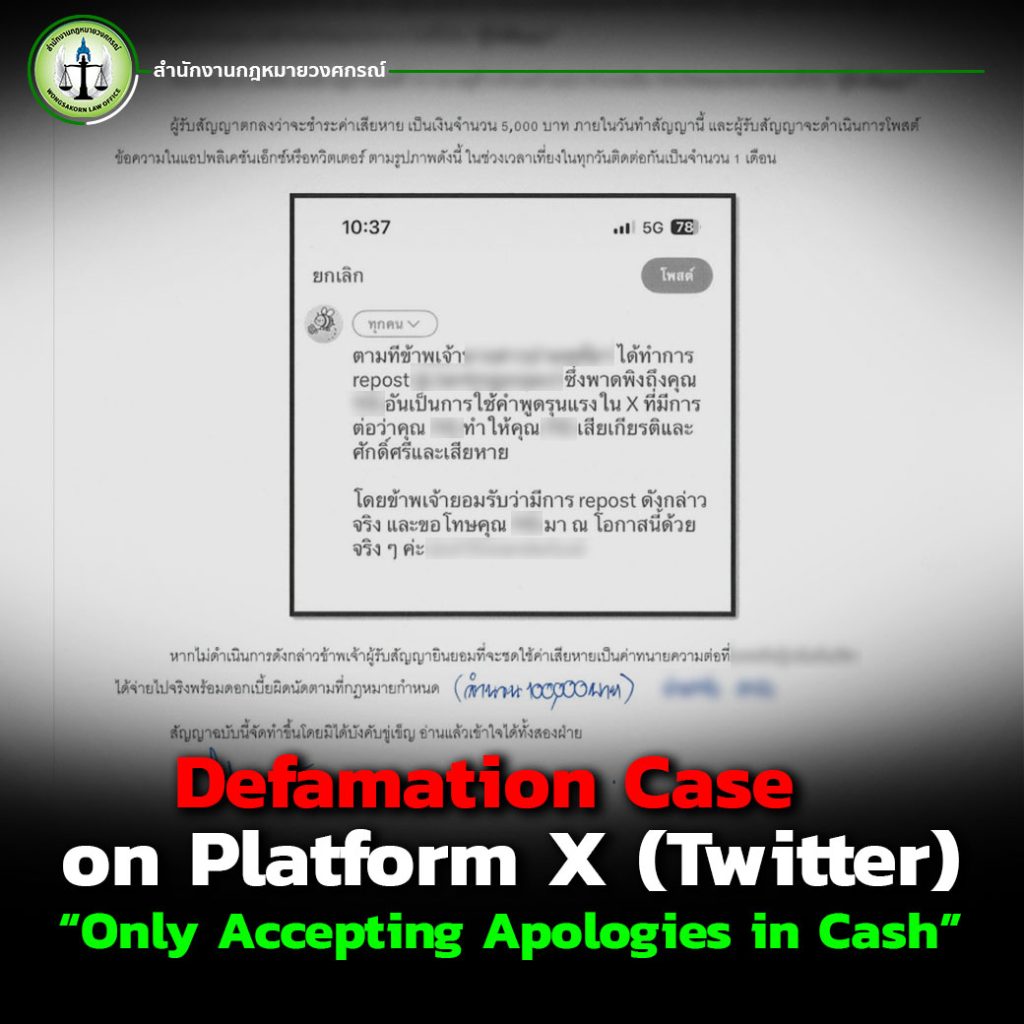
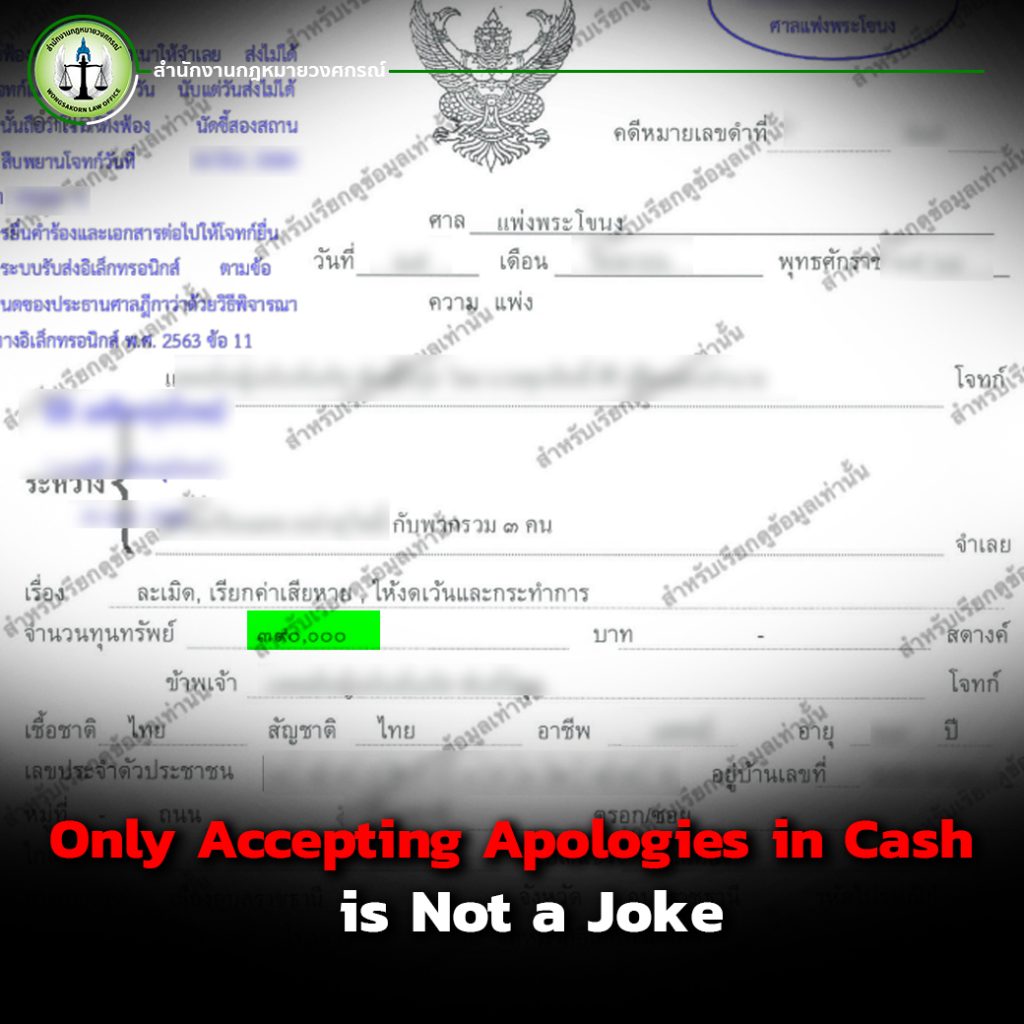
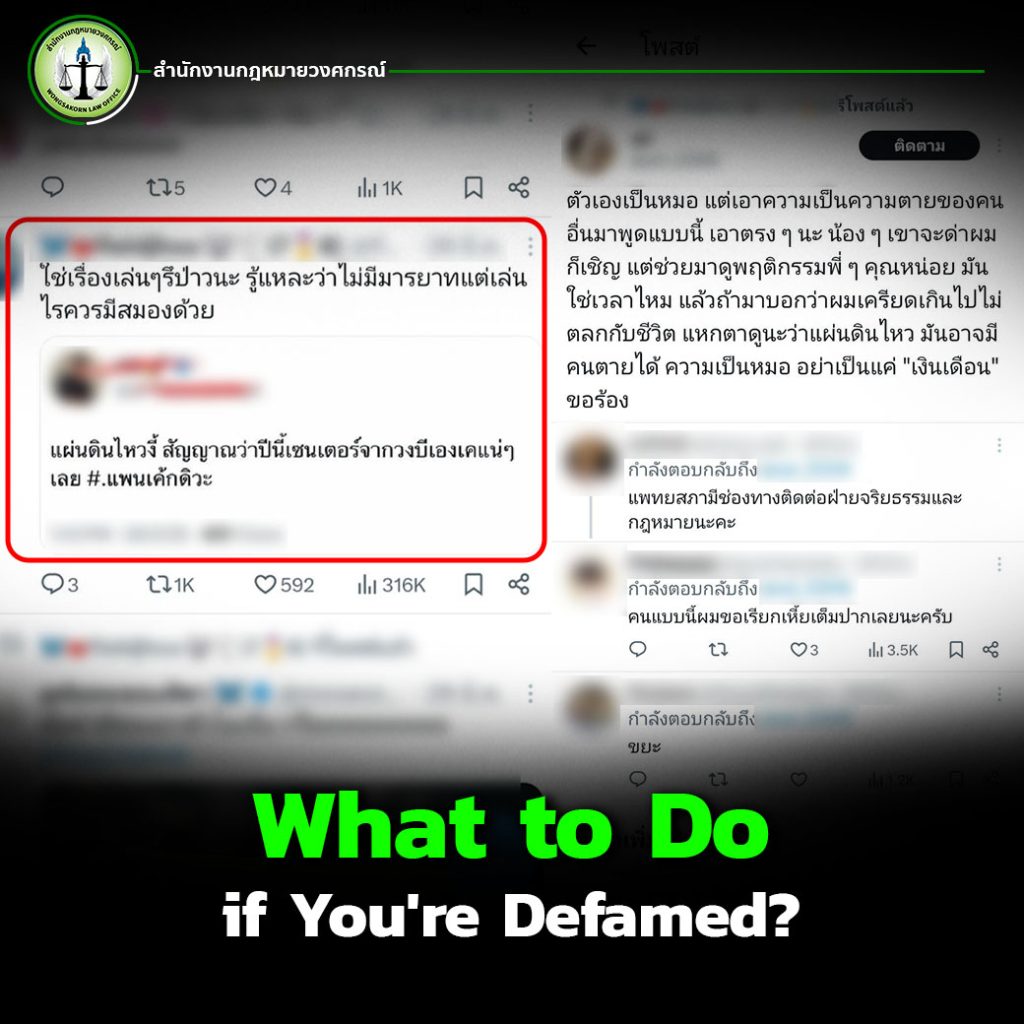
In an era where social media has become part of daily life, many people may carelessly share, retweet, or comment on posts without thinking carefully — especially on Platform X (formerly known as Twitter), an open space where everyone can freely express their opinions. However, did you know that such actions could potentially constitutedefamation without you even realizing it? You might even be liable for significant monetary damages.
Sharing someone else’s post could also put you at risk of “defamation.”
Many people mistakenly believe that defamation only applies to the original author or poster. In reality, however, those who share, retweet, or forward defamatory content can also be held legally liable.
Legally speaking, if the shared content contains false statements that harm another person’s reputation to a third party, whether through an original post or a repost, it constitutes dissemination to the public. This can immediately fall under the offense of defamation according to Section 326 of the Thai Criminal Code.
Furthermore, adding comments or expressing agreement with the original defamatory post significantly increases the likelihood of being seen as having clear intent to defame.
Platform X and the Increasing Problem of Defamation
Platform X is characterized by its emphasis on short posts and the ease of reposting (Repost or Retweet), leading to rapid dissemination of information. When someone posts defamatory content against another person and it gets widely reposted, the resulting damage can multiply significantly.
However, what many people don’t realize is that even if you are not the original poster, simply being a “distributor” of such content can still expose you to legal action. You may even be held liable as a “co-offender” under the law.
What Should You Do After Being Defamed? Lawyers Advise: Don’t Wait Until the Statute of Limitations Expires
For those who suffer damages from defamation on Platform X — whether from direct posts or reposts by others — Lawyer Arm from Wongsakorn Law Office advises not to delay taking legal action. Defamation cases have a limited “statute of limitations,” and if you fail to file within the prescribed period, you could lose your right to seek justice.
In criminal cases, the injured party must file a complaint within 3 months from the date they become aware of the defamation and the identity of the offender. In civil cases where monetary damages are sought, the statute of limitations is longer — 1 year from the date the defamation and the wrongdoer are known.
Therefore, if you are confident that you have been harmed, you should immediately collect evidence — such as screenshots, posts, links, and timestamps — and contact a lawyer to proceed with asserting your rights without delay.
Evidence: The Heart of a Defamation Case
In the digital era, various types of evidence can be used in defamation cases, including:
Screenshots of the posted or shared content
Links to the original post and any reposts
Dates and times when the incidents occurred
Witnesses who saw the posts or were affected by them
Information about the user account that posted the content (if identifiable)
Lawyer Arm advises that all evidence should be preserved without alteration to ensure it can be effectively used to prove the facts in court.
Think Before You Share — Better Than Losing Money Unknowingly
As social media users, we must recognize that “freedom of expression” is subject to legal boundaries. Sharing posts or commenting about others without clear evidence can cause irreversible damage and lead to both civil and criminal liability.
There have been numerous defamation cases involving reposts where courts ordered compensation of hundreds of thousands of baht, or even imposed imprisonment (though sometimes suspended). We should learn from these real-life examples.
Defamation through Platform X is a serious issue that can severely harm a person’s reputation and financial standing. Every share or repost must be done with caution. If you are a victim of defamation, do not wait until the statute of limitations expires. Contact Lawyer Arm for advice and to pursue your legal rights as soon as possible.
Renting out a house or condominium may seem simple — just agree on the price and sign a contract. But in reality, leasing property, or even allowing someone to stay without a proper agreement or without verifying tenant information, can lead the landlord to become a defendant in a criminal case or a party in a civil dispute without even realizing it.
In recent years, there have been multiple cases where landlords faced legal action because their rental properties were used as hideouts for fugitives, bases for criminal activity, or even venues for money laundering. These problems are especially complicated when the tenants are foreign nationals, making the legal proceedings more complex and harder to control.
What Types of Rentals Are Considered “Risky”?
1. No Written Rental Agreement According to the Civil and Commercial Code, Sections 537–571 regarding “Lease Contracts,” property rental should be executed with a formal written agreement. The contract should specify the rights and obligations, rental period, rental fees, termination conditions, and the return of security deposits. Without such documentation, in the event of disputes—such as property damage by the tenant or the landlord withholding the deposit—legal action may be difficult.
For instance, one tenant rented a condominium in Bangkok for one year, placing a two-month security deposit totaling over 40,000 baht. Upon the contract’s expiration, the tenant moved out after giving proper notice as agreed. However, the landlord refused to return the deposit, claiming the room had scratches and required complete repairs. The outcome was as follows:
The tenant sued in civil court, submitting photo evidence of the room before and after the rental period.
The court ruled that the damage was considered “normal wear and tear” from usage and did not constitute excessive damage.
The court ordered the landlord to return the full deposit with interest.
According to Sections 537–540 of the Civil and Commercial Code, the landlord must return the security deposit at the end of the lease if there is no serious damage. If the landlord refuses without a valid reason, it constitutes a “breach of contract,” and the tenant has the right to take legal action.
2. Failure to Conduct Background Checks on Tenants In many cases, foreign tenants have been found using fake documents or entering the country on tourist visas but illegally settling down. If property owners rent out properties without proper verification, they could be deemed as providing shelter to individuals residing illegally, which is punishable under the Immigration Act.
3. Accepting Only Cash Payments, Without Using Bank Transfers Accepting only cash payments without any record of bank transactions could expose the landlord to allegations of money laundering and tax evasion. It is advisable for property owners to require tenants to pay rent through bank transfers to ensure that there is verifiable documentation for future reference.
4. Subletting Without the Owner’s Knowledge
In some cases, tenants rent a property and then illegally sublet it to others, such as daily tourists or even unlawful groups. If any criminal incidents occur at the property, the landlord will immediately fall under suspicion.
Rights and Duties of Tenants and Landlords Under Civil Law
In a lease agreement, both parties have rights and obligations that must be upheld:
Tenants are obligated to take care of the rented property and must not alter it without permission.
Landlords are obligated to deliver the property in usable condition and must return the security deposit at the end of the lease if no damage has occurred.
If either party breaches the contract, the other party has the right to terminate the agreement or sue for damages.
In one case, a tenant refused to vacate the property even after the lease had ended, requesting an additional month. In response, the landlord locked the property and cut off the water and electricity, which constituted a violation of the tenant’s rights. Ultimately, the landlord was ordered to pay damages for exceeding the legal boundaries.
The Role of Lawyers in These Situations
Lawyers play a crucial role in providing consultation before entering into rental agreements. They can assist in document verification, translate contracts for foreign tenants, and support clients in both civil and criminal litigation if problems arise, such as:
Tenants failing to pay rent
Tenants damaging the property and refusing responsibility
Landlords refusing to return the security deposit
Questions regarding taxes or related financial transactions
Renting Out a House Is Not as Simple as It Seems
Without careful preparation, landlords can easily become entangled in legal disputes or unknowingly place themselves at a disadvantage. Having a well-drafted contract, thoroughly vetting tenants, and consulting a lawyer before engaging in any major transactions are essential steps to ensure strong protection and to prevent future problems.
If you are a homeowner, tenant, or agent facing issues related to rental agreements, disputes, or communication with foreign nationals, Wongsakorn Law Office is ready to provide you with comprehensive legal consultation and support. With expertise in Thai law and extensive experience handling disputes between Thais and foreigners, we ensure that your rights and interests are fully protected.
Written by : Kannikar Charoenweerawong (Internship Student in Chinese Language)
A recent murder case involving Chinese nationals in Thailand has stirred public concern, especially as the main suspect allegedly tried to frame an innocent Thai citizen by fabricating evidence. This raises a critical question: In a country with a legal system as thorough and stringent as Thailand’s, is it really that easy to shift blame onto an innocent local?
Today, Wongsakorn Law Office sheds light on the case, sharing insights from Thai police officers who meticulously examine every piece of evidence and are committed to ensuring justice is served for all parties involved. The firm also provides legal guidance for the family of the deceased as they navigate this complex case.
On July 3, 2024, the family of Ms. YAN, a 38-year-old Chinese woman, reported her missing at Bang Rak Police Station in Bangkok after she mysteriously disappeared during a trip to Thailand. Police investigations later revealed that Ms. YAN’s phone was last active near a public park close to Wat Sothonwararam in Chachoengsao Province—also the location where key evidence was later found.
Additionally, a WeChat Pay transaction traced to a Carrefour in Macau provided a crucial lead in uncovering the truth behind the murder. These findings have significantly contributed to the progress of the case.
Framing a Thai Citizen Isn’t as Easy as You Think – Thai Law Doesn’t Turn a Blind Eye!
In this case, the primary suspect—a Chinese national—attempted to divert blame onto a Thai citizen by casting suspicion that a local individual may have been involved in the incident. However, Thai police gathered clear and compelling evidence, including mobile phone data and online payment records, which directly contradicted the suspect’s claims. As a result, the investigation in Thailand progressed efficiently and ultimately uncovered the truth.
But the critical question remains: Is it really easy to frame a Thai citizen in Thailand?
**The answer is no—**not as easy as some might think. Thailand has a thorough and rigorous investigative process, particularly in criminal cases. Law enforcement officers in Thailand are highly experienced in handling complex criminal investigations, utilizing modern technology to analyze mobile phone activity, online payment systems, and physical evidence from the crime scene.
Thai law enforces strict measures for evidence collection and case analysis. Forensic science plays a key role in verifying information, such as examining data from the victim’s mobile phone and confirming WeChat Pay transactions. All of these steps provide solid proof to discredit the suspect’s attempt to falsely implicate a Thai citizen.
Evidence is a crucial variable! Don’t think you can escape the case
A murder case that occurs on Thai soil must undergo the full extent of the Thai legal process, with the Thai Criminal Code serving as the primary framework for investigation. In this particular case, Section 288 of the Thai Penal Code is applicable, which stipulates that any person found guilty of murder shall face the maximum penalty—either life imprisonment or the death sentence.
Thai police have relied heavily on digital evidence—specifically data extracted from the victim’s mobile phone and transaction records via WeChat Pay—to establish the facts. This allowed investigators to clearly identify the crime as being perpetrated by the suspect, not a Thai national as initially suggested.
Although the suspect attempted to eliminate or manipulate certain evidence, not all traces could be erased. Even the smallest pieces of digital or circumstantial evidence became critical variables that ultimately led to uncovering the truth and identifying the perpetrator.
Same-Nation Killing: Should Suspect Be Sent to China?
In cases where it is confirmed that the suspect is a Chinese national and may be connected to a murder case involving fellow Chinese citizens, Thai authorities may consider extradition to China under international legal frameworks. This can be done through extradition treaties and diplomatic channels that govern the transfer of suspects between countries.
However, Thailand retains full jurisdiction over crimes committed on Thai soil. As such, Thai officials will continue to investigate and prosecute the case under Thai criminal law. If an extradition request is submitted by China, Thai authorities must carefully follow all relevant legal procedures and diplomatic protocols before approving such a request.
In this particular case, Thai police have already gathered sufficient evidence to identify the suspect and build a strong case. While tracking the suspect internationally may require time and coordination, Thai authorities are prepared to collaborate with foreign counterparts to ensure justice is served.
Key investigative breakthroughs include:
Rental car GPS tracking – Authorities traced the suspect’s movements through multiple locations using GPS data from a rental vehicle.
CCTV footage – Surveillance cameras captured the suspect’s activities at various critical points during the investigation.
Forensic evidence – Blood samples and DNA material possibly linked to the victim were found at the scene.
Property destruction – The victim’s bag and other personal belongings were discovered burned in an attempt to destroy evidence.
Ongoing investigation – Police continue to search for additional evidence and conduct interviews in multiple locations.
This case clearly demonstrates that Thailand’s legal system is capable of handling serious crimes like murder with efficiency and rigor. The use of scientific evidence, technological tools, and international cooperation ensures that the truth can be uncovered—even when there is an attempt to frame innocent Thai citizens.
Family Takes Legal Action for Full Justice
In this case, the family of Ms. YAN has the right to hire a lawyer to help pursue justice for their loved one. A skilled attorney plays a vital role in overseeing every step of the legal process—from investigating facts, managing evidence, to interpreting relevant legal provisions—ensuring no aspect of justice is overlooked or neglected.
A lawyer can assist in several key areas:
Legal Consultation and Case Management The lawyer can provide legal advice to the victim’s family to ensure they understand their rights and every step of the process is properly followed. This includes initiating lawsuits and guiding the family through Thailand’s criminal justice system.
Evidence Gathering and Fact-Finding Beyond police work, attorneys can independently request further investigations—such as forensic reviews or expert analysis—to uncover overlooked or hidden evidence, thereby strengthening the case against the perpetrator.
Criminal Prosecution Should substantial evidence confirm the suspect’s involvement, the lawyer can assist in filing a lawsuit, advocating for appropriate punishment under Thai law, and submitting motions to the court for protective measures or criminal prosecution.
Compensation and Civil Claims The attorney can also help the victim’s family pursue financial compensation for the emotional and psychological damages caused by the murder, as well as the loss of a beloved family member.
International Legal Coordination (Extradition) If this case involves cross-border elements and an extradition request to China arises, the lawyer can assist the family in navigating international legal channels—such as invoking extradition treaties and coordinating with relevant agencies to facilitate the lawful transfer of the suspect.
Wongsakorn Law Office specializes in handling complex criminal cases and is fully prepared to represent families of victims seeking justice. Whether it’s prosecuting a murder case, collecting critical evidence, coordinating international legal efforts, or pursuing civil claims, our legal team is ready to support you at every stage.
If you or someone close to you has fallen victim to a criminal act—or has been wrongfully accused—do not stay silent. Inaction can allow the guilty to walk free and cost you the rights you deserve. Consult a lawyer immediately to have someone fight beside you. In the justice system, only those who understand and assert their rights can achieve true justice.
Don’t let injustice prevail simply because no one stood up for you.
In today’s tight economic climate, many people are forced to urgently seek financial solutions. One of the more common choices is “car pawning,” whether the car is still under financing or fully paid off. Pawning a vehicle with another individual or a car title loan company in hopes of getting quick cash can, unfortunately, become the beginning of a much bigger problem—the car goes missing.
When a vehicle disappears after being pawned, it’s no small matter. It’s not a problem that can simply be healed with time. If you or someone close to you has ever faced such a situation, this article serves as a guide to help you “make the right decisions” and “plan the right way”—so you can either recover your vehicle or, at the very least, get the justice you deserve.
Understand the Concept of “Car Pawning” Before Problems Arise
Car pawning can be categorized into several types, such as:
Legal pawning through licensed pawn companies that operate under official regulations.
Illegal pawning, which includes pawning a vehicle with private individuals without proper documentation, or through brokers with no clear legal status.
It is this latter case that often leads to incidents of “missing cars”, where the pawnee (the person holding the vehicle) might resell the car, dismantle it for parts, or even export it overseas. When such situations occur, the person who pawned the car is left facing a crucial question: “Where should I start?”
What to Do If Your Car Goes Missing After Being Pawned
Stay Calm and Gather All Evidence
Collect all relevant documents such as communication records, contracts (if any), photos of the car, the ID card of the person who took the vehicle, and anything else connected to the case. These items will be crucial for any legal proceedings.
Report the Loss to the Police Immediately
Filing a police report at the local station where the car was pawned or where the incident occurred is the first and most important step. The report will be essential for tracking the vehicle and filing with related authorities.
Notify the Department of Land Transport (DLT)
If you know the vehicle’s registration number, notifying the DLT can help prevent the car from being re-registered or the ownership transferred illegally.
Consult a Lawyer Right Away
If you’re unsure where to start, seeking advice from a lawyer or a legal firm experienced in stolen vehicle cases is a smart move. A lawyer can assist you with filing lawsuits, pursuing legal action, and properly navigating the process of recovering your car.
Why Choose “Wongsakorn Law Office” When Your Car Goes Missing?
Many people facing the problem of a missing vehicle often attempt to handle the situation on their own, only to encounter delays, confusion regarding legal processes, or discomfort when dealing with the police and other authorities.
Wongsakorn Law Office understands these concerns. Our team of lawyers has hands-on experience with vehicle recovery cases—whether the car was lost due to pawning, theft, or more complex situations such as illegal resale or exportation.
By choosing our services, you will receive comprehensive legal support, including:
Assisting in the collection of all relevant evidence
Coordinating with the police and Department of Land Transport
Filing civil or criminal lawsuits, if necessary
Negotiating for the return of your vehicle or seeking compensation
Recovering a lost vehicle is not about luck—it’s about knowledge, legal insight, and strong networks.
At Wongsakorn Law Office, we offer a one-stop legal solution with clear advantages:
Specialized lawyers experienced in asset recovery and investigative legal processes.
Field investigation network capable of inspecting CCTV footage, coordinating with public authorities, and quickly tracing the vehicle’s location.
Free initial consultation to assess the situation and professionally plan your legal strategy.
Full legal representation in both civil and criminal proceedings if a perpetrator is identified.
What Makes Us Different?
Many people believe that once a car is missing, there’s nothing they can do except rely on insurance. But the truth is, “refusing to give up” is the key. In many cases, the car is still in the country—it may have simply been hidden or its identity altered.
Wongsakorn Law Office will not let you fight alone. Our team works closely with law enforcement and other related networks to conduct systematic tracking of lost vehicles—whether it’s a personal car, motorcycle, rental vehicle, or corporate fleet.
A missing car is no small matter—and it’s not something you have to face alone.
While missing a car due to pawning may seem like a personal issue, in reality, it’s a broader social problem that requires both legal tools and public awareness to resolve. If you’re currently facing this issue, don’t wait for it to escalate.
Contact Wongsakorn Law Office today for a free initial consultation, and let us help you recover your vehicle or obtain the justice you deserve.
A missing car after pawning it : Think Carefully, Walk the Right Path, Consult a Lawyer for a Solution
Pawning a car is not wrong if done correctly and carefully. However, if you choose the wrong person or make a small mistake, you might face significant losses. If your car is stolen, what you need to do is not just blame yourself, but to “rise up” and “walk the right path.”
Whether it’s filing a police report, contacting government agencies, or seeking help from professional lawyers, every step is important. And with “Wongsakorn Law Office” by your side, you won’t have to face everything alone anymore.
If your car is missing, or if you’re unsure where to start, contact us immediately. Our team of lawyers is ready to provide sincere and professional advice.
A missing car is no small matter. Don’t leave it to chance—let the legal team at Wongsakorn Law Office help you with a systematic, professional, and effective approach.
A “condominium” is a type of real estate that many people choose for investment or living, thanks to its convenience, safety, and proximity to various facilities. However, one important thing that condo owners should not overlook is condo insurance. No matter how luxurious the building is or how high up you live, unexpected events can still happen—such as fires, water leaks from upper floors, damage to personal belongings, or even liability for third-party injuries.
And if you’re looking for more than just standard insurance coverage, we recommend “Condo Insurance with Lawyer Arm”—a new alternative that offers more than just protection. With us, you’ll receive not only comprehensive coverage, but also a personal legal advisor who will stand by your side in every situation.
Why should you get condo insurance?
Many people might think that living in a condo, with its good security systems, means there’s no need for additional insurance. However, risks still exist, such as:
Electrical short circuits causing fires
Water leaks from upstairs damaging your ceiling and furniture
Theft of personal belongings in your unit
Damage from external events like storms or flooding (especially on lower floors)
Injuries to third parties, such as someone tripping and getting hurt in your unit
Condo insurance helps reduce these risks and relieve you of financial burdens in case of unexpected events.
What Makes “Condo Insurance with Lawyer Arm” Truly Unique
What sets Condo Insurance with Lawyer Arm apart from standard insurance is its all-in-one service and peace of mind that goes beyond just a policy.
Instant legal advisor – If any issues arise, such as the insurance company refusing to pay, delaying, or giving unclear information, you can immediately consult Lawyer Arm without the need to find and pay for another lawyer in a stressful moment.
Policy interpretation support – Many policyholders do not fully understand the terms or exclusions in their insurance policy. Lawyer Arm helps explain all the details clearly so you know your rights from the start.
Claim assistance and follow-up – If you need to file a claim, we act as a coordinator with the insurance company and help ensure your claim is handled fairly and smoothly.
Legal consultation for all matters – Not limited to insurance, you can also consult Lawyer Arm on real estate law, buying or selling property, ownership transfer, or legal disputes with neighbors.
Proven experience – Lawyer Arm has handled numerous insurance-related cases, including claim denials and violations of OIC (Office of Insurance Commission) regulations, successfully helping clients win in court.
Comprehensive Condo Insurance Plans
Condo insurance comes in various plans depending on your needs and budget, such as:
Building coverage (interior only): Covers walls, ceilings, and floors
Contents coverage: Protects furniture, appliances, and other belongings inside the unit
Liability coverage: For accidents involving third parties (e.g., a guest getting injured in your unit)
Theft coverage: In case of stolen or damaged property due to burglary
All-in-one coverage: Ideal for those seeking complete peace of mind
When you choose to insure with Lawyer Arm, we help you analyze your needs and recommend the most suitable insurance plan based on your budget and lifestyle.
How to Get Condo Insurance with Lawyer Arm? It’s super easy! Just add us on LINE: @Wongsakorn to ask questions, receive initial legal advice, or request a quote — completely free of charge for the initial consultation.
Condo Insurance with Lawyer Arm – A Smarter Choice , More Valuable Future
In a world where unexpected events can happen at any time — such as the recent earthquake that caused structural and property damage in many condominium projects — having condo insurance is no longer just an option, but a necessity for every condo owner. It acts as a protective shield, helping reduce financial burdens when the unexpected occurs.But more important than just having insurance is having someone who truly understands you. With Condo Insurance from Lawyer Arm, you not only get comprehensive policy coverage, but also a professional legal advisor by your side through every situation.
As mentioned earlier, condo insurance isn’t just about protection — it’s about preparing for the future. And when you have a trusted lawyer guiding you every step of the way, you can feel confident that you’ll never face problems alone.
With Lawyer Arm, you’re not just getting coverage — you’re gaining a trusted legal partner. If you’re looking for insurance that’s not only reliable but also comes with genuine support and care, Lawyer Arm is your answer.
📲 Want to learn more or get a quote? Add us on LINE: @Wongsakorn or click >> Contact Us <<
In today’s world where love knows no borders, cross-cultural marriages have become increasingly common in Thai society. But when love falls apart, one pressing question remains: “Who gets custody of the child?” This issue becomes particularly complex when a Thai and Chinese couple, who have a child together, separate—often while living in different countries. Whose laws apply? Which country has the authority to decide?
There was a recent case involving a Thai woman who was subjected to domestic abuse by her Chinese husband and eventually managed to escape. In one of the cases she had previously assisted, a Thai woman married a Chinese man and had one child with him. They lived together in China. However, because the child was a girl, she was beaten and abused—allegedly due to the husband’s family wanting a male heir.
Now that the child remains with the father in China, the mother is left to grapple with a painful and complicated question: “How much legal right does she still have over her own child?”
What Does Thai Law say about child custody ?
Under Thai family law, if the parents divorce and there is no mutual agreement on child custody, the court will decide based on “the best interests of the child.” In most cases, the mother is likely to be granted custody—unless there is evidence of unfit behavior, such as abandonment or inability to care for the child.
However, if the child resides in another country, exercising custody rights under Thai law becomes much more difficult. It typically requires proceedings through international legal channels, which can be both time-consuming and expensive.
Child custody after divorce (referred to as “parental power”) is governed under the Thai Civil and Commercial Code, Sections 1520–1565, which clearly state that:
📌 If there is no agreement between the parents, the court will decide.
The main criterion used by Thai courts is the “best interests of the child.”
Decisions are not made automatically based on whether the parent is the mother or father. Instead, the court will assess factors such as:
Who has been the child’s primary caregiver
Who can provide a stable, safe, and supportive environment for the child’s development
The emotional bond between the child and each parent
The conduct of each parent (e.g., history of abuse, drug use, or abandonment)
📌 In the end, Thai law provides a legal framework, but the court retains broad discretion to decide based on the specific circumstances of each case. In serious or complex matters, the court will take full control of the decision-making process.
The strictness of Chinese court rulings
China also has laws governing family matters, outlined in the Civil Code (民法典 – Min Fa Dian), which underwent a major revision in 2021. The law contains clear provisions under the section titled “Marriage and Family.”
🔍 Key Legal Principles in China:
Chinese courts primarily follow the principle that a child should be placed in the most suitable environment for their well-being.
For children under the age of 2, custody is typically awarded to the mother by default, unless there are exceptional circumstances.
For children aged 7 and above, the court will consider the child’s own preferences in determining custody.
When making a decision, the court takes into account factors such as:
The income of each parent
Stability of living conditions and economic capability
The emotional bond between the child and each parent
The environment where the child will live (health, safety, quality of life, etc.)
Past behavior of each parent, including any history of abuse or misconduct toward the child or family
📌 While Chinese law provides clear general guidelines, the court still has discretion—much like in Thailand—and will decide based on the specific circumstances and evidence presented in each case.
What Should Be Done in Cross-Border Custody Cases?
When a child is in a foreign country, regardless of which parent is involved, seeking custody through a Thai court cannot be directly enforced in another country. Instead, international legal mechanisms must be used, such as the Hague Convention on the Civil Aspects of International Child Abduction. However, since China is not a party to this Convention, the process becomes significantly more complicated.
In cases involving physical abuse, there are clear signs that the child may be in an unsafe environment—possibly from the father or mother. If it can be proven that one party has exhibited violent behavior, this becomes a strong point in favor of the other party gaining custody.
Hiring a lawyer who specializes in family law or international legal matters
Filing a custody petition in the local court (in this case, China), supported by relevant documents and evidence from Thailand
Engaging with the Thai Embassy in China and the Ministry of Foreign Affairs for diplomatic assistance
This is not merely a personal family issue—it highlights a broader legal and humanitarian challenge in cross-cultural marriages. These situations don’t end with a relationship breaking down; they affect the rights and future of a child, who may be silently asking: “Who will love and care for me unconditionally ? ”
In such cases, legal proceedings must involve both countries, since they fall under different jurisdictions. This makes cross-border litigation complex and time-consuming, as each country has different laws, procedures, and limitations that cannot be bypassed at will.
Consult A Family Lawyer For Child custody Rights !
At Wongsakorn Law Office, our experienced legal team—specializing in family and international law—is equipped to assist clients navigating complex custody disputes across borders. Here’s how our services can support you:
👉 Initial Legal Support from Our Attorneys:
✅ Provide preliminary consultations on child custody rights under Thai and international law ✅ Assess the legal feasibility of filing custody cases in Thailand and abroad ✅ Coordinate with government agencies in both Thailand and China ✅ Prepare and translate legal documents according to international legal standards ✅ Offer emotional support and practical guidance to affected parents throughout the process
👉 Legal Representation in Litigation Proceedings:
✅ Evaluate the possibility of initiating legal action in foreign courts ✅ Coordinate with the Ministry of Foreign Affairs and the Thai Embassy to assist with visitation or contact with the child ✅ File petitions in foreign jurisdictions where direct custody transfer is not yet possible ✅ Submit supporting evidence—including police reports, medical documentation, or statements from the Thai Embassy—to strengthen your case ✅ Seek assistance from human rights organizations or international bodies to highlight concerns about the child’s safety and wellbeing
In cross-border custody battles, even a biological mother with full legal rights may face significant challenges if the case occurs outside of Thailand. The legal process becomes extremely complex and must follow the judicial systems of more than one country.
This is why consulting a qualified lawyer from the very beginning is the most effective way to secure justice and navigate the legal landscape properly.
At Wongsakorn Law Office, we have extensive experience in family law cases—both domestic and international. Our legal team and case assistants are well-versed in handling various types of custody disputes, including sensitive cross-border situations.
If you or someone you know is facing a similar legal issue, please do not hesitate to reach out. We offer professional guidance, full confidentiality, and committed representation to help you achieve the best possible outcome. Contact us today to discuss your case.
The robbery case committed by a group of Chinese nationals in the heart of Bangkok is not just an ordinary crime, but a reflection of a larger picture—an organized international operation. These foreign syndicates enter Thailand with well-planned intentions to commit crimes and then quickly flee the country before being apprehended. Most recently, police successfully arrested one of the suspects in Chonburi province while he was secretly gambling with a group of other Chinese nationals inside a restaurant.
This incident not only alarmed foreign tourists but also highlighted significant security vulnerabilities and the urgent need for a legal system capable of tackling transnational crime more effectively.
The event occurred on September 22, 2023, at approximately 8:40 p.m., when six Chinese men, armed with guns and knives, stormed into the residence of three fellow Chinese nationals living in the Huai Khwang area of Bangkok. They threatened the victims before stealing valuables worth over 3 million baht. The stolen items included:
A white gold diamond ring (BVLGARI)
A white gold diamond bracelet (CARTIER)
Three black CHANEL handbags
A black RIMOWA suitcase
Two iPhone 14 Pro smartphones
Following the incident, authorities launched an urgent investigation and issued arrest warrants for all six suspects. It was later discovered that some of them had already fled the country. However, one suspect—Mr. Liu Jian, 34 years old—was apprehended at a Chinese restaurant in Bo Win Subdistrict, Si Racha District, Chonburi Province.
At the time of his arrest, Liu was found illegally gambling on mahjong with six other Chinese nationals. Officers proceeded to arrest all individuals involved. Liu was sent to Huai Khwang Police Station under the existing warrant, while the other six were handed over to Bo Win Police Station for prosecution related to illegal gambling.
Transnational Crime — A Hidden Threat
According to Police Major General Teeradej Thammasuthee, investigators discovered that this group of suspects entered Thailand with the specific intent to commit the crime. Their operation was carefully planned, targeting wealthy fellow Chinese nationals known to possess high-value assets. After executing the robbery, the suspects quickly dispersed and attempted to flee the country.
This type of operation falls under “Transnational Organized Crime,” a serious offense due to its premeditated nature, clear division of roles, and the existence of international networks.
Thai law clearly states that when an offense is transnational in nature or involves perpetrators across multiple countries, cooperation with Interpol is required. This includes pursuing international legal action such as extradition and the issuance of “Red Notices” for the apprehension of suspects abroad.
According to Section 339 of the Thai Penal Code:
“Any person who commits robbery in collaboration with three or more persons, or who carries a weapon during the commission of the offense, shall be liable to imprisonment for a term of 10 to 20 years, a fine of 20,000 to 40,000 baht, or life imprisonment.”
If the robbery involves physical assault or occurs during nighttime, the penalty may be increased. Additionally, any stolen assets are subject to seizure for restitution to the victim.
Role of Government Agencies and Immigration Control
After such incidents, government agencies like the Immigration Bureau (IB) have increased their surveillance on the entry and exit of foreign nationals. This is particularly true for individuals whose activities do not align with the purpose they stated upon entry. For instance, those who enter as tourists but later engage in activities such as settling down, opening bank accounts, renting long-term condos, or showing suspicious financial transactions.
According to the Immigration Act B.E. 2522 (1979), authorities are empowered to revoke visas or deport individuals if it is determined that they pose a “threat to public order or good morals.” Additionally, there are mechanisms in place for cooperation with the Ministry of Foreign Affairs to share information with the embassies of the respective home countries.
Increasing Trends: Beyond Theft and Fraud, there has been a rising trend of certain groups infiltrating the country by posing as “businesspeople.” They may open restaurants, massage parlors, or tourism-related businesses to conceal their true intentions of money laundering or use these establishments as sources for gathering intelligence on potential targets.
In many cases, these groups have been able to establish internal networks quickly. They might have connections with local police or even have interpreters on hand, which can obstruct or delay legal proceedings due to the complexities of language and culture. This has made the “role of lawyers” a crucial bridge in understanding the intersection between Thai law and foreign nationals.


Such cases clearly illustrate that the modern world is not only home to street criminals but also to “suit-wearing criminals” and “transnational gangs” with advanced technology and complex plans. Both victims and suspects need a “voice” that understands both the language and the law equally.
A lawyer specializing in international law, especially one who can communicate in multiple languages and understands international investigation processes, plays a crucial role in assisting with cases like this. This includes litigation, protecting rights, and coordinating with government agencies.
Therefore, whether you are Thai or a foreigner, you can contact us if you need a lawyer who specializes in and understands the cross-border aspects of law. It is not just a convenience, but a necessity that will help you “survive” any misunderstandings or biases that may arise in the justice process.