Loss of Use Compensation: Do You Really Have to Sign a Consent Form to Wait for Spare Parts? A Real Case from Wongsakorn Law Firm: Know Your Rights Before Dealing with an Insurance Company.

When a road traffic accident occurs, most people focus on getting their vehicle repaired and back on the road as quickly as possible. However, many policyholders overlook an important legal right—the right to claim Loss of Use Compensation. If a damaged vehicle cannot be used while it is undergoing repairs, the injured party may be legally entitled to compensation for the loss of its use. 

Based on the extensive experience of Lawyer Arm Supasit Siri of Wongsakorn Law Firm in handling insurance disputes, it has been observed that in many cases involving lengthy vehicle repairs, insurance companies ask consumers to sign documents consenting to wait for spare parts or agreeing to an extended repair period. Unfortunately, many consumers are unaware that signing such documents may later affect their legal rights, including their ability to claim Loss of Use Compensation or other forms of compensation available under the law.

Through this article, Lawyer Arm Supasit Siri shares insights drawn from actual cases handled by Wongsakorn Law Firm to shed light on legal issues that many consumers do not know. The goal is to help readers understand their legal rights before dealing with insurance companies and to avoid unintentionally waiving compensation to which they may be legally entitled.

Real Case: An Insurance Company Asked Our Client to Sign a Consent Form to Wait for Spare Parts

The case began when a client of Wongsakorn Law Firm was involved in a road traffic accident, and the damaged vehicle had to be repaired at an authorized service center.

During the repair process, a representative from the insurance company contacted Lawyer Arm Supasit Siri and stated that the client needed to sign a Consent to Wait for Spare Parts form, acknowledging and agreeing to the delay in repairs caused by the unavailability of spare parts.

Lawyer Arm immediately asked a straightforward question:

“If my client refuses to sign this document, will the insurance company still repair the vehicle?”

The insurance company’s response was:

“Yes, we will.”

Upon hearing this, Lawyer Arm asked a follow-up question:

“If the vehicle will be repaired regardless of whether the document is signed, why is my client required to sign it?”

The response was:

“It is simply to acknowledge that the customer has been informed.”

However, the key question remains:

Is the document truly intended only to acknowledge that the customer has been informed, or could it also affect the customer’s right to claim Loss of Use Compensation or other legal entitlements at a later stage?

Why Should You Carefully Consider Before Signing Such a Document?
In practice, the contents of these documents vary from case to case. If a document contains provisions relating to consenting to repair delays, agreeing to wait for spare parts, or other terms that may affect your legal rights, consumers should carefully read and fully understand every provision before signing.

Such documents may later be relied upon as evidence or referenced in the event of a dispute. Whether they affect your legal rights will depend on the specific wording of the document and the facts of each individual case.

For this reason, before signing any document, an injured party should ensure they fully understand its contents. If there is any uncertainty about the legal implications, it is always advisable to consult a lawyer before signing, in order to avoid unintentionally affecting any legal rights or potential claims.

What Is Loss of Use Compensation? 

Loss of Use Compensation refers to damages arising from an owner’s inability to use their vehicle while it is being repaired following an accident for which another party is legally responsible.

In other words, if your vehicle cannot be used during the repair period because of an accident caused by someone else, you may be legally entitled to claim compensation from the at-fault party or their insurance company for the loss of use.

For example:

  • A vehicle used for commuting to and from work
  • A vehicle used to transport children to and from school or other activities
  • A vehicle used for business purposes
  • A vehicle used to meet or transport clients
  • A vehicle used in the company’s day-to-day operations

When a vehicle cannot be used, the owner inevitably suffers inconvenience or financial loss. Accordingly, the law allows an injured party to claim compensation for such loss, subject to the facts of the case and the applicable legal principles. 

Why Do So Many People Unknowingly Lose Their Legal Rights? 
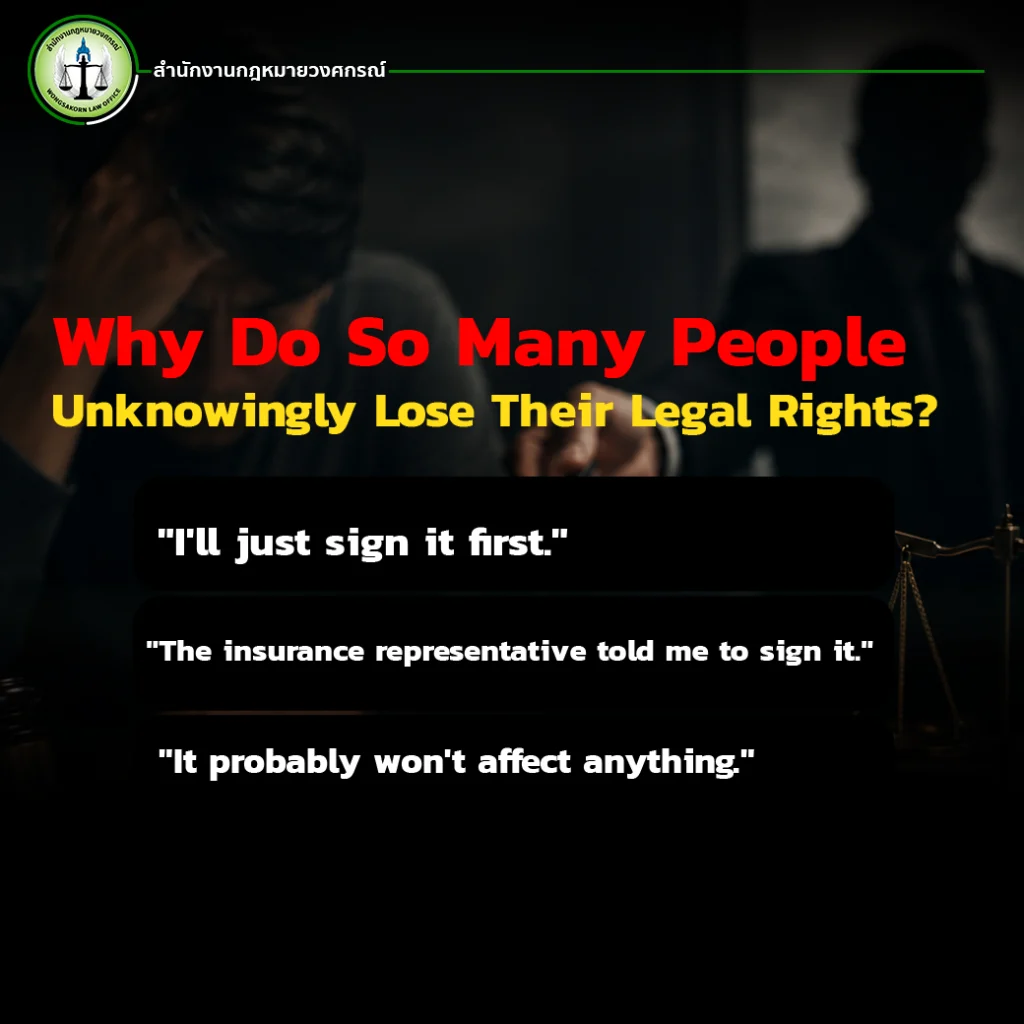
Based on the experience of Wongsakorn Law Firm, many accident victims focus primarily on getting their vehicle repaired as quickly as possible.

However, during the repair and insurance claims process, they are often asked to sign several documents. Many people simply assume:

  • “I’ll just sign it first.”
  • “The insurance representative told me to sign it.”
  • “It probably won’t affect anything.”

Unfortunately, when they later attempt to claim Loss of Use Compensation, those previously signed documents may become a point of dispute or be relied upon in the claims process.

This is why it is essential to carefully read and fully understand any document before signing it. A seemingly routine signature may later have significant implications for your legal rights and entitlement to compensation.

Key Point to Know: Insurance Companies Have Legal Support from Lawyers from the Very Beginning.

From the perspective of Lawyer Arm Supasit Siri, insurance companies operate through established procedures, internal systems, and with the support of legal counsel who provide advice throughout the claims process.

By contrast, most consumers are dealing with a traffic accident for the first time and may not fully understand their legal rights or the legal implications of the documents they are asked to sign.

Seeking legal advice is therefore not about creating unnecessary conflict. Rather, it enables injured parties to fully understand their rights and make informed decisions based on a complete understanding of the legal consequences before signing any document or proceeding with an insurance claim.
If You’re Involved in a Car Accident, Consult a Lawyer from Day One 

Many people wait until a dispute arises with an insurance company before seeking legal advice.

However, based on the experience of Wongsakorn Law Firm, obtaining legal guidance immediately after a traffic accident allows the matter to be handled in a structured and strategic manner, helping to protect your legal rights from the outset. This may include:

  • Preserving and collecting relevant evidence
  • Communicating and dealing with the insurance company
  • Reviewing documents before signing
  • Monitoring the vehicle repair process
  • Protecting your right to claim Loss of Use Compensation
  • Assessing the damages you may be entitled to recover under applicable law. 

Planning from the outset can significantly reduce the risk of unintentionally losing your legal rights.

A traffic accident does not end once the vehicle is sent for repairs. It may involve several legal rights that an injured party is entitled to pursue, particularly Loss of Use Compensation and Diminution in Value claims. Unfortunately, many people unknowingly compromise these rights by signing documents without fully understanding their legal consequences.

If you are currently experiencing issues with an insurance company—such as being asked to sign documents, agreeing to wait for spare parts, dealing with repair delays, claiming Loss of Use Compensation, or seeking compensation for your vehicle’s diminished value—do not rush to sign any document before carefully reviewing its contents. Understanding the legal implications in advance can help protect your rights and avoid unnecessary disputes later.

Wongsakorn Law Firm is ready to provide legal advice and help you develop an appropriate legal strategy from the very first day after a traffic accident. Our goal is to ensure that you fully understand your legal rights and can make informed decisions at every stage of the claims process.

Rather than waiting until a dispute arises, early legal planning can significantly reduce the risk of unintentionally losing the rights and compensation to which you may be legally entitled.

To consult Lawyer Arm, please click “Contact Us.” 
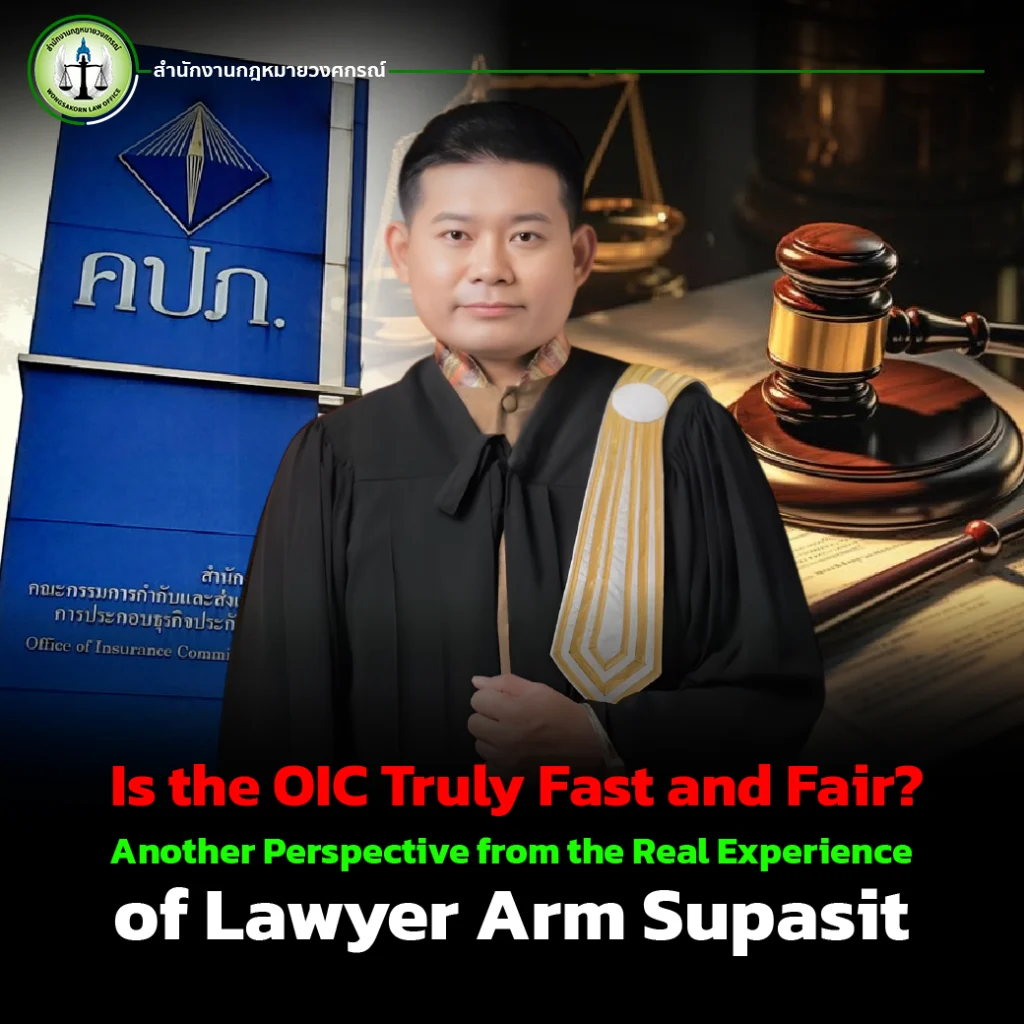
Is the OIC Truly Fast and Fair? Another Perspective from the Real Experience of Lawyer Arm Supasit

Many people who purchase insurance, whether life insurance, health insurance, or motor insurance, are familiar with the “OIC,” or the Office of Insurance Commission, as the agency responsible for regulating the insurance business in Thailand, as well as protecting the rights of consumers who hold all types of insurance policies.
But the important question is:

Is the OIC Truly Fast and Fair?

This is another perspective from Lawyer Arm Supasit of Wongsakorn Law Firm, who would like to reveal facts based on direct experience so that the public can think, analyze, and gain a better understanding of the OIC’s processes before deciding to enter arbitration proceedings.
What Is the OIC? What Are Its Responsibilities?

Many people may still not fully understand that the OIC is the agency responsible for regulating all insurance businesses in Thailand, including:

  • Health insurance
  • Life insurance
  • Motor insurance
  • Accident insurance
  • Property insurance
  • As well as all other types of insurance

The OIC’s main responsibilities are to:

  • Supervise insurance companies
  • Protect consumers
  • Receive complaints
  • Conduct arbitration proceedings in certain cases

At first glance, it may seem like an agency that fully supports and assists the public. However, once people enter the actual process, many begin to question whether it is truly “fast and fair” as promoted.

What Is OIC Arbitration?

When members of the public visit the OIC website, they will find a description of “arbitration” as a process that is:

  • Fast
  • Fair
  • Cost-effective

The phrase “fast and fair” immediately gives many people confidence because the general public naturally understands that if a dispute arises with an insurance company, this process should help them obtain justice quickly.

However, from the perspective of Lawyer Arm Supasit, the following questions are raised:

“What does speed really mean?”

And more importantly:

“Who determines what is fair?”

Even Lawyer Arm Supasit himself believes that the meaning of the word “fair” is something that is very difficult to define in practice.

Revealing the Actual Timeline of a Case at Wongsakorn Law Firm

To help the public see the process more clearly, Lawyer Arm Supasit shared a real case handled by Wongsakorn Law Firm.

Step 1: Submission of the Petition
8 May 2025
The OIC accepted the arbitration petition.

Step 2: First Hearing Appointment
17 June 2025
The first hearing was scheduled.

Many people may ask: Was that fast?

From the perspective of the general public, some people may feel that this already took quite a long time.

From the first hearing to the appointment of the arbitrator, the process took another month.

After 17 June 2025, the parties had to wait until:

18 July 2025

to appoint the arbitrator, or the neutral party who would decide the dispute.

The question is:

Why did appointing the neutral decision-maker alone take almost another full month?

This is one of the observations raised by Lawyer Arm Supasit, who believes that if something is described as “fast,” each person’s standard of what counts as fast may be different.

Preliminary Hearing, Witness Examination, and Waiting for the Award

After the arbitrator was appointed, the next stage was the preliminary hearing, which is the stage used to:

  • Define the disputed issues
  • Determine what evidence the consumer would present
  • Determine what arguments the insurance company would raise in response

After that, the process moved into the witness examination hearing.

However, reaching this stage required waiting until:

8 October 2025

A simple calculation shows that from June to October, the process took approximately four months.

When Was the Arbitration Award Issued?

After the witness examination was completed on 8 October 2025, the arbitration award was issued on:

12 February 2026

Meanwhile, the OIC had already received the arbitration award on:

6 February 2026

When calculating the total period from the submission of the petition to receiving the arbitration award, the process took many months.

The question therefore returns:

Can this truly be considered “fast”?

The Meaning of Speed for the Public and for an Agency May Not Be the Same

From the perspective of the general public, the word “fast” may mean:

  • Not having to wait for several months
  • Not having to spend a long time going through procedures
  • Receiving an answer quickly

However, from the perspective of an institutional process or the arbitration system, there may be a different standard.

Therefore, Lawyer Arm Supasit would like the public to:

  • Analyze it for themselves
  • Compare it for themselves
  • And decide for themselves whether the process is truly fast

The Agency Says It Is Cost-Effective. Is That Really True?

Another phrase that the public often sees is “cost-effective.” However, based on a real case handled by Wongsakorn Law Firm, the total cost came to approximately:

THB 12,800

And simply to begin the process, the party submitting the arbitration petition was required to pay an initial filing fee of:

THB 10,000

This means that the process is not free, as many people may understand.

From the perspective of the general public, the word “fast” may mean:

  • Not having to wait for several months
  • Not having to spend a long time going through procedures
  • Receiving an answer quickly

However, from the perspective of an institutional process or the arbitration system, there may be a different standard.

Therefore, Lawyer Arm Supasit would like the public to:

  • Analyze it for themselves
  • Compare it for themselves
  • And decide for themselves whether the process is truly fast

The Agency Says It Is Cost-Effective. Is That Really True?

Another phrase that the public often sees is “cost-effective.” However, based on a real case handled by Wongsakorn Law Firm, the total cost came to approximately:

THB 12,800

And simply to begin the process, the party submitting the arbitration petition was required to pay an initial filing fee of:

THB 10,000

What Should the Public Do When They Have a Problem with an Insurance Company?

The most important thing is not to make a decision based solely on advertising messages or short descriptions.

Whether it is claims such as:

  • Fast
  • Fair
  • Cost-effective

Because in reality, every case has different details and circumstances.

Why Should You Consult a Lawyer Before Entering the OIC Process?

Many people only consult a lawyer after they have already:

  • Entered the process
  • Paid the fees
  • Spent several months waiting

Even though proper planning from the beginning is extremely important.

Because a lawyer can:

  • Analyze which process is the most appropriate
  • Assess the chances of success in the case
  • Develop the legal strategy for the case
  • Help prevent the client from being placed at a disadvantage

Especially in insurance disputes, where insurance companies often have legal teams involved from the very beginning.

Is the OIC Truly Fast and Fair? Let the Public Decide

This article from Wongsakorn Law Firm is not intended to criticize any agency. Its purpose is to reflect another perspective based on real experience so that the public can gain a better understanding of the OIC process.

Because in the end, the terms:

  • “Fast”
  • “Fair”
  • “Cost-effective”

may carry different meanings depending on each person’s perspective.

Therefore, before entering any insurance-related process, people should carefully study all available information and consult a lawyer with direct experience in this area in order to avoid wasting time, incurring unnecessary expenses, and being placed at a disadvantage in the future.

For consultation with Lawyer Arm Supasit, click >> Contact Us <<

 Does the OIC Really Help the Public? The Truth Policyholders Need to Know About Why Many People Unknowingly End Up at a Disadvantage

When people talk about insurance, most assume that if an accident or damage occurs, the agency responsible for helping the public is the OIC, or the Office of Insurance Commission, which oversees the insurance industry in Thailand.

However, in reality, there are many things that the public may not know, especially regarding the process of filing complaints or claiming compensation from insurance companies. In many cases, policyholders or injured parties unknowingly end up at a disadvantage.

Recently, Lawyer Arm Supasit of Wongsakorn Law Firm shared real stories about the complaint process with the OIC that many people may never have known before. This is important information for everyone who has insurance.

When Filing a Complaint with the OIC but Being Told “The Officer Cannot Make a Decision”

หOne real issue that often occurs is when an injured party or policyholder files a complaint with the OIC, only to be told by the officer that:

“The officer cannot make a decision.”

The officer may then recommend that the person proceed through:

  • arbitration proceedings, or
  • court proceedings.

At first glance, this may seem normal. However, in reality, the issue is far more complex than many people realize.

Lawyer Arm Supasit believes that the public should not immediately believe everything without careful consideration. In some cases, officers may provide accurate information, but in other situations, matters should still be analyzed thoroughly.

The key problem is this: if an ordinary person has no legal knowledge, how can they determine:

  • what should be trusted, and
  • what should be further examined?

This is exactly why many injured parties unknowingly end up at a disadvantage.

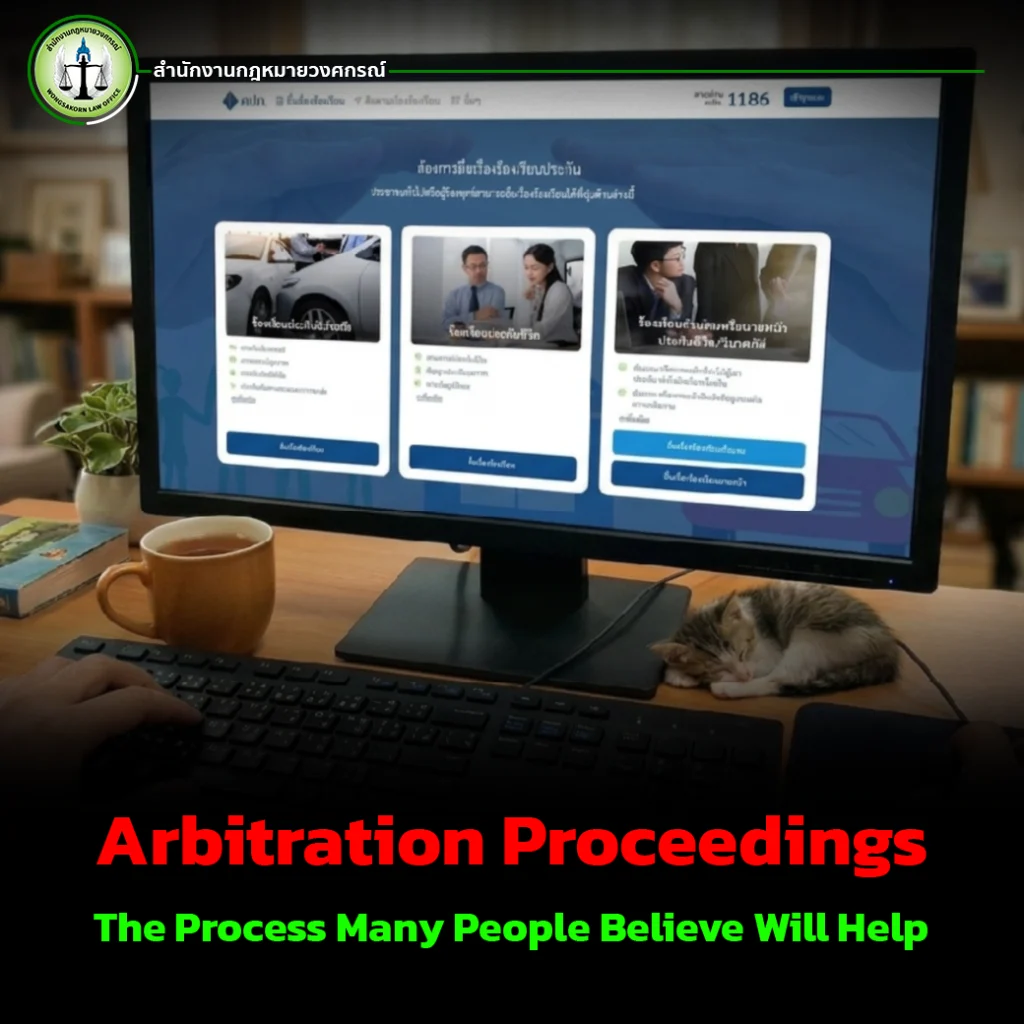
Arbitration Proceedings: The Process Many People Believe Will Help

Most insurance policies contain provisions stating that:

the injured party or claimant has the right to choose to proceed through arbitration.

The important question is:

if the law or the insurance contract gives policyholders or injured parties the right to choose this process, why do problems often arise once they actually enter the proceedings?

The Truth Many People Have Never Known

From the experience of Wongsakorn Law Firm in handling client consultations, it has been found that in many cases, injured parties chose to enter arbitration proceedings based on the recommendation of the OIC. However, once the process began, the insurance company submitted a petition to the arbitration panel stating that:

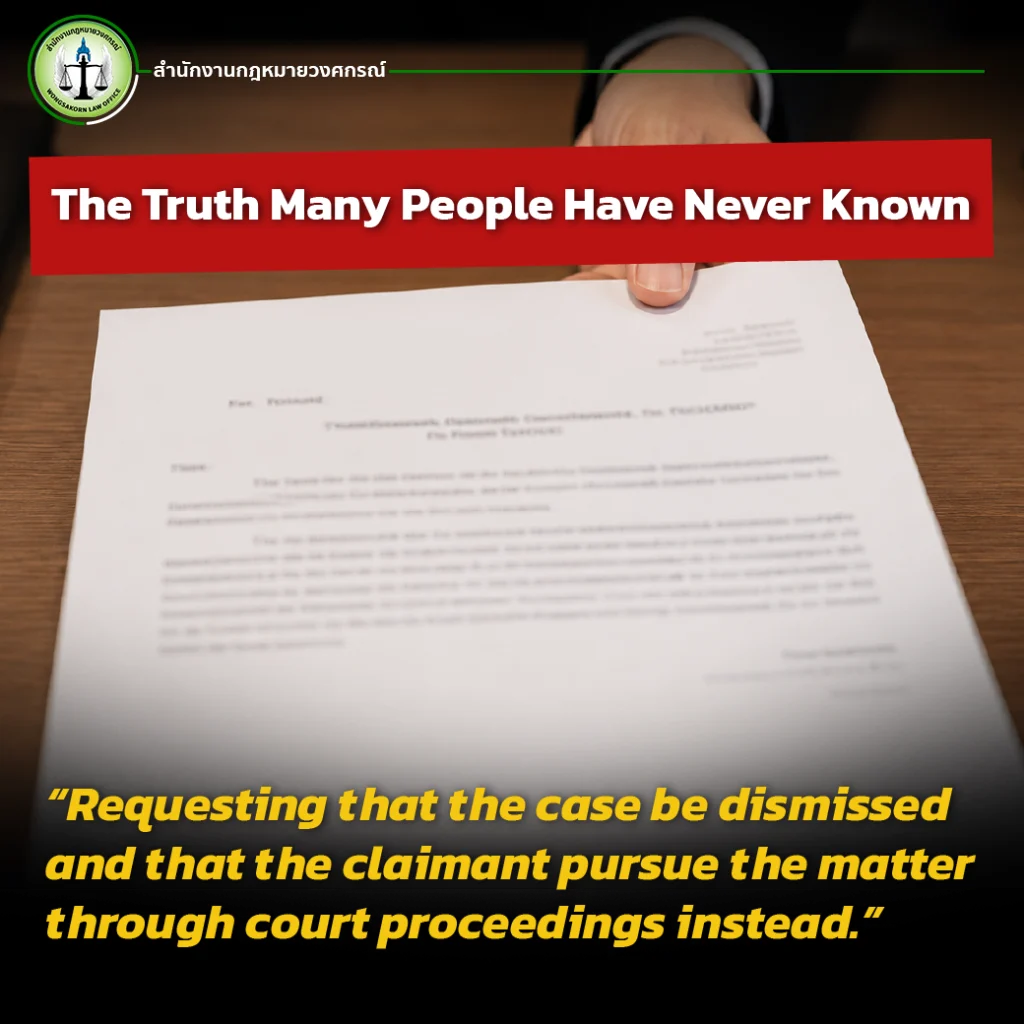
“Requesting that the case be dismissed and that the claimant pursue the matter through court proceedings instead.”

This raises an important question:

if, in the end, the injured party must still return to court anyway,

then why should they first have to:

  • lose time,
  • incur expenses, and
  • pay arbitration-related costs?

In some cases, injured parties may have already spent tens of thousands of baht before discovering that the case had been dismissed from the arbitration process.

What Role Should the OIC Play in Situations Like This?

An important question many people have begun asking is: if this type of situation repeatedly happens to the public, what responsibility or protective role should the OIC have?

Most people believe that 

  • once they enter the process,
  • they will receive assistance,
  • or at least be given a clear path for exercising their legal rights.

However, when reality turns out differently, many injured parties end up feeling disadvantaged in terms of both time and expenses.

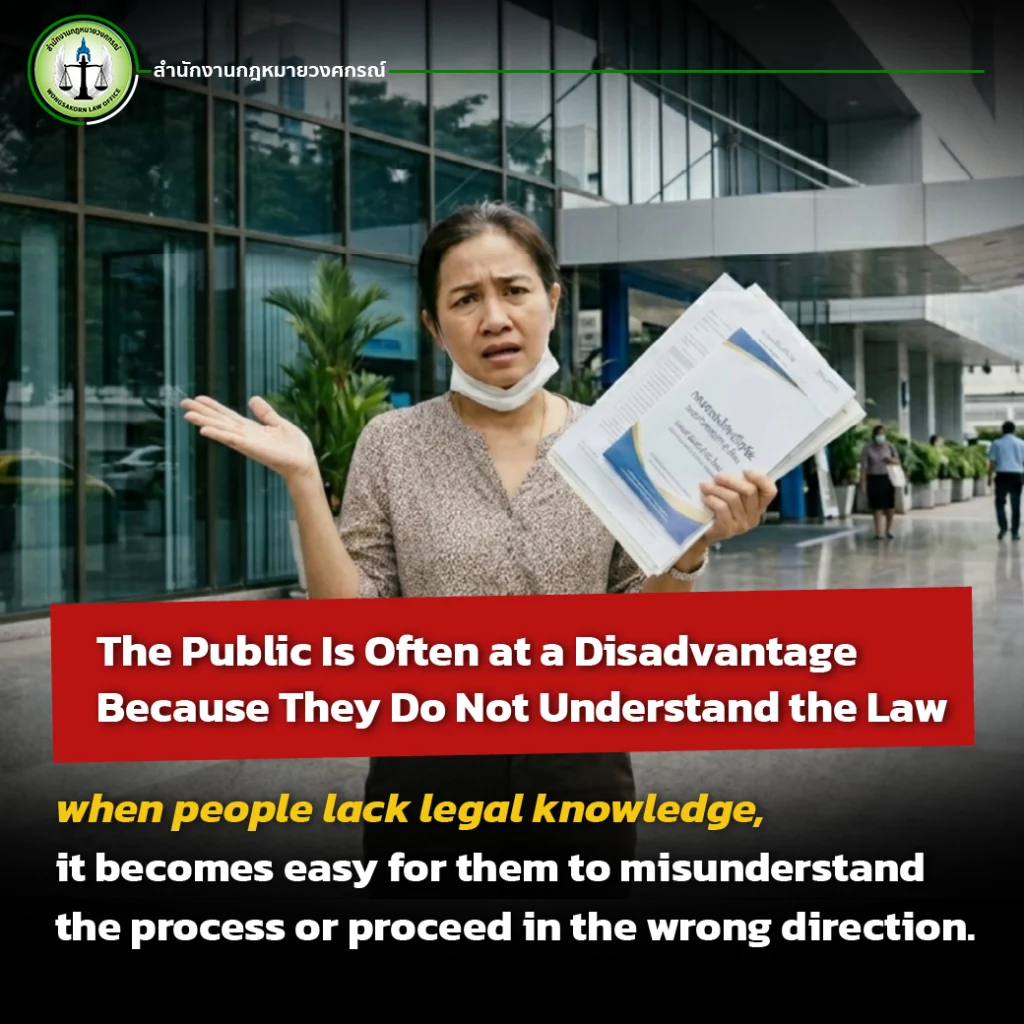
The Public Is Often at a Disadvantage Because They Do Not Understand the Law

The biggest issue is that most injured parties are not legal professionals.

As a result, they often do not understand:

  • which legal process is most appropriate,
  • which steps should be taken first, or
  • what rights insurance companies actually have within the process.

And when people lack legal knowledge, it becomes easy for them to misunderstand the process or proceed in the wrong direction.

This is exactly why many people end up at a disadvantage against insurance companies, even when they are genuinely the injured party.

Insurance Companies Have Legal Teams from the Very Beginning

One important thing injured parties must understand is that insurance companies already have:

  • legal teams,
  • lawyers, and
  • case specialists

handling matters from the moment an incident occurs. As a result, if an injured party handles the matter alone without legal counsel to guide the strategy, the chances of being placed at a disadvantage are extremely high.

This is especially true in cases involving:

  • denial of insurance claims,
  • interpretation of policy terms,
  • arbitration proceedings, and
  • court litigation.

Do Not Wait Until Problems Arise Before Looking for a Lawyer

This is something Lawyer Arm Supasit has consistently emphasized. Many injured parties wait until problems occur, wait until the insurance company denies the claim, or wait until they are already at a disadvantage before consulting a lawyer. In reality, establishing the right legal approach from the very beginning is far more important.

Because sometimes, simply:

  • drafting the complaint properly,
  • organizing the facts and supporting information, or
  • choosing the appropriate legal process

can significantly affect the entire direction of the case.

Understanding the OIC and Understanding Insurance Is Important

This article from Wongsakorn Law Firm is not intended to attack any organization. Its purpose is to help the public “stay informed” because in the world of insurance:

  • not every recommendation is suitable for everyone, and
  • not every process will always benefit the injured party.

Therefore, before deciding to enter any legal or insurance-related process, people should always study the information carefully and consult an insurance law specialist first.

Consulting a Lawyer Immediately After an Incident Is the Best Option

Wongsakorn Law Firm, led by Lawyer Arm Supasit, believes that the most important thing after an accident or insurance dispute occurs is:

“to consult a lawyer immediately”

in order to:

  • structure the case properly,
  • analyze the relevant legal issues,
  • assess the appropriate approach for claiming compensation, and
  • prevent being placed at a disadvantage throughout the legal process.

Because if the case is handled incorrectly from the very beginning, the injured party may ultimately lose significant time and incur unnecessary expenses.

Do Not Be Misled by Insurance Companies or the Process Itself

Today, having insurance is not just about purchasing coverage.

Policyholders must also:

  • understand their rights,
  • understand the legal process, and
  • stay informed about legal strategies.

This is especially important when dealing with the OIC, arbitration proceedings, or insurance compensation claims.

If you do not want to be placed at a disadvantage by insurance companies or by the legal process itself, consulting a lawyer from the very beginning is the safest option.

You may consult Lawyer Arm Supasit of Wongsakorn Law Firm today to properly structure your case from the start.

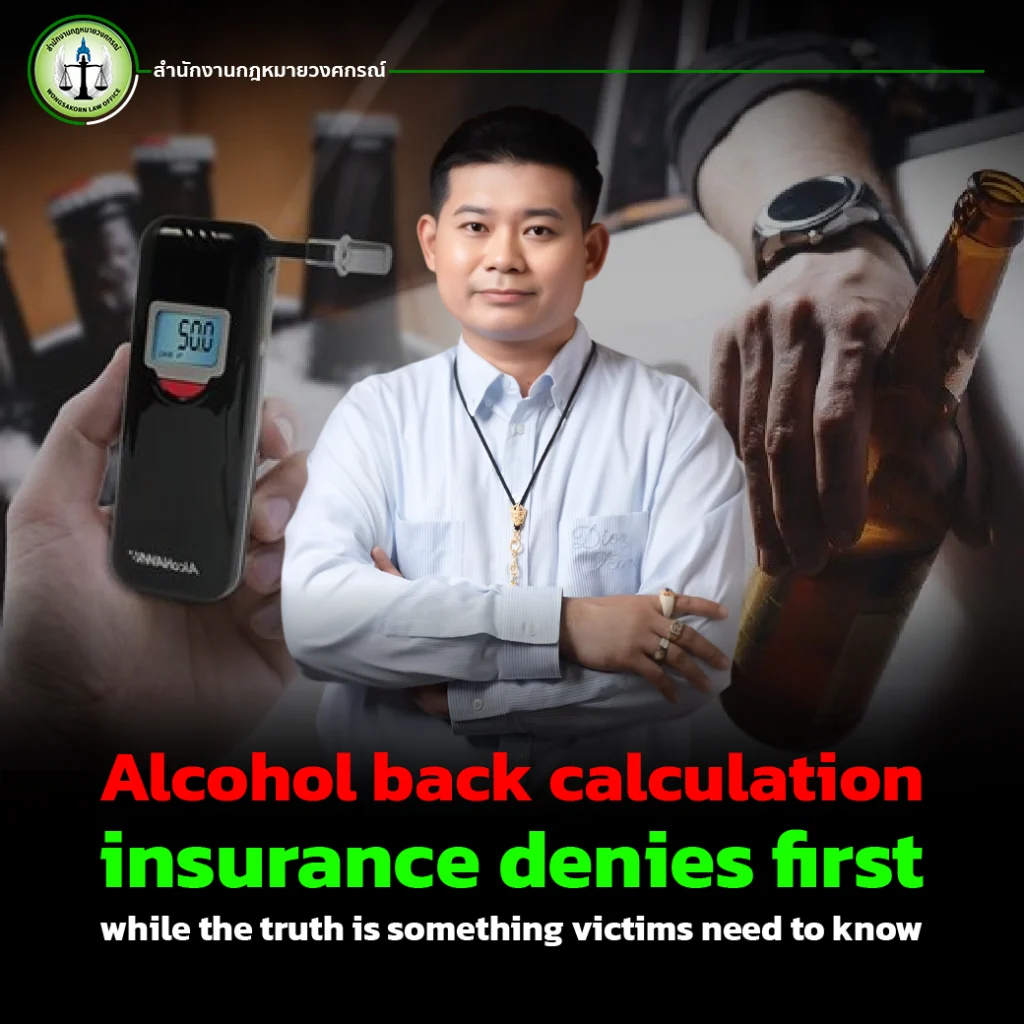
Alcohol back calculation  insurance denies first, while the truth is something victims need to know.

Alcohol exceeding 50 milligrams percent while driving becomes a major point of conflict between victims and insurance companies. When a road accident occurs, one of the issues that is always raised for consideration is the “back-calculation of blood alcohol content” of the driver, especially in cases involving insurance claims. Many people may have encountered situations like this.

The key question is: Is this kind of alcohol back-calculation fair to consumers?
This article from Wongsakorn Law Office will take you deeper into the issue of alcohol and insurance, explaining mechanisms that many people may have never known before.

Conditions in insurance contracts regarding alcohol
In general, motor insurance policies clearly state an important condition:
The company will not pay compensation if the driver’s blood alcohol level exceeds 50 milligrams percent “while driving.”

It sounds straightforward, but in practice there is a significant “gap,”
because the term “while driving” cannot be measured in real time.

The starting point of the issue of alcohol back-calculation

In reality, when an accident occurs, alcohol testing usually takes place “after the incident.” This leads to the concept of “alcohol back-calculation,” which is a medical principle used to calculate backward from the level detected at a later time.

So who determines that “back-calculation” should be used?
There are guidelines from regulatory authorities that allow back-calculation in certain cases, such as using the rate of alcohol metabolism in the body.

But the problem is that the general public has little to no knowledge about this.

Why do victims feel they are being “treated unfairly”?
Try to imagine this situation:

  1. You did not feel intoxicated while driving.
    There was no explanation about back-calculation when purchasing the insurance.
    But after the incident, the insurance company uses “back-calculation”
    and concludes that your alcohol level exceeded the limit while driving.

The result is that your claim is immediately denied afterward.

Can this be called “tricky” or “cunning” insurance?

From the victim’s perspective, many people see it as the use of technical or legal loopholes, because it was never explained at the time of purchase that alcohol back-calculation would be applied while driving; it relies on medical principles that are difficult to understand, as not every member of the public can grasp such concepts; and it is often used at the moment of “denying payment.” When it is found that the driver had alcohol in their system while driving, the insurance company uses this approach to immediately deny the claim, in order to protect its own interests, rejecting first in the hope that the victim will believe it. If the victim believes it, the company does not have to pay any compensation.

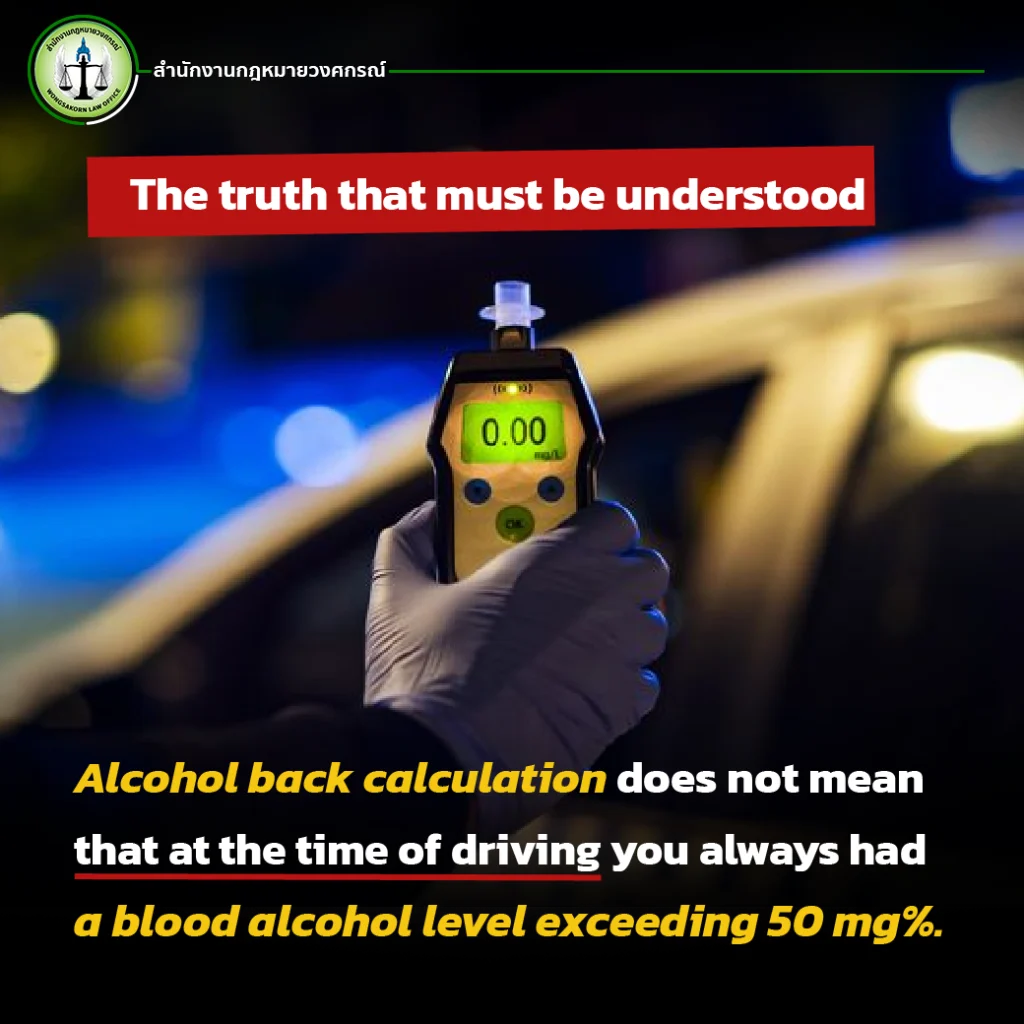
The truth that must be understood Back-calculation is not a 100% conclusion.

 What is important for victims to know is

Alcohol back-calculation does not mean that at the time of driving, you always had a blood alcohol level exceeding 50 mg.%

Because the level of alcohol in the body
depends on many factors, such as
the time of drinking,
the amount of food in the stomach,
body weight,
and each individual’s metabolism.

Therefore, back-calculation is only an “estimation,” not a 100% fixed fact.

A common strategy used by insurance companies

From experience in many insurance cases, one approach frequently used is

 “Deny first if the victim does not dispute it, the matter ends.”
Why does this strategy work?

 Because most victims do not know the law. Insurance companies use terminology and principles in a way that leads victims to believe they are actually at fault. Most people are reluctant to fight or dispute, as they do not want trouble or to go to court. This becomes a loophole that allows insurance companies to gain an advantage with minimal effort, because in the end, the company does not have to pay any compensation.

Do not immediately believe that you had “excess alcohol” without verification

The most dangerous thing is when a victim “immediately believes” that they are at fault,
when in reality, there may still be many legal arguments available.

Questions you should ask

  • When was the alcohol test conducted?
  • How much time had passed since the incident?
  • How accurate is the back-calculation method?
  • Are there other factors that could affect the measured value?

The best solution consult a lawyer immediately after the incident

If you or someone close to you has been involved in an accident and there is an issue regarding alcohol or alcohol back-calculation,
What you should do immediately is do not wait, do not assume, and do not immediately believe the insurance company.

Why is it necessary to consult a lawyer right away?
Because a case must be “structured” from the very beginning. Certain evidence or information must be collected immediately, and responding requires specialized knowledge.

Because insurance companies already have legal teams
What many people may not know is that insurance companies already have legal teams, litigation approaches, and negotiation strategies to persuade victims to settle, even from “before the incident” occurs.

Therefore, if a victim does not have an expert to handle the compensation claim process, they are clearly at a disadvantage.

Being subjected to alcohol back-calculation is not the end of your rights
Having an issue related to alcohol back-calculation does not mean you “lose your rights” immediately. What matters is that you stay informed and do not allow yourself to be taken advantage of by the insurance company.

If you are facing this problem
If your claim has been denied due to “alcohol back-calculation,”
do not let the matter end easily. In many cases our office has handled, there has not been a single case lost, because we pursued each case to the fullest extent. Victims can fight and claim their rights.

An option for those seeking fairness
Consulting a lawyer who specializes in insurance cases, especially those involving alcohol back-calculation, will help you understand your rights, plan your case correctly, and increase your chances of receiving fair compensation.

Do not let a lack of knowledge cause you to lose your rights.

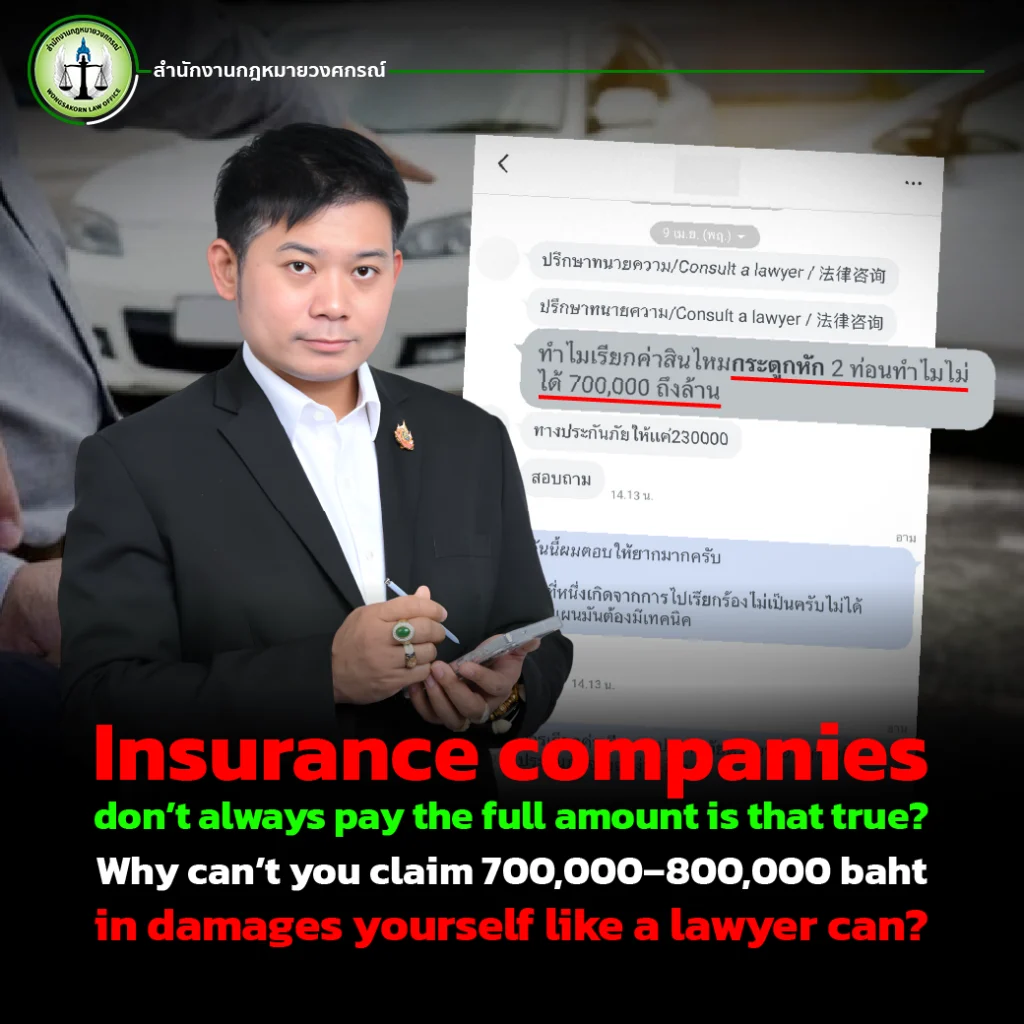
Insurance companies don’t always pay the full amount. Is that true? Why can’t you claim 700,000–800,000 baht in damages yourself like a lawyer can?

Do insurance companies really not pay in full? This is a very common question when a car accident results in serious injuries. One of the key doubts victims often have is
“Why is it that when I file a claim with the insurance company myself, I don’t receive as much compensation as when a lawyer handles it?”

Many people may have seen cases where compensation reaches 700,000–1,000,000 baht.
But when they deal with the insurance company on their own, they receive only a portion of that amount, or less than expected.

The truth is, this does not depend on the injury alone. Legal factors, strategy, and the method of making the claim all play a significant role.

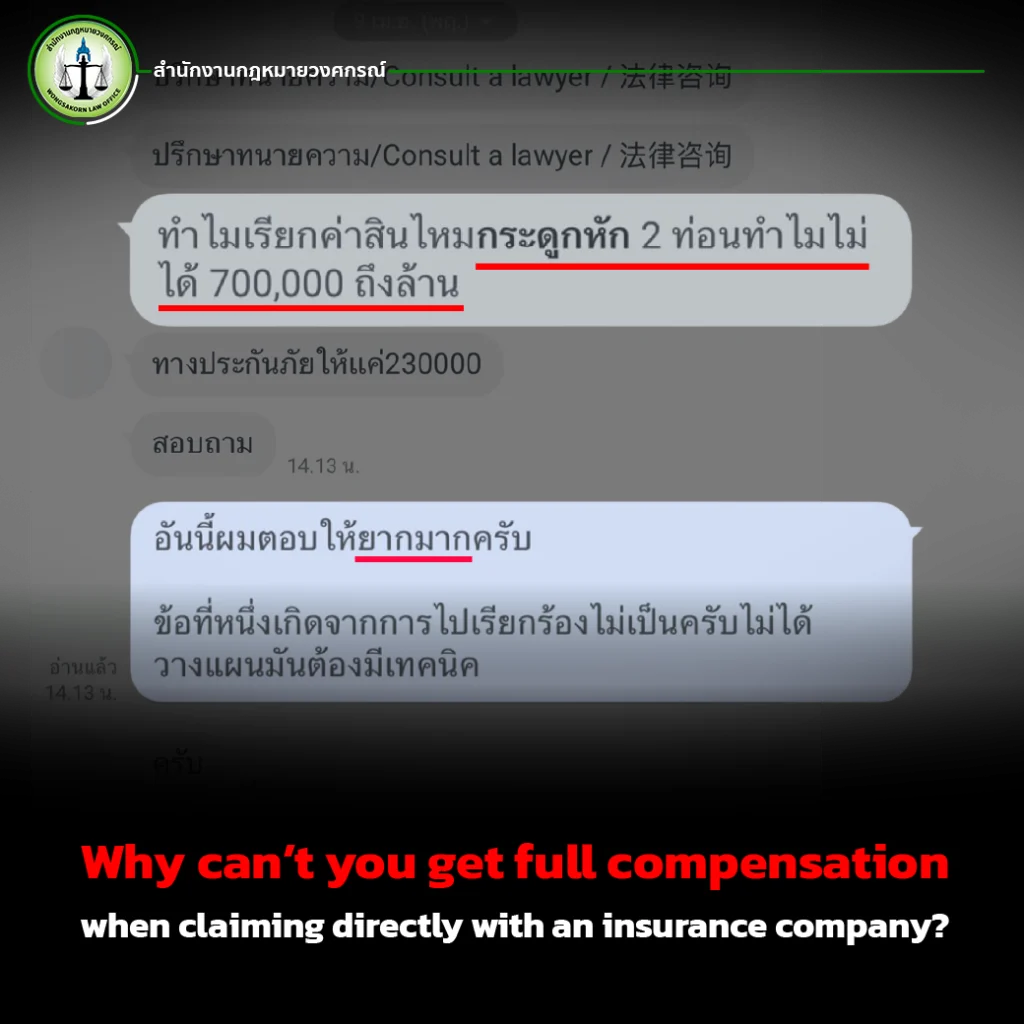
Why can’t you get full compensation when claiming directly with an insurance company?

From the experience of lawyers who work directly in the insurance field, it must be said honestly that
for an insurance company to pay a large sum such as 700,000–800,000 baht at the general claims stage is “very unlikely.”
It’s not that it’s completely impossible, but in practice, it is considered “very difficult” if the injured party handles the claim on their own.
The main reasons why victims often receive lower compensation when handling claims on their own

1. Lack of legal understanding
Most victims assume that “serious injury = high compensation.”
However, legally, compensation claims involve many elements, such as:

-Medical evidence

-Continuity of treatment

-Future damages

If these are not properly structured, the value of the damages may be “underestimated.”

2. No planning from the beginning
Claiming compensation from an insurance company is not just about submitting documents. It requires “case structuring” from the start. If the process begins incorrectly, the final outcome is often lower than it should be.

3. Lack of understanding of insurance company strategies
It is important to understand that insurance companies are not responsible for “helping victims,”
but for “paying based on provable damages.”

In practice, insurance companies usually have legal teams ready to deny or handle claims. They deal with cases every day, meaning they have extensive negotiation experience and established approaches. Additionally, they have internal strategies for evaluating compensation.

Therefore, it is quite clear that handling a claim alone makes it difficult to obtain a high level of compensation. If the victim lacks sufficient knowledge, they are more likely to be at a disadvantage.

Key technique Don’t wait until you fully recover before making a claim

One of the “biggest mistakes” victims often make is
waiting until they have fully recovered before claiming compensation.

From the perspective of insurance cases, this means being “at a disadvantage from the very beginning.”

Why shouldn’t you wait?

Insurance companies often tell victims to complete their treatment first and then come back later to claim compensation. The question is can you really do that?

In reality, who do those words truly benefit? The longer you wait to fully recover, the more your injuries improve over time until you reach 100% recovery. In some cases, this may take several months, or even years. When the time finally comes to claim compensation from the insurance company, they may say, “You have fully recovered, so this amount of compensation is sufficient.”

This is considered a common strategy used by insurance companies. It often starts with a denial or delay, in case the victim believes it. If the victim does believe it, they will almost certainly receive less compensation than expected.

Therefore, consulting a lawyer from the very beginning after the accident is a way to increase the chances of receiving higher compensation. Importantly, the lawyer should be someone who understands how insurance companies operate.

“Understanding insurance” is the key.

An important piece of advice is
Do not beg the insurance company to pay,
because the insurance system does not operate on sympathy,
but on “law and evidence.”

What should victims do?

-Gather all documents and evidence completely

-Keep a continuous record of injuries and medical treatment

-Assess both short-term and long-term damages

-Plan the claim process systematically

However, these things are “difficult to do on your own” without legal knowledge. Therefore, it is important to “consult a lawyer from the moment the accident happens.”

Why do you need a lawyer from the beginning?
What many people misunderstand is:
“Only look for a lawyer after a problem arises.”

But in reality, for insurance cases, you should have a lawyer even before any dispute occurs.

This is because insurance companies already have legal teams in place before any incident happens. They have systems and strategies ready, including evaluating damages to be “as low as possible.”

Therefore, if a victim wants “fairness,” they must also have a professional to plan and handle the case in the same way.

Don’t be at a disadvantage with insurance because of a wrong start

Claiming compensation from an insurance company is not about “luck,” but about “strategy.”

If:

– You start off wrong
If you make a mistake from the very beginning like buttoning a shirt incorrectly it can cause the whole situation to spiral out of control.

– You misunderstand
Nowadays, on various social media platforms, there are many lawyers or so-called experts who provide incorrect information. Consuming misleading or inaccurate content may cause victims to misunderstand and take the wrong steps, which may ultimately lead to outcomes that fall short of expectations.

– You have no plan
Whether you handle the claim yourself or follow general advice, if you do not have a proper plan or structured process and no lawyer to shape the case the chances of receiving compensation lower than the actual value are very high.

Consult a lawyer starting today, no need to wait until you have fully recovered.

If you or someone close to you has been in an accident and wants to claim fair compensation from an insurance company, our key advice is:
Do not wait until you are fully recovered. Do not be misled by negotiations that put you at a disadvantage.

Most importantly, you should consult a lawyer from the very beginning, because your rights “must be protected.”

The injuries you have suffered are real damages, and you have the right to receive appropriate compensation.

Don’t let a lack of knowledge cause you to lose the rights you deserve.

Start planning today so you won’t be at a disadvantage with insurance companies in the future. Consult a lawyer click >>Contact Us<<

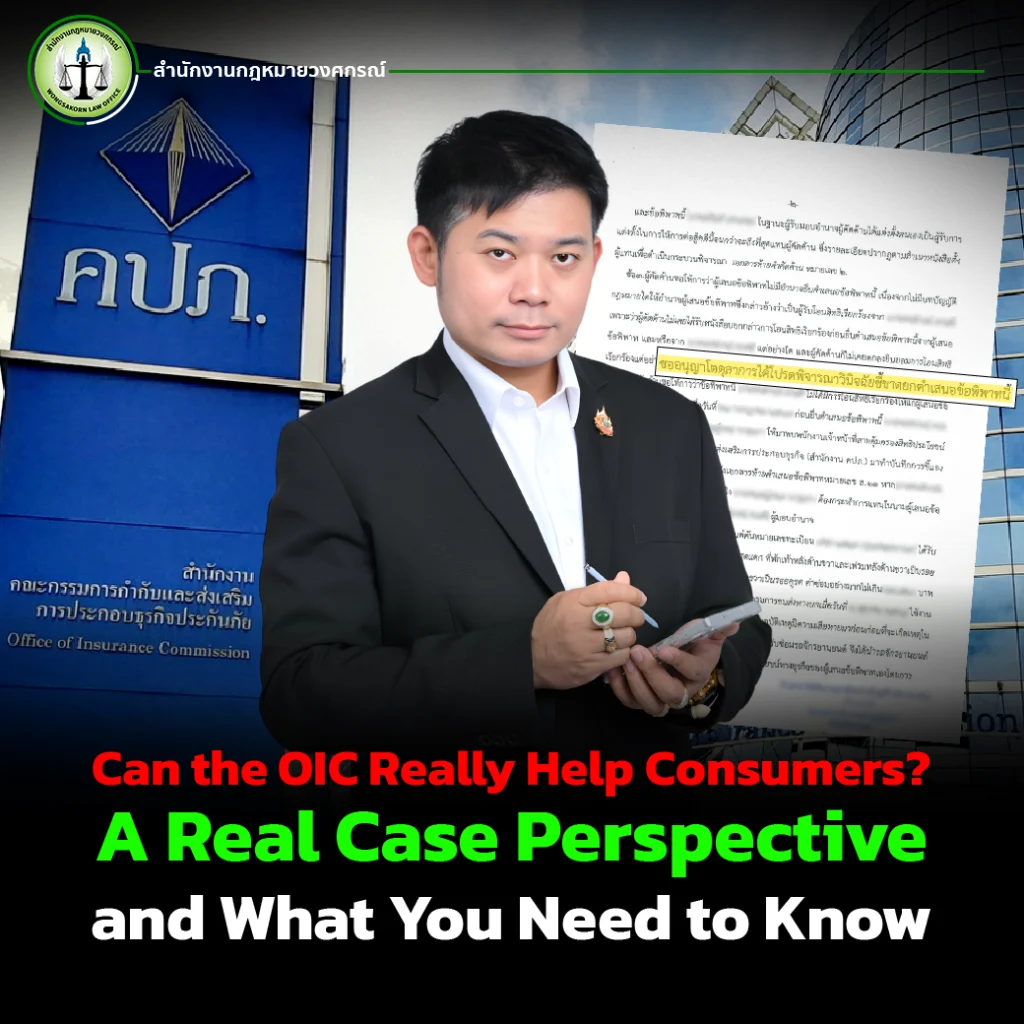
Can the OIC Really Help Consumers? A Real Case Perspective and What You Need to Know

In today’s world, insurance has become essential not only for drivers on the road but also for business operators such as auto repair companies (like our client). One key organization many people are familiar with is the Office of Insurance Commission (OIC), the regulatory body responsible for overseeing insurance companies and assisting the public in dispute situations.

But the crucial question is Can the OIC truly help consumers?

This article by Wongsakorn Law Firm takes a closer look at a real case, offering legal insights to help you better understand the OIC’s role and who you should rely on to avoid losing your rights.

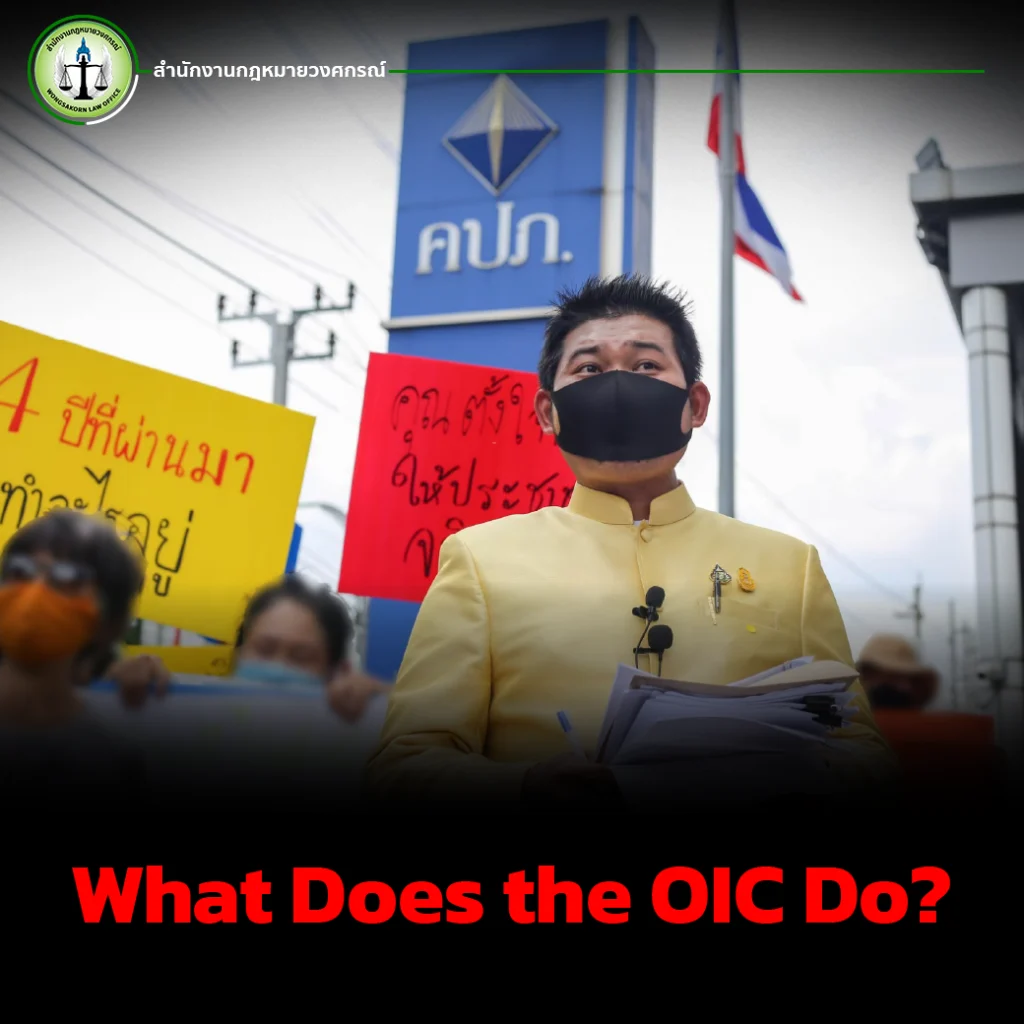
What Does the OIC Do?

The OIC’s main responsibilities include

-Regulating the insurance industry

-Protecting policyholders’ rights

-Acting as a mediator in disputes

-Providing arbitration as an alternative to court proceedings

On paper, it sounds like a reliable support system for consumers. However, in practice, things do not always work out that way.

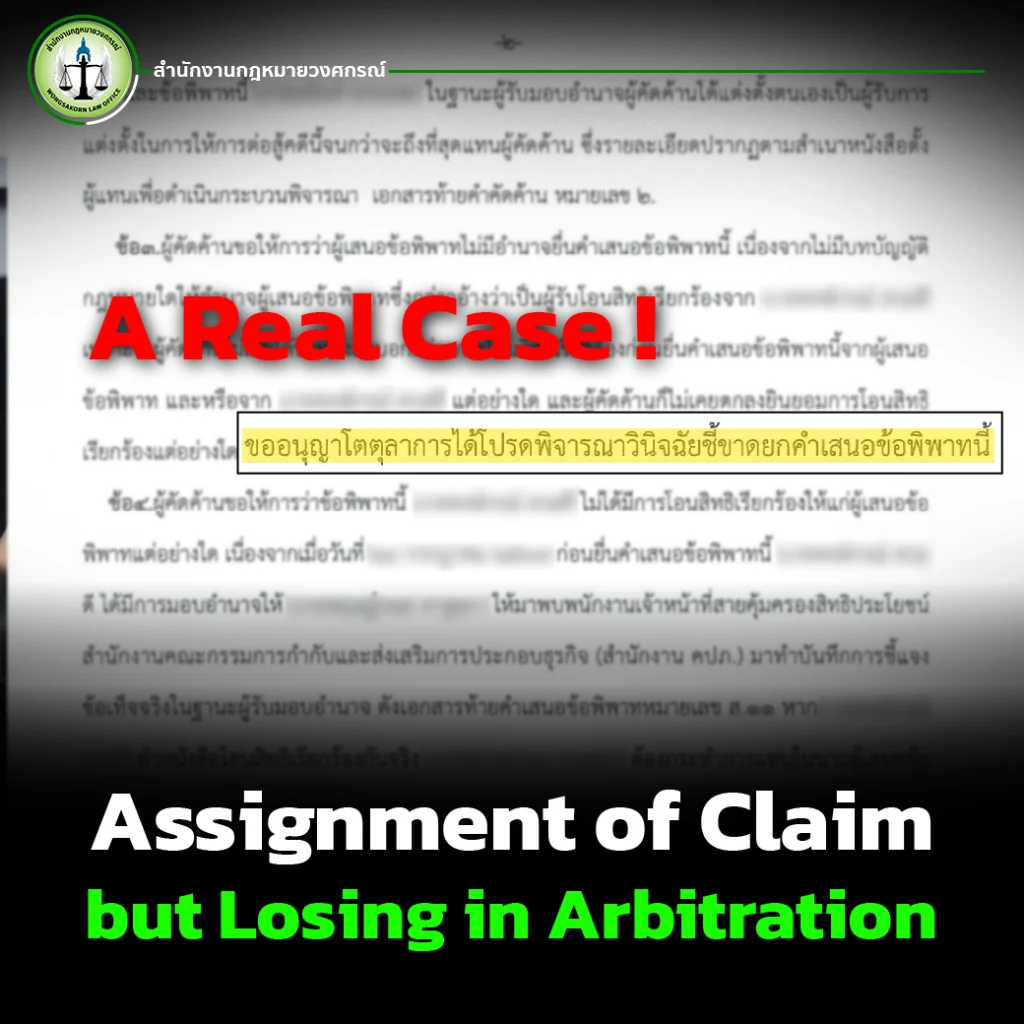
A Real Case Assignment of Claim but Losing in Arbitration

In one notable case, an auto repair company received an assignment of claim from a customer, allowing it to directly claim repair costs from the insurance company.

However, during the OIC process and arbitration, the insurance company argued:

“We were never notified of the assignment of claim.”

This was despite the fact that all relevant documents had already been submitted during the OIC process.

The Turning Point An Internal Issue at the OIC

The critical issue in this case was that an OIC officer failed to properly record a key document.

As a result, the arbitrator ruled that there had been no valid notification, causing the repair company (our client) to lose the case in arbitration.

This raises an important question: Who does the OIC really serve?

Justice from the Court

Although the case was lost at the arbitration stage, the matter was later brought before the court and the outcome was completely different.

The court ruled in favor of our client, citing Section 306 of the Civil and Commercial Code, which states that once a debtor has been informed of an assignment of claim, the assignment is legally valid.

The court found that notification had indeed occurred. As a result:

-The assignment of claim was legally effective

-The arbitration award was set aside

-Justice was ultimately delivered by the court, not the OIC

Is the OIC Still Reliable?

This case highlights several important realities:

-The OIC is not a court of law

-Arbitrators can make errors in evaluating evidence

-Internal processes may have flaws

-Arbitration awards can be challenged and overturned

From our experience handling insurance disputes, such cases where arbitration decisions are overturned are not uncommon.

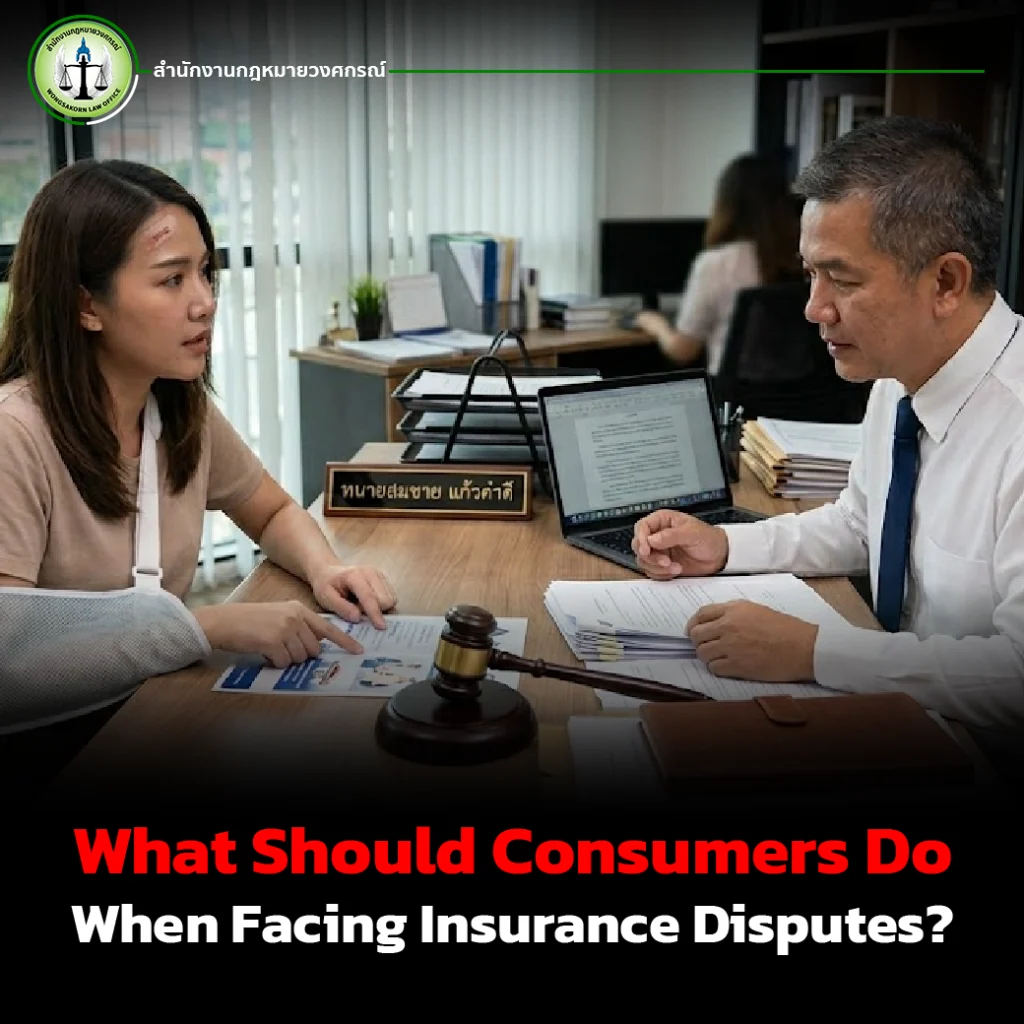
What Should Consumers Do When Facing Insurance Disputes?

If you are involved in an accident and need to claim compensation from an insurance company, here are key precautions

1. Do Not Rely on Verbal Assurances

Always ensure everything is supported by clear documentation.

2. Monitor the OIC Process Carefully

Even after filing a complaint, follow up to ensure all documents are properly recorded and no key facts are overlooked.

3. Do Not Depend Solely on Arbitration

While faster, arbitration is not always accurate or fair.

4. Consult a Lawyer Early

This is the most important step. An experienced lawyer can:

-Structure your case correctly from the beginning

-Prevent procedural mistakes

-Develop an effective legal strategy

Having a legal expert in insurance disputes not only prevents you from being disadvantaged by insurance companies but also helps you avoid costly mistakes.

In complex disputes, relying solely on the OIC may cause you to lose your rights without realizing it.

Don’t Place All Your Trust in the OIC

So, can the OIC really help consumers?

The answer is: Yes but not always.

Ultimately, the outcome depends on

-The strength of your evidence

-Legal strategy

-And proper case handling by an experienced lawyer

If You Are Facing an Insurance Dispute

Whether your case involves personal injury or property damage, do not let the situation escalate by filing a complaint with the OIC without proper legal preparation.

Consult with us today. Our legal team specializes in insurance disputes and can:

-Analyze your case

-Develop a strategic legal approach

-Represent you effectively both before the OIC and in court

Because we believe that justice should never depend on systemic errors.

Get legal advice today so you don’t become a victim of the system or insurance companies.

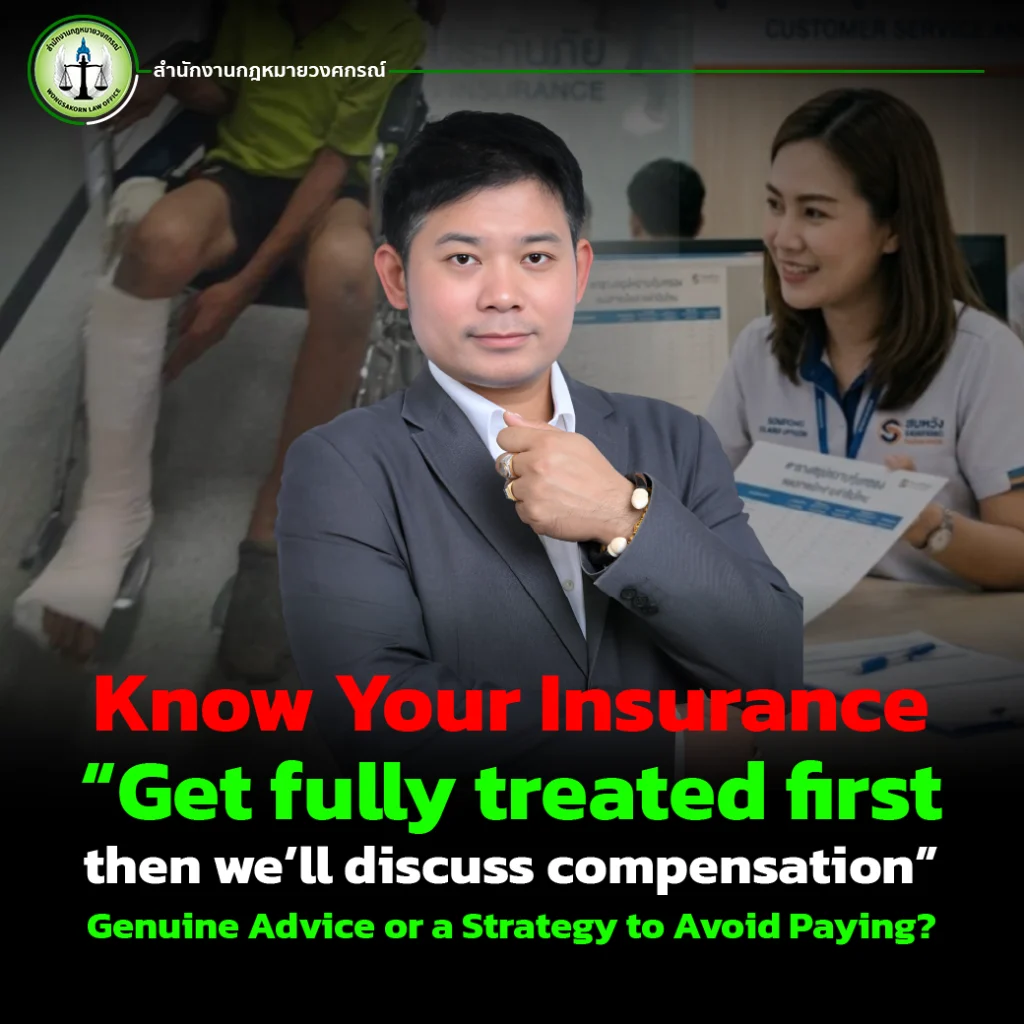
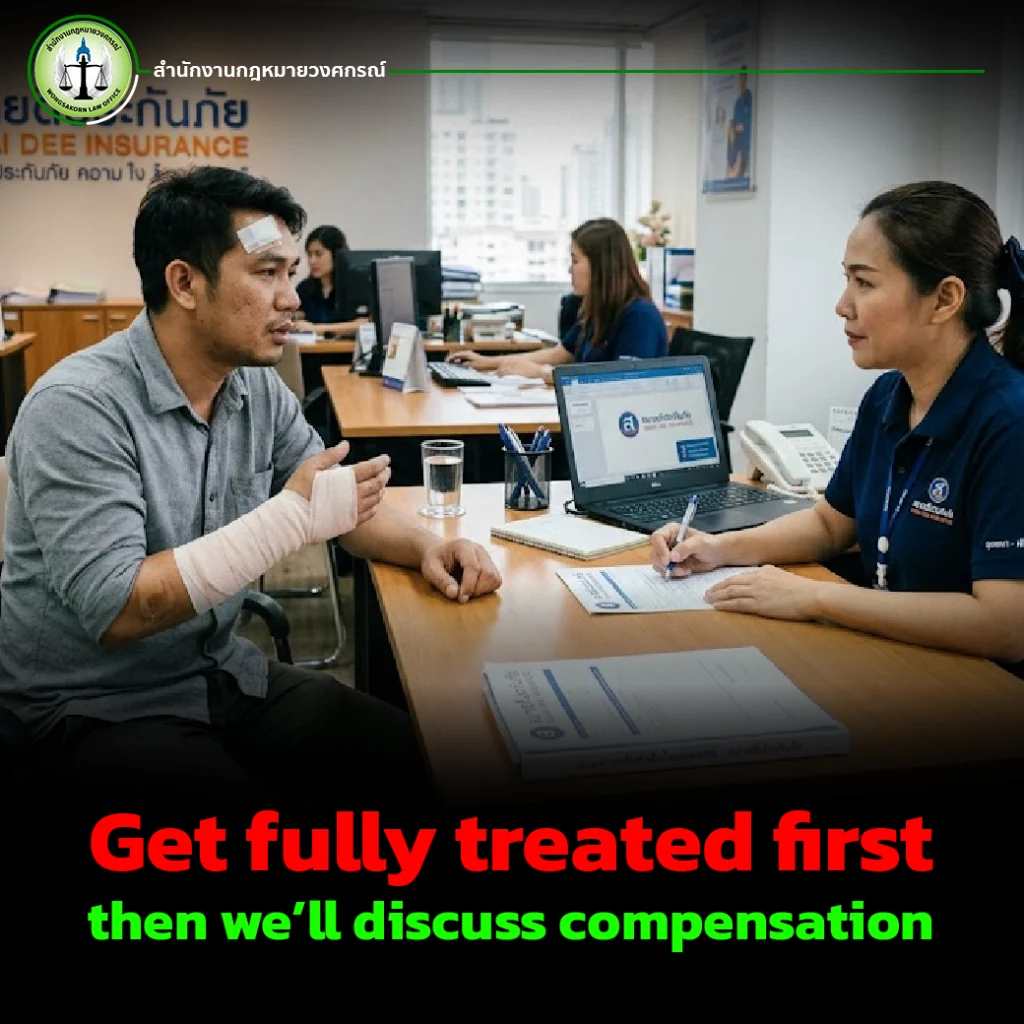
Know Your Insurance: “Get fully treated first, then we’ll discuss compensation” Genuine Advice or a Strategy to Avoid Paying?

When a car accident occurs, especially in cases involving injuries, one of the most common phrases victims hear from insurance companies is

It may sound like well-intentioned advice. However, in reality, this statement could be merely a “strategy” used by insurance companies to delay or avoid paying compensation. If victims believe this, they may unknowingly lose their legal rights, and in some cases, end up “suffering for free” without receiving the compensation they deserve.

This article will help you understand insurance tactics, know your rights, and learn what to do after a car accident.

Why You Should Be Cautious About “Settle Later”?

In practice, insurance companies are highly experienced in handling claims and often have strategies to minimize liability or limit payouts.

Common phrases include:

  • “Get treated first”
  • “We’ll settle everything later”
  • “Let’s wait until you fully recover”

Although these sound reasonable, they are often used to delay the process, because the longer it takes, the lower the chances for victims to claim full compensation.

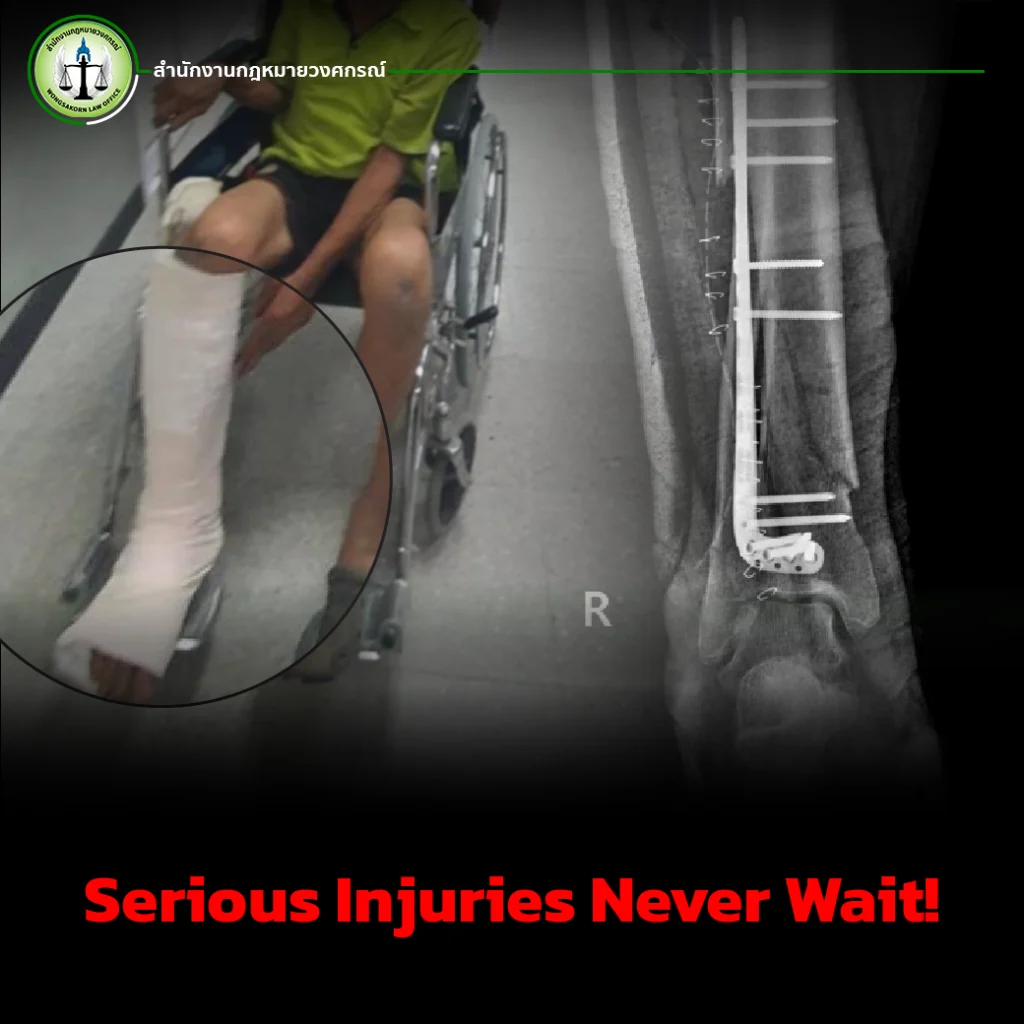
Serious Injuries Never Wait!

-In cases of severe injuries such as

-Bone fractures requiring surgery

-Long-term recovery

-Temporary loss of working ability

You should never wait until full recovery before claiming compensation, because damages include more than just medical expenses

-Loss of income

-Future medical care

-Emotional distress

-Loss of quality of life

Delays may result in missing evidence or incomplete damage assessments.

The Truth You Don’t Need to Wait

Many people misunderstand that they must fully recover before making a claim.

 In reality, this is NOT legally required.

Claims can be pursued alongside medical treatment, and in many cases, the earlier you start, the better your position.

Insurance Tactics You Should Know

Some insurers may

Initially deny claims to test your reaction

-Delay communication

-Request excessive documents

-Offer low compensation

Without legal knowledge, victims may accept less than they deserve.

Timing Is Critical

Time plays a crucial role in injury claims. Delays may lead to

-Lost evidence

-Incomplete evaluations

-Arguments like “you’ve already recovered”

-Reduced compensation

The Right Approach Consult a Lawyer Early

The best way to protect your rights is to consult a lawyer from the very beginning.

A lawyer can help

-Assess your legal rights

-Plan your claim strategy

-Gather evidence

-Negotiate with insurers

-Prevent unfair treatment

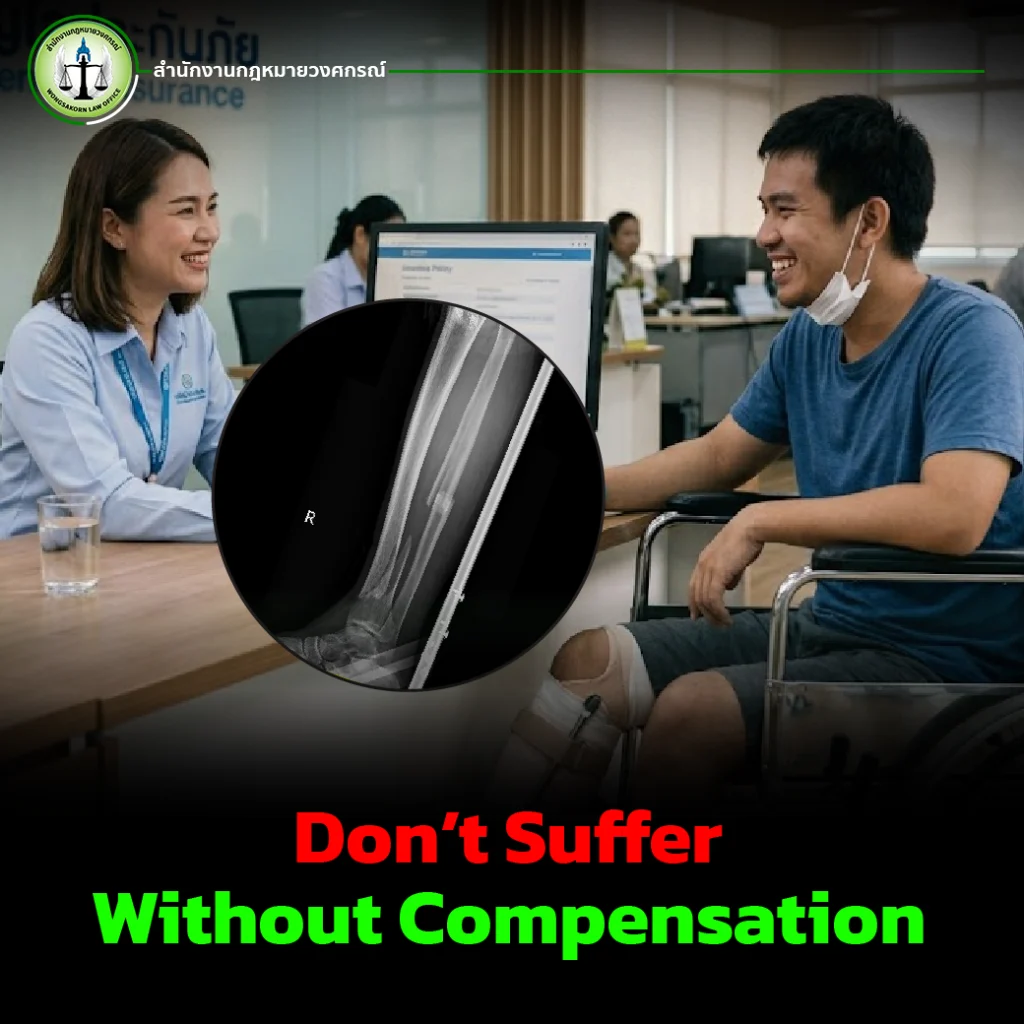
Don’t Suffer Without Compensation

Many victims trust insurers too much, delay action, or fail to seek expert advice, resulting in incomplete or no compensation. With proper legal guidance from the start, victims can fully protect their rights.

Awareness Protects Your Rights

The phrase “Get treated first, then we’ll talk” is not always good advice, it can be a tactic.

Remember

-You don’t need to wait to claim compensation

-Acting early gives you an advantage

-Evidence and timing are crucial

-Legal advice prevents loss of rights

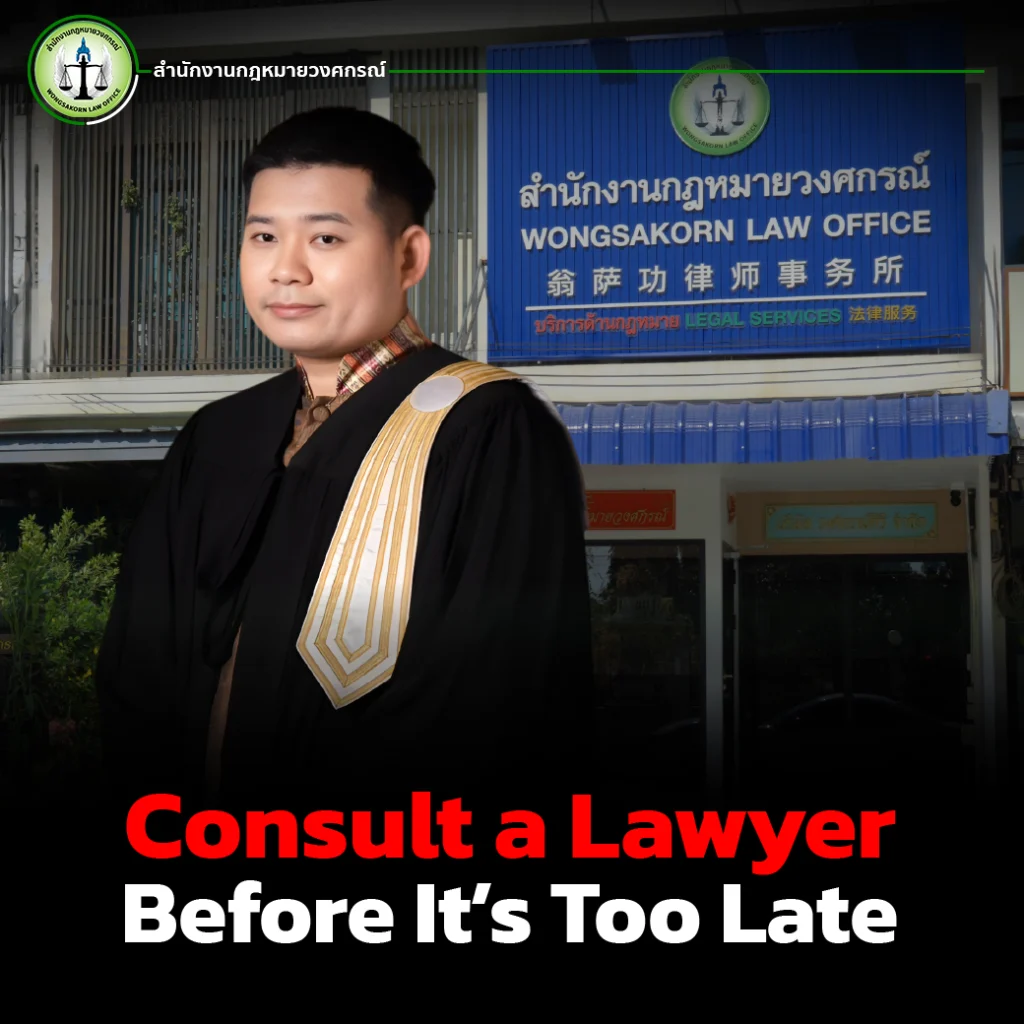
Consult a Lawyer Before It’s Too Late

If you or someone close to you has experienced a car accident and heard this from an insurer, don’t wait.

The sooner you act, the better you can protect your rights.

Wongsakorn Law Office is ready to provide legal advice and strategic support from day one so you don’t suffer both physically and legally.

👉 Contact a lawyer today to fully protect your rights without waiting for full recovery.

Compensation for Car Accidents: If You Are at Fault, Can You Still Claim Insurance? Understand Before You Lose Your Rights

Car accident compensation in cases where you are at fault is a topic that often causes confusion. Accidents can happen to anyone whether you are a new driver or experienced. One of the most common questions is:

“If I am at fault, can I still claim compensation from my insurance company?”

Many people have been told by insurers that “you cannot claim because you are at fault,” leading them to believe they have no rights at all. However, in reality, car accident compensation involves more complex legal considerations, and in some cases, the insured may still have the right to claim.

This article and the accompanying video aim to clearly explain what rights you may have when you are at fault, and under what circumstances you can still claim additional compensation from your insurance company.

What Is Car Accident Compensation?

Car accident compensation refers to the amount paid by an insurance company to the insured or injured party to cover damages caused by an accident, such as:

  • Vehicle repair costs
  • Medical expenses
  • Damage to third-party property
  • Loss of use of the vehicle

However, the right to receive compensation depends on the type of insurance policy, policy conditions, and facts of the accident.

If You Are at Fault, Can You Still Claim Compensation?

Consider a real case where a driver lost control and slid off the road. When contacting the insurance company, they were told:

“You cannot claim because you are at fault.”

Legally, this situation must be analyzed in two key scenarios:

1. General Rule: When You Cannot Claim

If the insured is at fault, for example:

  • Crashing into a pole
  • Rear-ending another vehicle
  • Causing an accident due to negligence

In such cases, you generally cannot claim compensation from your own insurance company for damages caused by your own fault, especially if the policy has coverage limitations.

2. Exceptions: When You May Still Claim

Even if you are at fault, you may still be able to claim compensation if the insurance company:

  • Fails to perform its duties
  • Ignores or delays your claim
  • Does not control or manage repair costs
  • Fails to provide reasonable repair estimates
  • Causes unjustified delays (e.g., waiting indefinitely for assessment)
  • Rejects your claim without valid reasons

In such cases, you may claim damages resulting from the insurer’s negligence or improper conduct.

Examples of Claimable Situations

Case 1:
You caused the accident, but the insurer delays repairs excessively
➡ You may claim compensation for loss of use

Case 2:
The insurer fails to coordinate repairs
➡ This may be considered negligence

Case 3:
The insurer rejects your claim without clear justification
➡ You may challenge the decision

👉 Therefore, being at fault does not always mean losing all rights to compensation.

Key Techniques for Claiming Compensation

Successfully claiming compensation in such cases requires Legal analysis, Evidence collection, Proper case structuring, Strategic claim presentation.

In practice, how the case is structured legally can significantly affect the outcome.

Importance of Having Car Insurance

Car insurance remains essential because it helps reduce financial burdens after an accident. Even if not all damages are claimable, insurance still covers:

  • Third-party liability
  • Medical expenses
  • Property damage

Choosing the right policy and understanding its terms is crucial.

Why Should You Consult a Lawyer?

Many people try to handle claims themselves. However, insurance disputes can be legally complex, especially when dealing with insurer misconduct.

Consulting a lawyer early helps you

  • Understand your rights
  • Evaluate your claim
  • Plan legal strategy
  • Avoid losing benefits

Being at Fault Doesn’t Mean Losing All Rights

Being at fault does not automatically mean you lose all rights to compensation. It depends on the facts and the insurer’s conduct.

If the insurance company acts improperly, delays, or rejects claims unfairly, you still have the right to seek compensation.

Consult a Lawyer to Protect Your Rights

If you are involved in a car accident whether at fault or not consulting a lawyer early is the best decision.

Proper legal guidance from the beginning can help you secure full compensation and protect your rights.

Wongsakorn Law Office, led by Lawyer Arm, is ready to assist you with professional legal strategies to safeguard your interests.
👉 Contact us today

The Importance of Motor Insurance: Protection for Life, Property, and Financial Security

Insurance In today’s world, cars are not only a means of transportation but also an essential factor in daily life, work, and business for many people. However, using a car always comes with unpredictable risks, whether from accidents, collisions, theft, or natural disasters. These incidents may cause damage to both life and property at values much higher than many people expect.

For this reason, motor insurance is not just an extra expense, but an important risk management tool and a financial shield that everyone should have.

What is Motor Insurance and Why is It Necessary?

Motor insurance is a contract between the insured and the insurance company. The insurance company is responsible for compensating for damages resulting from accidents or unexpected events according to the terms stated in the policy. This may include repair costs, medical expenses, third-party property damage, or compensation in cases of death or disability.

Without insurance, when an accident occurs, drivers may have to bear all expenses themselves. These costs may range from tens of thousands to millions of baht and may affect long-term financial stability.

How Insurance Reduces Financial Risk?

Road accidents can happen anytime, no matter how careful a driver is. If an accident involves a luxury car or causes serious injury, the damage costs may exceed what a car owner can afford to pay.

Insurance helps convert large, unpredictable financial risks into predictable insurance premiums. This allows drivers to plan their finances more securely without worrying about losing life savings due to a single accident.

Insurance and Peace of Mind in Daily Life

Beyond financial protection, insurance also provides peace of mind. Drivers can use their vehicles more confidently, knowing that if an unexpected incident occurs, the insurance company will assist in handling processes such as coordinating with repair garages, managing claim documents, or negotiating with third parties.

In real accident situations, many people panic and do not know where to start. Insurance therefore acts like a professional assistant who helps manage the process from beginning to end.

Insurance as Social Responsibility

Having motor insurance is not only about protecting yourself, but also about showing responsibility toward others on the road. If an accident causes damage to others, the insured can be confident that the injured party will receive fair compensation.

This helps reduce conflicts, lawsuits, and promotes a more just society.

How to Choose Insurance Without Being Disadvantaged?

Although insurance is highly beneficial, buying insurance without understanding the details may disadvantage consumers. For example, choosing an unsuitable coverage amount, misunderstanding policy conditions, or not knowing policy exclusions.

In many cases, insured persons only discover coverage limitations after an incident occurs, causing repeated financial and emotional damage.

Therefore, buying insurance with full understanding is crucial. Buyers should receive accurate, transparent, and fair advice to fully understand their rights and obligations.

Buy Insurance with Experts for Confidence in Every Situation

Choosing an insurance office that has knowledge in both insurance and legal matters, with guidance from a Lawyer, helps ensure that insured persons are not placed at a disadvantage against insurance companies. Experts can explain policy conditions, clarify precautions, and protect customer benefits comprehensively.

Having an advisor who understands both insurance systems and consumer rights ensures that buying insurance is not just buying a policy, but truly planning life security.

If you want to buy insurance with a true understanding of the insurance system,

Because good insurance does not only protect you when incidents happen,
But protects you from the moment you decide to buy it.

Supasit Siri Insurance Ready to take care of you on every road of life and every risk on the road.

Which Car Insurance Should You Choose to Stay Informed and Avoid Disadvantages After an Accident?

In today’s world, where driving is part of daily life, car insurance is not merely a document for vehicle registration. It is a vital form of financial and legal protection. Accidents can happen at any time, and the damage from a single incident can be far greater than many people expect.

However, a common problem is that many policyholders “buy car insurance without truly understanding the policy conditions.” When an accident occurs, they later find that the coverage does not meet their needs or that the insurance company refuses certain liabilities. This leads to financial loss, wasted time, and the unintentional loss of legal rights.

This article will help you understand how to choose car insurance wisely and why purchasing car insurance through a lawyer can significantly reduce long-term risks.

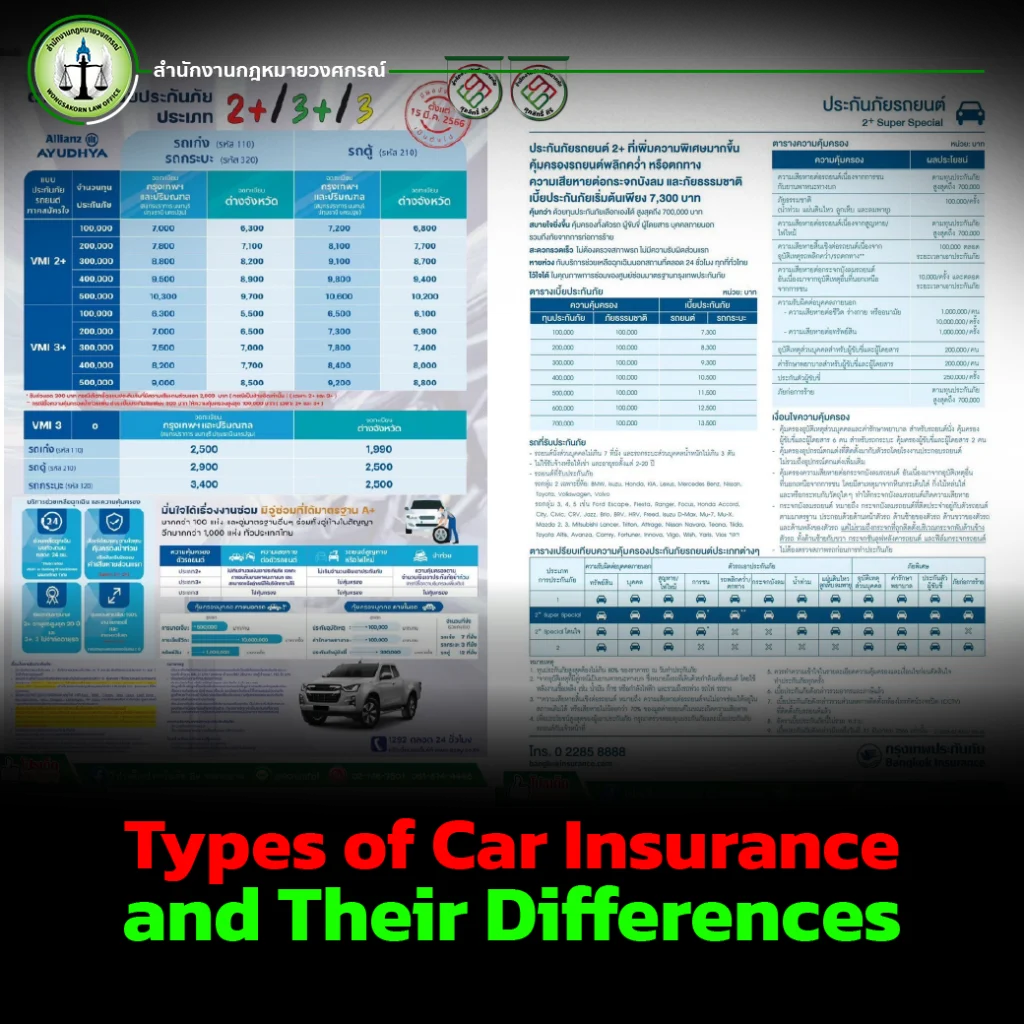
Types of Car Insurance and Their Differences

Before buying car insurance, you should understand the main types

1. First-Class Car Insurance (Comprehensive Insurance)
Provides the highest level of coverage, including damage to your own vehicle, third-party vehicles, collisions, fire, flood, and theft. Suitable for new or high-value cars.

2. Second-Class Plus Insurance (Type 2+)
Similar to comprehensive insurance but mainly covers collisions with other vehicles, including fire and theft. Suitable for general use vehicles.

3. Third-Class Plus Insurance (Type 3+)
Covers only collisions with other vehicles. It does not cover theft or fire.

4. Third-Class Insurance (Type 3)
Covers only bodily injury and property damage to third parties, not the insured vehicle.

Choosing car insurance should depend on the age of the car, usage, and budget not solely on the lowest premium.

Common Mistakes That Cause Policyholders to Lose Their Rights

Many drivers believe that “having insurance means no worries,” but in reality, policies contain many conditions and exclusions, such as:

  • Insufficient coverage limits
  • Garage vs. dealer repair conditions
  • Deductibles
  • Exclusions for drunk driving or illegal acts
  • Late accident reporting

Insurance companies may interpret policies narrowly. Without legal knowledge, policyholders may accept unfair conditions and lose their rightful benefits.

Why Buy Car Insurance Through Us?

The key difference between a general insurance agent and Supasit Siri Non-Life Insurance Office with Lawyer Arm is the legal perspective.

Lawyer Arm not only recommends suitable insurance packages but also explains legal terms, policyholder rights, and contract risks in detail. When disputes arise, you can consult a lawyer immediately without having to suffer losses first and seek help later.

Car Insurance Is Not Only to Protect Your Car, but to Protect Others

Many people think car insurance exists mainly to protect their own vehicle. In fact, its primary purpose is to cover damages caused to others. Accidents are unpredictable, and compensation for injury or property damage can exceed what an individual can afford. Therefore, car insurance is a crucial financial and legal safeguard.

Good Car Insurance Is More Than a Cheap Premium

A quality policy should be evaluated based on

  • Scope of coverage
  • Appropriate liability limits
  • Claim processing efficiency
  • Fair legal conditions
  • Post-sale consultation support

Having legal expertise from the beginning ensures that your policy truly protects you when problems occur.

How Car Insurance Helps You After an Accident?

Car insurance covers more than vehicle repairs. It also involves:

  • Compensation to third parties
  • Medical expenses
  • Loss-of-use compensation
  • Legal damages
  • Negotiation and dispute resolution

Without proper legal guidance, you may bear unnecessary costs.

Where to Buy Car Insurance with a Lawyer Arm?

You can purchase car insurance with lawyer Arm at Supasit Siri Non-Life Insurance Office, offering multiple plans from various companies, tailored specifically to your needs.

The Best Car Insurance Is the One That Does Not Put You at a Disadvantage

Car insurance is a long-term investment for peace of mind. Buying without understanding the terms may cost more than expected. With a Lawyer Arm, you gain both coverage and legal knowledge.

Line @ คลิก! โทรหาเรา คลิก!