The Importance of Checking Arrest Warrants: A Personal Matter That Should Not Be Overlooked

In everyday life, many people believe that an “arrest warrant” is something distant and only applies to those who have committed serious crimes. However, in reality, many cases begin with minor issues such as civil cases, dishonored checks, unpaid debts, traffic offenses, or misunderstandings. These situations can later develop into the issuance of an arrest warrant without the individual even realizing it. Therefore, checking for arrest warrants is extremely important in preventing legal problems that may affect one’s life, career, and reputation.

In many cases, individuals who are subject to arrest warrants do not intend to evade the law. Instead, they are unaware that legal proceedings exist against them for example, after changing their address and not receiving court summons, failing to appear in court as scheduled, or neglecting to follow up on their own cases. When a person fails to appear as ordered, the court may automatically issue an arrest warrant, causing that person to become a suspect or defendant without knowing it.

What Is an Arrest Warrant and How Does It Affect Daily Life?

An arrest warrant is a court order authorizing police officers to detain a person suspected of committing an offense or failing to comply with a court summons. Having even a single arrest warrant can result in serious consequences, such as being arrested anytime and anywhere at home, at work, or while traveling. It may also affect job applications, financial transactions, visa applications, and overseas travel.

Many people only discover that they have an arrest warrant when their identification is checked or when they are suddenly arrested, which can cause panic and damage both mental well-being and reputation. If arrest warrants are checked in advance, individuals can prepare themselves and plan appropriate legal actions.

Why Is Checking Arrest Warrants Necessary?

Checking arrest warrants is not only for those who have committed crimes, but also a way to protect one’s legal security especially for those who have been involved in legal disputes, civil or criminal cases, or business conflicts. Case status checks help determine whether a case has been concluded and whether any summons or arrest warrants remain outstanding.

In today’s fast-paced society, many people neglect to follow up on their legal matters. Checking arrest warrants is like a legal health check-up. Detecting problems early allows them to be resolved before they escalate.

Risks of Not Checking Arrest Warrants

Many people assume that if they have not committed a serious offense, there is no need to check for arrest warrants. In reality, many legal problems do not start with major crimes but with small neglected matters such as missing court appointments, failing to receive court documents, or misunderstanding legal procedures. Over time, these issues can escalate into arrest warrants without the person’s knowledge and severely affect their life, career, and freedom.

In some cases, if checked early, individuals with arrest warrants can voluntarily meet investigators or the court with a lawyer and apply for bail properly, significantly reducing legal consequences.

Who Should Check for Arrest Warrants?

Those who should pay particular attention to checking arrest warrants include:

  • Individuals who have had previous legal disputes or cases
  • Those who received court summons but failed to attend
  • Business owners or company directors
  • Individuals planning to travel abroad
  • Those who frequently change their address and may not receive court documents

Checking for arrest warrants does not mean you are guilty; it is simply verifying your legal status for peace of mind and safety.

How Should Arrest Warrants Be Checked?

Arrest warrant checks should be conducted through lawful channels and preferably with legal professionals who can review all details thoroughly. Some cases are complex, such as warrants issued in other provinces or cases still under investigation. Having a lawyer conduct the check ensures correct and safe guidance.

Check First, Solve Later Is Riskier

Many people believe that “if nothing is wrong, there is no need to check.” In fact, checking arrest warrants is a form of preventive risk management similar to life or car insurance. Once legal problems arise, their impact is often greater than expected.

Knowing one’s legal status early allows better planning for life, work, and travel without fear or anxiety.

Arrest Warrant Checking Services by Wongsakorn Law Office for Your Safety

If you are unsure whether you have an arrest warrant or had previous legal cases and want clarity, Wongsakorn Law Office provides lawful arrest warrant checking services with careful and confidential legal consultation.

Checking arrest warrants today is to prevent legal problems tomorrow.
Check first for maximum safety.

Wongsakorn Law Office is ready to protect your rights and legal security with professional care.

Summoned as a “Nominee”? Don’t Panic – Understand It Correctly Before the Problem Escalates

In recent years, the term Nominee has been increasingly discussed in the fields of business and law, especially in cases involving shareholding on behalf of others or concealing the true controlling person of a company. Many people who have never been directly involved in business are shocked and confused when they receive a “Nominee Summons” from an investigator, wondering how they became involved in such a case.

The most important thing to understand is that being summoned as a Nominee is not the end of your life, nor is it as frightening as many people think. If you clearly understand your legal status and take appropriate action from the beginning, the issue can be properly handled under the law.

What is a Nominee?

Legally, a Nominee refers to a person who allows another person to use their name as a shareholder, director, or authorized person of a business, instead of the true owner. This is commonly found where the beneficial owner cannot legally hold shares or operate the business directly, such as in cases involving foreign ownership restrictions.

In simple terms, a Nominee is a “name holder,” not the real owner, but whose name appears in legal documents.

Why Are You Summoned as a Nominee?

A summons does not mean that you are already guilty. It only means that the authorities need to investigate facts, such as:

  • Your name appears as a shareholder or director of a company
  • Financial transactions are linked to the case
  • There are indications that you may act as a Nominee
  • There has been a complaint or government inspection

In many cases, the summoned person is merely someone whose name appears in documents without actual control or benefit.

Should You Be Worried?

Not necessarily. A summons is only part of the investigation process, not a judgment and not an arrest warrant.

If you had no intention to evade the law and did not engage in fraudulent conduct, providing accurate information with proper evidence can significantly reduce legal risk. Many cases are resolved at the investigation stage without going to court.

These mistakes may put you at a legal disadvantage unnecessarily.

Is Acting as a Nominee Illegal?

Nominee conduct may violate several laws, such as:

  • Foreign Business Act
  • Company law
  • Anti-Money Laundering law
  • Criminal law regarding false statements

Penalties may include fines and imprisonment, depending on the circumstances.

Proper Steps When Summoned as a Nominee

If you receive a Nominee summons, you should:

1. Do not ignore it

2. Consult a lawyer immediately

3.  Prepare relevant documents (contracts, share certificates, bank records)

4. Provide factual information carefully

5. Do not give unnecessary statements

Early legal representation significantly reduces legal risks.

A Nominee Case Is Not as Scary as You Think

Many people fear the word “Nominee” and believe they will be imprisoned immediately. In reality, many cases can be resolved by clarifying facts and proving your true role. The law aims to punish those who misuse Nominee structures to evade regulations, not innocent individuals.

The Importance of Legal Counsel

A lawyer plays a crucial role in:

  • Analyzing your legal status and risks
  • Preparing appropriate legal strategies and statements
  • Coordinating with investigators
  • Preventing disadvantageous statements
  • Reducing the risk of prosecution

Having legal counsel from the beginning is essential to protect your rights.

Which Car Insurance Should You Choose to Stay Informed and Avoid Disadvantages After an Accident?

In today’s world, where driving is part of daily life, car insurance is not merely a document for vehicle registration. It is a vital form of financial and legal protection. Accidents can happen at any time, and the damage from a single incident can be far greater than many people expect.

However, a common problem is that many policyholders “buy car insurance without truly understanding the policy conditions.” When an accident occurs, they later find that the coverage does not meet their needs or that the insurance company refuses certain liabilities. This leads to financial loss, wasted time, and the unintentional loss of legal rights.

This article will help you understand how to choose car insurance wisely and why purchasing car insurance through a lawyer can significantly reduce long-term risks.

Types of Car Insurance and Their Differences

Before buying car insurance, you should understand the main types

1. First-Class Car Insurance (Comprehensive Insurance)
Provides the highest level of coverage, including damage to your own vehicle, third-party vehicles, collisions, fire, flood, and theft. Suitable for new or high-value cars.

2. Second-Class Plus Insurance (Type 2+)
Similar to comprehensive insurance but mainly covers collisions with other vehicles, including fire and theft. Suitable for general use vehicles.

3. Third-Class Plus Insurance (Type 3+)
Covers only collisions with other vehicles. It does not cover theft or fire.

4. Third-Class Insurance (Type 3)
Covers only bodily injury and property damage to third parties, not the insured vehicle.

Choosing car insurance should depend on the age of the car, usage, and budget not solely on the lowest premium.

Common Mistakes That Cause Policyholders to Lose Their Rights

Many drivers believe that “having insurance means no worries,” but in reality, policies contain many conditions and exclusions, such as:

  • Insufficient coverage limits
  • Garage vs. dealer repair conditions
  • Deductibles
  • Exclusions for drunk driving or illegal acts
  • Late accident reporting

Insurance companies may interpret policies narrowly. Without legal knowledge, policyholders may accept unfair conditions and lose their rightful benefits.

Why Buy Car Insurance Through Us?

The key difference between a general insurance agent and Supasit Siri Non-Life Insurance Office with Lawyer Arm is the legal perspective.

Lawyer Arm not only recommends suitable insurance packages but also explains legal terms, policyholder rights, and contract risks in detail. When disputes arise, you can consult a lawyer immediately without having to suffer losses first and seek help later.

Car Insurance Is Not Only to Protect Your Car, but to Protect Others

Many people think car insurance exists mainly to protect their own vehicle. In fact, its primary purpose is to cover damages caused to others. Accidents are unpredictable, and compensation for injury or property damage can exceed what an individual can afford. Therefore, car insurance is a crucial financial and legal safeguard.

Good Car Insurance Is More Than a Cheap Premium

A quality policy should be evaluated based on

  • Scope of coverage
  • Appropriate liability limits
  • Claim processing efficiency
  • Fair legal conditions
  • Post-sale consultation support

Having legal expertise from the beginning ensures that your policy truly protects you when problems occur.

How Car Insurance Helps You After an Accident?

Car insurance covers more than vehicle repairs. It also involves:

  • Compensation to third parties
  • Medical expenses
  • Loss-of-use compensation
  • Legal damages
  • Negotiation and dispute resolution

Without proper legal guidance, you may bear unnecessary costs.

Where to Buy Car Insurance with a Lawyer Arm?

You can purchase car insurance with lawyer Arm at Supasit Siri Non-Life Insurance Office, offering multiple plans from various companies, tailored specifically to your needs.

The Best Car Insurance Is the One That Does Not Put You at a Disadvantage

Car insurance is a long-term investment for peace of mind. Buying without understanding the terms may cost more than expected. With a Lawyer Arm, you gain both coverage and legal knowledge.

Famous Individuals Having Their Videos “Scraped” and Used to Promote Online Gambling Websites: A Silent Threat Causing Greater Damage Than Expected

In the era where social media has become a platform for building personal identity, reputation, and income, one increasingly common and serious problem is the unauthorized “scraping” of video clips for improper use. This issue is particularly prevalent among famous individuals, influencers, and content creators whose videos are taken and reposted with links to online gambling websites. Such acts not only damage their reputation but also carry severe legal consequences.

Many people may perceive video scraping as merely reusing content. However, in reality, scraping videos for deceptive purposes, impersonation, or association with illegal activities such as online gambling constitutes a violation of rights and may place the original content owner at legal risk without their knowledge.

What Is “Video Scraping,” and Why Is It a Legal Issue?

In practice, “video scraping” refers to taking video clips belonging to others from platforms such as TikTok, Facebook, YouTube, or Instagram and re-uploading them to one’s own account without the copyright owner’s permission.

The issue becomes more serious when the scraped videos are used to:

  • Attach links to online gambling websites
  • Promote illegal websites
  • Encourage gambling activities
  • Mislead the public into believing that the original content owner is affiliated with gambling websites

Such actions go beyond copyright infringement; they also involve impersonation and may directly expose the original content owner to legal consequences.

Why Are Famous Individuals at Risk of Having Their Videos Used for Gambling Websites?

The groups most frequently targeted for video scraping linked to online gambling websites include:

  • Influencers
  • Internet celebrities
  • YouTubers
  • Online business owners
  • Individuals with viral or widely recognized content

Perpetrators often select videos from creators with credible images and large followings, then edit the content, add captions, or attach gambling links to enhance the credibility of their illegal websites without regard for the harm caused to the real content owners.

Impacts Faced by Content Owners When Their Videos Are Used for Gambling Websites

Many people are unaware that having their videos scraped and used in connection with online gambling can result in multiple forms of damage, such as:

1.Damage to Reputation and Public Image
Followers and the general public may mistakenly believe the content owner is involved in gambling activities.

2.Loss of Income and Advertising Opportunities
Brands or business partners may terminate collaborations to avoid association with gambling websites.

3.Risk of Government Scrutiny
Even if the content owner is not involved, impersonation may require time and resources to clarify matters with authorities.

4.Long-Term Loss of Opportunities
An online reputation takes years to build but can be destroyed by a single misused video.

How Is Scraping Videos for Gambling Websites Illegal?

Legally, scraping videos for such purposes may constitute several offenses, including:

  • Copyright infringement under the Copyright Act
  • Violation of personality and image rights
  • Impersonation and public deception
  • Involvement in the promotion or support of online gambling

Even if the offender does not directly use the content owner’s name, legal action and claims for damages may still be pursued if the conduct misleads the public.

What Should You Do If Your Video Is Scraped and Linked to a Gambling Website?

If you discover that your video has been misused in this manner, you should not remain passive. Proper steps include:

1. Immediately Collect Evidence
Such as account links, scraped videos, screenshots, and dates of discovery.

2. Avoid Emotional Confrontations
Responding without evidence may place you at a disadvantage later.

3. Report to the Relevant Platforms
Request investigation and removal of infringing content.

4.  Consult a Lawyer for Legal Action
To assess damage claims and protect your legal rights.

Can You Claim Compensation for Scraped Videos Used for Gambling?

Yes, compensation can be claimed if it can be proven that:

  • You are the copyright owner of the video
  • The unauthorized use caused actual damage
  • There was impersonation or unauthorized association with gambling websites

Engaging a lawyer from the outset allows for proper legal strategy, increases the likelihood of compensation, and reduces long-term risks.

Consult Wongsakorn Law Office When Your Videos Are Used Illegally

If you are a public figure, influencer, or content creator facing the issue of having your videos scraped and linked to online gambling websites, do not let the damage escalate.

Wongsakorn Law Office has experience handling cases involving:

  • Video scraping
  • Copyright infringement
  • Online impersonation and reputation abuse
  • Compensation claims arising from illegal use of content

Early consultation with legal professionals helps you protect your rights, reputation, and interests carefully and lawfully.

Because in the online world, a single video may generate income for others but the damage may fall upon you if it is not handled properly.

Why Should New Business Owners Have a Legal Advisor from the First Step of Investing?

In an era where anyone can enter the world of investment more easily, whether by starting a personal business, expanding an existing enterprise, or investing in real estate, many people tend to focus primarily on “capital.” The common belief is that having sufficient funds alone is enough to generate returns and achieve success. In reality, however, capital is only one essential component. Without a proper legal structure in place from the beginning, the risks involved may be far greater than expected.

For new business owners and first-time investors, having a legal advisor from the very first step of investment is not a luxury, but a crucial foundation for long-term business and investment stability. This article explains why legal advisors play a vital role for new investors and compares the advantages and disadvantages of investing with and without legal counsel.

Hidden Risks in Investments for New Business Owners

Every form of investment carries inherent risks, especially for new investors who lack experience in business and legal matters. Common risks include:

  • Entering into contracts with unclear or unfavorable terms
  • Investing without understanding the legal structure
  • Holding assets or shares without clear legal evidence
  • Joint ventures without written agreements
  • Future disputes with partners, sellers, or contractors

These issues may not be apparent at the initial stage, but once the business grows or conflicts arise, the financial and time-related losses may be difficult to resolve.

The Role of a Legal Advisor in Investment

A legal advisor’s role extends far beyond litigation. Their involvement is crucial even before an investment begins, such as:

  • Analyzing legal risks of investment projects
  • Reviewing and drafting investment contracts
  • Structuring shareholding or joint ventures
  • Providing legal advice on real estate investments
  • Preventing potential future disputes

Having a lawyer from the start is like having an expert who can identify risks that new investors may overlook.

Before Investing: Why Is a Legal Advisor a Key Factor?

Many first-time investors believe that legal advisors are only necessary when disputes or lawsuits arise. In fact, whether or not a legal advisor is involved from the beginning can significantly influence the direction and outcome of an investment. Every investment involves contracts, agreements, and legal obligations that may conceal hidden risks.

Investing with legal guidance is fundamentally different from relying solely on personal understanding or experience. The following sections clearly outline the advantages of having a legal advisor and the disadvantages of investing without one, enabling investors to make informed decisions before stepping into the investment world.

Advantages of Having a Legal Advisor for New Investors

1. Reducing Legal Risks from the Start
Lawyers review contracts and conditions to ensure fairness and prevent legal disadvantages.

2. Systematic Investment Structuring
Whether establishing a company, holding shares, or investing in real estate, legal advisors can recommend structures aligned with investment goals.

3.  Preventing Future Disputes
Clear agreements from the outset reduce the likelihood of litigation and conflicts.

4. Long-Term Cost Savings
Legal consultation costs are far lower than future litigation or corrective expenses.

5. Greater Confidence in Investment Decisions
Investors can make informed decisions knowing legal professionals are safeguarding their interests.

Disadvantages of Investing Without a Legal Advisor

On the other hand, investing without legal counsel may lead to:

  • Signing unfair or disadvantageous contracts
  • Being unaware of hidden legal obligations
  • Being taken advantage of by more experienced parties
  • Costly and time-consuming disputes
  • Business disruption due to legal issues

Many new investors have suffered significant financial losses simply by neglecting legal considerations from the outset.

Why Are Legal Advisors Especially Important in Real Estate Investment?

Real estate investment such as purchasing land, condominiums, or property development often involves high-value transactions and extensive legal documentation. Legal advisors help verify ownership rights, encumbrances, contracts, and conditions to prevent risks such as:

  • Purchasing property with mortgages or disputes
  • Incomplete transfer of ownership
  • Unintentional loss of property rights

Money Alone Is Not Enough for Long-Term Investment Growth

For new business owners and investors, long-term investment success depends not only on capital but also on careful planning especially legal planning. Having a legal advisor from the first step creates a strong protective shield against risks and supports sustainable growth.If you aspire to grow as a successful business owner or investor, do not overlook the role of a legal advisor.

Common Problems Faced by Chinese Nationals in Thailand in 2025

Investment, Tourism, and Legal Solutions When Disputes Arise

In 2025, Thailand will continue to be one of the most popular destinations for Chinese nationals, whether for tourism, business investment, or long-term residence. With its attractive tourist destinations, rich cultural diversity, affordable cost of living, and promising economic opportunities, Thailand remains highly appealing. However, in practice, many Chinese nationals encounter various challenges arising from differences in language, legal systems, cultural norms, and administrative procedures in Thailand.

This article outlines the common problems faced by Chinese nationals when traveling to or investing in Thailand in 2025, covering tourism-related issues, business and investment challenges, and legal risks. It also provides guidance on prevention and proper solutions, concluding with recommendations for consulting lawyers who specialize in legal cases involving Chinese nationals in Thailand through Wongsakorn Law Office.

One of the most common challenges faced by Chinese nationals in Thailand is language barriers. While English or Chinese may be used in major cities, Thai remains the primary language in rural areas, government offices, and official administrative procedures.

Unclear communication may result in:

  • Misinterpretation of legal provisions
  • Signing contracts or legal obligations without fully understanding the content
  • Inability to communicate effectively with authorities such as police officers, hospitals, or banks
  • Being placed at a disadvantage during negotiations or disputes

Due to significant differences between Thai law and the Chinese legal system, as well as differences in enforcement practices, Chinese nationals often face legal challenges in the following areas:

Traffic Regulations and Driving Licenses
Many are unaware that an international driving permit or a Thai driving license is required. Failure to present proper documentation may result in fines or vehicle seizure.

Copyright and Intellectual Property Infringement
Selling counterfeit branded goods or importing infringing products may lead to both criminal and civil liability.

Labor Law Issues
Chinese investors who employ workers may encounter disputes due to a lack of understanding of Thai labor laws, including working hours, employee benefits, and employment contracts.

Thailand attracts many foreign investors, but Chinese investors often face business-related obstacles, including:

Company Registration
There are legal restrictions on foreign shareholding ratios and foreign business regulations that may be misunderstood or improperly applied.

Business Contracts
Signing contracts drafted in Thai without proper legal understanding may lead to unfair terms or unfavorable legal obligations.

Taxation and Financial Compliance
Lack of understanding of VAT, corporate income tax, or Bank of Thailand regulations may result in violations, penalties, or legal accusations.

Differences in culture and working styles may also create difficulties, such as:

  • Different corporate management systems
  • Misunderstandings during negotiations
  • Differing expectations regarding service quality, standards, or timelines

Although these issues may not be purely legal, they can significantly affect business operations and long-term success.

When facing criminal accusations or legal disputes whether criminal, civil, or labor-related many Chinese nationals find themselves in difficult situations due to:

Lack of Understanding of the Thai Legal System
Thailand’s judicial process differs from China’s, and misunderstanding procedural requirements may result in legal disadvantages.

Language Barriers
Without interpreters or lawyers fluent in Chinese and Thai law, critical information may be misunderstood or overlooked.

Arrest and Detention Risks
If an arrest warrant exists or a criminal complaint has been filed, arrest in Thailand may significantly impact bail proceedings and long-term legal outcomes.

Legal Solutions: Consulting Lawyers Specialized in Chinese-Related Cases

When legal issues escalate into disputes or litigation in Thailand, Chinese nationals need not worry. Specialized legal services are available to support Chinese investors and tourists, including:

Pre-Entry Legal Consultation
Advisory services before traveling to or investing in Thailand to minimize legal risks.

Legal Status Verification
Such as checking whether an arrest warrant exists, without the need to travel to Thailand.

Legal Representation in Thailand
Including statements to authorities, filing petitions, initiating lawsuits, and court representation through legal counsel.

Document Translation and Legal Representation
Lawyers experienced in handling cases involving Chinese nationals can provide accurate translations and clear legal explanations.

Thailand remains an attractive destination for Chinese nationals in 2025. However, living, investing, or traveling in Thailand inevitably involves legal risks and challenges that differ from those in China. Verifying legal status, understanding local laws, and engaging experienced legal counsel can help Chinese nationals navigate these challenges with confidence.

If you are a Chinese national facing legal, business, or investment-related issues in Thailand, you may consult lawyers specializing in Chinese-related legal cases at Wongsakorn Law Office, ensuring that your stay, business operations, and activities in Thailand proceed smoothly and lawfully.

Drafting a Legal Notice: Why Should It Be Prepared by a Lawyer?

Reducing Legal Risks and Strengthening Your Negotiating Power in Every Dispute

In the business world and internal corporate operations, a “Notice” or “Legal Notice / Letter of Notice” is a legal document of significant importance. Whether the issue involves internal organizational disputes, employer–employee conflicts, or commercial disputes between companies and business partners, a legal notice often serves as the starting point of a legal process that may lead to negotiations, dispute resolution, or litigation before the courts.

However, many organizations and individuals often ask: “Can a legal notice be drafted independently?” and “Why should a lawyer be engaged to draft a notice?” This article by Wongsakorn Law Office explains the importance of legal notices, compares the advantages and disadvantages of self-drafting versus lawyer-drafted notices, and helps you make informed decisions while minimizing long-term legal risks.

What Is a Legal Notice and Why Is It Important?

A legal notice is a formal written document intended to notify the other party of facts, claims, or demands for corrective action within a specified timeframe. Legal notices are commonly used in situations such as:

  • Demand for payment of outstanding debts
  • Notification of breach of contract
  • Demand to cease infringing acts
  • Disciplinary warnings or internal misconduct notifications
  • Notice of contract termination or reservation of legal rights

A legal notice is not merely an ordinary letter. It may later be used as evidence in court and can directly affect the rights, duties, and liabilities of the parties involved.

Self-Drafting a Legal Notice: Advantages and Limitations

Advantages of Self-Drafting

1.Short-term cost savings
No immediate legal fees are required.

2.Speed and convenience
The notice can be written and sent without undergoing legal consultation.

Disadvantages and Legal Risks

1.Improper legal language
Inappropriate wording may render the notice legally ineffective or give the opposing party grounds to challenge it.

2.Incorrect facts or legal references
Misstating laws or contractual terms may place the sender at a disadvantage from the outset.

3.Unintentional infringement of the other party’s rights
Overly aggressive or threatening language may expose the sender to legal liability.

4.Negative impact on future legal proceedings
Poorly drafted notices may later be used as unfavorable evidence in court.

Benefits of Having a Lawyer Draft a Legal Notice

1. Accurate, comprehensive, and legally effective language
Lawyers possess the expertise to select precise legal wording that aligns with applicable laws and factual circumstances, ensuring the notice carries legal weight and credibility.

2. Strategic planning before litigation arises
A lawyer-drafted notice is not merely a notification, but a strategic legal step designed to protect the client’s rights should the matter escalate to court.

3. Enhanced negotiating power and legal pressure
Notices issued by lawyers or law firms often signal seriousness, encouraging negotiations or dispute resolution without litigation.

4. Reduced risk of counterclaims or further disputes
Lawyers carefully review content to avoid wording that may create additional liabilities or future legal conflicts.

Legal Notices: A Systematic Tool for Managing Business and Organizational Disputes

In dispute management whether internal organizational issues or conflicts between businesses and partners structured actions supported by clear legal documentation are essential. Legal notices serve as a formal mechanism to communicate claims, notify breaches, or assert legal rights.

Proper use of legal notices not only informs the opposing party and offers an opportunity for early resolution, but also establishes a clear legal framework for negotiations, alternative dispute resolution, or litigation, ensuring fairness and efficiency for all parties.

Such disputes may include:

  • Employer–employee conflicts
  • Conflicts of interest
  • Breach of business contracts
  • Outstanding payments between business partners

Beginning with a properly drafted legal notice prepared by a lawyer enables organizations to manage disputes systematically, preserve evidence, and reduce both legal and reputational risks.

A Well-Drafted Legal Notice: The Professional First Step Toward Resolution

Although self-drafting a notice may appear simple and cost-effective, it often carries substantial legal risks. Engaging a lawyer to draft a legal notice is a worthwhile investment that protects rights, minimizes errors, and increases the likelihood of efficient dispute resolution.

Legal Notice and Document Drafting Services by Wongsakorn Law Office

Wongsakorn Law Office provides professional services including:

  • Drafting legal notices and formal letters
  • Drafting contracts and business agreements
  • Drafting all types of legal documents
  • Legal consultation on disputes and litigation

If you are facing a dispute or are unsure how to proceed, consulting a lawyer from the outset allows you to take the right steps safely and effectively. Contact Wongsakorn Law Office today for professional legal advice.

What Is a Bounced Cheque Case? What Cheque Holders and Issuers Should Know Under the Law

In business practice and financial transactions, a cheque remains an important instrument for settling debts between contracting parties, whether for the sale of goods, service agreements, or commercial payments. However, one common issue that frequently gives rise to legal disputes is a bounced cheque, which may lead to both criminal and civil liability if the parties involved do not properly understand their rights and obligations under the law.

What Is a Bounced Cheque?

A bounced cheque refers to a situation where the cheque holder presents the cheque for payment at a bank, but the bank refuses to honor the payment for the amount stated on the cheque. Common reasons for a cheque being dishonored include:

  • Insufficient funds in the account
  • The bank account has been closed
  • The account has been suspended by the bank
  • The signature on the cheque does not match the bank’s records

When a cheque is dishonored, the cheque issuer may be subject to legal liability, particularly where the case falls within the scope of a criminal bounced cheque offense.

Is Issuing a Bounced Cheque a Criminal Offense?

Under the law, if a cheque is issued for the purpose of settling a debt, and such debt is legally enforceable, the issuer of a bounced cheque may be subject to criminal penalties, including:

  • A fine of not more than 60,000 THB, or
  • Imprisonment for a term not exceeding one year,
  • Or both a fine and imprisonment.

However, not all bounced cheque cases can be prosecuted criminally. The injured party must strictly comply with the procedures and time limits prescribed by law.

What Should the Cheque Holder Do When a Cheque Bounces?

When a cheque is dishonored, many cheque holders feel uncertain about how to proceed or fear losing their legal rights due to procedural errors. In fact, the law clearly prescribes the proper steps and time limits for legal action. If the cheque holder acts promptly and correctly from the outset, the chances of enforcing their rights and minimizing losses will be significantly increased.

1. File a Criminal Complaint Within the Prescribed Period

The injured party must file a criminal complaint with the investigating officer within three months from the date the cheque is dishonored. If this period expires, the criminal case becomes time-barred, and criminal proceedings against the cheque issuer can no longer be initiated.

After a complaint has been filed, there are two primary legal approaches:

Approach 1: Prosecution Through the Investigating Officer
The investigating officer will conduct an investigation, collect evidence, and submit the case file to the public prosecutor for consideration and prosecution before the court. This is the standard criminal procedure, though it may take a considerable amount of time.

Approach 2: Direct Filing of the Case Through a Lawyer
The injured party may engage a lawyer to file the case directly with the court. In practice, this method is often faster and allows for more effective legal strategy planning.

Key Issue: The Cheque Must Be Issued to Settle a “Legally Enforceable Debt”

The core element of a bounced cheque case is that the cheque must be issued to settle an existing debt that is legally enforceable.

Example of a Legally Enforceable Debt
Mr. A purchases steel from Mr. B and issues a cheque to pay for the goods. This constitutes a lawful debt arising from a sales contract. If the cheque bounces, Mr. B may initiate a bounced cheque case.

Example of a Non-Enforceable Debt
Mr. A issues a cheque to Mr. B to settle an illegal gambling debt. If Mr. B presents the cheque and it bounces, Mr. B cannot file a bounced cheque case, as gambling debts are not recognized or enforceable under the law.

Can a Civil Lawsuit Also Be Filed?

In addition to criminal proceedings, the injured party may also file a civil lawsuit to claim damages equal to the amount stated on the cheque, as the cheque issuer remains liable under the terms of the cheque.

However, investigating officers do not handle civil cases. The injured party must engage a lawyer to pursue civil proceedings independently. Properly coordinating civil and criminal actions can significantly increase the chances of recovery and reduce financial losses.

Why Is Consulting a Lawyer Important?

Bounced cheque cases involve complex legal issues, including statutes of limitation, debt validity, and litigation strategy. Procedural mistakes may result in the loss of legal rights without the injured party even realizing it.

If you are a victim of a bounced cheque case or have questions regarding civil or criminal proceedings, consulting a lawyer at an early stage will help you understand your rights, plan your case correctly, and reduce legal risks. You may contact a lawyer directly by clicking >>Contact Us<<.

What Should Foreign Nationals Do If Arrested in Thailand? Understanding Essential Legal Rights and the Importance of Bail under Thai Law

Thailand welcomes a large number of foreign nationals each year for residence, employment, tourism, and business purposes. However, despite the best precautions, situations may arise in which a foreign national is arrested by Thai authorities, whether in connection with criminal matters, labor disputes, immigration issues, or other legal proceedings under Thai law.

It is important to emphasize that foreign nationals in Thailand are entitled to fundamental legal rights under Thai law, particularly rights within the criminal justice process and the right to apply for bail in order to defend their case fairly. Unfortunately, many foreign nationals are not fully aware of these rights, which may place them at a disadvantage during legal proceedings.

This article provides an overview of the essential rights of foreign nationals when arrested in Thailand and explains how these rights, including the right to bail, can be exercised to ensure proper legal protection.

1. The Right to Be Informed of the Grounds for Arrest

One of the most fundamental rights of an arrested person is the right to be informed of the reason for the arrest.

Thai law requires law enforcement officers to clearly inform the arrested person of:

  • The specific charge(s),
  • The factual grounds for the arrest, and
  • The legal provisions relied upon.

Failure to properly inform the arrested person may render the arrest unlawful and may be challenged during the investigation or court proceedings.

2. The Right to Immediate Access to Legal Counsel

A foreign national who has been arrested has the right to consult with a lawyer immediately, either:

  • A lawyer of their own choosing, or
  • A lawyer arranged with the assistance of the authorities.

The arrested person is also entitled to consult with legal counsel privately before providing any statement to investigators. Early legal representation is particularly important in cases involving language barriers, as it helps prevent misunderstandings and protects the individual’s legal interests from the outset.

3. The Right Against Self-Incrimination

Under Thai law, an arrested person has the right to:

  • Remain silent,
  • Decline to answer certain questions, or
  • Wait until legal counsel is present before giving a written statement.

It is important to note that remaining silent does not constitute an offense. Any statement given may later be used as evidence in legal proceedings; therefore, exercising this right carefully and with legal guidance is strongly advised.

4. The Right to Notify Relatives, Trusted Persons, or Diplomatic Missions

A foreign national who has been arrested has the right to request that authorities:

  • Notify a relative or trusted person, and
  • Inform the relevant embassy or consulate.

Notification of the embassy or consulate is particularly significant, as diplomatic missions may assist with communication, coordination, and the protection of their citizen’s fundamental rights.

5. The Right to Apply for Bail

The right to apply for bail is one of the most important procedural rights available to an arrested person.

Where Thai law permits temporary release, a foreign national may submit a bail application at any stage of the proceedings, including:

  • During the police investigation,
  • At the public prosecutor’s stage, or
  • Before the court.

Bail allows the suspect or defendant to prepare their defense effectively, gather evidence, and consult with legal counsel outside of detention. For foreign nationals, bail may be subject to specific conditions, such as financial security, a guarantor, or restrictions on travel outside Thailand. Professional legal representation significantly increases the likelihood of a successful bail application.

6. Prohibition of Violence or Coercion by Authorities

Law enforcement officers are strictly prohibited from using violence, threats, physical force, or coercive measures to compel a confession.

Any evidence obtained through unlawful means may be challenged and may be deemed inadmissible by the court. Arrested persons have the right to file complaints and seek legal remedies if such violations occur.

In the event of an arrest, the most critical response is not to hastily explain or justify one’s actions, but to remain calm and exercise one’s legal rights appropriately. Many legal cases are adversely affected by panic, inaccurate statements, or providing testimony without legal counsel.

If you or someone close to you is arrested, the following steps should be taken immediately:

1.  Remain calm

2.  Avoid making statements beyond the facts or without legal counsel

3.  Request access to a lawyer without delay

Every statement may later be used as evidence. Having legal counsel involved from the earliest stage is the most effective way to protect one’s rights.

Foreign Nationals Have Legal Rights  Legal Counsel Is Essential

Regardless of the nature of the arrest, foreign nationals in Thailand are protected by fundamental legal rights, including the right to legal counsel and the right to apply for bail.

If you or someone close to you is a foreign national who has been arrested in Thailand, prompt consultation with an experienced lawyer is strongly recommended. In legal matters, time is critical, and a clear understanding of one’s rights is essential to ensuring fair treatment under the Thai legal system.

Why Do Modern Organizations Need a “Legal Advisor” Before Problems? Arise The Key to Sustainable Growth in 2026 and Beyond

As the world rapidly enters a new era of change, particularly in 2026, businesses are facing both opportunities and challenges from technological advancements and evolving workforce structures to increasingly complex legal regulations. It is undeniable that organizations and companies of all sizes need a legal advisor to provide guidance, legal advice, and risk prevention before problems actually arise.

Many organizations still believe that lawyers are only necessary when disputes or lawsuits occur. In reality, however, the role of a legal advisor is not merely to resolve problems but to prevent legal issues from the outset, which is a highly cost-effective and strategic form of risk management.

Organizational Problems Exist at Every Scale Only the Context Differs

Whether a company is small, medium, or large, internal problems are inevitable. The difference lies only in the form and complexity of those issues. One of the most common and impactful problems organizations face involves personnel or employees.

Based on the experience of Wongsakorn Law Office, led by Lawyer Arm Supasit Siri, who serves as a legal advisor to numerous companies, personnel-related issues are among the most recurring and increasingly severe challenges especially in organizations with a large workforce.
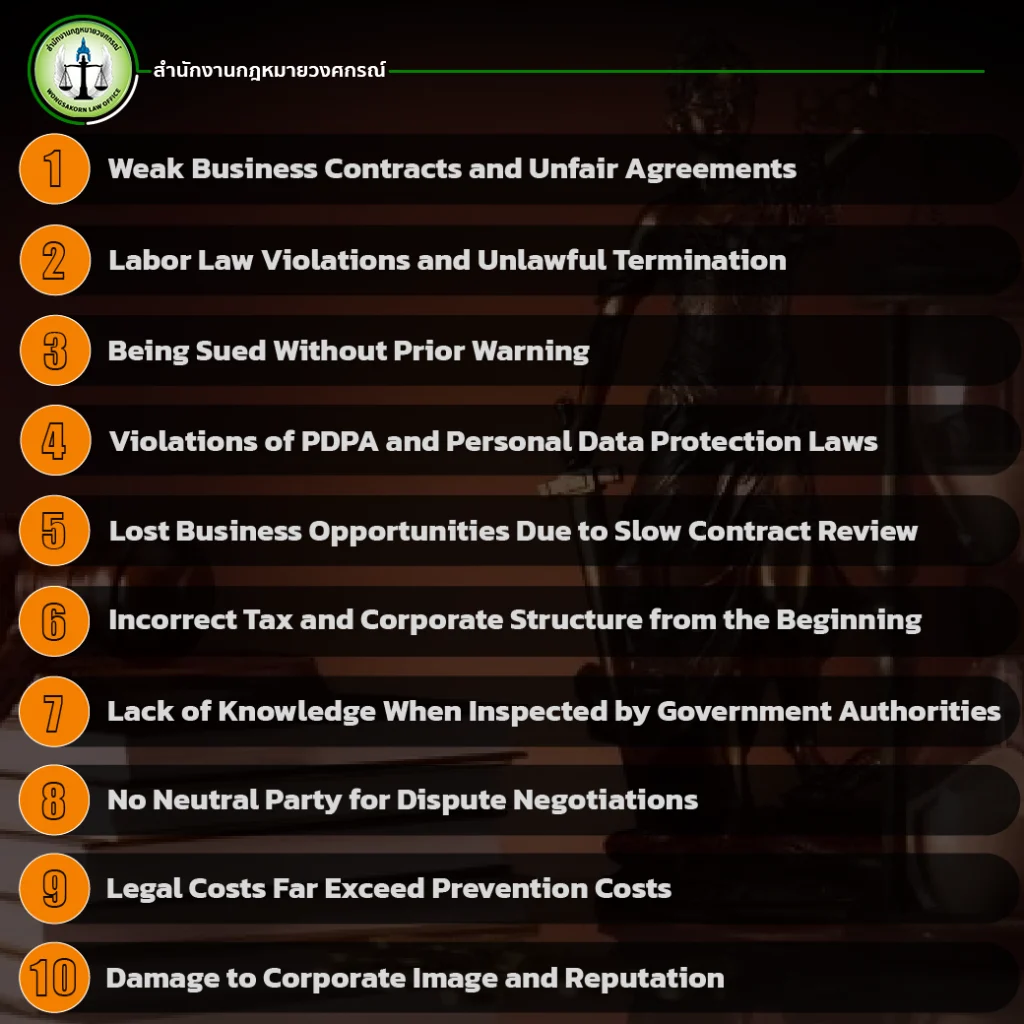
Common examples include:

  • Employees resigning and deleting or destroying important company data
  • Chronic lateness without a clear management system
  • Groups of employees coordinating mass resignations
  • Unlawful termination in violation of labor laws
  • Conflicts between management and employees

These issues negatively affect organizational management, corporate image, and long-term operational costs.

Why Is a Legal Advisor Essential to Organizational Growth?

Having a legal advisor on retainer does not mean an organization is in trouble, it means the organization is planning ahead for stable growth. A legal advisor can support organizational development in several key areas, such as:

1.Preventive Legal Advice
Establishing proper legal frameworks from the outset to reduce future litigation risks.

2.Internal Documentation and Policy Management
Drafting and reviewing employee regulations, employment contracts, and workplace policies in compliance with current labor laws.

3.Proper Management of Employee Issues
Minimizing disputes and providing legal opinions to enable confident executive decision-making.

4.Strategic Advisory for Management
Particularly in business deals, expansion plans, and corporate restructuring.

Graceful Growth Requires Organization-Wide Cooperation

Successful organizations of the future are not those without problems, but those that manage issues systematically and fairly. When executives and employees grow together harmoniously, organizations become stronger, more stable, and better prepared for future change.

A legal advisor is therefore not an external entity, but a core member of the organizational team, contributing to sustainable growth.
Is Your Organization Ready for a Legal Advisor?

In 2026 and beyond, competitive organizations must excel not only in business acumen but also in legal preparedness. Retaining a legal advisor is not an unnecessary expense, it is a long-term investment in organizational stability.

If your company is seeking a legal advisor who truly understands business contexts, provides preventive legal guidance, and partners with your organization’s growth, Wongsakorn Law Office is ready to assist. We offer tailored legal advisory packages suitable for organizations of all sizes.

Line @ คลิก! โทรหาเรา คลิก!