Can the OIC Really Help Consumers? A Real Case Perspective and What You Need to Know

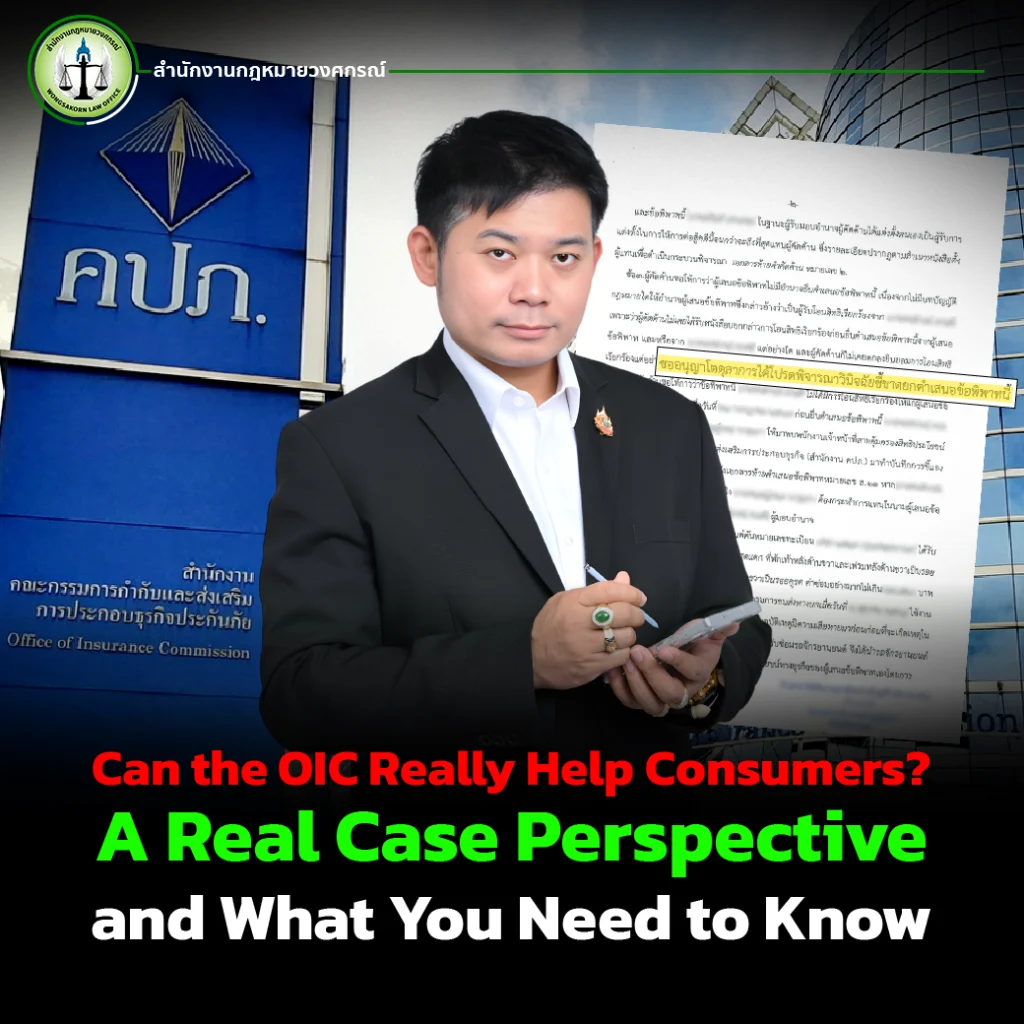
In today’s world, insurance has become essential not only for drivers on the road but also for business operators such as auto repair companies (like our client). One key organization many people are familiar with is the Office of Insurance Commission (OIC), the regulatory body responsible for overseeing insurance companies and assisting the public in dispute situations.

But the crucial question is Can the OIC truly help consumers?

This article by Wongsakorn Law Firm takes a closer look at a real case, offering legal insights to help you better understand the OIC’s role and who you should rely on to avoid losing your rights.

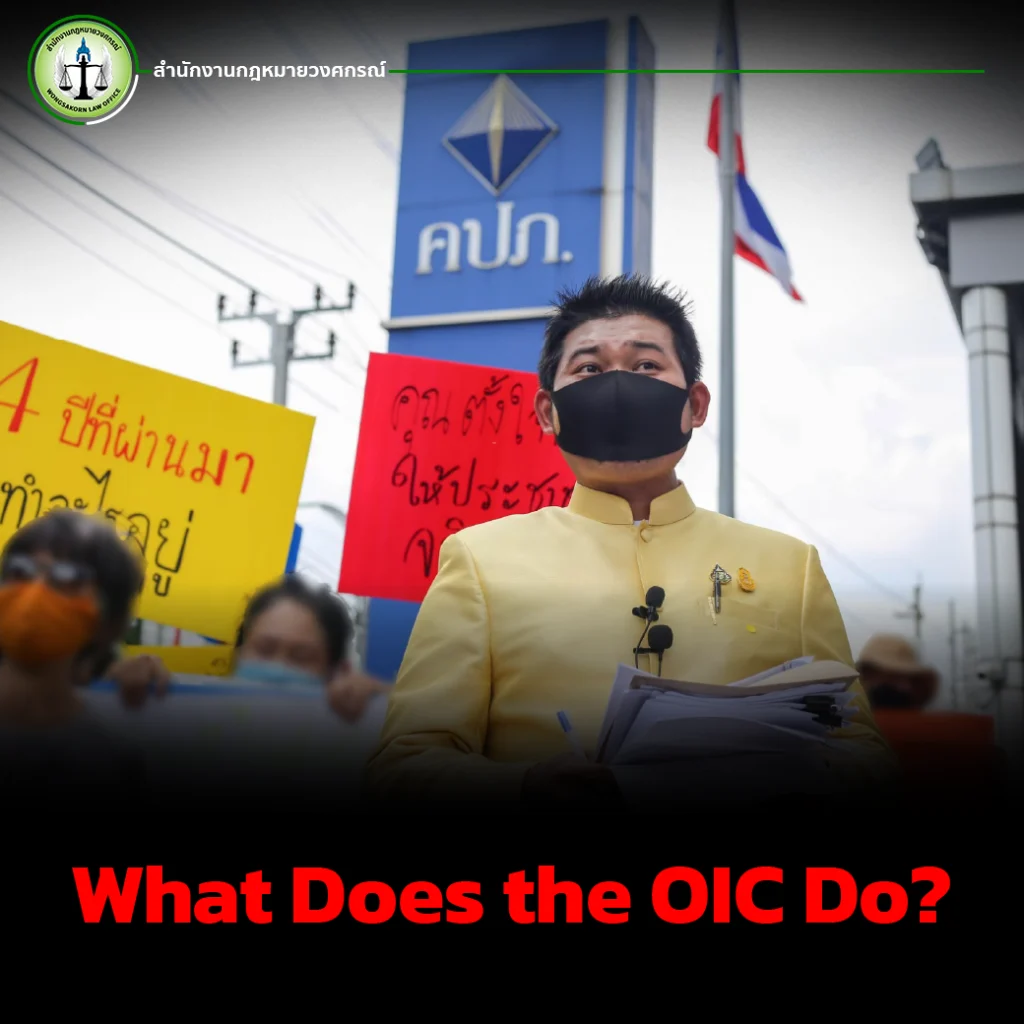
What Does the OIC Do?

The OIC’s main responsibilities include

-Regulating the insurance industry

-Protecting policyholders’ rights

-Acting as a mediator in disputes

-Providing arbitration as an alternative to court proceedings

On paper, it sounds like a reliable support system for consumers. However, in practice, things do not always work out that way.

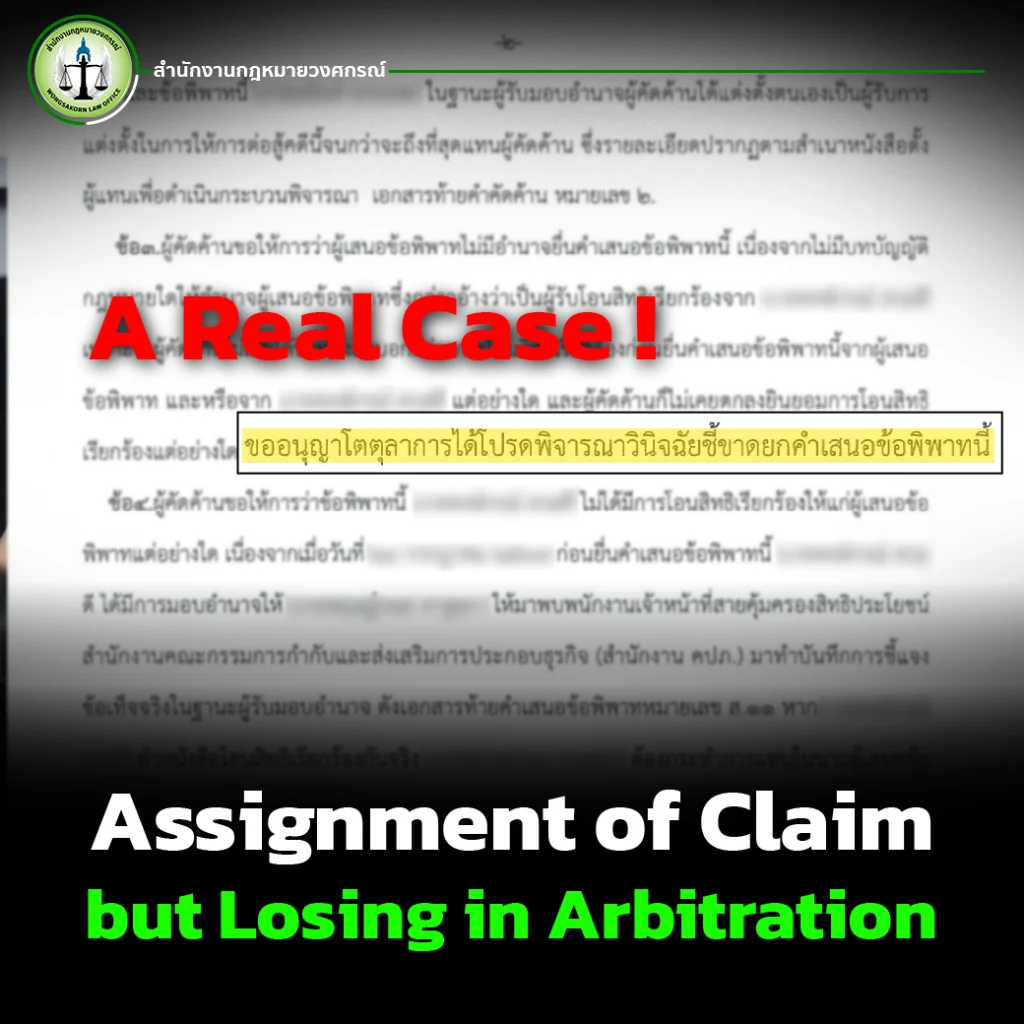
A Real Case Assignment of Claim but Losing in Arbitration

In one notable case, an auto repair company received an assignment of claim from a customer, allowing it to directly claim repair costs from the insurance company.

However, during the OIC process and arbitration, the insurance company argued:

“We were never notified of the assignment of claim.”

This was despite the fact that all relevant documents had already been submitted during the OIC process.

The Turning Point An Internal Issue at the OIC

The critical issue in this case was that an OIC officer failed to properly record a key document.

As a result, the arbitrator ruled that there had been no valid notification, causing the repair company (our client) to lose the case in arbitration.

This raises an important question: Who does the OIC really serve?

Justice from the Court

Although the case was lost at the arbitration stage, the matter was later brought before the court and the outcome was completely different.

The court ruled in favor of our client, citing Section 306 of the Civil and Commercial Code, which states that once a debtor has been informed of an assignment of claim, the assignment is legally valid.

The court found that notification had indeed occurred. As a result:

-The assignment of claim was legally effective

-The arbitration award was set aside

-Justice was ultimately delivered by the court, not the OIC

Is the OIC Still Reliable?

This case highlights several important realities:

-The OIC is not a court of law

-Arbitrators can make errors in evaluating evidence

-Internal processes may have flaws

-Arbitration awards can be challenged and overturned

From our experience handling insurance disputes, such cases where arbitration decisions are overturned are not uncommon.

What Should Consumers Do When Facing Insurance Disputes?

If you are involved in an accident and need to claim compensation from an insurance company, here are key precautions

1. Do Not Rely on Verbal Assurances

Always ensure everything is supported by clear documentation.

2. Monitor the OIC Process Carefully

Even after filing a complaint, follow up to ensure all documents are properly recorded and no key facts are overlooked.

3. Do Not Depend Solely on Arbitration

While faster, arbitration is not always accurate or fair.

4. Consult a Lawyer Early

This is the most important step. An experienced lawyer can:

-Structure your case correctly from the beginning

-Prevent procedural mistakes

-Develop an effective legal strategy

Having a legal expert in insurance disputes not only prevents you from being disadvantaged by insurance companies but also helps you avoid costly mistakes.

In complex disputes, relying solely on the OIC may cause you to lose your rights without realizing it.

Don’t Place All Your Trust in the OIC

So, can the OIC really help consumers?

The answer is: Yes but not always.

Ultimately, the outcome depends on

-The strength of your evidence

-Legal strategy

-And proper case handling by an experienced lawyer

If You Are Facing an Insurance Dispute

Whether your case involves personal injury or property damage, do not let the situation escalate by filing a complaint with the OIC without proper legal preparation.

Consult with us today. Our legal team specializes in insurance disputes and can:

-Analyze your case

-Develop a strategic legal approach

-Represent you effectively both before the OIC and in court

Because we believe that justice should never depend on systemic errors.

Get legal advice today so you don’t become a victim of the system or insurance companies.

Know Your Insurance: “Get fully treated first, then we’ll discuss compensation” Genuine Advice or a Strategy to Avoid Paying?

When a car accident occurs, especially in cases involving injuries, one of the most common phrases victims hear from insurance companies is

It may sound like well-intentioned advice. However, in reality, this statement could be merely a “strategy” used by insurance companies to delay or avoid paying compensation. If victims believe this, they may unknowingly lose their legal rights, and in some cases, end up “suffering for free” without receiving the compensation they deserve.

This article will help you understand insurance tactics, know your rights, and learn what to do after a car accident.

Why You Should Be Cautious About “Settle Later”?

In practice, insurance companies are highly experienced in handling claims and often have strategies to minimize liability or limit payouts.

Common phrases include:

  • “Get treated first”
  • “We’ll settle everything later”
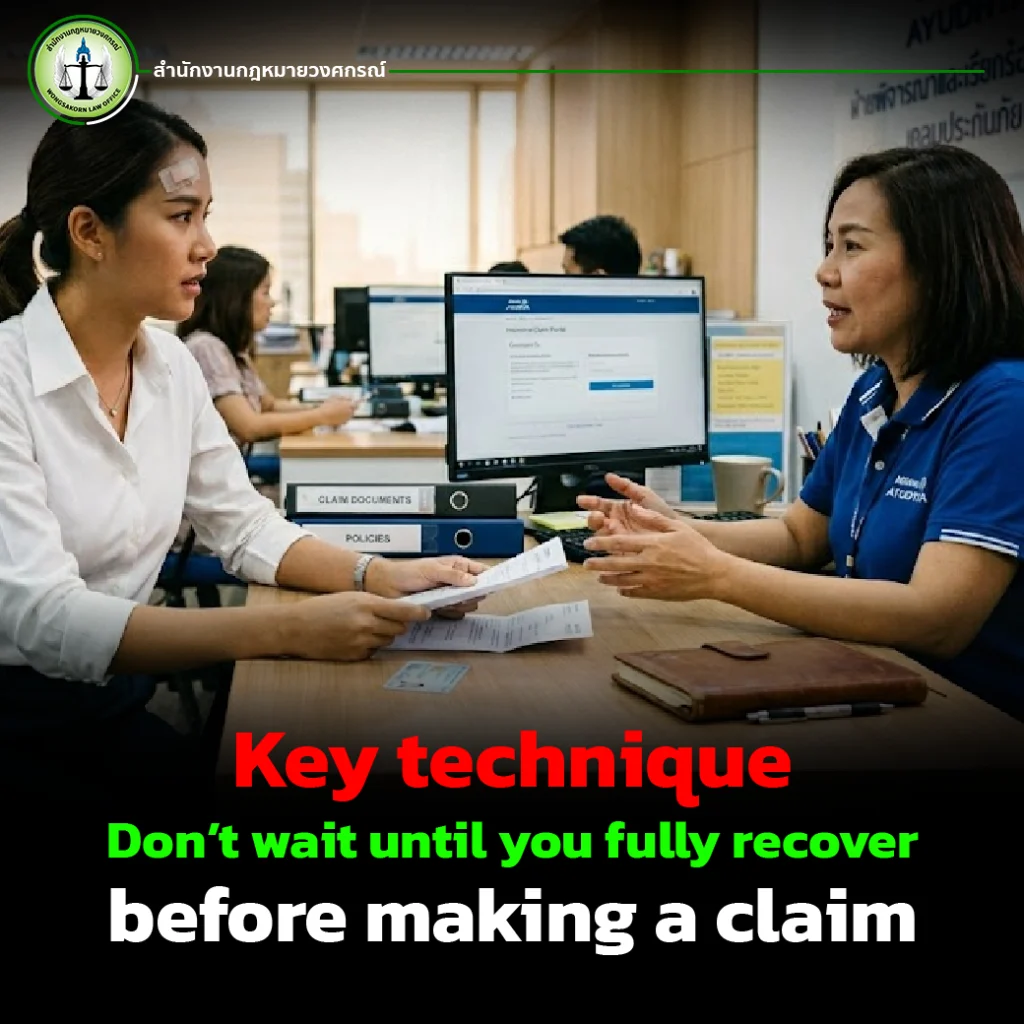
  • “Let’s wait until you fully recover”

Although these sound reasonable, they are often used to delay the process, because the longer it takes, the lower the chances for victims to claim full compensation.

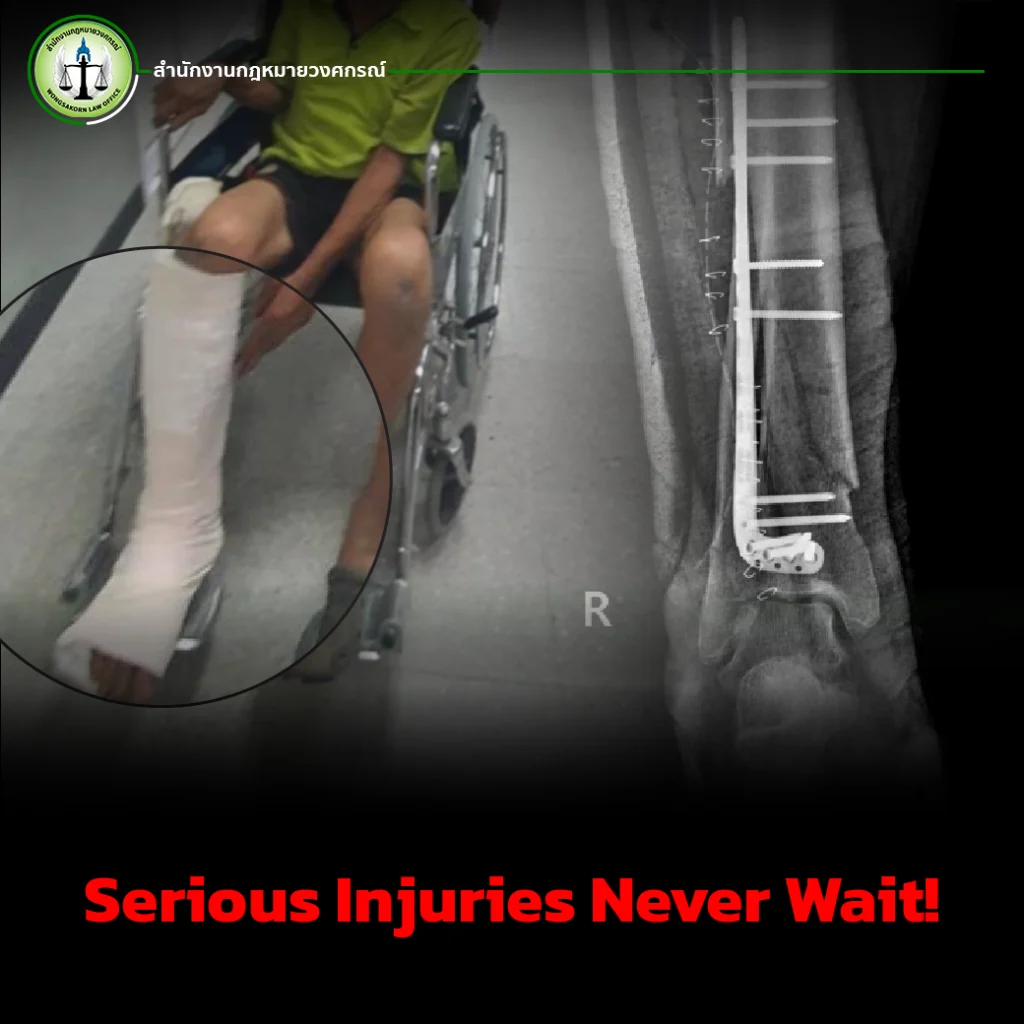
Serious Injuries Never Wait!

-In cases of severe injuries such as

-Bone fractures requiring surgery

-Long-term recovery

-Temporary loss of working ability

You should never wait until full recovery before claiming compensation, because damages include more than just medical expenses

-Loss of income

-Future medical care

-Emotional distress

-Loss of quality of life

Delays may result in missing evidence or incomplete damage assessments.

The Truth You Don’t Need to Wait

Many people misunderstand that they must fully recover before making a claim.

 In reality, this is NOT legally required.

Claims can be pursued alongside medical treatment, and in many cases, the earlier you start, the better your position.

Insurance Tactics You Should Know

Some insurers may

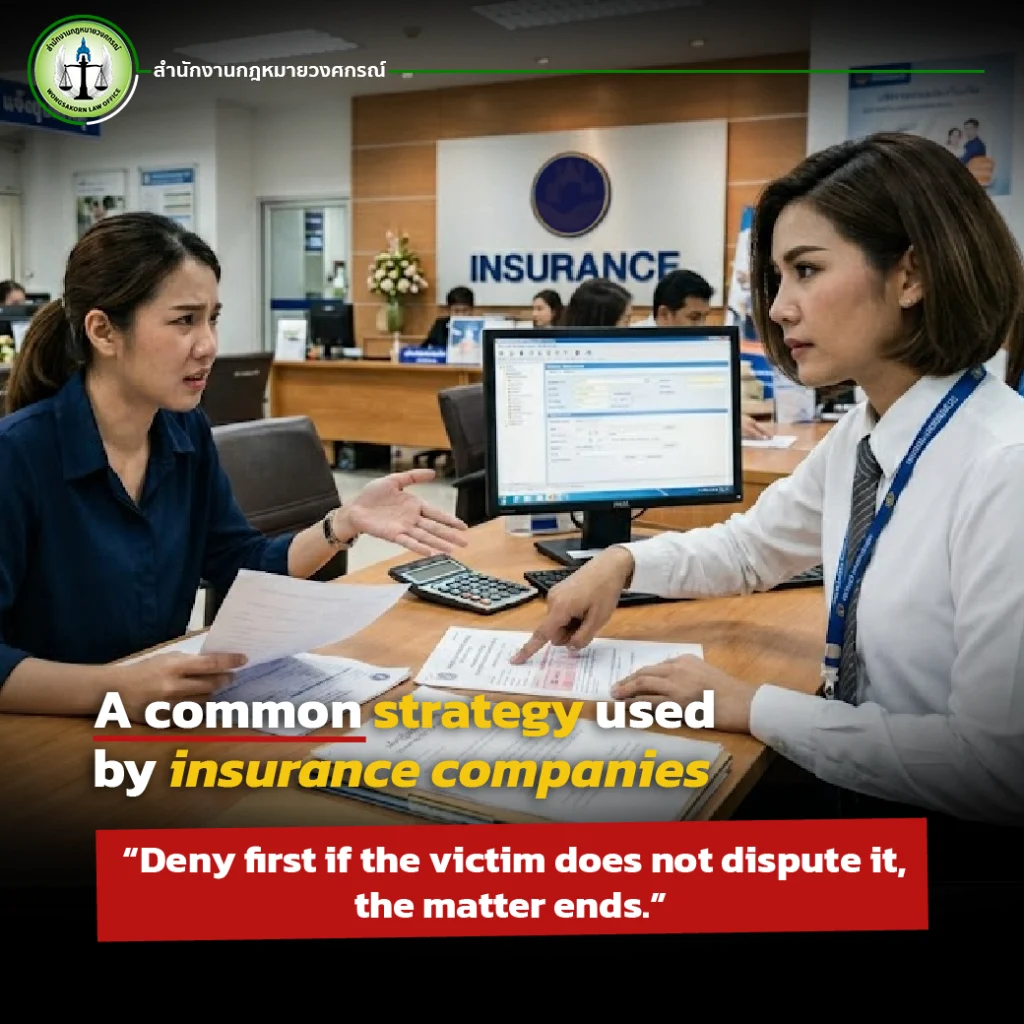
Initially deny claims to test your reaction

-Delay communication

-Request excessive documents

-Offer low compensation

Without legal knowledge, victims may accept less than they deserve.

Timing Is Critical

Time plays a crucial role in injury claims. Delays may lead to

-Lost evidence

-Incomplete evaluations

-Arguments like “you’ve already recovered”

-Reduced compensation

The Right Approach Consult a Lawyer Early

The best way to protect your rights is to consult a lawyer from the very beginning.

A lawyer can help

-Assess your legal rights

-Plan your claim strategy

-Gather evidence

-Negotiate with insurers

-Prevent unfair treatment

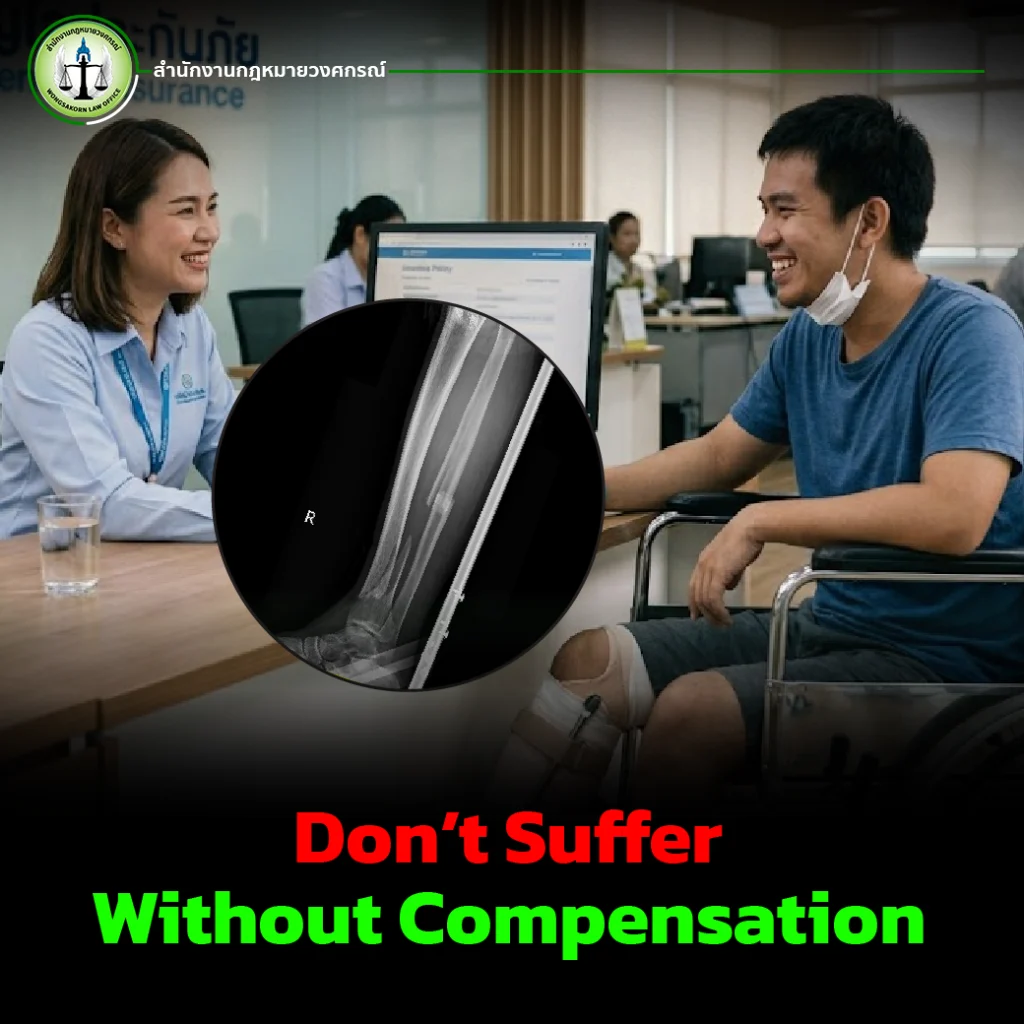
Don’t Suffer Without Compensation

Many victims trust insurers too much, delay action, or fail to seek expert advice, resulting in incomplete or no compensation. With proper legal guidance from the start, victims can fully protect their rights.

Awareness Protects Your Rights

The phrase “Get treated first, then we’ll talk” is not always good advice, it can be a tactic.

Remember

-You don’t need to wait to claim compensation

-Acting early gives you an advantage

-Evidence and timing are crucial

-Legal advice prevents loss of rights

Consult a Lawyer Before It’s Too Late

If you or someone close to you has experienced a car accident and heard this from an insurer, don’t wait.

The sooner you act, the better you can protect your rights.

Wongsakorn Law Office is ready to provide legal advice and strategic support from day one so you don’t suffer both physically and legally.

👉 Contact a lawyer today to fully protect your rights without waiting for full recovery.

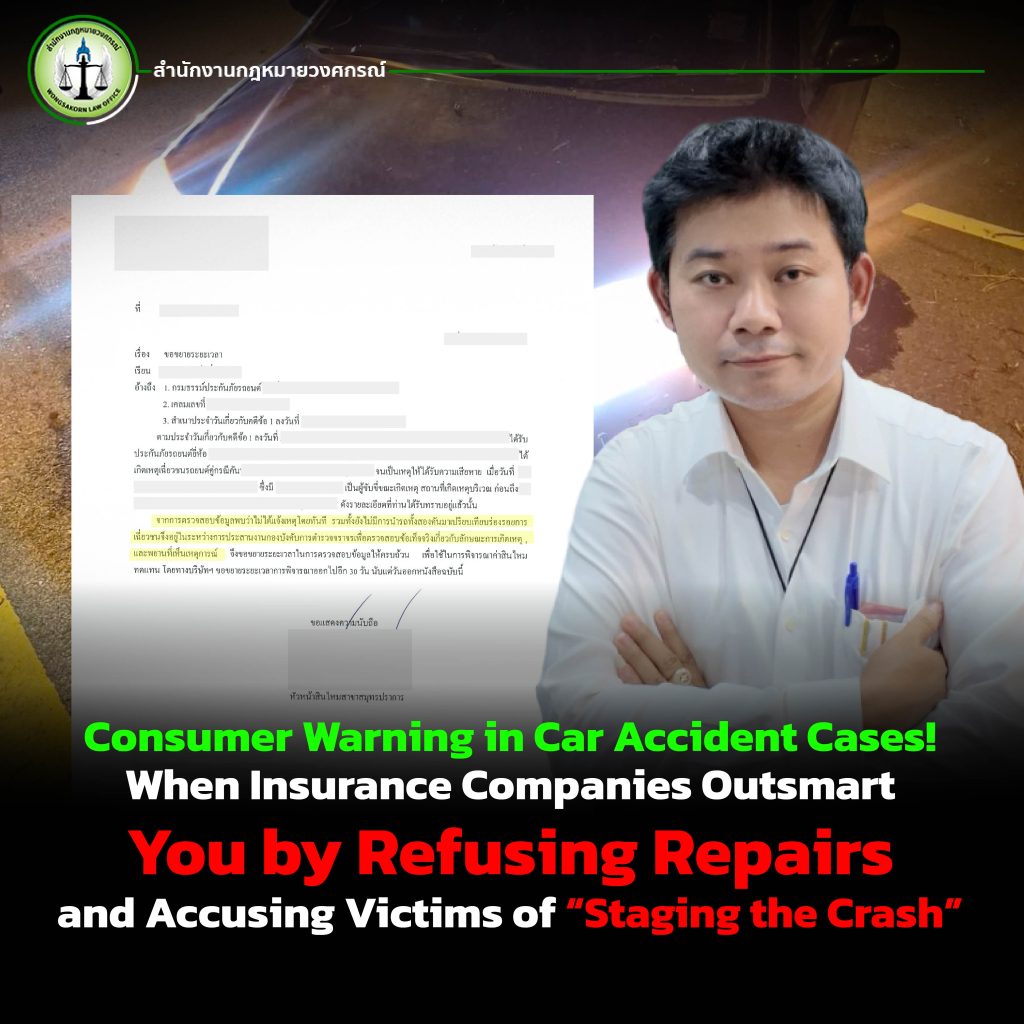
Consumer Warning in Car Accident Cases! When Insurance Companies Outsmart You by Refusing Repairs and Accusing Victims of “Staging the Crash”

As car accident cases continue to rise, many consumers still believe that once an accident occurs, the insurance company will handle everything, arranging repairs, assessing damage, and compensating the injured party fairly. Unfortunately, reality is far from this assumption. Many insurance companies adopt strategies to avoid responsibility: refusing to repair, claiming documents are incomplete, or even alleging that the victim contributed to the incident.

One such case involves an elderly woman, a case that has now become an important lesson for all consumers regarding their rights in car accident disputes.

Insurance Company Ignored the Case for 2 Full Months No Repairs, No Assessment, No Response

The incident began when the elderly woman’s car was hit and severely damaged. Instead of arranging repairs as required, the at-fault driver’s insurance company did nothing.
For two months, they:

  • did not contact her,
  • did not assess the damage,
  • did not bring the vehicle in for repair.

The woman, who had no legal knowledge, had no idea what to do. People around her advised her to file a complaint with the OIC (Office of Insurance Commission). However, it is widely known that the OIC often works in ways that lean toward supporting insurance companies. Starting the process this way may cause unnecessary delays and potential loss of rights.

Fortunately, she had not filed the complaint yet and instead chose to consult the Lawyer Arm from Wongsakorn Law Office.

Lawyer Arm Immediately Took Over the Case and Issued a Formal Notice Demanding Repairs

After reviewing all the details, Lawyer Arm found that the case carried a high risk of the insurance company misleading the victim or avoiding responsibility.

The office immediately drafted and sent a formal letter to the insurance company instructing them to:

  • bring the damaged vehicle in for repair,
  • restore it to its pre-accident condition,
  • fulfill all duties required under the insurance policy.

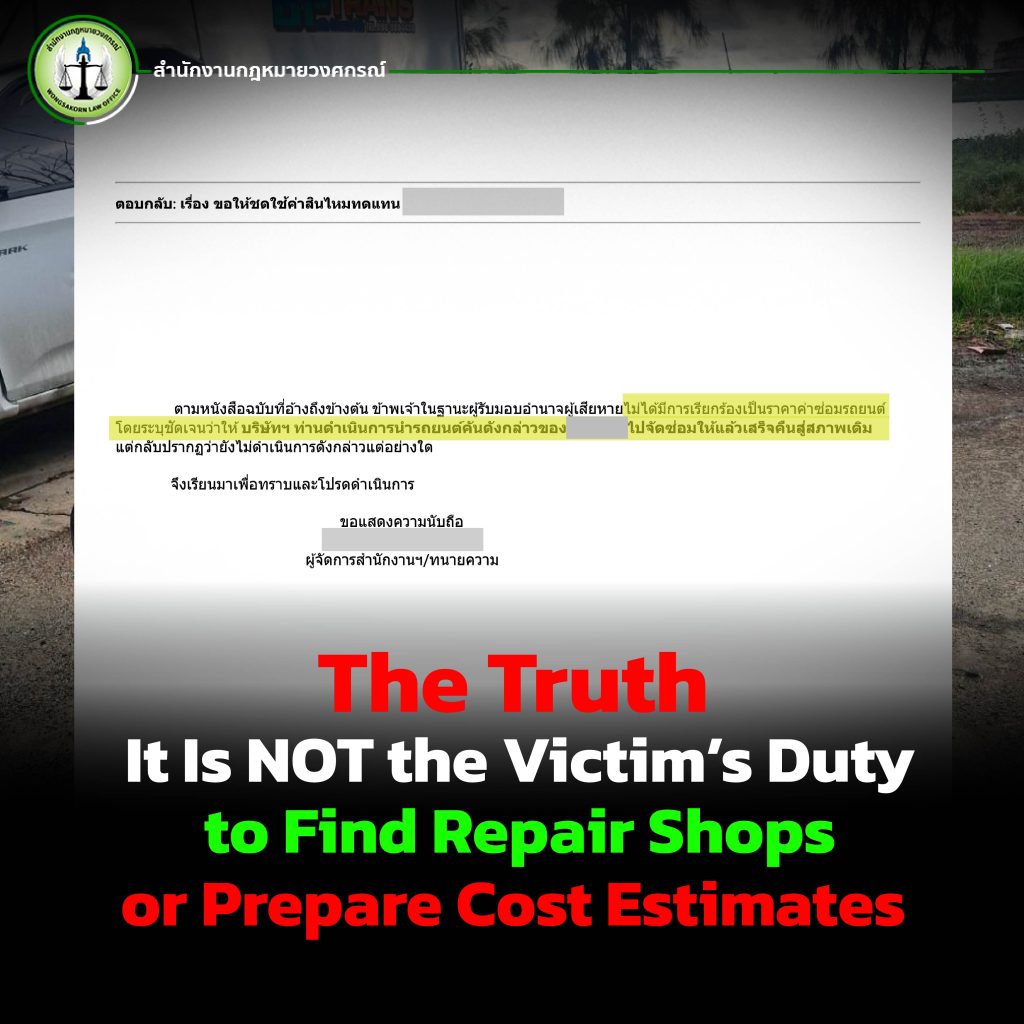
Importantly, the letter did NOT demand any repair costs from the insurance company; it merely required them to take the car and repair it, as the responsible insurer.

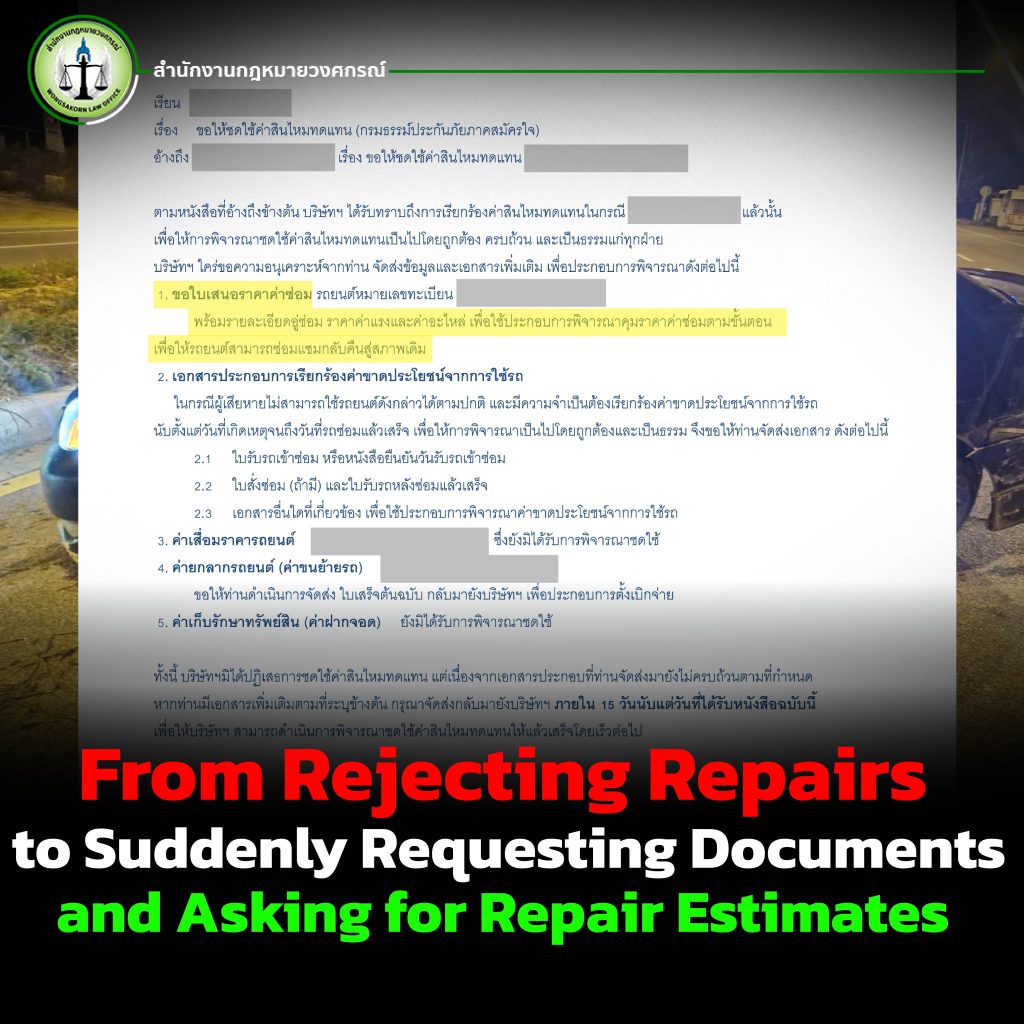
From Rejecting Repairs to Suddenly Requesting Documents and Asking for Repair Estimates

After receiving the letter, the insurance company shifted their attitude and responded by requesting:

  • repair cost estimates,
  • repair shop details,
  • labor costs,
  • parts pricing,

which they claimed were needed for “price control procedures.”
Although it might sound reasonable, in reality…

 This is a strategy designed to shift responsibility onto the victim.

Why Did the Lawyer Advise “Do NOT Prepare Repair Estimates”?

According to Lawyer Arm, preparing repair estimates poses high risks, because the insurance company could later accuse the victim of:

  • providing a fake estimate,
  • listing incorrect parts,
  • inflating prices,
  • adding unnecessary items.

They could even file a counter-lawsuit against the victim, claiming attempted fraud.

Most consumers have no idea this can happen.

The Truth: It Is NOT the Victim’s Duty to Find Repair Shops or Prepare Cost Estimates

In car accident and insurance law:

  • The insurance company must manage all repair arrangements.
  • The insurance company must select the repair garage.
  • The insurance company must assess repair costs.
  • The insurance company must restore the car to its original condition.

The victim has zero responsibility to prepare repair estimates.

Therefore, the insurance company’s attempt to push this duty onto the victim is a clear violation of proper procedure.

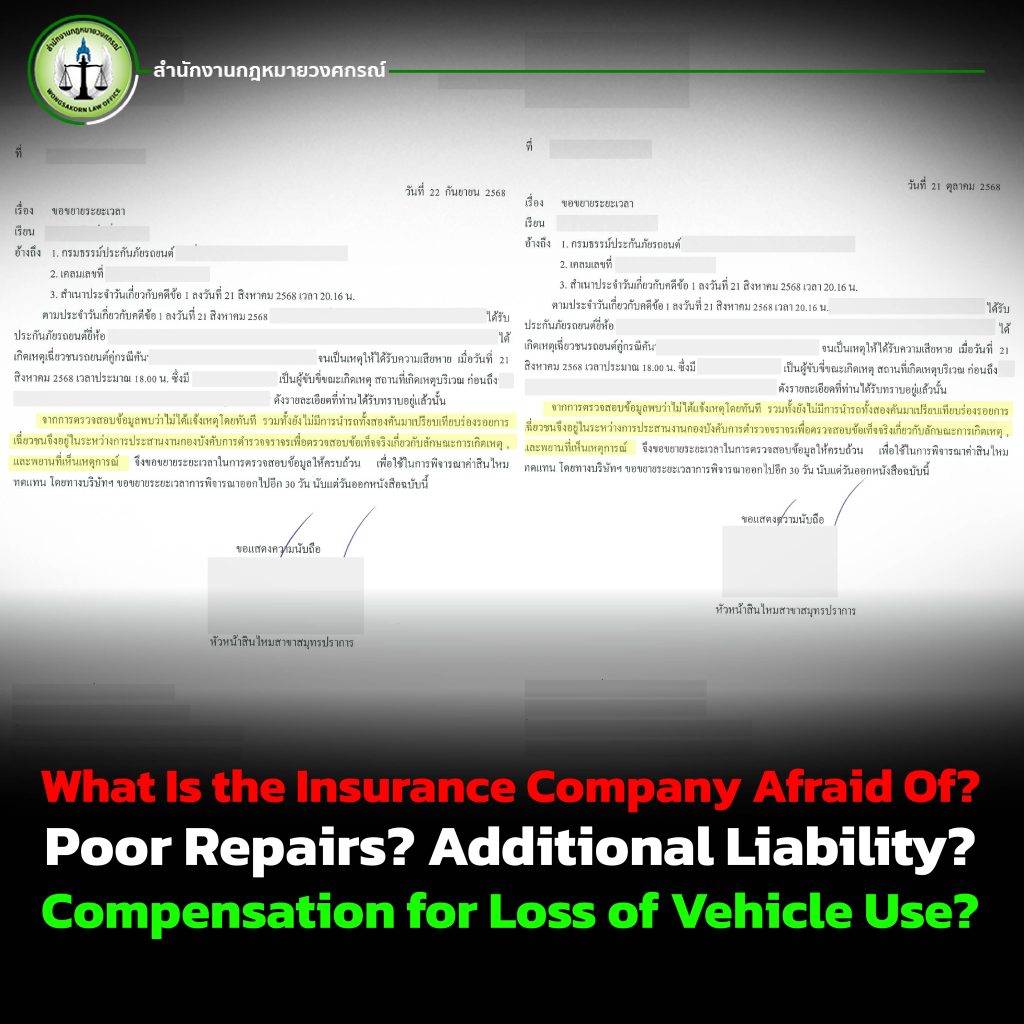
What Is the Insurance Company Afraid Of? Poor Repairs? Additional Liability? Compensation for Loss of Vehicle Use?

Many people wonder:

  • Are they afraid repairs will not meet standards?
  • Are they afraid they will incur additional liability if problems arise later?
  • Are they afraid they will have to pay loss of vehicle use compensation while the car is being repaired?

Regardless of the reason, the victim should not be forced to bear these burdens.

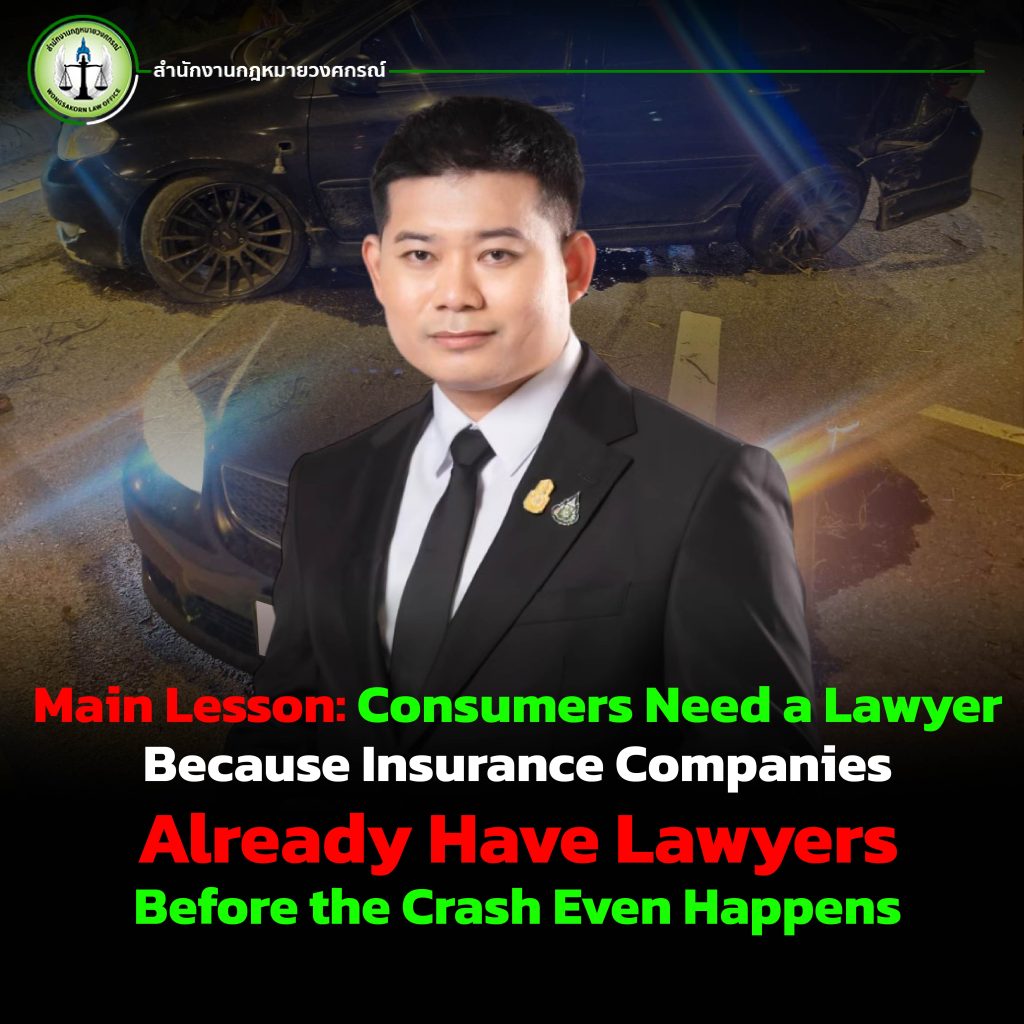
Main Lesson: Consumers Need a Lawyer Because Insurance Companies Already Have Lawyers Before the Crash Even Happens

Most people do not realize:

Insurance companies already have lawyers prepared before any car accident occurs.
They have time, legal resources, and strategies ready to reduce liability.

But consumers usually:

  • have no legal advisor,
  • have no knowledge of their rights,
  • lack experience dealing with insurance tactics.

Thus, when an accident occurs, consumers should consult a lawyer to:

  • protect their rights,
  • prevent unfair treatment,
  • compel the insurance company to fulfill its duties,
  • avoid being pushed into taking responsibility for things they shouldn’t.

Don’t Let Insurance Companies Manipulate Your Rights

This case shows how some insurers may:

  • reject repairs altogether,
  • accuse the victim of staging the crash,
  • demand documents the victim is not responsible for,
  • twist procedures to avoid paying compensation.

Consumers must stay informed and have a professional to protect their interests.

If you are facing a car accident dispute, if your insurance company refuses repairs, or if you feel the company is avoiding responsibility:

👉 Consult Lawyer Arm – Wongsakorn Law Office
📞 Tel: 062-195-1661

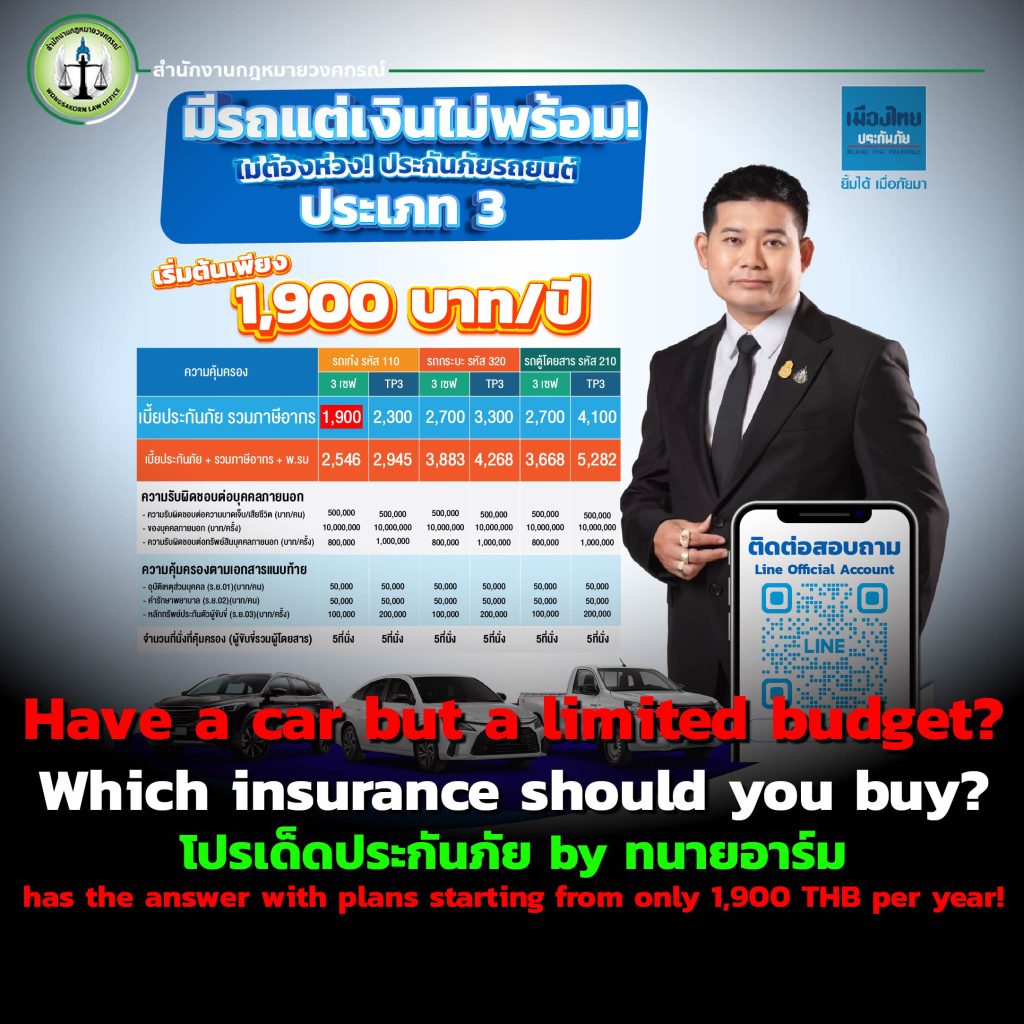
Have a car but a limited budget? Which insurance should you buy? โปรเด็ดประกันภัย by ทนายอาร์ม has the answer with plans starting from only 1,900 THB per year!

Owning a car today is no small matter. Whether you drive to work, drop off your children, or run your business, your car is an essential part of daily life. Yet, what many people often overlook are the risks that come with driving accidents, collisions, and damage to other people’s lives or property.

So here’s the question: if you have a car but not much money, which type of car insurance should you buy to stay protected without breaking the bank?

Today, โปรเด็ดประกันภัย by ทนายอาร์ม introduces an affordable option Third-Class Car Insurance, ideal for drivers on a budget who still want solid protection for themselves and others in case of an accident.

Understand before you buy insurance

Before deciding to buy car insurance, it’s important to understand what each type of policy covers:

1.First-Class Insurance – The highest level of coverage for both your car and the other party’s, including theft, fire, and natural disasters.

2.Class 2+ and 3+ Insurance – Covers accidents involving other vehicles on the road, but with certain limitations.

3.Third-Class Insurance – Covers the other party and third persons when you cause damage to someone’s life or property in an accident.

For anyone looking to buy affordable car insurance that still meets legal protection standards, Third-Class Insurance is the best option.

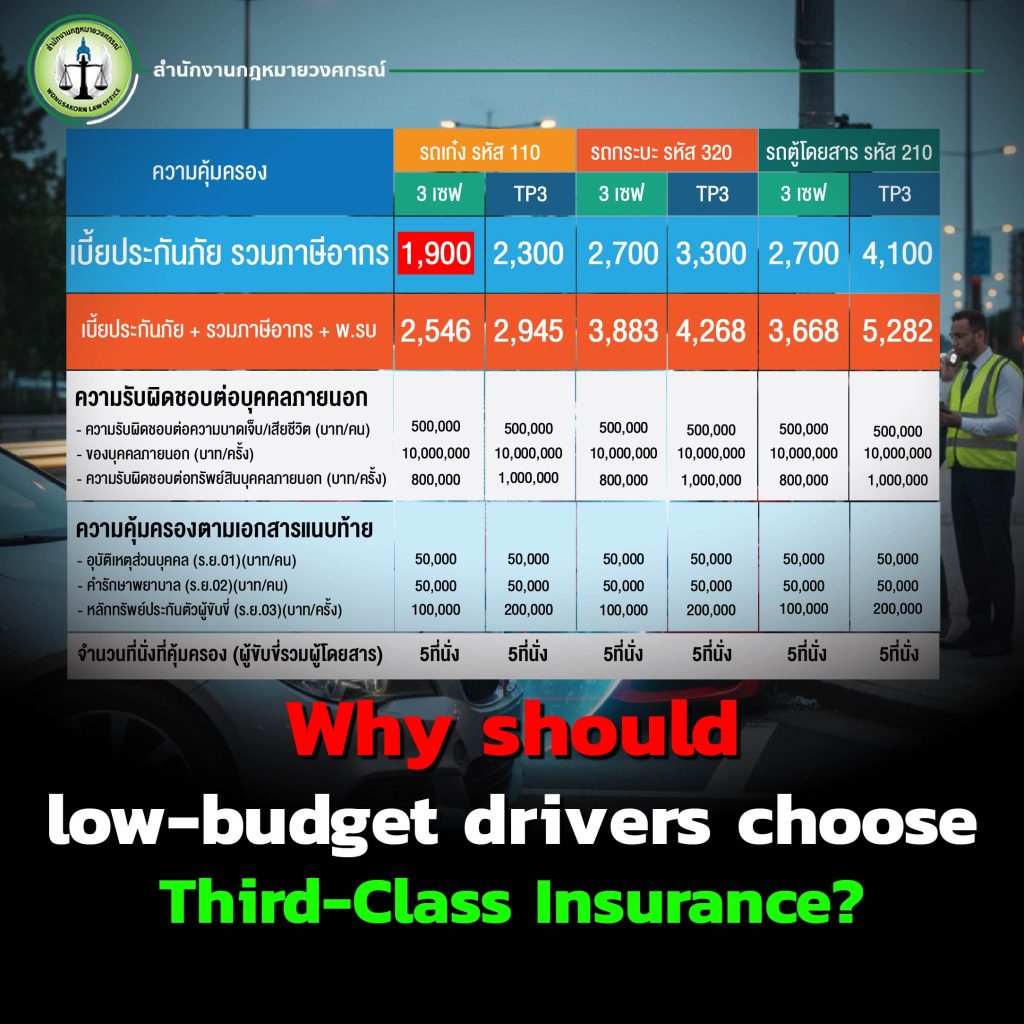
Why should low-budget drivers choose Third-Class Insurance?

Many people believe that “cheap insurance” means “no coverage.” That’s not true.
Third-Class Car Insurance actually provides solid and essential benefits, including:

Coverage for life and property of the other party
If you cause an accident, the insurance company pays for the damages up to the policy limit.

Low annual premium only 1,900 THB per year
Especially with โปรเด็ดประกันภัย by ทนายอาร์ม, you can get protection starting from just 1,900 THB per year an affordable price even for low-income earners.

Why buy insurance from Proded Insurance by Lawyer Arm?

What makes โปรเด็ดประกันภัย by ทนายอาร์ม different from others is that you don’t just buy insurance you also get a professional legal advisor along with it.

👨‍⚖️ Lawyer Arm is an experienced attorney specializing in insurance law, with hundreds of real court cases under his belt. He understands insurance companies’ tactics and knows exactly how to protect policyholders’ rights.

When you buy insurance through Lawyer Arm, it means:

“You’re not just buying insurance, you’re gaining a lawyer by your side from day one.”

So if your insurance company refuses to help or denies responsibility, you won’t have to face it alone anymore.

More coverage than you expect even at just 1,900 THB

You may wonder, “Can a 1,900 THB insurance policy really protect me?”
The answer is yes more than you think.

Third-Class Insurance includes:

  • Compensation for injury, death, or property damage to others
  • Medical expenses for the injured party within policy limits
  • Property damage compensation
  • Legal defense costs if you face civil litigation

And when you buy through โปรเด็ดประกันภัย by ทนายอาร์ม, you also get free legal consultation whenever disputes arise with the insurance company.

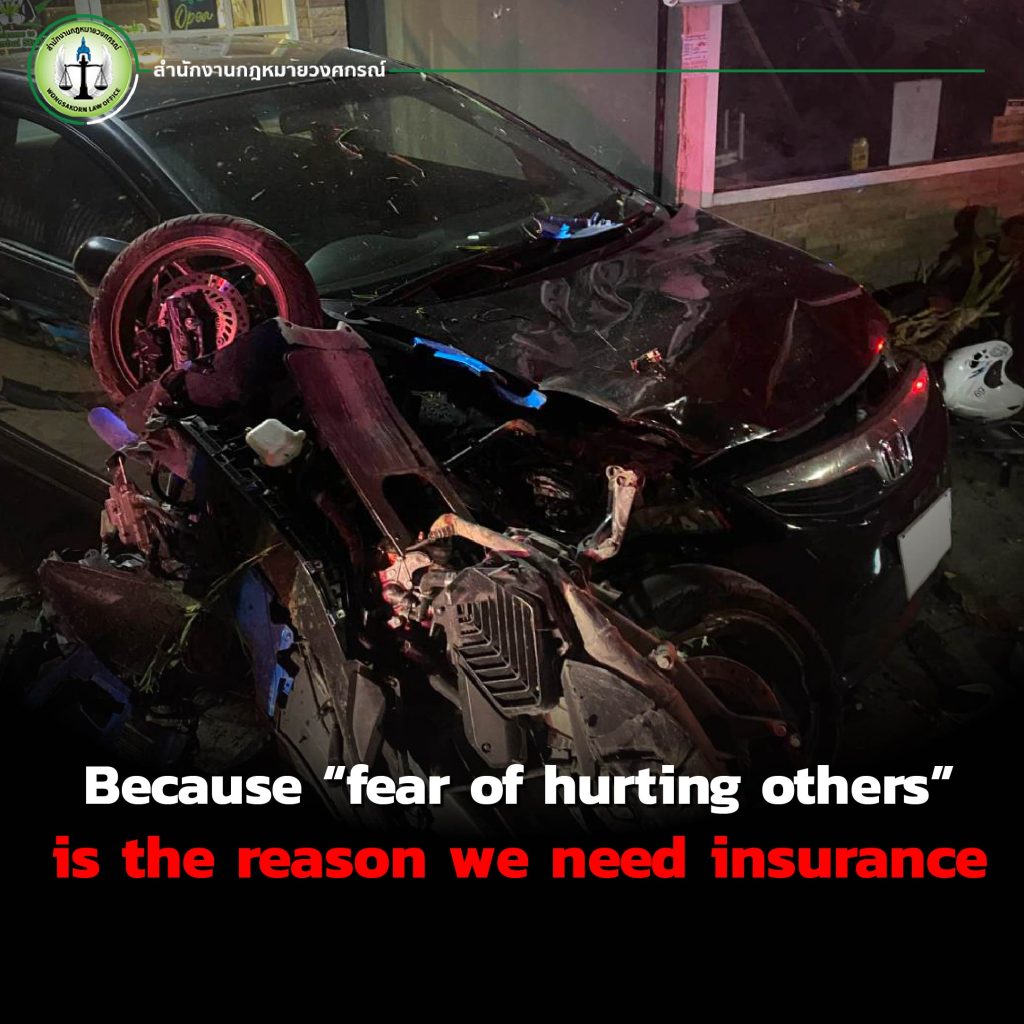
Because “fear of hurting others” is the reason we need insurance

Many drivers think they’re careful enough and don’t need insurance but accidents can happen even when it’s not your fault.
The purpose of car insurance is not only to protect your vehicle, but also to prevent you from financially hurting others.

Having insurance is like buying peace of mind and social responsibility.
When something happens, the insurer pays for damages, so you don’t have to.

Even with a limited budget, 1,900 THB per year is a small price to pay for peace of mind and protection.

Looking for affordable and reliable car insurance?

โปรเด็ดประกันภัย by ทนายอาร์ม is your answer.
Our professional team and experienced insurance lawyers provide full legal guidance before, during, and after the insurance process.

Because what customers truly need is not just a “cheap policy,” but the confidence that they will never be taken advantage of by an insurance company.

Buying insurance through Lawyer Arm is the smartest choice

In today’s world where everyone needs to save money, good insurance doesn’t have to be expensive.
Choose a trusted expert, and you can protect yourself and others without financial burden.

✅ Starting at only 1,900 THB/year
✅ Professional legal support from Lawyer Arm
✅ Full, transparent protection

Because “buying insurance through Lawyer Arm” means buying peace of mind and fairness for yourself.

For more information, contact the Official Line: โปรเด็ดประกันภัย by ทนายอาร์ม

Thailand’s No.1 Legal Insurance Advisor

Buy insurance with us = Get your own legal advisor!

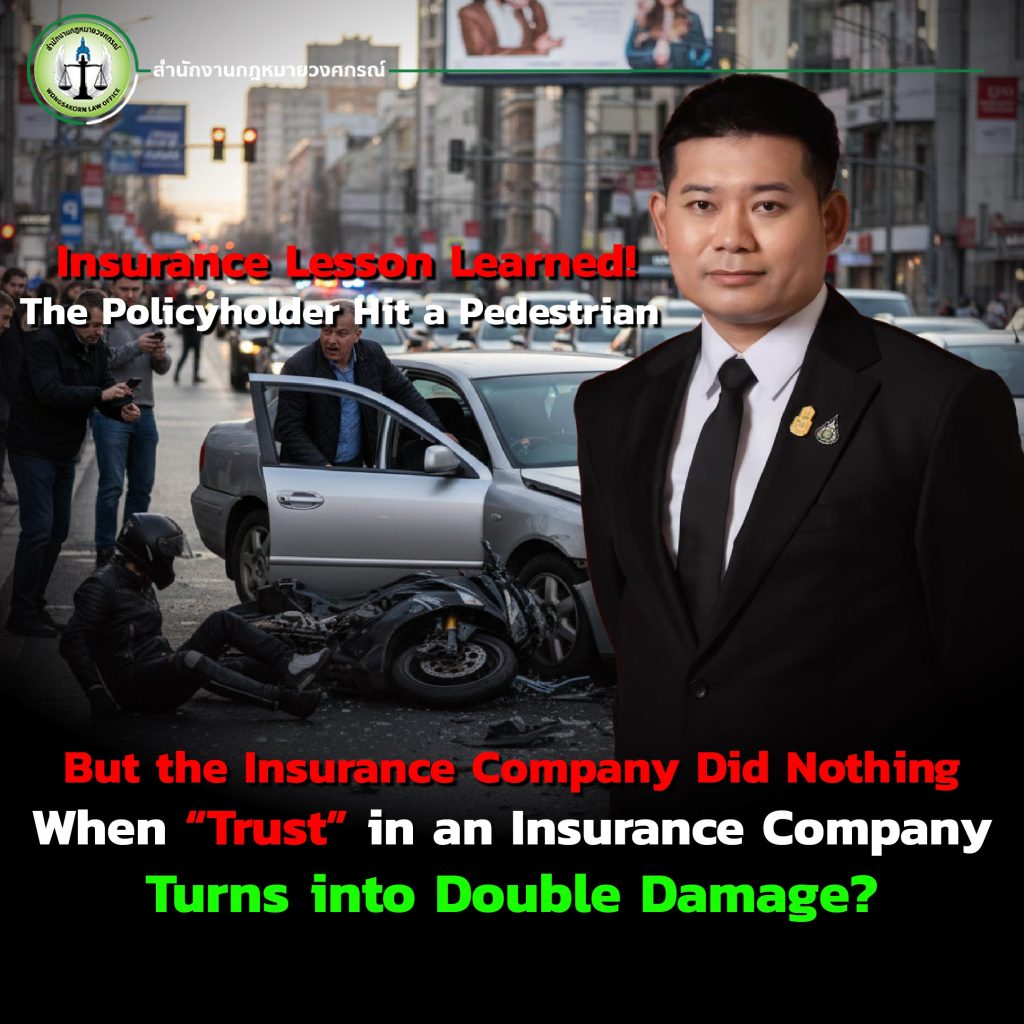
Insurance Lesson Learned! The Policyholder Hit a Pedestrian but the Insurance Company Did Nothing When “trust” in an insurance company turns into double damage?

Lawyer Arm shares how to claim your legal rights correctly from the start.

In the world of insurance, many people believe that having a policy is a shield of protection when unexpected accidents happen, especially road accidents.
However, in reality, there are many cases where the insured must handle everything on their own, and worse, insurance companies sometimes refuse to take responsibility, leaving the policyholder to share the financial burden with the injured party.

This true story happened to a man who held a car insurance policy. He hit a pedestrian, causing injuries that required hospitalization. The police ruled him at fault. Everything seemed to proceed normally toward a claim until the insurance company refused to help, even with the advance payment for medical expenses.

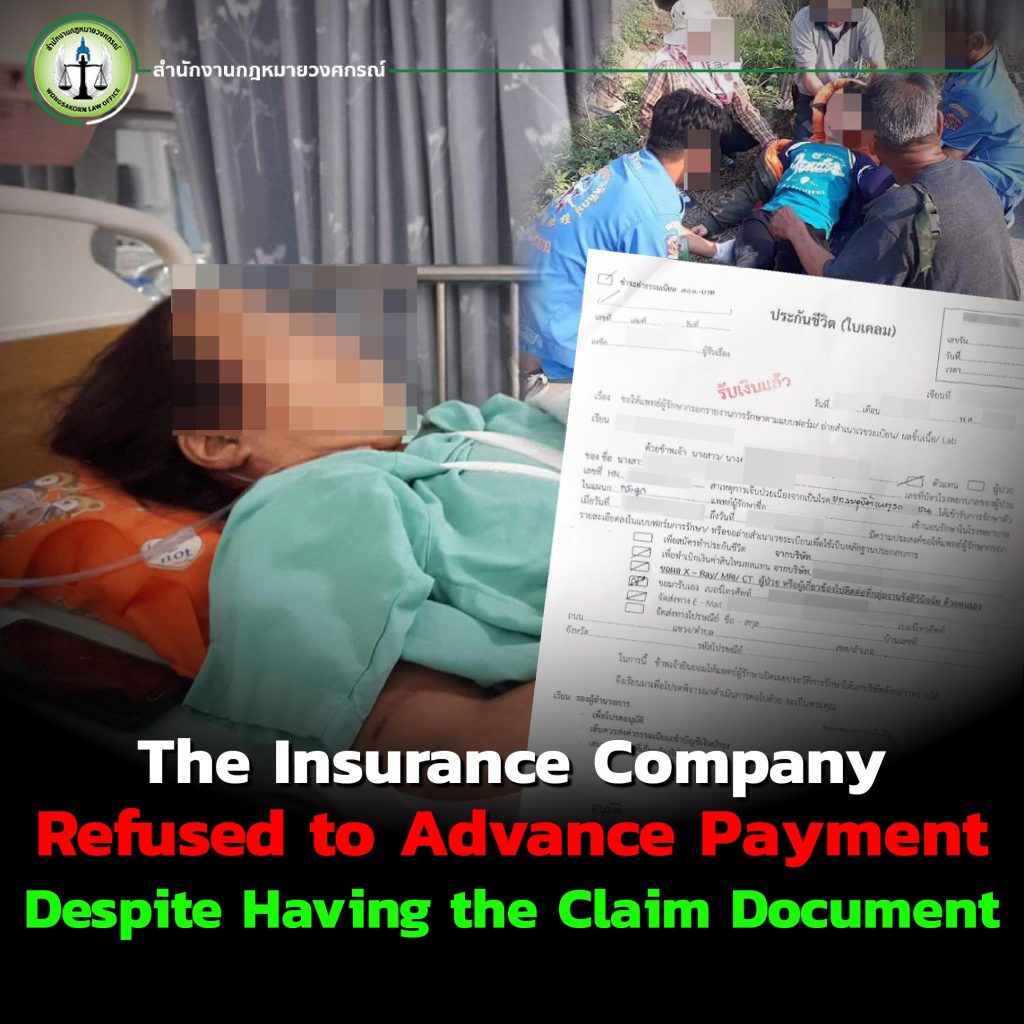
The Insurance Company Refused to Advance Payment Despite Having the Claim Document

The insured man said he had all the required documents, a claim form and an accident report but the company told him both he and the injured person must “advance the payment first.”
Even with the claim form in hand, the insurer would not issue a guarantee letter for the hospital to claim directly. As a result, both the insured and the victim had to pay medical expenses from their own pockets first.

This might sound unbelievable, but such cases do happen. It’s a clear reminder that:

“Having insurance doesn’t automatically mean you’ll be protected in every case.”

When the Insured Becomes a Double Victim?

Since the police ruled him at fault, the insured had the legal duty to compensate the injured party.
But instead of the insurer managing the claim as promised, both the insured and the injured person had to jointly demand compensation from the insurance company.
This turned the policyholder into a “double victim” losing money, time, and peace of mind.

Lawyer Arm’s Advice: File a Joint Lawsuit as a Consumer Protection Case

Lawyer Arm suggests that if both the policyholder and the injured person file a lawsuit together against the insurance company, it can be considered a consumer protection case, as both are consumers suffering from unfair business practices.

If the court finds that damage truly occurred, the insured can claim full compensation including Lawyer’s fees.
In many cases, the court orders the insurer to pay for legal costs, though it depends on the evidence and court discretion.
That’s why having a lawyer from the very beginning is essential to ensure that every step follows the law and that your rights are fully protected.

Lawyers Can Legally Charge a Percentage of the Awarded Amount

Under Thai law, lawyers can legally charge a percentage-based fee from the recoverable amount.
Therefore, policyholders can make a transparent agreement with their lawyer, for example:

  • Setting a fair percentage from the total recovered amount; or
  • Paying a flat fee for the entire case.

This clarity helps avoid disputes later and ensures smoother case progression.

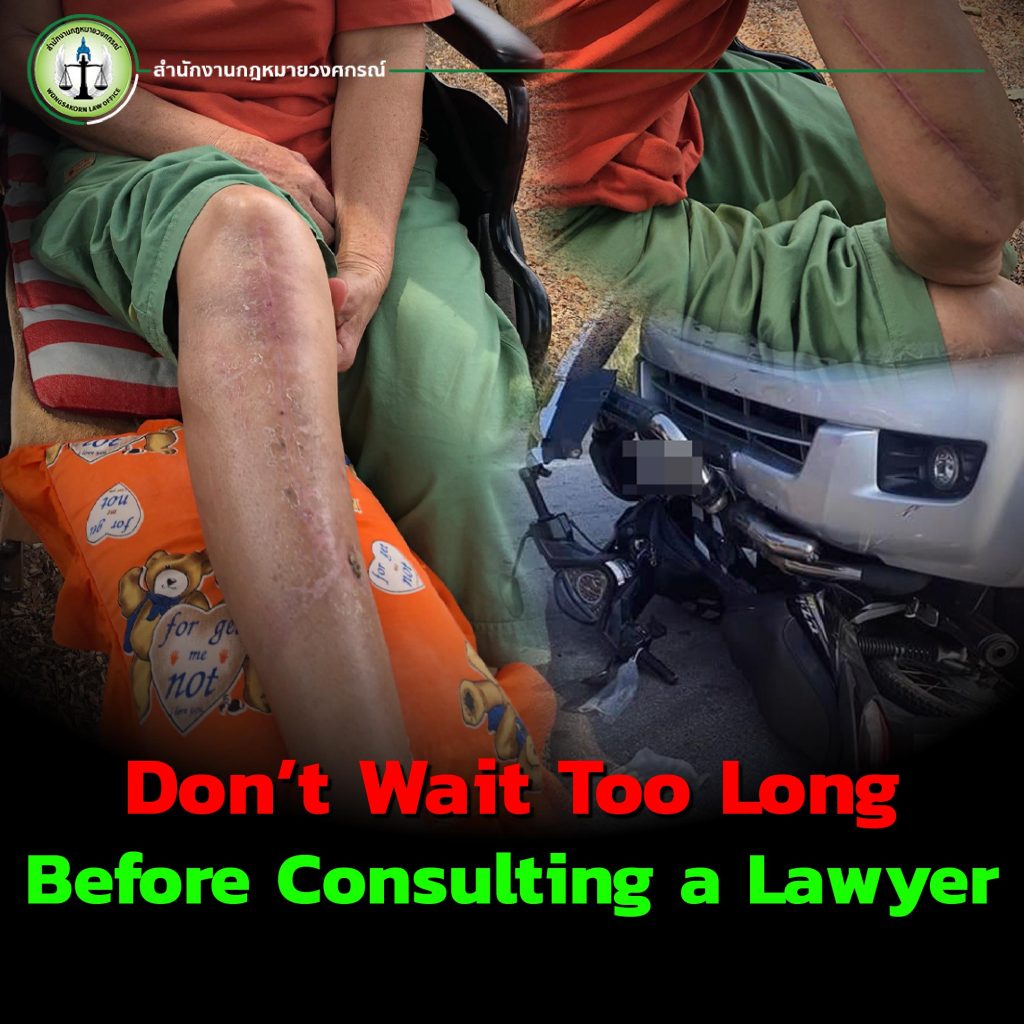
Don’t Wait Too Long Before Consulting a Lawyer

Lawyer Arm also warns:

“Don’t wait until you fully recover or years have passed before filing your claim. Once you’ve recovered, you may lose the right to claim compensation for permanent disability.”

In practice, many people wait too long only to receive partial compensation.
Always seek legal advice immediately after an accident, so your lawyer can verify your claim and documentation right from the start.

Insurance Companies Sell Easily but Claims Are Hard

Many insurance companies market themselves as “fast and reliable”, but when accidents actually happen, they often give excuses such as:

  • “We’re overloaded with cases.”
  • “It’s not our department’s responsibility.”
  • “We need to wait for documents from the hospital.”

In the end, the policyholder ends up doing all the paperwork and follow-ups.
As Lawyer Arm often says:

“When you sell insurance, you sell trust but when a client has an accident, you must serve them, not make excuses.”

Key Advice for Every Policyholder

1.Keep all evidence — claim forms, police reports, medical certificates, receipts.

2.Notify your insurer immediately after an accident and ask for a claim number.

3.Don’t sign any documents you don’t fully understand especially waivers or settlements.

4.Consult a lawyer right away if the insurer refuses to pay or delays the claim.

The Takeaway

Having insurance doesn’t guarantee fair treatment but knowing your rights and having a lawyer by your side can help you recover your losses and gain true justice.
In a world where companies compete to sell insurance, don’t forget as a policyholder, you must also learn to understand and defend your rights.
Consult a lawyer today so you’ll never be taken advantage of by an insurance company again.

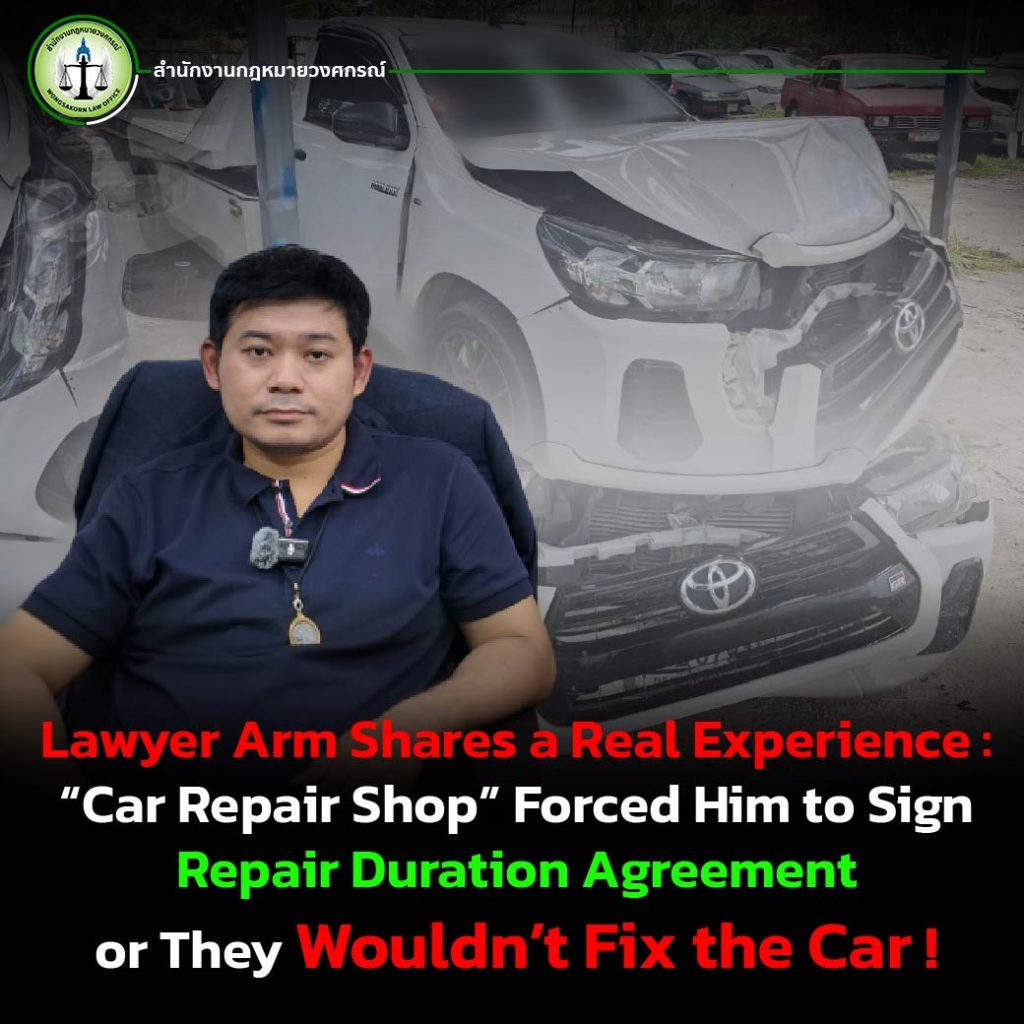
Lawyer Arm Shares a Real Experience: “Car Repair Shop” Forced Him to Sign Repair Duration Agreement or They Wouldn’t Fix the Car!

A car repair shop is something every car owner has to deal with at some point especially after an accident. But surprisingly, even if you already have car insurance, many consumers still fall victim to the practices of certain repair shops and insurance companies without realizing it.

Recently, Lawyer Arm shared a real-life experience that happened to him. One of his employees accidentally crashed his car, and when he brought it in for repairs, something shocking happened. In this article, Lawyer Arm aims to raise awareness and warn the public:
If you don’t understand your rights or have a lawyer guiding you from the beginning, you could easily be taken advantage of by the repair shop or the insurance company.

The Repair Shop Called and Demanded a Signature Before Continuing the Repair

After the accident, Lawyer Arm’s car was sent to an insurance-affiliated repair shop. One day, the shop called and said:

“You must sign to accept the repair period and waiting time for parts. If you don’t sign, we can’t continue fixing your car.”

It might sound like a standard request for customer acknowledgment, but for someone who knows the law, Lawyer Arm immediately recognized this was not in line with OIC (Office of Insurance Commission) regulations.

OIC Clarifies: “Notification” Doesn’t Mean “Signature Required”

According to the OIC’s official regulation, “notifying the insured” means informing them not requiring a signature.

Notification can be done through:

  • Phone call
  • Email
  • LINE message
  • Written document or repair report

The intent is simply to update progress, not to make customers accept unfair conditions, such as excessive waiting periods or the use of mixed genuine and imitation parts.
However, in this case, the repair shop twisted the rule, turning a simple “notification” into a forced signature, which is both misleading and unfair to consumers.

The Problem with Mixing Genuine and Imitation Parts

Besides forcing a signature, the repair shop also said:

“We’ll use both genuine and imitation parts.”

At first, this might sound like a compromise but in legal and professional terms, repairs must restore the vehicle to its pre-accident condition as closely as possible.

Lawyer Arm explained:

“It’s simple if your car originally had genuine parts, the repair should use genuine parts. Mixing parts reduces quality, safety, and future resale value.”

If the repair shop must wait for genuine parts, they only need to notify the customer, not force them to sign anything. Refusing to continue repairs unless you sign is a clear violation of regulations.

What to Do If the Repair Shop Refuses to Fix Your Car?

Lawyer Arm recommends consulting a lawyer immediately if you face such a situation. A lawyer can communicate directly with the insurance company and document the shop’s refusal properly, for instance, by email or chat to preserve evidence in case of future disputes.

Understand Clearly  “Notify” ≠ “Sign”

Many people confuse the two terms. Lawyer Arm clarifies:

“‘Notify’ doesn’t mean signing acknowledgment, nor does it release the repair shop from responsibility for delays. It’s just a progress update, not an agreement to delay.”

So, if a repair shop says, “If you don’t sign, we won’t fix your car,” you have the right to refuse and report the matter to your insurance company immediately.

Why Having a Lawyer Matters from the Moment of the Accident?

Lawyer Arm’s real experience shows that even someone knowledgeable about the law can face unfair treatment without proper legal representation.
Both the repair shop and the insurance company might interpret regulations in their own favor, not yours.

Without a lawyer to guide you from the start, you risk losing your rights without realizing it.
In reality, “If you don’t have a lawyer from the moment of the accident, you can easily be taken advantage of.”

Know Your Rights Before You Sign Anything

This case perfectly illustrates why understanding the law and OIC regulations protects consumers.
If any repair shop or insurance company pressures you to sign documents or accept unclear conditions don’t hesitate to consult a lawyer.

Because at the end of the day:

“The insurance company always has their lawyer. Do you have yours?”

📞 Contact: 062-195-1661 | Click to Consult a Lawyer Now

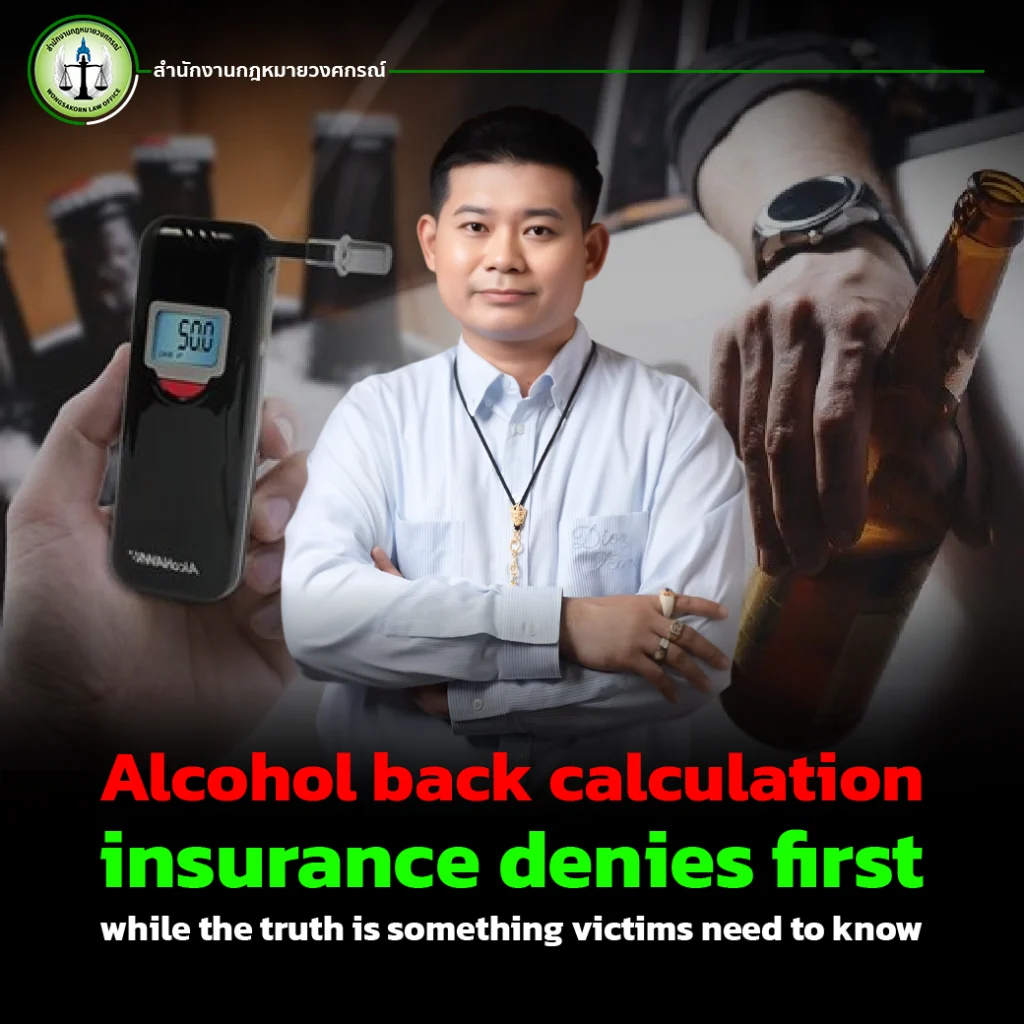
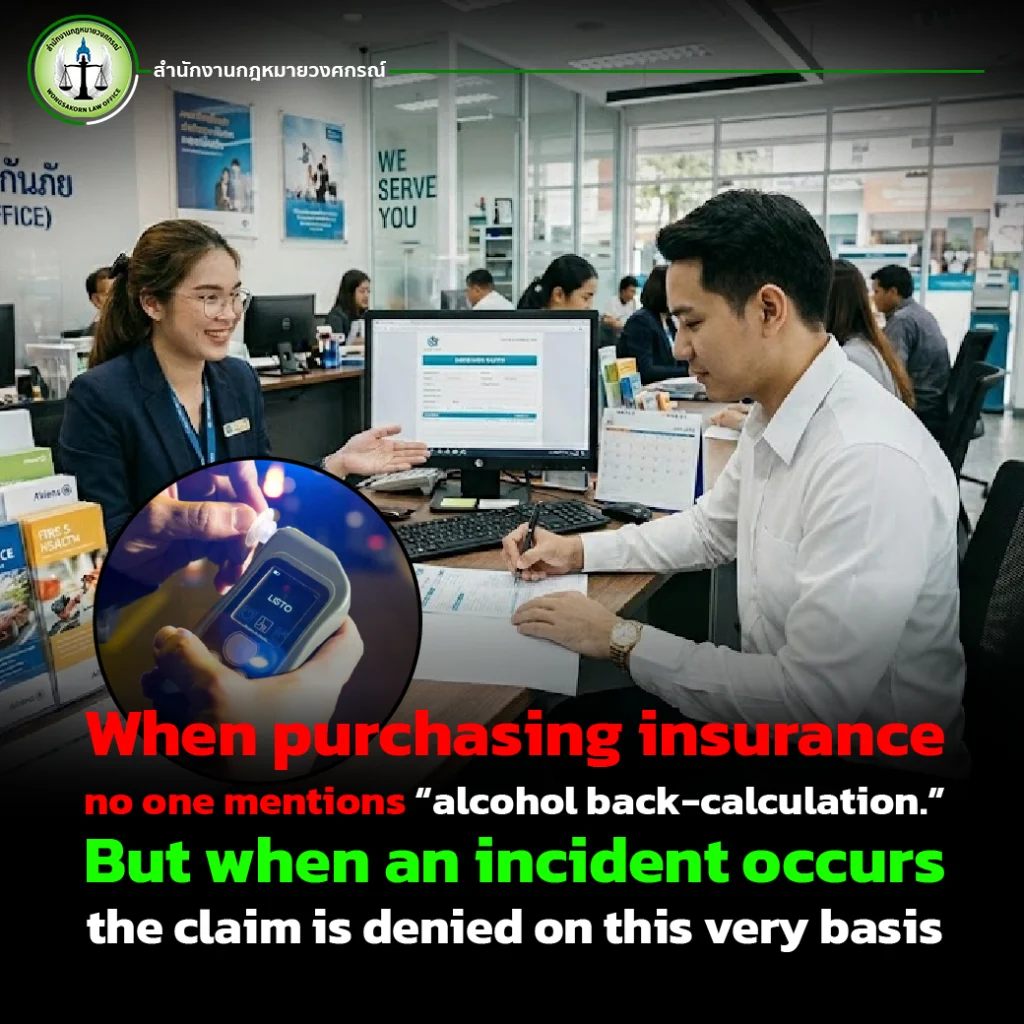
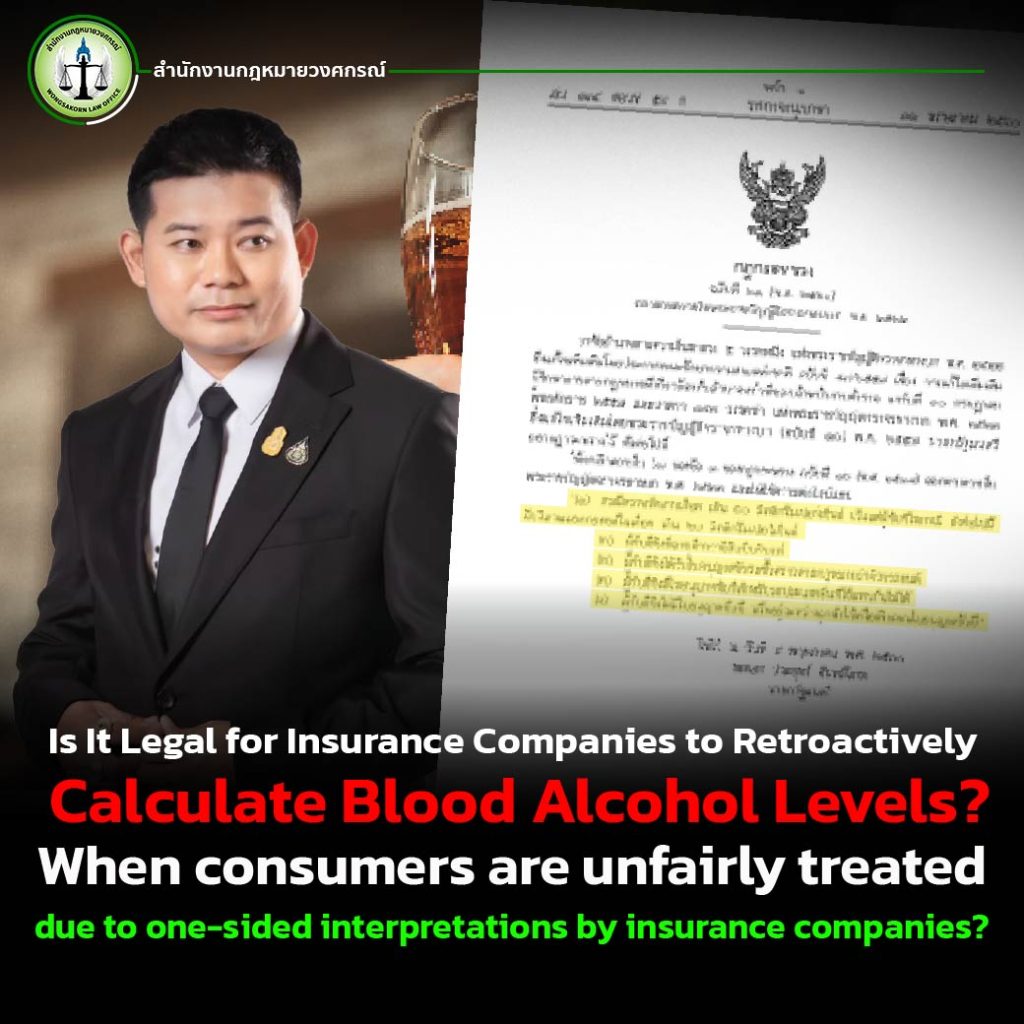
Is It Legal for Insurance Companies to Retroactively Calculate Blood Alcohol Levels? When consumers are unfairly treated due to one-sided interpretations by insurance companies?

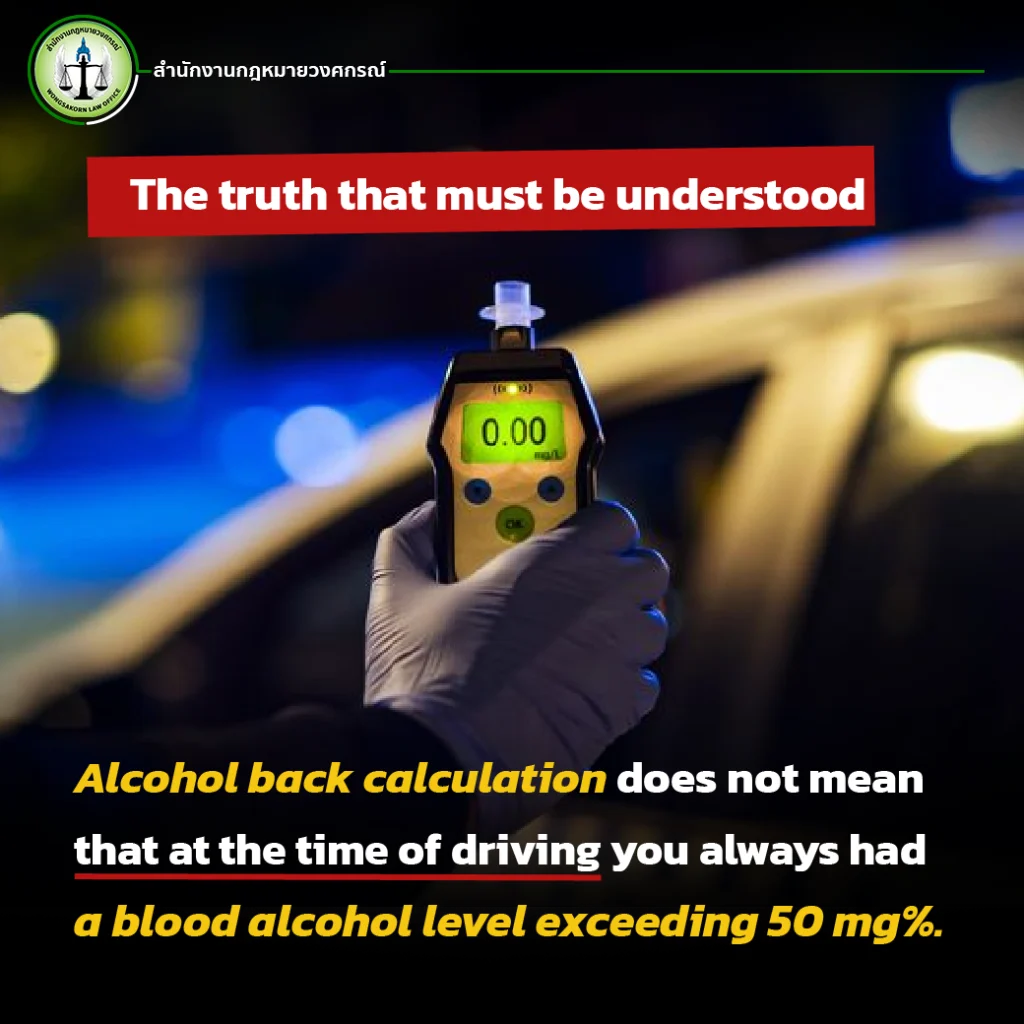
Over the past several years, there have been numerous cases where car insurance companies have denied compensation on the grounds that the driver’s blood alcohol concentration (BAC) exceeded 50 milligrams percent at the time of the accident, the legal limit under the Land Traffic Act B.E. 2522 (1979).

However, what has caused serious unfairness to consumers is that some insurance companies retroactively calculate alcohol levels without relying on the actual test results taken at the time of the incident. Instead, they use internal calculation manuals, assuming that the alcohol level in the blood decreases by 15 milligrams percent per hour, then use this formula to conclude that the insured person must have exceeded the legal limit at the time of the accident.

This practice raises a serious legal and ethical question:

“Do insurance companies have the legal right to retroactively calculate alcohol levels on their own?”

The Law Is Clear: Only the Actual Alcohol Level at the Time of the Accident Matters

According to both insurance policy terms and Section 43(2) of the Land Traffic Act:

“If the driver has a blood alcohol level exceeding 50 milligrams percent at the time of the incident, it is considered a violation of the law.”

Therefore, determining whether the driver exceeded the legal limit must be based on actual test results taken at the time of the accident, or as close to that time as possible not on retroactive estimations or assumptions derived from internal company guidelines.

Hence, when an insurance company unilaterally interprets that retroactive calculation is valid, it violates the insurance contract and potentially exploits consumers, lacking credible scientific evidence.

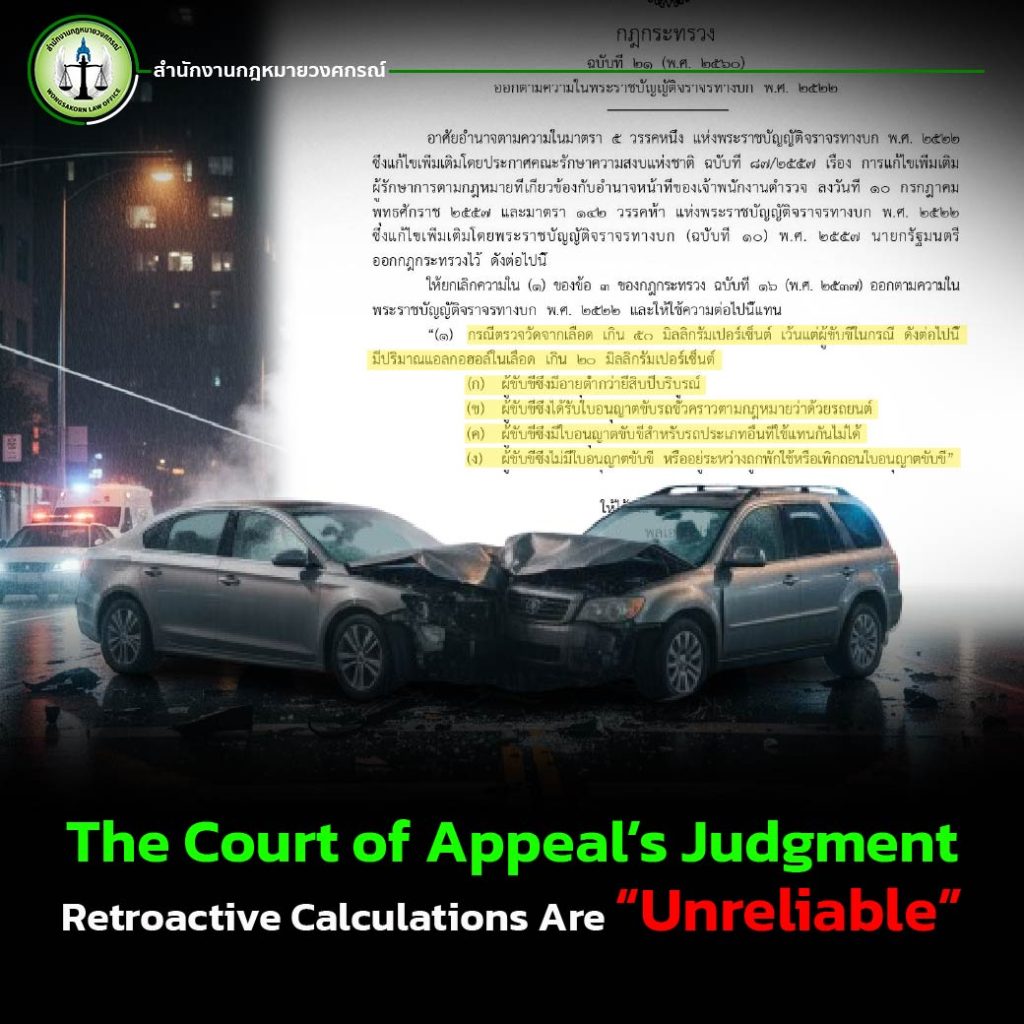
The Court of Appeal’s Judgment: Retroactive Calculations Are “Unreliable”

In one case handled by Wongsakorn Law Office, the Consumer Case Division of the Court of Appeal ruled decisively on this issue.

The Court stated that the insurance company’s reliance solely on its internal policy interpretation manual, which claimed that alcohol decreases by 15 milligrams percent per hour and then retroactively calculated the driver’s BAC to exceed 50 mg%, was weak and unreliable evidence.

The Court held that such retroactive estimation represents a one-sided interpretation by the insurance company and unfairly disadvantages the consumer, violating the principles of fairness in consumer contracts.

Therefore, the Court established a key principle:

“If an insurance company claims the driver exceeded the alcohol limit, it must provide clear, impartial, and credible evidence, not merely internal calculations.”

In other words, without actual medical or police test results taken at the time of the incident, the insurer cannot deny coverage.

The Bigger Problem: Why Doesn’t the OIC Penalize Insurers?

Even though the Court of Appeal has already set a clear legal precedent, in practice, when consumers file complaints with the Office of Insurance Commission (OIC) after being denied compensation due to “retroactive alcohol levels,”
Many cases show that the OIC still sides with the insurers without thoroughly verifying the facts.

Lawyer Arm questioned:

“When the court has already ruled that the insurance company was wrong, why doesn’t the OIC penalize them?”

This highlights a major gap in the regulatory system, allowing insurers to continuously take advantage of consumers even under the oversight of the very agency meant to protect public rights.

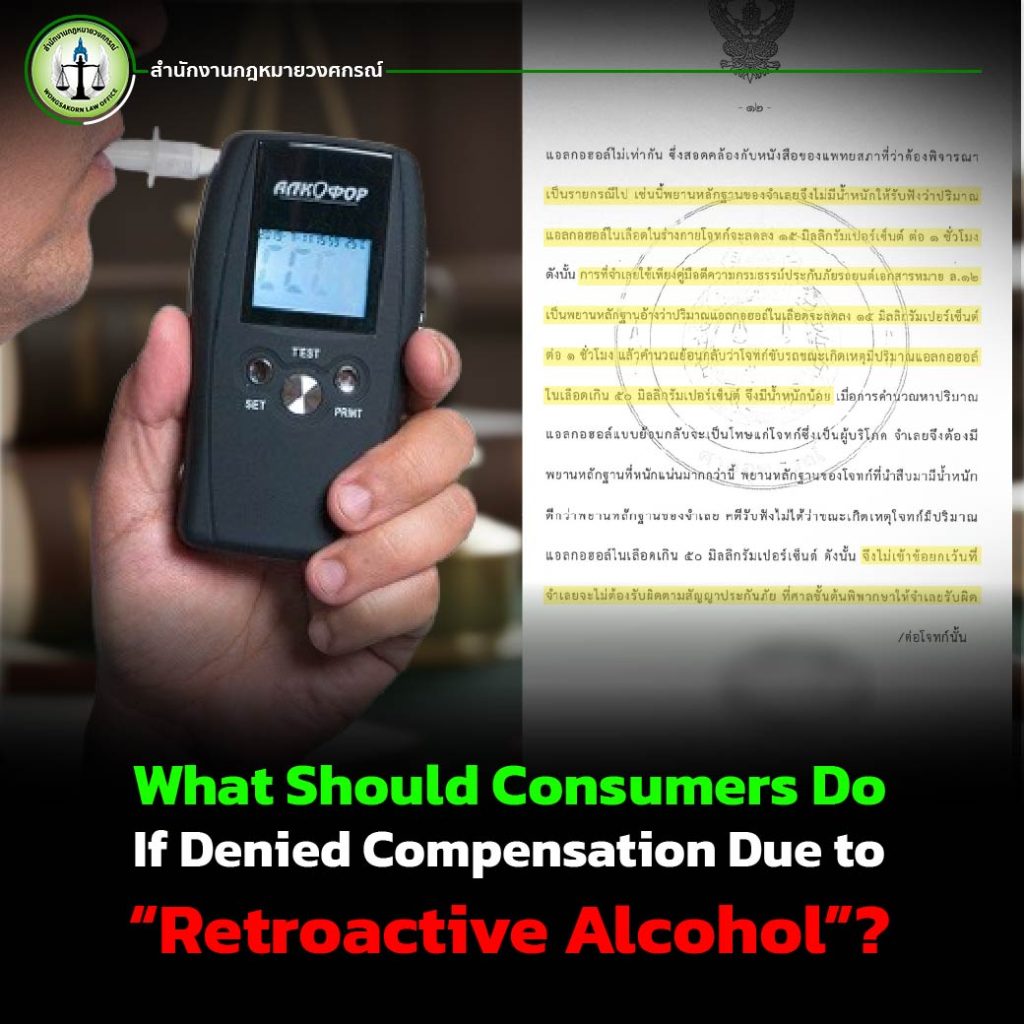
What Should Consumers Do If Denied Compensation Due to “Retroactive Alcohol”?

Do not hesitate to consult a lawyer.
If an insurance company denies your claim on the grounds that you “had alcohol in your system while driving,” consult a lawyer immediately.

Many people mistakenly believe, “If I just explain the truth, they’ll understand,” or “I already have hospital test results; that should be enough.”
In reality, insurance companies have teams of lawyers who know every legal loophole, interpret contracts strategically, and rely on the fact that most consumers are afraid to sue.

Without a lawyer who understands insurance law and strategy, you will never outsmart the insurance company, and you will inevitably be taken advantage of.

Every word in the policy and every number in the alcohol test report can be used as a basis to deny responsibility. Some insurers even use vague terms such as “having alcohol in the blood” without specifying that the level must be measured at the time of the accident, leaving room for manipulative interpretations.

Not Supporting Drunk Driving But Also Not Supporting Corporate Exploitation

Lawyer Arm emphasizes:

“We do not condone driving under the influence of alcohol, but we also do not support insurance companies exploiting the public.”

Retroactively calculating alcohol levels not only breaches the insurance contract but also creates a dangerous precedent for consumer protection in Thailand. It allows insurers to deny compensation under virtually any pretext.Therefore, if you or someone you know has been denied coverage due to “retroactive alcohol,”
Don’t stay silent consult a lawyer experienced in consumer and insurance law to ensure your rights are fully protected.

The insurance company always has a lawyer on their side. What about you — Do you have a lawyer?

If your insurance company denies your claim using “retroactive alcohol” as an excuse, don’t waste time trying to handle it alone because ultimately, the insurer will use the law to their advantage.

Consult an experienced insurance lawyer immediately. A skilled lawyer will strategically structure your case from the beginning, ensuring that your legal rights are preserved.

Retroactive alcohol results are not legally valid evidence.

Insurance companies have no right to use such calculations to deny compensation.
If you’ve been unfairly treated, the law is on your side and having a lawyer by your side is the strongest protection you can have.

📞 For legal consultation: 062-195-1661 or click Contact Us to get immediate assistance.

Does an Insurance Company Have the Right to Choose a Lump-Sum Repair for the Customer’s Car?

The answer is “Yes” But not at the expense of the customer’s rights.

When a car accident happens, many insured drivers feel reassured knowing that their insurance company will handle the repair costs. However, what most policyholders don’t realize is that insurance companies can manage car repairs in several ways. One common practice is “lump-sum repair” or “contracted repair,” where the insurer negotiates a fixed amount with a repair shop. This often leads to dissatisfaction among customers who feel their cars were “not restored to their original condition” or “poorly repaired.”

So, does an insurance company have the right to do this?
Legally, yes, they do but that right must remain within reasonable limits and must not cause harm to the insured party. The goal of repairing the customer’s car should be to restore it to its original condition, not to cut costs for the company’s own benefit.

Understanding “Lump-Sum Repairs” in the Insurance Industry

A “lump-sum repair” means the insurer estimates the total repair cost and agrees on a fixed price with a repair shop or service center often without consulting the customer. For example, if your car sustains 40,000 baht in damages, the company might strike a deal with a garage for that amount, leaving you out of the decision-making process.

While this may sound reasonable from a business perspective  as insurers must control costs in practice, this often leads to cost-cutting repairs rather than quality restoration.

Common problems include:

  • Incomplete or substandard repairs
  • Use of second-hand or non-genuine parts
  • Paintwork that doesn’t match the original
  • Or worst of all recurring issues requiring multiple repair attempts

Even though insurers have the right to choose lump-sum repairs, they do not have the right to infringe upon the customer’s legal rights.

The Customer’s Legal Right: “Restoration to the Original Condition”

Under motor insurance principles, repairs after an accident must restore the vehicle to its pre-accident condition.
 That means your car should be as close as possible to its original state in terms of structure, paint quality, safety, and functionality.

If an insurer’s chosen repair method worsens the car’s condition or reduces its quality, that could amount to a “tortious act.”
 An insurer cannot act in bad faith under the contract to the detriment of the insured.

Legally, even though the insurer is a contracting party, this doesn’t grant them unlimited authority over your vehicle.
Customers are entitled to fair, quality repairs that return their property to its original state. Acting solely for the company’s financial gain is not legally justifiable.

Lawyer Arm’s View: “Yes, They Can  But Not at the Customer’s Expense”

Lawyer Arm explains:

“The insurer may have the right to choose lump-sum repairs, but they have no right to cause the customer further harm.”

The insurer’s right to manage operations is protected by law, but it must be exercised in good faith and responsibility  consistent with Section 420 of the Thai Civil and Commercial Code, which states:

“A person who, willfully or negligently, unlawfully injures another is bound to make compensation.”

If the insurer’s repair decision leads to further damage such as mismatched paint, reduced performance, or new mechanical issues that could constitute a tort.

Moreover, a car is not just a financial asset it directly relates to safety. Poor-quality repairs may not only devalue the car but could cause further accidents, making the insurer liable under civil or even criminal law.

Why Should You Consult a Lawyer from the Start?

When an accident occurs, and your car needs repair, the first thing you should do is ask for clarity upfront:
 Where will the repair take place? How will it be handled? Can you choose your preferred repair center?

If you let the insurer take full control of the repair without reviewing the terms, you might end up with a poorly repaired vehicle  and the struggle to demand compensation afterward can cost you both time and money.

Consulting a lawyer early ensures that you:

  • Understand your rights under your insurance policy
  • Know your options regarding repair types
  • Can take legal action if the insurer breaches its obligations

The Insurer’s Right Exists But It Must Be Fair

Ultimately, insurers do have the right to manage repairs, including using lump-sum arrangements.
However, that right must never override the customer’s right to fair treatment.
The car must be restored as closely as possible to its original state, not just “patched up” to save the insurer money.

If you’ve been in an accident, don’t wait until problems arise to seek legal advice.
Consult a lawyer immediately. It’s the best way to protect your rights and ensure a fair outcome.

WongSakorn Law Office

Our team of experienced insurance and compensation lawyers can help you file and pursue insurance claims properly and effectively ensuring you receive the full amount you deserve and that your car is restored to its original condition without compromise.

Let us “restore your rights” just like restoring your car  properly, and completely.

Should You Claim Compensation from the Insurance Company or the Other Driver After a Car Accident?

A Legal Perspective from Lawyer Arm Knowing Where to Start to Get Fair Compensation

Road accidents can happen anytime, whether you’re driving a short or long distance. The resulting damages go beyond just vehicle repairs or property loss; they also include physical and emotional injuries that victims are legally entitled to claim. However, when it’s time to actually make a claim, many people are unsure: Should I claim from the insurance company or from the other driver directly?

According to Lawyer Arm from Wongsakorn Law Office, who has extensive experience handling car accident compensation cases, claiming from the insurance company is often the more practical choice. It is usually faster, more reliable, and more likely to result in fair compensation.

Who is Responsible for the Damages?

After an accident, the first step is to report the incident to the police to record the details and determine fault. Then, check whether the other party has insurance.

If they do, the insurance company will be responsible for covering the damages within the limits of the insurance policy, such as:

  • Repair costs for your car
  • Medical expenses
  • Lost income during recovery
  • Compensation for serious injury or death
  • Other related damages

In these cases, the insurance company must pay compensation on behalf of the insured driver within the coverage limits.

Can You Claim Directly from the Other Driver?

Legally, yes, you can. The person at fault must pay for all damages caused. If the other driver has no insurance or insufficient coverage, you can sue them directly.

However, in practice, this is rarely easy.
You may face challenges like:

  • The other driver denying fault
  • Inability to contact them or lack of assets to enforce judgment
  • Long court procedures to prove the claim amount
  • Even if you win, you may still not get paid if the driver has no money

So, while claiming directly from the other party is possible, it’s often slow and uncertain.

Why Is Claiming from the Insurance Company Better?

Lawyer Arm emphasizes:

“Claiming from the insurance company isn’t necessarily easier, but it’s more reliable because the company is legally obliged to pay and has the financial capacity to do so.”

Insurance companies, especially large, publicly listed ones have legal obligations and reserve funds to handle claims. While documentation and review steps may take time, victims are more likely to receive proper compensation.

Additionally, dealing with a professional insurance claim department makes negotiation smoother, compared to individuals who might avoid responsibility.

What Should You Do Right After the Accident?

When the accident happens, remember this key step:

“Ask which insurance company the other driver uses.”

This information is crucial for filing a proper claim. Then:

1. Get a police report or official record.

2. Notify the at-fault driver’s insurance company that you intend to claim as a victim.

3. Gather documents: repair receipts, medical certificates, bills, photos, and evidence of loss.

4. Negotiate with the insurer’s claim department.

5. If the insurer denies responsibility, you may pursue legal action with an attorney’s help.

Set a Clear Goal: How Much to Claim and From Whom?

Before making a claim, Attorney Arm advises:

“Be clear about how much you want to claim and who is responsible for paying it.”

This clarity helps you plan properly and avoid confusion. For example:

  • Property damage → claim from voluntary insurance (if applicable)
  • Medical costs → may be claimed from both the insurer and compulsory motor insurance (P.A.)
  • Lost income or extra compensation → may require negotiation or litigation

Evidence and Understanding Are the Keys to Successful Claims

Compensation claims rely on both complete documentation and knowledge of legal procedures. If you’re unsure how to proceed, consult an experienced lawyer in insurance and accident cases to help verify coverage, negotiate with the insurer, or file a lawsuit if needed.

The Keys to Successful Claims Talk to a Lawyer Early

“Don’t rush to blame anyone after an accident. First, identify who’s responsible for paying and the best way to claim fair compensation.”

Claiming from the insurance company might take time and paperwork, but it’s the safest and most reliable way to receive compensation. Insurance companies are legally required to pay and have the resources to do so.

Important: Always ask, “Which insurance company is the other driver insured with?” it might be the key to receiving full and timely compensation.

Wongsakorn Law Office provides expert legal services for insurance and accident claims, handled by experienced attorneys who specialize in compensation law.

 Consult our legal team today. Click [Contact Us]

Claiming Compensation for Car Accident Injuries: Don’t Be Misled by “Get Well First”

When a road accident occurs, victims often suffer both physical and emotional pain. The most important thing is to receive fair and timely compensation. However, many insurance companies use delaying tactics, often saying, “Get well first, then make your claim.” In reality, this can cause victims to lose their right to claim full compensation.

Insurance Tactic: “Get Well First”

At first glance, this advice may sound reasonable since victims naturally want to recover. But legally, waiting until full recovery can weaken the case because:

  • Evidence of injuries fades over time.
  • In court, insurers often argue:
    • The victim has already recovered.
    • There is no ongoing damage.
    • No need to pay the claimed compensation.

Thus, “get well first” is not just about delaying it’s a legal strategy to weaken the victim’s claim.

Case Study: Father’s Advice from Taiwan “You should consult a lawyer here.”

In one real case, a passenger injured in a van accident was told by the insurance company: “Recover first, then claim.”
Initially, the vehicle owner promised to help but soon withdrew support, leaving the victim anxious and helpless. Fortunately, her father, working in Taiwan and following Lawyer Arm’s YouTube channel, insisted: “If you hear this phrase, contact Lawyer Arm immediately.” This changed everything the victim sought proper legal counsel.

Why Consult a Lawyer Immediately?

Claiming compensation is not just paperwork, it’s a legal battle against insurance companies backed by professional lawyers. Without legal support, victims are at a huge disadvantage. Lawyers can:

  • Assess damages (medical bills, lost income, future costs).
  • Prepare legally valid medical and legal documents.
  • Represent victims effectively in court.
  • Prevent insurers from delaying or denying compensation.

Attorney Arm emphasizes: Insurance companies already have lawyers before an accident even happens, but victims often have none.

The Pitfalls of “Get Well First”

Victims who follow this advice often find:

  • Insurers argue recovery means no claim.
  • Compensation is reduced or denied.
  • Crucial evidence (medical certificates, injury photos, receipts) is lost.

The law allows victims to claim both present and future damages. Waiting only weakens the claim.

The Danger of Wrong Advice from “Fake Lawyers”

Victims often receive misleading advice from so-called “know-it-alls” or “People who don’t know the truth” neighbors or acquaintances without legal training. For example:
“If you claim it once, you can’t claim it again.”
This is legally incorrect. Courts allow victims to claim for future damages and even add claims later if necessary.

Insurance Company Have “Lawyers,” Victims Only Have “People who don’t know the truth”

Insurance companies have legal teams from the start. Victims, however, often rely on unqualified advice, making them vulnerable. One common tactic:
“Recover first, then claim.”
Later in court, insurers counter with: “You’re already recovered, so you can’t claim more.”

Only Real Lawyers Can Protect Your Rights

Being a lawyer requires years of study and licensing. “People who don’t know the truth” only pretend to know and mislead victims. Believing them risks losing your legal rights.

  • Don’t rely on unqualified advice.
  • Consult an experienced lawyer immediately after an accident.
  • Don’t let insurers delay or trick you with “get well first.”

Claiming compensation after a car accident is not a minor issue. Insurance companies protect their interests with legal teams. Victims need real lawyers too. Acting fast ensures fair compensation and justice.

Don’t let the words of the insurance company take away your rights to consult a lawyer from the very day the accident happens.

In the event of a car accident, no matter how serious or minor your injuries are, do not wait until you have fully recovered before making a claim. Doing so may put you at a disadvantage in court and cause you to lose your right to claim compensation. From the moment the accident occurs, you should collect evidence, contact a lawyer, and proceed with your claim according to your legal rights.

If you or your loved one has been in a car accident and hears the phrase “Get well first before claiming” from the insurance company, do not believe it. Immediately seek advice from a professional lawyer. The legal team at Wongsakorn Law Office, led by Lawyer Arm, is ready to consult with you and stand by your side, ensuring that you receive justice and the full compensation you deserve.

Line @ คลิก! โทรหาเรา คลิก!