“Yut Fedfe Boyband” or “Yut Chaisoro” appoints Lawyer Arm Supasit Siri as Legal Consultant. 

Lawyer Arm Supasit Siri of Wongsakorn Law Firm has been entrusted by famous YouTuber and creator “Yut Fedfe Boyband” (also known as Yut Chaisoro) with his official appointment as legal counsel. In this role, Lawyer Arm Supasit will provide legal advice and manage various legal matters for Mr. Yut. Earning this trust marks another point of immense pride for Wongsakorn Law Firm. 

Serving as legal counsel is not limited to litigating disputes after problems arise; it also encompasses providing strategic advice and assessing legal risks prior to decision-making. This is especially vital for digital media professionals who routinely navigate content publishing, copyright usage of images, audio, and video, contract drafting, and potential legal disputes stemming from daily operations. Having a dedicated legal consultant enables creators to structure their operations with far greater prudence and foresight.
For Lawyer Arm Supasit Siri, earning the trust of “Yut Fedfe Boyband” (Yut Chaisoro) represents a significant opportunity to leverage his legal knowledge and experience in delivering tailored advice suitable for content creators and public figures. Wongsakorn Law Firm stands ready to provide guidance across all legal matters with meticulous care, prudence, and an unwavering commitment to prioritizing the client’s best interests. 

Wongsakorn Law Firm, led by Lawyer Arm Supasit Siri, extends its sincere gratitude to “Yut Fedfe Boyband” (Yut Chaisoro) for placing his trust in the firm as his official legal counsel. Lawyer Arm Supasit is fully dedicated to delivering top-tier legal advice and ensuring comprehensive legal oversight at every step going forward. 

Pol. Lt. Gen. Dr. Thaweesilp Wechvitarn, former Physician-in-Chief of the Police General Hospital, has trusted and appointed Lawyer Arm Supasit Siri as his legal advisor and attorney. 

On August 17, 2026, Pol. Lt. Gen. Dr. Thaweesilp Wechvitarn, former Physician-in-Chief of Police General Hospital, visited Wongsakorn Law Office to discuss and consult on related legal issues and litigation matters. On this occasion, he officially appointed Lawyer Arm (Supasit Siri) as his legal advisor and attorney to provide counsel and handle all legal proceedings related to his cases.

Wongsakorn Law Firm, represented by Lawyer Arm (Supasit Siri), is deeply honored and grateful for the trust placed in us by Pol. Lt. Gen. Dr. Thaweesilp  to serve as his legal advisor and attorney. Earning the trust of a distinguished professional with extensive experience and expertise is a source of immense pride for our firm and serves as a vital driving force for our team to consistently maintain the highest standards of legal services.
On this occasion, Lawyer Arm (Supasit Siri) expresses his heartfelt gratitude for the trust placed in Wongsakorn Law Firm and stands fully committed to executing his duties as legal advisor and attorney to the absolute best of his ability. He will proceed with utmost prudence, accountability, and professional integrity to ensure that all legal actions are carried out appropriately and yield the maximum benefit for the client. 

What to Do When Leaked Videos Lead to Blackmail: When Love Becomes a Tool for Extortion

During a romantic relationship, taking intimate photos or recording private videos may occur with the mutual consent of both partners. Most people never imagine that these recordings could one day become a source of trouble, as they believe their relationship will continue harmoniously.

However, in reality, relationships can change at any time. When a breakup, conflict, or resentment arises, those intimate images and videos may be turned into tools for intimidation and coercion. This often leads to leaked intimate  image video  leaks and blackmail, causing devastating consequences for victims, including damage to their reputation, career, psychological well-being, and financial security.

“Based on real case experiences, victims have been subjected to extortion demands for substantial sums of money.”

Attorney Suppasit Siri (Lawyer Arm) from Wongsakorn Law Firm revealed that a substantial number of victims have sought legal consultation after being blackmailed by ex-partners. The perpetrators threatened to release explicit 18+ videos or private intimate images unless monetary transfers were made.

Based on legal litigation experience, while the majority of victims are women, male victims have also fallen prey to these schemes. The modus operandi remains largely consistent: perpetrators weaponize private media to extort money or force victims into reconciliation.

In numerous cases, extortion demands ranged from tens of thousands to hundreds of thousands of baht. Alarmingly, even after victims complied and transferred the funds, the blackmail rarely ceased, often resulting in continuous, escalating demands for more money.

Why Do Leaked Private Videos So Often Lead to Blackmail? 

Perpetrators typically operate under the assumption that victims will not dare to speak out, constrained by the fear of losing their reputation, family discovery, or adverse consequences on their education and career.

This fear directly becomes a leverage point, allowing perpetrators to press and manipulate victims with greater ease.

Therefore, it is paramount that victims remain calm and composed, refusing to let fear dictate decisions that require sound, rational judgment.

How to Respond When Threatened with Private Video Leaks and Extortion

The primary task is to maintain composure and rationality
Subsequently, victims should systematically gather and preserve all relevant evidence, including chat transcripts, user profiles, contact handles, and any other data associated with the extortion. Evidence collection must be comprehensive and methodical to support subsequent legal proceedings.

Attorney Suppasit highlighted that every case possesses unique circumstances. Seeking timely legal counsel from the outset enables victims to fully understand their rights and formulate an appropriate, fact-based action plan in coordination with law enforcement officers.
Do not believe that “once a private video is leaked, life goes into destruction”.
Many victims feel overwhelmed by despair upon discovering that their private images or videos have been circulated online.

However, non-consensual dissemination of private media carries severe legal consequences. Victims retain full legal rights to protect their dignity and interests, including invoking established protocols and legal frameworks to request the removal or deletion of such content from digital platforms.

Crucially, victims should never face this crisis alone; seeking support and intervention is essential.

The most effective preventive policy is none other than avoiding risk at its source. 

While no one can predict the long-term trajectory of a relationship, refraining from recording sensitive imagery remains the most effective measure to mitigate potential risks.

Once information is generated in a digital format, it is perpetually vulnerable to being duplicated, forwarded, or accessed by third parties.

Ultimately, proactive prevention is far superior to attempting damage control after the harm has occurred.

Consult a lawyer prior to reporting; far-sighted strategic planning is always the key to victory.

Intimate image video  leaks and blackmail are no longer distant threats; they can affect individuals of any gender or age.
If you find yourself a victim, do not let fear force you to confront this crisis alone. Promptly seek professional legal counsel to strategize, build your case, and pursue appropriate action. Doing so is critical to protecting your rights, mitigating damage, and maximizing your coverage under the law.
Consult with a legal expert, click >>Contact Us<<

Leaked Intimate Video? Being Blackmailed by an Ex-Partner? Don’t Rush to File a Police Report Yet! Lawyer Arm Shares Real Case Experience and Explains the Crucial Steps to Take Before It’s Too Late. 

In an era where smartphones can capture every moment of our lives with a single tap, cases involving leaked intimate videos and blackmail using private photos or videos have become increasingly common. Such cases are particularly prevalent among students, university students, and working adults in romantic relationships. Many individuals trust their partners enough to allow intimate photos or videos to be taken. However, when the relationship ends, what was once a private memory can become a tool for extortion, financial blackmail, or coercion to resume the relationship.

Drawing on extensive experience handling such cases, Lawyer Arm Supasit Siri of Wongsakorn Law Firm has found that these incidents often cause devastating harm to victims, affecting not only their mental well-being but also their reputation, education, career, and family life. By sharing the following case as a cautionary example, he hopes to raise public awareness and help others avoid becoming victims of similar situations.

While in love, everything may seem ordinary. Yet once the relationship comes to an end, that is often when the real problems begin.

Lawyer Arm Supasit Siri explained that many of the cases he has handled begin in almost exactly the same way. While the couple is still in a relationship, both parties trust one another and willingly take or record intimate photos or videos, believing that such content will never become a problem.

However, once the relationship ends, some individuals turn those private images or videos into tools of blackmail, using them to threaten the other party, demand money, or coerce them into resuming the relationship. Such conduct is not only unethical but may also constitute multiple criminal offenses under the law.

What is particularly concerning is that many victims blame themselves for what happened. In reality, the person who uses, threatens to disclose, or distributes another person’s private images or videos without consent is the one who may be held legally responsible.

The Case of a 19-Year-Old: The Investigation Began with an X Account and Ultimately Led to an Arrest Warrant.
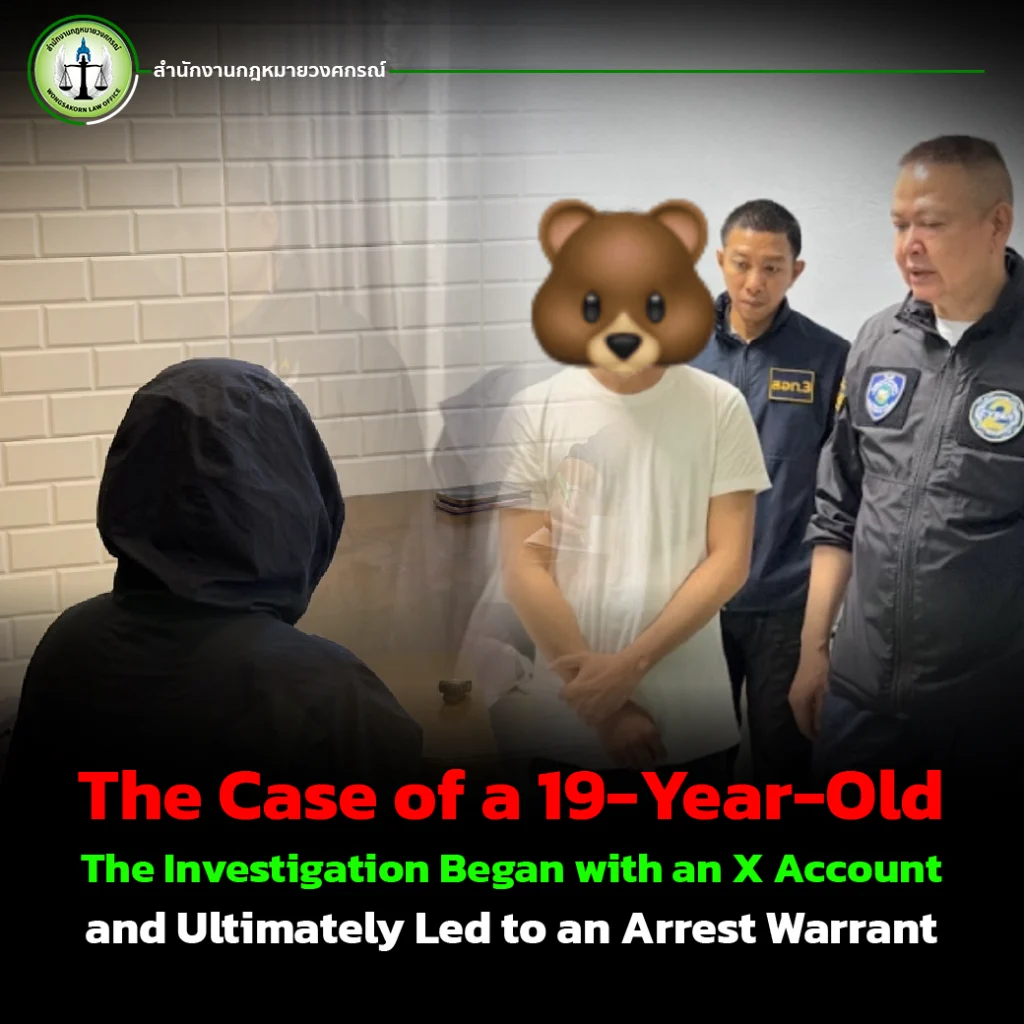
One of the cases handled by Lawyer Arm Supasit Siri involved a 19-year-old female university student whose former boyfriend unlawfully distributed her intimate video online without her consent.

The investigation began after the video was discovered on an X account (formerly Twitter). Investigators then traced the account to associated Instagram profiles and other online platforms, connecting relevant digital evidence until the individuals involved could be identified.

Following the collection of evidence and close coordination with the police, the case ultimately resulted in the issuance of an arrest warrant for the suspect. Authorities are currently continuing their investigation to locate two additional individuals believed to be connected to the case.

This case demonstrates that many people mistakenly believe they can remain anonymous when posting content online. In reality, when digital evidence is properly collected and analyzed, law enforcement authorities are often able to trace online activities and pursue legal action against those responsible.
A Leaked Intimate Video Is Not the End of Your Life.
According to Lawyer Arm Supasit Siri, his greatest concern is not merely whether legal proceedings can be pursued, but the emotional and psychological well-being of the victims.

There have been several heartbreaking cases in which young people, overwhelmed by threats from former partners to release their intimate photos or videos, experienced severe emotional distress and ultimately resorted to harming themselves.

Such tragedies should never happen.

If you are being threatened with the release of an intimate video or private images, remember this: you are not alone, and you still have legal avenues available to protect your rights.

Remaining calm, seeking legal advice from a qualified lawyer, and developing an appropriate legal strategy are far more effective than making impulsive decisions driven by fear or panic. Doing so can help safeguard your rights and prevent further harm.

Why Does Lawyer Arm Advise, “Don’t Rush to File a Police Report Yet”? 
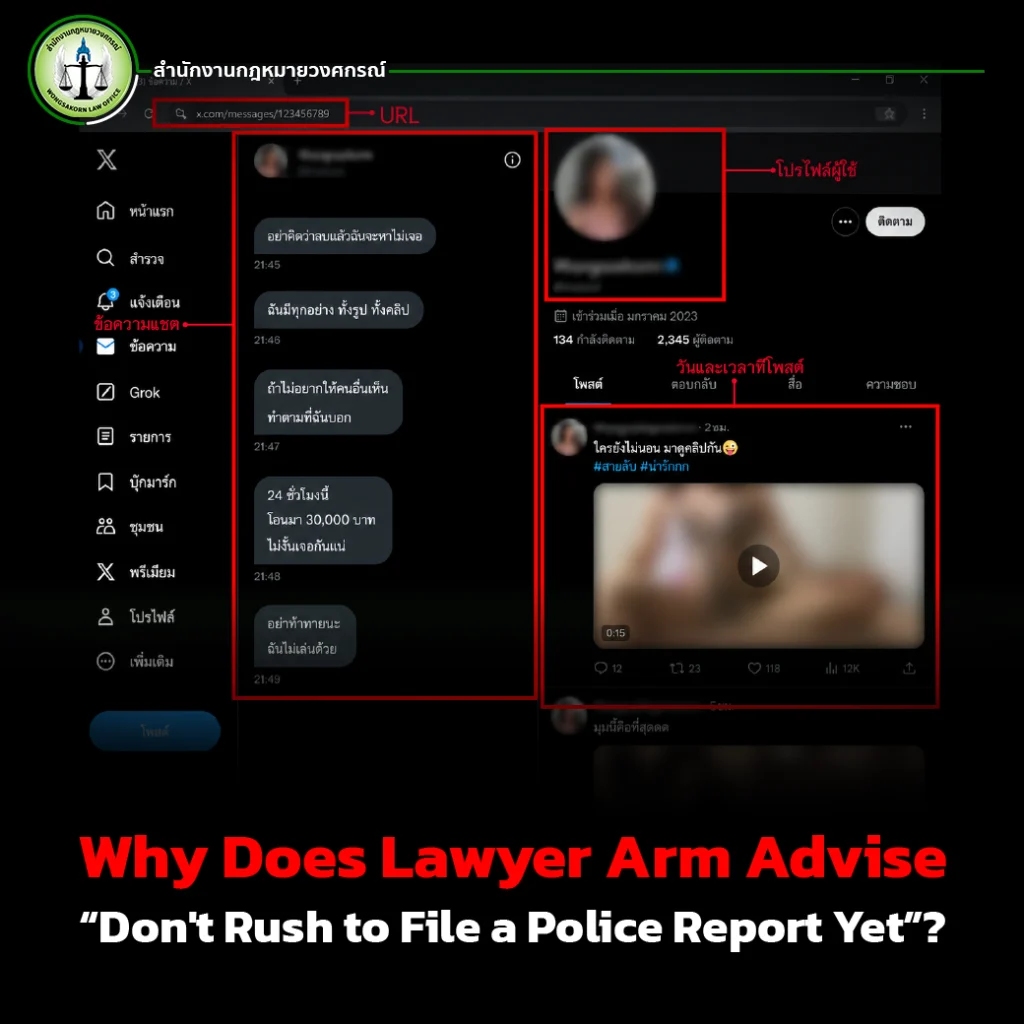
Many people may wonder, if someone is being blackmailed, why shouldn’t they report the matter to the police immediately?

According to Lawyer Arm Supasit Siri, this advice does not mean that victims should refrain from reporting the crime. Rather, it means they should avoid taking legal action before developing an appropriate strategy.
In many cases, victims report the incident immediately out of fear or panic without first preserving essential digital evidence, such as:

  • Chat conversations
  • Links to the published content
  • Website URLs
  • The date and time the content was posted
  • Proper screenshots
  • Evidence of threats or blackmail
  • Relevant user accounts or online profiles

Without adequate preparation, the perpetrator may become aware of the investigation, delete crucial evidence, or accelerate the public distribution of the intimate video, making it significantly more difficult for investigators to trace and preserve the digital evidence.

For this reason, consulting a lawyer and developing a legal strategy before filing a police report can help ensure that evidence is collected systematically and that the case is handled in a careful and effective manner.

The Cooperation of Law Enforcement Authorities Is Crucial.

In one case handled in Sakon Nakhon Province, Lawyer Arm Supasit Siri expressed his sincere appreciation to the investigating officers of the Mueang Sakon Nakhon Police Station for their professionalism and close cooperation throughout the legal process.

Effective collaboration among the victim, legal counsel, and law enforcement authorities was instrumental in identifying the suspect, securing the necessary evidence, and ultimately obtaining an arrest warrant.

Cases involving leaked intimate videos and blackmail should not be viewed as battles that victims must face alone. With proper planning and effective coordination between lawyers and the police, the legal process can be carried out far more efficiently and effectively.

A Lesson for Everyone: Never Underestimate the Importance of Digital Privacy

Above all, never underestimate the importance of protecting your personal information in the digital age. Even if two people are deeply in love today, no one can guarantee what the future may hold.

Whenever possible, avoid creating or storing intimate photos or videos that could cause harm if disclosed in the future. Once such content exists in digital form, it can be copied, shared, or distributed at any time, and the consequences may be difficult—or even impossible—to fully reverse.

What Should You Do If You Are Threatened with the Release of an Intimate Video?
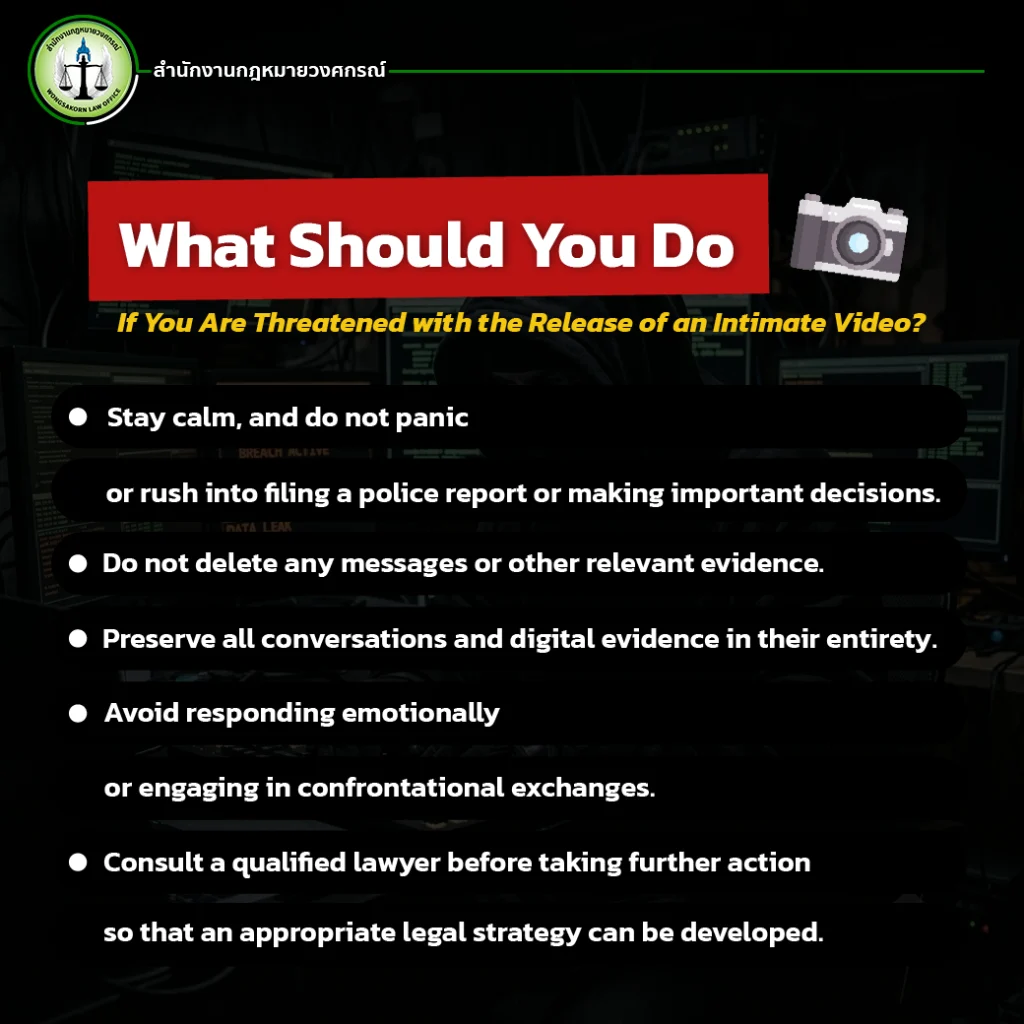
If your former partner or any other person is using your private photos or intimate videos to blackmail you, we recommend taking the following steps:

  • Stay calm, and do not panic or rush into filing a police report or making important decisions.
  • Do not delete any messages or other relevant evidence.
  • Preserve all conversations and digital evidence in their entirety.
  • Avoid responding emotionally or engaging in confrontational exchanges.
  • Consult a qualified lawyer before taking further action so that an appropriate legal strategy can be developed.

Wongsakorn Law Firm has extensive experience assisting victims in cases involving leaked intimate videos, blackmail, and other offenses related to the unauthorized online dissemination of personal information.

If you or someone close to you is facing a similar situation, you are welcome to contact Lawyer Arm Supasit Siri through our “Contact Us” page for legal advice. We will work with you to develop a carefully planned legal strategy aimed at minimizing harm and protecting your legal rights to the fullest extent possible.
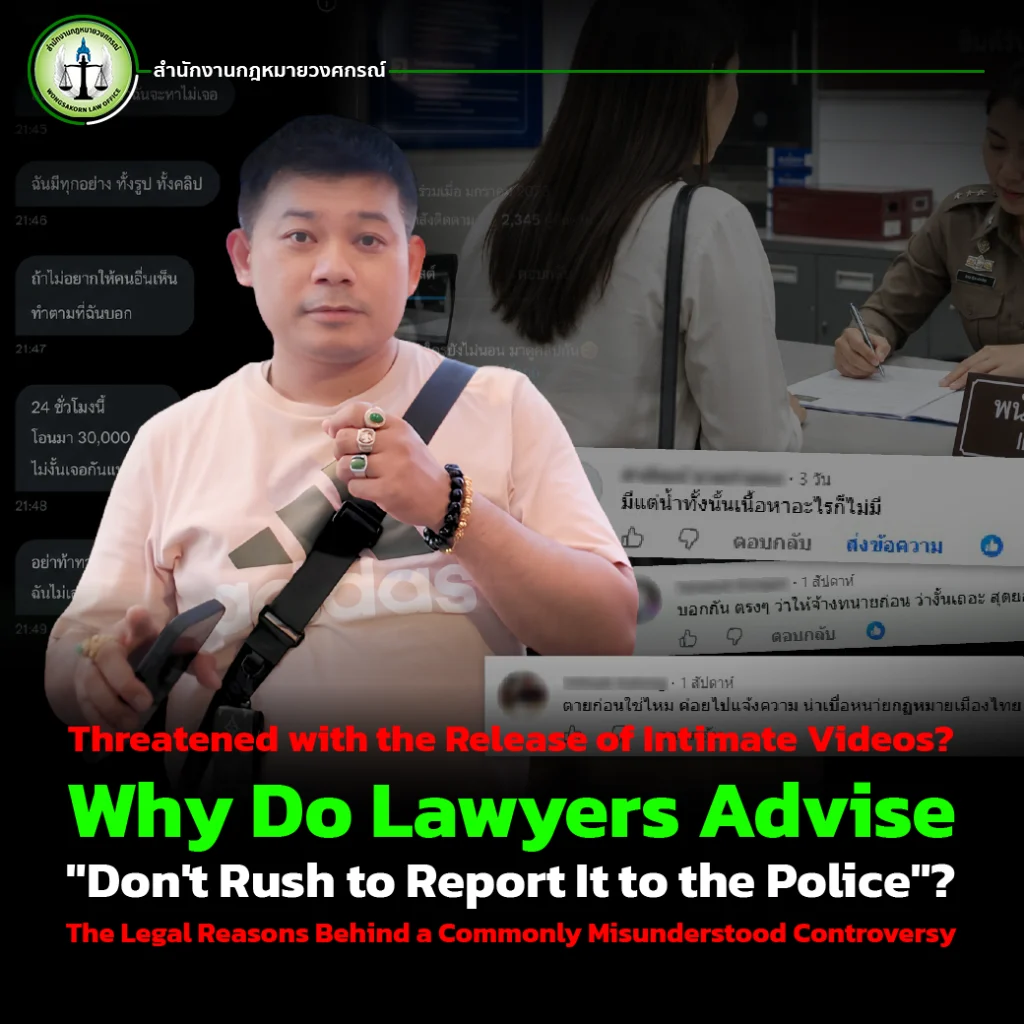
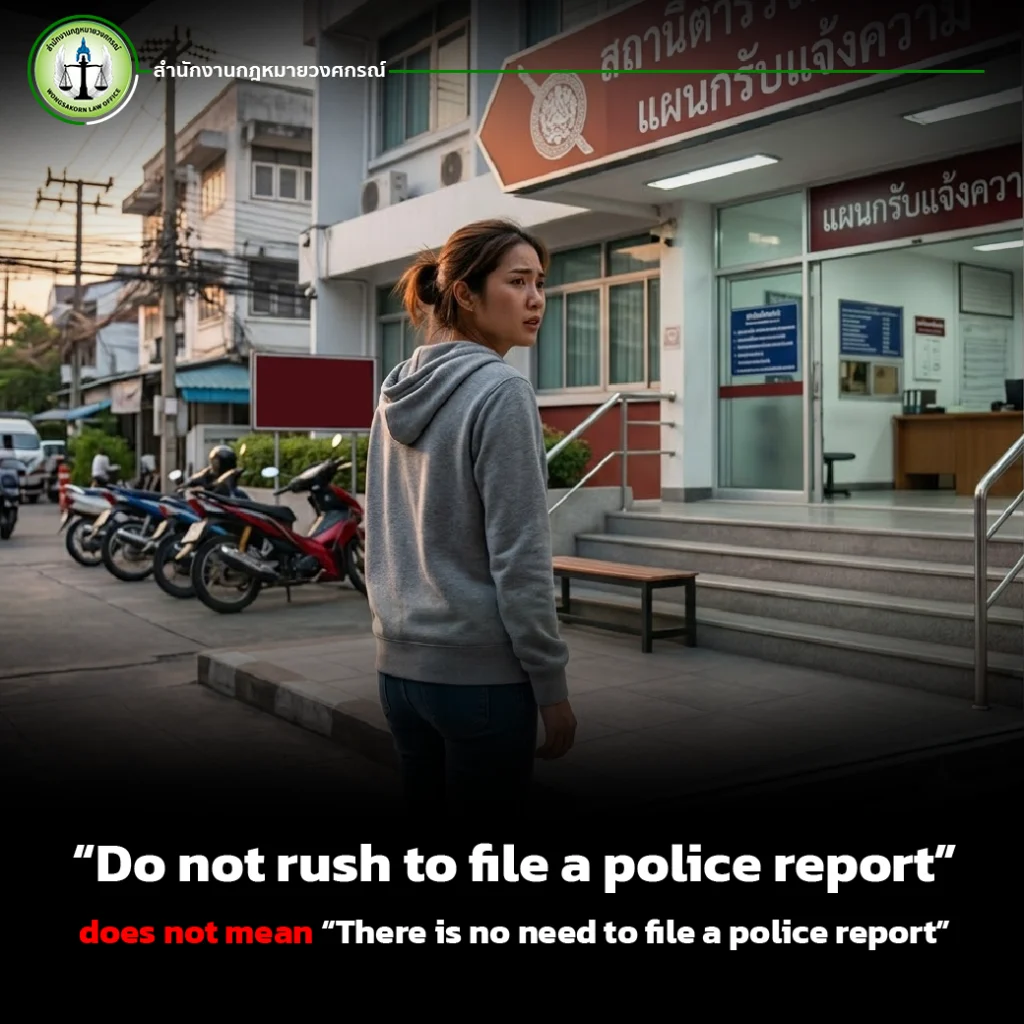
Threatened with the Release of Intimate Videos? Why Do Lawyers Advise, “Don’t Rush to Report It to the Police”? The Legal Reasons Behind a Commonly Misunderstood Controversy 

Recently, Wongsakorn Law Firm released an educational video providing legal guidance on cases in which victims are threatened with the disclosure of intimate videos or private photographs taken during a romantic relationship. In the video, Lawyer Arm Supasit Siri advised that:
“Do not rush to file a police report. Consult a lawyer first.”
However, after the video was released, it sparked widespread discussion in the comment section of Wongsakorn Law Firm’s Facebook page. While some viewers understood the message the video intended to convey, many others raised questions, including:

  • “I watched the entire video, but it did not provide any substantial information. It simply advised viewers not to rush to file a police report without explaining the reason.” 
  • What message is this video actually trying to convey?” 
  • “If victims are not supposed to file a police report immediately, what should they do instead? Why wasn’t this explained?” 

These comments indicate that many people may have interpreted the advice, “Do not rush to file a police report,” differently from its intended meaning.
In this article, Lawyer Arm Supasit provides a clear explanation of why lawyers make such a recommendation and why careful legal planning before initiating legal proceedings is essential, particularly in cases involving the disclosure of intimate videos and online threats.

‘Do not rush to file a police report’ does not mean ‘There is no need to file a police report.’

A key misunderstanding stems from interpreting only part of the statement.
What Lawyer Arm intended to communicate is as follows:
Instead, it means that:

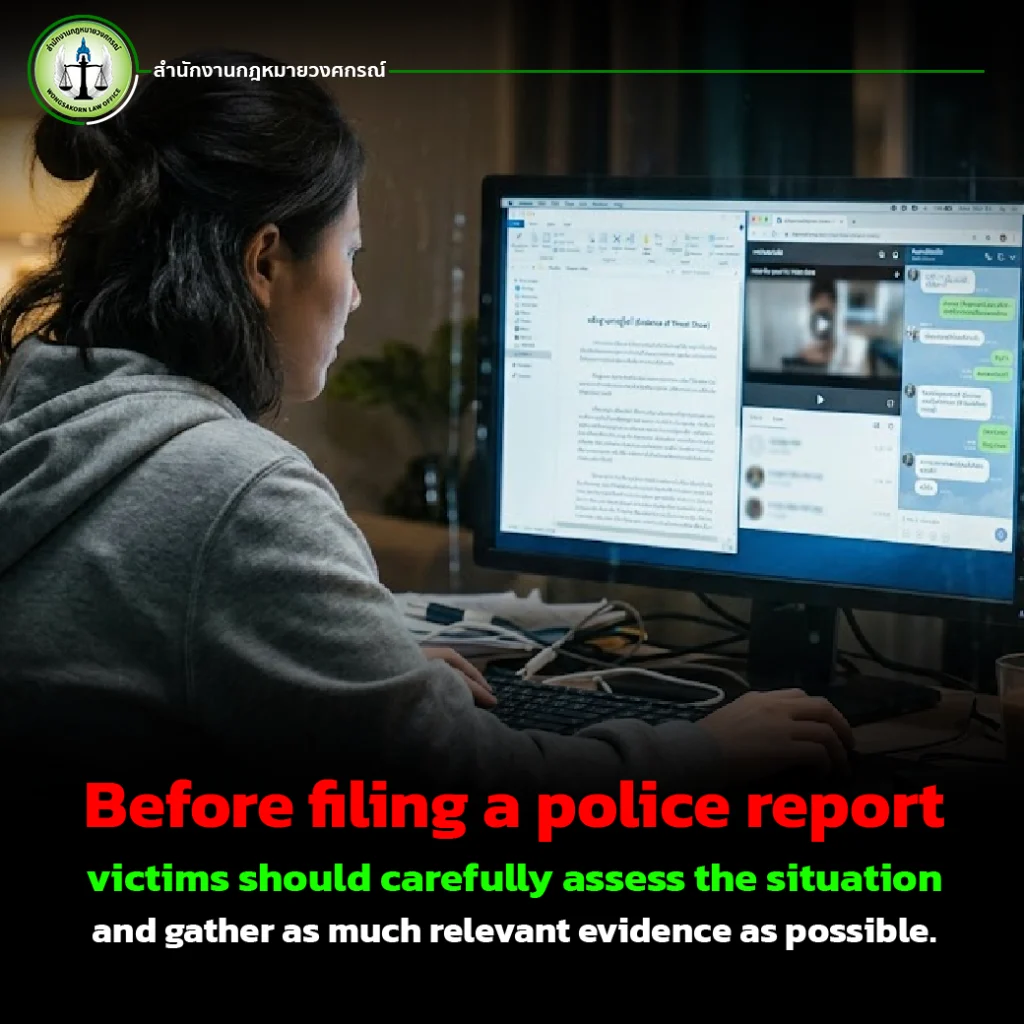
Before filing a police report, victims should carefully assess the situation and gather as much relevant evidence as possible. 

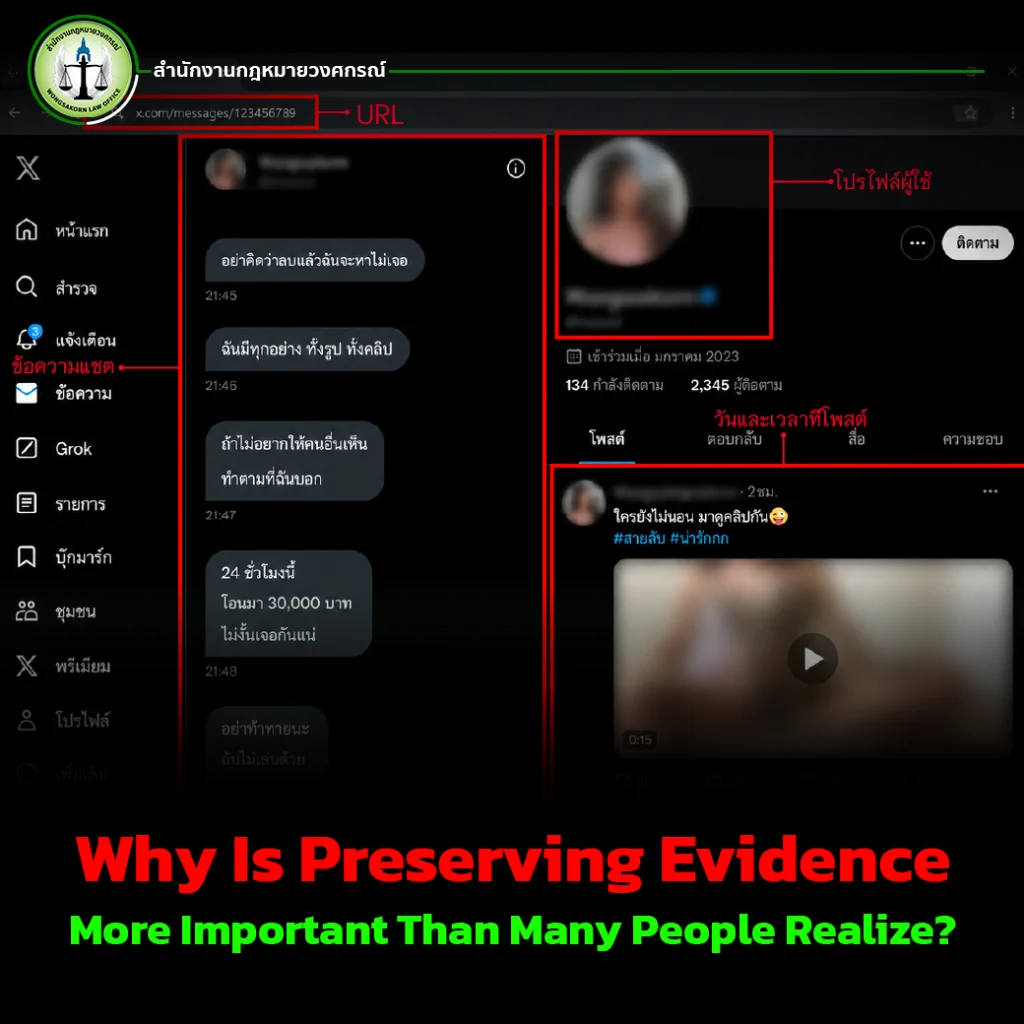
This is because, in cases involving the disclosure of intimate videos or blackmail, much of the key evidence exists in digital form, such as:

  • Chat messages
  • URLs
  • User profiles
  • Social media accounts
  • Dates and times of posts
  • Money transfer records
  • Screenshots
  • Data stored in cloud services or electronic devices

Some of this digital evidence may be deleted, altered, or become unavailable within a very short period of time.

Why Is Preserving Evidence More Important Than Many People Realize?

In cases involving the disclosure of intimate videos, many victims react with shock and immediately take action as soon as they discover that their videos have been shared.

However, in many cases, acting too quickly before properly preserving the available evidence may result in the loss of critical information, such as:

  • The uploader deleting the video;
  • The user account being deactivated or removed;
  • Messages being deleted;
  • Links becoming inaccessible;
  • Digital evidence being lost.

Once such information is lost, it may become significantly more difficult to establish the facts of the case at a later stage.

For this reason, lawyers often advise victims to first assess the situation and preserve evidence in a systematic manner before taking legal action. The appropriate course of action, however, will always depend on the specific facts and circumstances of each case.

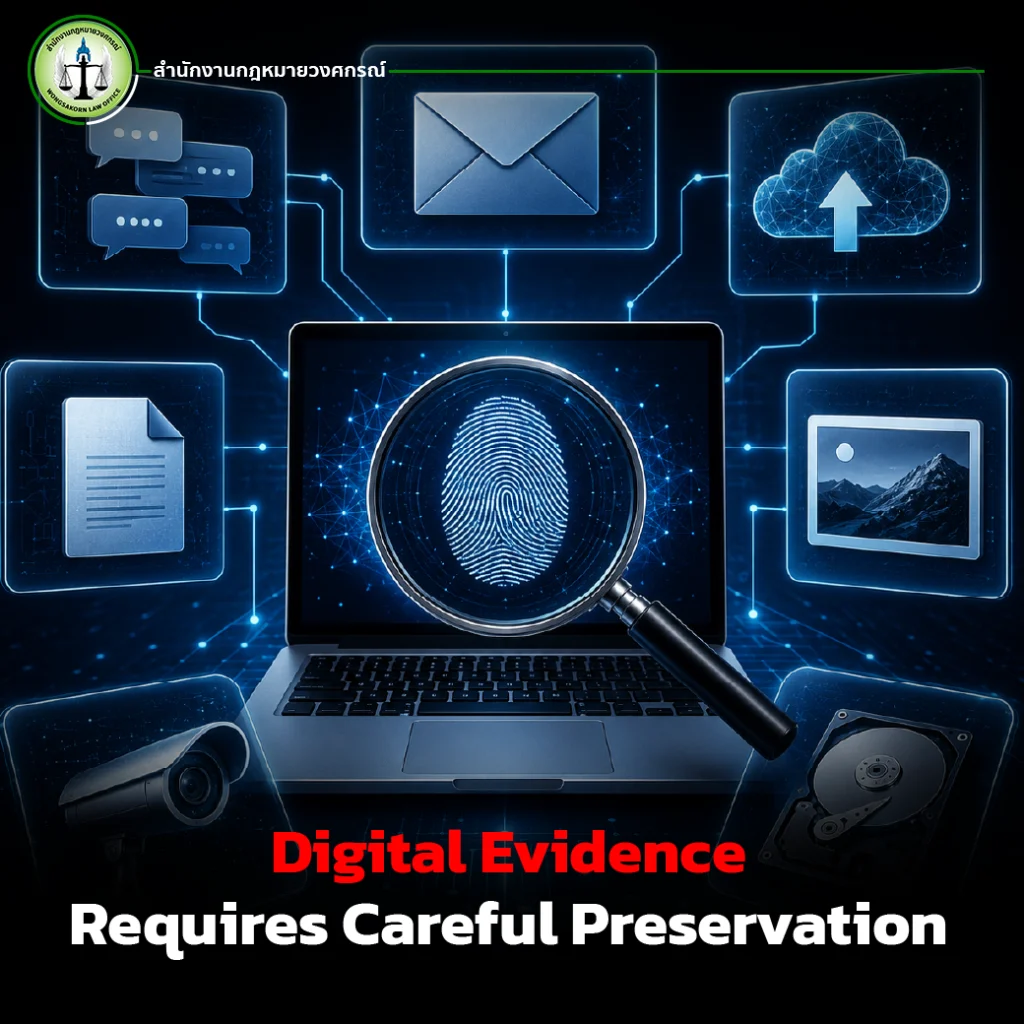
Digital Evidence Requires Careful Preservation

Lawyer Arm Supasit explained that preserving electronic evidence involves much more than simply taking screenshots. It should be carried out carefully to ensure that details which may be crucial to establishing the facts of the case are properly preserved.

In certain types of cases, collecting and preserving evidence thoroughly from the outset can help improve the effectiveness of legal proceedings while reducing the risk of losing critical information.
The Controversy Also Highlights Communication Challenges in the Online Environment

Another noteworthy point is that many comments suggest some viewers may have formed conclusions after watching only part of the video rather than considering its full context.

In the online environment, information is often consumed very quickly, making misunderstandings more likely—particularly when legal issues are involved, as they require context and careful explanation.

Taking the time to read or watch the complete content before expressing an opinion can help reduce misunderstandings and encourage more constructive and informed public discussion.
Does Consulting a Lawyer Require Payment?

Another common question raised by the public is:

“Is there a fee for consulting a lawyer?”

The answer is that the service models and fee structures vary from one law firm to another.

However, obtaining legal advice at an early stage can help victims better understand their legal rights, plan an appropriate legal strategy, and reduce the risk of further harm or complications later on.

In cases involving the disclosure of intimate videos or threats made to extort money, the consequences often extend far beyond reputational damage. Such incidents may also affect a victim’s education, employment, personal relationships, and psychological well-being.

What Should You Do If You Are Threatened With the Release of an Intimate Video?

If you find yourself in such a situation, the following steps are recommended:

  • Stay calm and avoid responding emotionally.
  • Preserve all relevant evidence, including chat messages, screenshots, URLs, and the other party’s contact information.
  • Avoid deleting messages or any other important evidence.
  • Consult a legal professional to assess the most appropriate legal course of action.
  • File a police report or exercise your legal rights when sufficient information and evidence have been gathered, taking into account the specific circumstances of the case.

The controversy that arose following the release of Wongsakorn Law Firm’s video highlights the importance of providing clear and comprehensive explanations when communicating legal issues, so as to minimize misunderstandings and prevent misinterpretation by the public.
The phrase “Do not rush to file a police report” does not mean that victims should refrain from exercising their legal rights. Rather, it emphasizes the importance of preparing carefully, preserving relevant evidence, and planning an appropriate legal strategy before initiating legal proceedings. The most suitable course of action will depend on the specific facts and circumstances of each individual case.
If you or someone close to you is facing the unauthorized disclosure of intimate videos, blackmail, or online harassment, you may seek legal advice from Wongsakorn Law Firm. Our legal team can assess the facts of your case, advise on the proper preservation of evidence, and recommend an appropriate legal strategy before the damage escalates further. Consult a Lawyer >> Contact Us<<

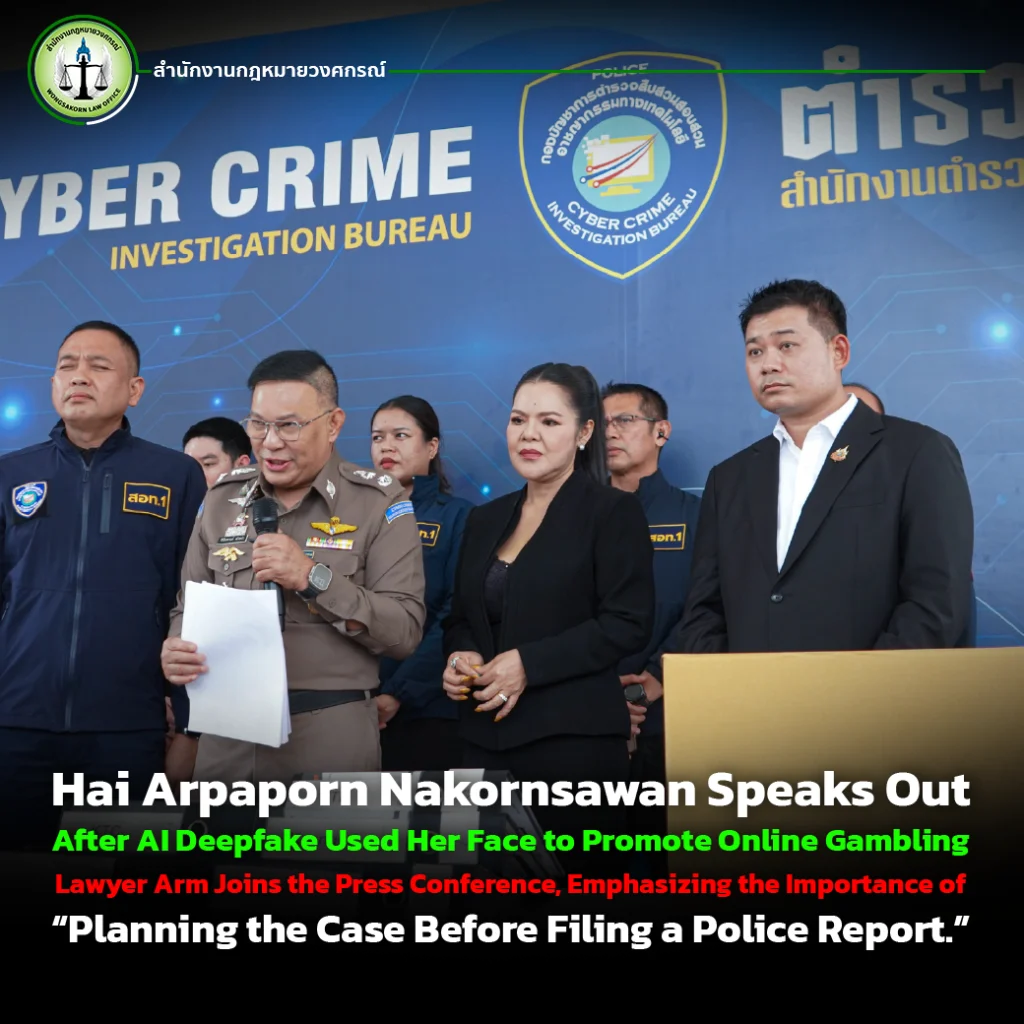
Hai Arpaporn Nakornsawan Speaks Out After AI Deepfake Used Her Face to Promote Online Gambling; Lawyer Arm Joins the Press Conference, Emphasizing the Importance of “Planning the Case Before Filing a Police Report.”   

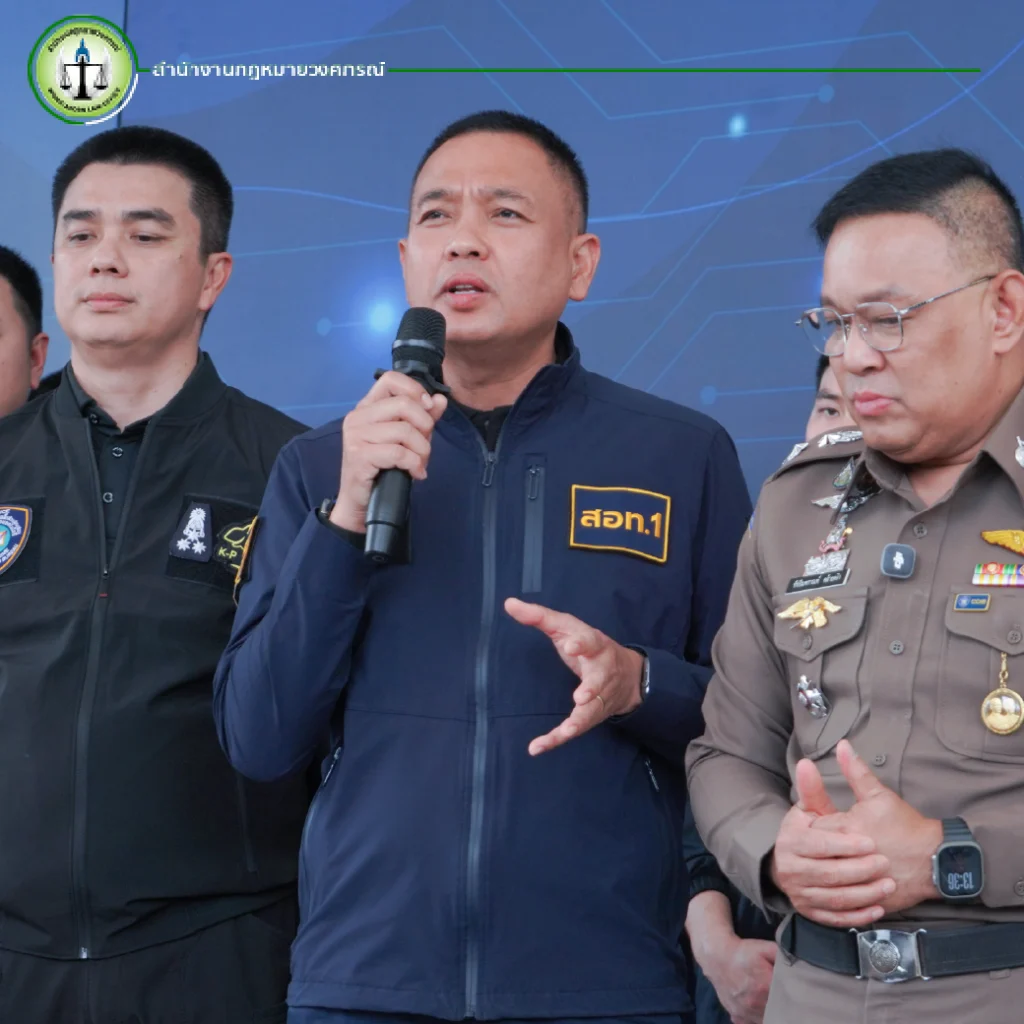
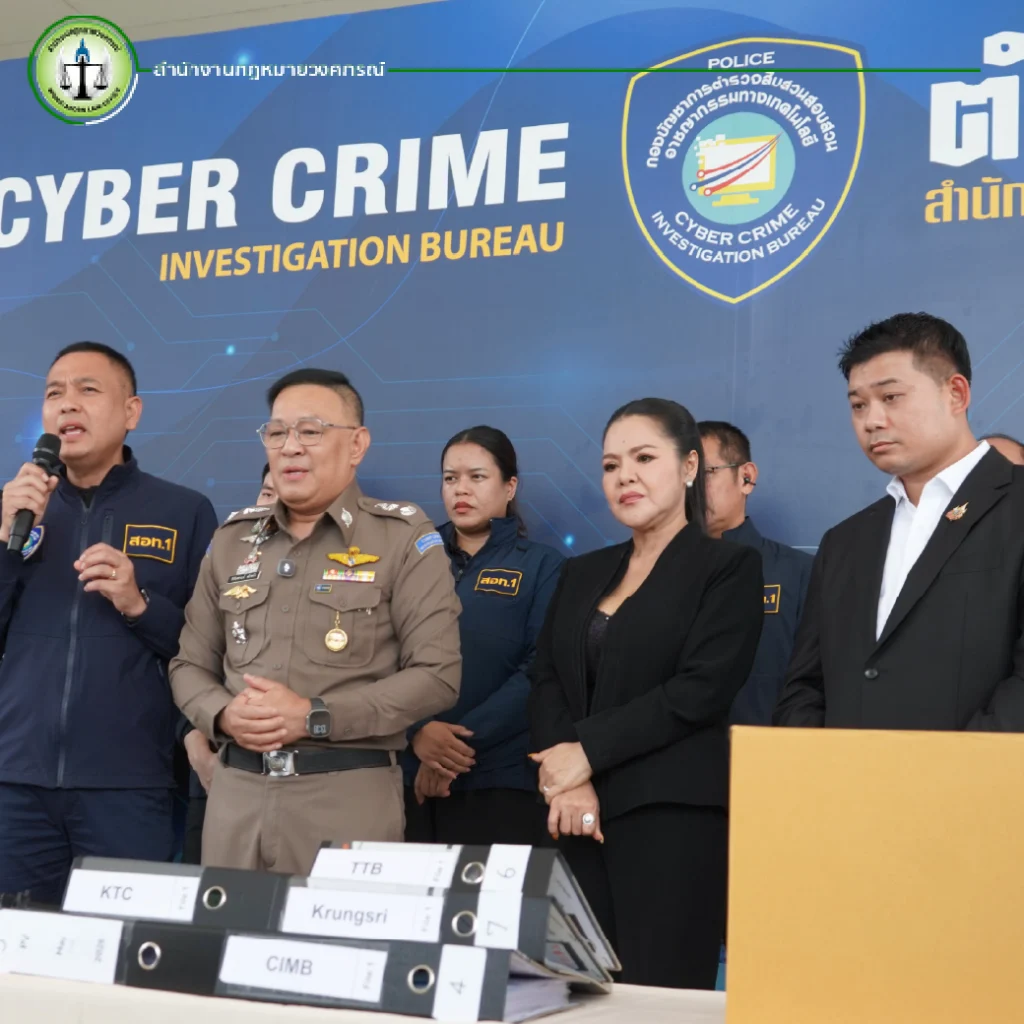
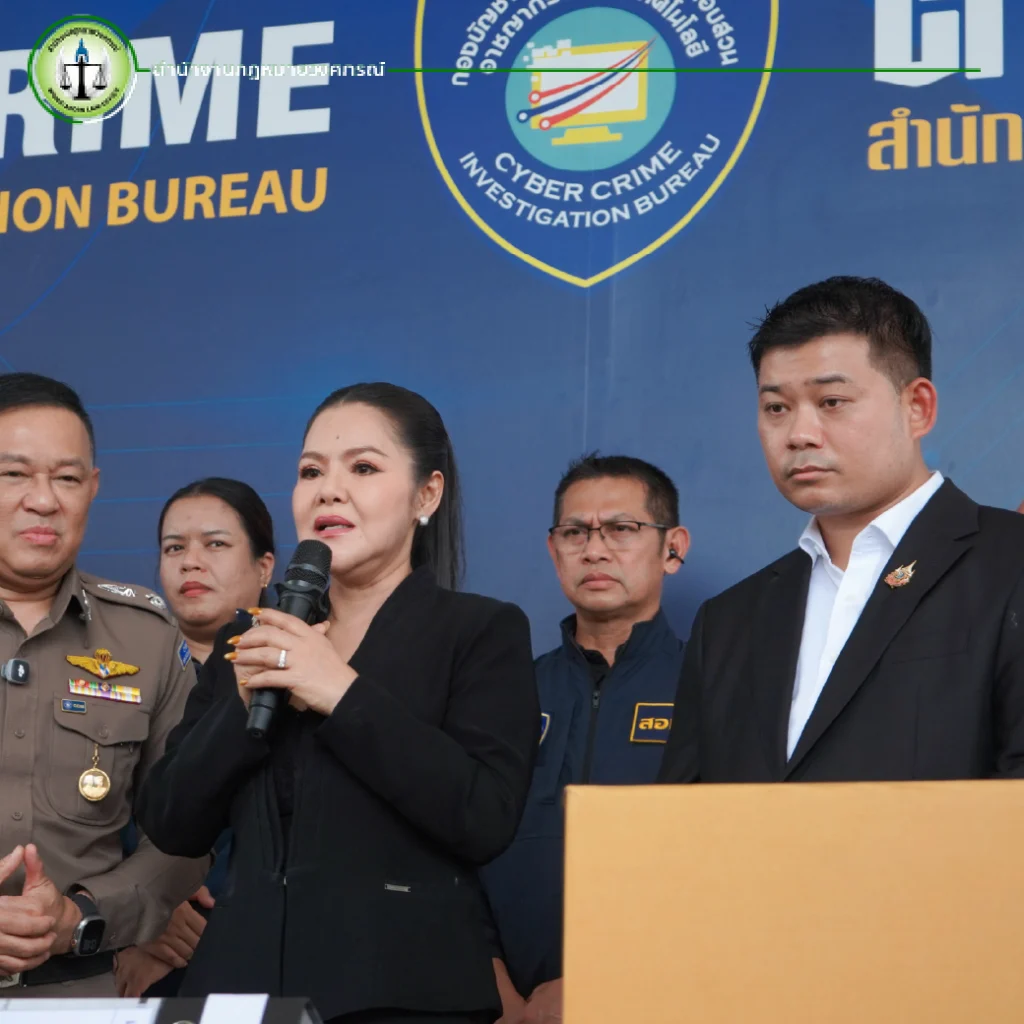
On 1 July 2026, Lawyer Arm Supasit Siri of Wongsakorn Law Firm, acting as the legal counsel for renowned Thai singer Hai Arpaporn Nakornsawan, attended a press conference at the Technology Crime Suppression Division 2 (TCSD Division 2) regarding a high-profile case that has attracted widespread public attention. The case involves the unauthorized use of artificial intelligence (AI) to create deepfake videos using Ms. Hai’s face and voice to promote online gambling websites. The unauthorized content has damaged her reputation and could mislead the public into believing that she is associated with those gambling websites.

At the press conference, the Cyber Crime Investigation Bureau, under the direction of Pol.Lt.Gen. Surapol Prembut, Commissioner of the Bureau, assigned Pol. Maj. Gen. Chatphandakan Klaiklueng, Deputy Commissioner, and Pol.Maj.Gen. Siriwat Deepor, Commander of Technology Crime Suppression Division 1, together with relevant officers, announced the results of an operation against the online gambling network KFC888. The investigation found that the website had an annual cash flow of more than 2.5 billion baht. Officers also discovered that the network had used AI technology to generate images and voice recordings that imitated Hai Arpaporn Nakornsawan in advertisements designed to persuade the public to gamble online, even though she had never given permission and had no connection whatsoever with the website. The case highlights a new form of cyber threat arising from the misuse of AI technology.

Further investigation revealed that a Payment Gateway service provider was involved in processing financial transactions for the online gambling website. As a result, officers carried out search operations at two targeted locations, where they seized computers, mobile phones, and a large number of important documents for use as evidence in the legal proceedings. In addition, summonses have been issued to individuals connected to the case. The investigation is also being expanded to identify other members of the network, while authorities continue tracing financial transactions in order to locate and seize assets that may have been obtained through illegal activities.

Following the incident, Hai Arpaporn Nakornsawan shared a message with the public, especially those whose identities have been impersonated or whose images, voices, or personal information have been used online without permission: “Don’t be afraid to file a police report. Don’t be afraid to consult a lawyer. There is nothing embarrassing about it. If you discover that your personal information has been used without your permission, take action immediately.” Her message highlights the importance of protecting one’s legal rights and not allowing offenders to remain unpunished and continue harming others.

According to Lawyer Arm Supasit Siri, handling online crime cases today involves more than simply collecting evidence or filing a police report. An equally important step is planning the legal strategy and carefully analyzing the facts before entering the legal process. Decisions made at each stage of a case may affect its direction, the ability to identify and apprehend the offenders, and the collection of additional evidence later in the investigation. A well-planned legal strategy from the very beginning can improve the effectiveness of the case and reduce the risk of mistakes that may affect the rights of the victim.

Based on its experience in handling and advising on cybercrime cases, Wongsakorn Law Firm has found that many victims file a police report immediately without first preparing sufficient evidence or carefully planning their legal strategy. As a result, some may miss the opportunity to preserve important evidence or take certain actions that could benefit the case. For this reason, consulting a lawyer at an early stage is an important factor in helping ensure that legal proceedings are handled more effectively and thoroughly.

Wongsakorn Law Firm would like to take this opportunity to remind artists, actors, influencers, content creators, students, internet personalities, and the general public that the use of AI technology to create fake faces, voices, or videos of individuals for product advertising, fraud, or the promotion of online gambling websites is becoming increasingly common. If you discover that your identity has been impersonated, or that your image, voice, or personal information has been used without your permission, you should preserve all available evidence and seek legal advice as soon as possible to protect your rights and minimize potential damage.

Wongsakorn Law Firm would like to thank Hai Arpaporn Nakornsawan for placing her trust in Lawyer Arm Supasit Siri as her legal counsel in this important case. The firm remains committed to providing legal advice and representation in online crime cases, unauthorized use of images, AI-related impersonation and deepfake cases, and other identity fraud cases, with the goal of protecting the rights of victims to the fullest extent possible. If you are facing a similar situation, you should consult a lawyer as early as possible to develop an appropriate legal strategy before filing a police report. Careful planning from the beginning can help ensure a more effective legal process and better protect the interests of the victim throughout the justice system.
How Can Chinese Nationals Legally Own a Home in Thailand? What You Should Know Before Investing in Thai Real Estate

Over the past several years, Thailand has remained one of the most popular destinations for foreign nationals, particularly Chinese nationals seeking to live, invest, or retire in the country. This is largely due to Thailand’s reasonable cost of living, well-developed infrastructure, diverse cuisine, and convenient transportation system.

However, one of the most common questions asked by Chinese nationals is:

“Can Chinese nationals purchase a house or own land in Thailand?”

The answer is that foreign nationals may acquire rights in certain types of real estate in Thailand, but such ownership or use must be structured and carried out in compliance with Thai law.

In this article, Wongsakorn Law Firm explains the lawful options available to Chinese nationals who wish to own a home or make use of real estate in Thailand.

Can Chinese Nationals Own Land in Thailand?

Under Thai law, foreign nationals are generally prohibited from directly owning land in Thailand in the same manner as Thai citizens.

As a result, a Chinese national cannot, in ordinary circumstances, purchase land and register ownership in his or her own name.

In the past, some individuals attempted to acquire land through nominees or other structures that were not compliant with Thai law. Such arrangements may create significant legal risks, including civil and criminal liability, as well as the potential loss of the property in the future.

For this reason, foreign nationals who wish to invest in or reside in Thailand should pursue only those ownership or investment structures that are clearly recognized and permitted under Thai law.

Chinese Nationals Can Purchase Condominium Units in Thailand

One of the most popular ways for Chinese nationals to own real estate in Thailand is through the purchase of a condominium unit.

Thai law permits foreign nationals to own condominium units, provided that the legal requirements are satisfied, including compliance with the foreign ownership quota applicable to the condominium project.

Key advantages include:

  • Direct ownership of the condominium unit
  • The ability to resell the unit in the future
  • The ability to lease the unit and generate rental income
  • Greater legal certainty and security compared to high-risk ownership structures

For these reasons, purchasing a condominium has become one of the most common and practical options for Chinese nationals seeking either a residence or a real estate investment in Thailand.

How Can Chinese Nationals Have a House with Land in Thailand?

Although Chinese nationals cannot directly own land in Thailand, Thai law provides several legal mechanisms that allow foreign nationals to lawfully use and benefit from land.

Usufruct

A usufruct is a right that can be registered with the relevant authority, granting the holder the right to possess, use, and enjoy the benefits derived from the land or immovable property.

Examples include:

  • Living in a house on the land
  • Gardening or agricultural use
  • Operating a business as permitted by law
  • Leasing the property and receiving rental income

A usufruct allows Chinese nationals to legally use and benefit from land in Thailand, even though they do not hold ownership of the land itself.

Long-Term Lease Rights

Another option is to enter into a long-term lease agreement in accordance with Thai law.

Leasing land or a house on a long-term basis can enable foreign nationals to reside in and make use of real estate without acquiring ownership.

However, lease agreements should be carefully reviewed and structured by legal professionals to help prevent future disputes and protect the interests of all parties involved.

Where the Foreign National Has a Thai Spouse

Many Chinese nationals who are married to Thai citizens often ask:

“Can a house or land be purchased if my spouse is Thai?”

As a general rule, a Thai national spouse may legally own land in Thailand.

However, the ownership structure and rights relating to the property should be carefully planned to avoid potential issues in the future, such as:

  • Division of property
  • Transfer of ownership rights
  • Divorce proceedings
  • Inheritance matters

In many cases, legal mechanisms such as a usufruct or other rights recognized under Thai law may be utilized to provide greater security and protection for both parties.

Do Not Rely on Illegal Land Ownership Arrangements

Today, there is a significant amount of information and advertising online regarding ways for foreign nationals to acquire land rights in Thailand.

Some of these arrangements may carry substantial legal risks or could be regarded as attempts to circumvent Thai law.

Before making any investment decision, Chinese nationals should carefully verify the information they receive and seek advice from qualified real estate legal professionals.

Establishing a legally compliant ownership or usage structure from the outset is always safer and more effective than attempting to resolve legal disputes after problems arise.

Wongsakorn Law Firm Is Ready to Assist Chinese Nationals Seeking to Own a Home in Thailand

If you are a Chinese national or other foreign investor seeking to purchase a home, invest in real estate, enter into a long-term lease, register a usufruct, or establish a legally compliant real estate ownership structure in Thailand, Wongsakorn Law Firm is ready to provide comprehensive legal consultation, document review, and related legal services.

A successful real estate investment is not merely about acquiring property. It is about ensuring that the property can be legally owned, used, and enjoyed in a secure manner while receiving long-term protection under Thai law.

If you require legal advice regarding the purchase of a home, the registration of a usufruct, long-term lease arrangements, or real estate ownership structures for Chinese nationals, you may contact Wongsakorn Law Firm for guidance tailored to your specific circumstances.

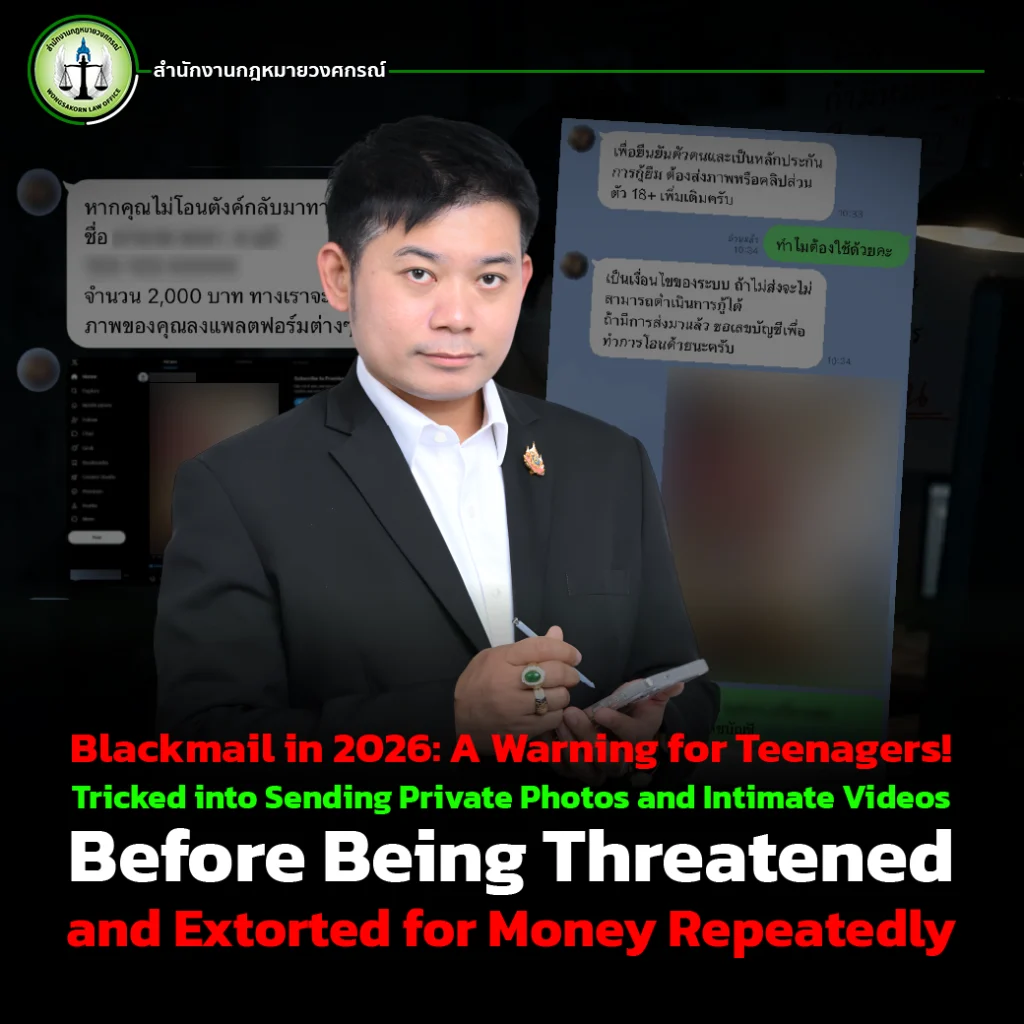
Blackmail in 2026: A Warning for Teenagers! Tricked into Sending Private Photos and Intimate Videos Before Being Threatened and Extorted for Money Repeatedly 

In 2026, blackmail conducted through online channels remains a serious threat that continues to cause significant harm to many people. Teenagers and youths, in particular, have increasingly become targets of new and evolving schemes used by criminals.

Based on the legal consultation experience of Wongsakorn Law Firm, a considerable number of victims have been deceived through social media platforms. Offenders often begin by establishing credibility, building familiarity, and engaging in conversations until trust is formed. They then offer rewards or various incentives to persuade victims to send private photos or personal videos.

Once the offenders obtain the desired content, the promised rewards are never delivered. Instead, the photos or videos are used as tools to threaten and extort money from the victims. As a result, many victims suffer substantial financial losses, while some experience severe psychological distress.

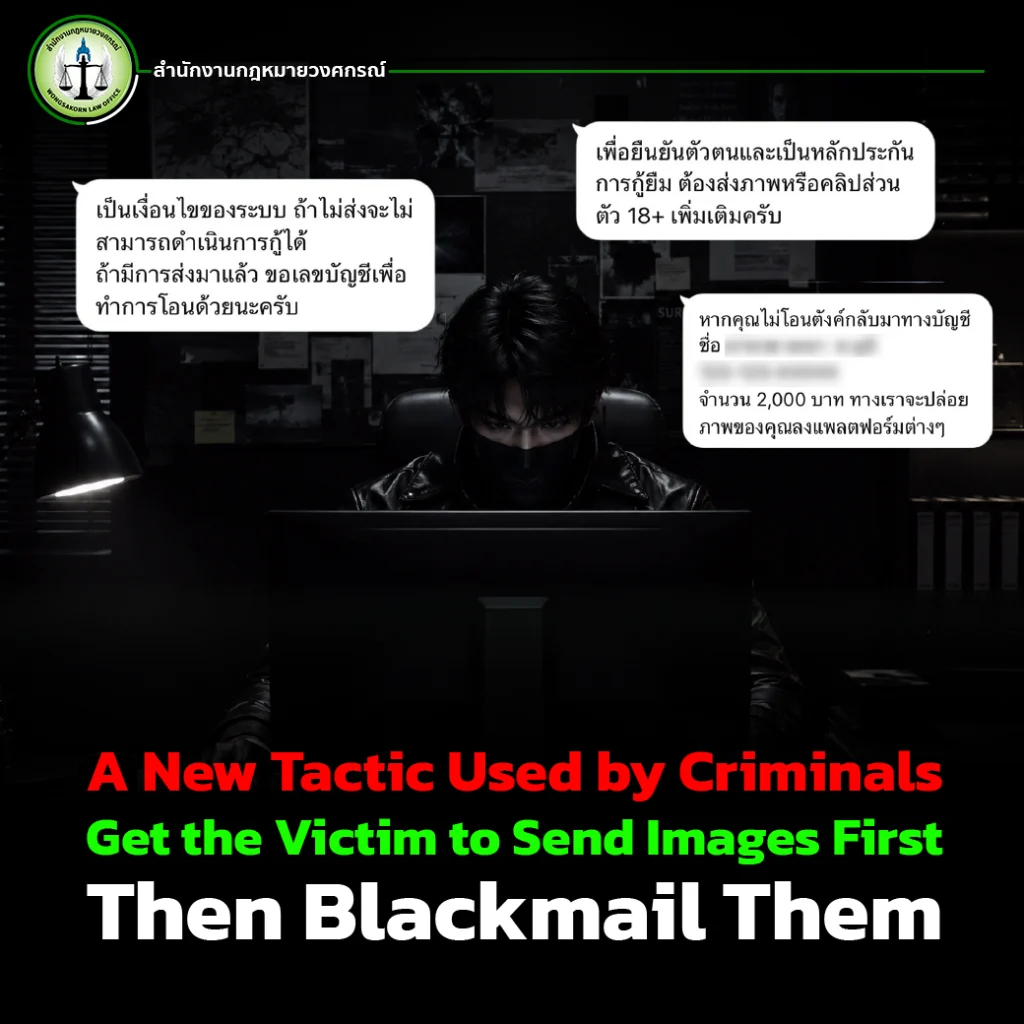
A New Tactic Used by Criminals: Get the Victim to Send Images First, Then Blackmail Them

Today, criminals rarely begin with direct threats. Instead, they create incentives that encourage victims to voluntarily send photos or videos of themselves.

Common examples include:

  • Claiming they will transfer money to the victim
  • Promising special compensation or rewards
  • Offering a brand-new smartphone for free
  • Promising expensive gifts
  • Offering financial assistance
  • Claiming they can provide employment opportunities or make the victim a brand ambassador

Once the victim is persuaded to send private photos or videos, the offender’s behavior changes immediately. The offender then begins threatening to distribute the content to the victim’s family members, friends, school, or the public unless the victim transfers the amount of money being demanded.

This is one of the most common forms of blackmail increasingly seen today.

Why Are Teenagers Common Targets?

Teenagers and young people are among the most active users of online platforms and are generally more likely to communicate with strangers through various social media channels.

In addition, offenders often use psychological manipulation to gain trust, such as:

  • Pretending to be someone of a similar age
  • Using trustworthy-looking profile photos
  • Spending a long period building rapport before initiating the scam
  • Creating relationships that resemble friendship or romance
  • Offering benefits or rewards that appear attractive

Once the victim’s trust has been gained, the offender begins requesting private photos or videos, using various reasons to persuade the victim to voluntarily provide the content.

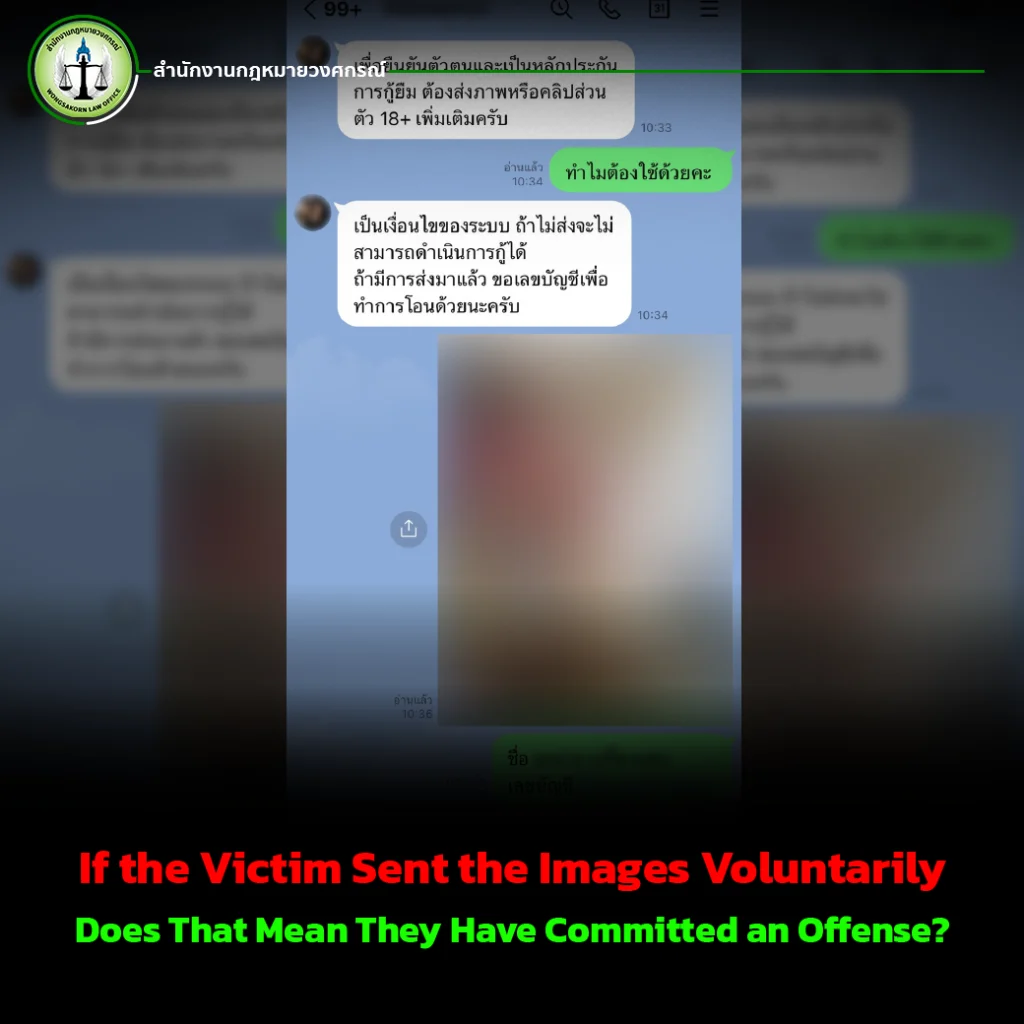
If the Victim Sent the Images Voluntarily, Does That Mean They Have Committed an Offense?

This is one of the most common concerns among victims.

Many people are afraid to seek help because they believe that, since they voluntarily sent the photos or videos, they may not be entitled to legal protection.

In reality, the fact that a victim previously shared personal photos or information does not give another person the right to use that content as a tool for intimidation or financial gain.

If photos or videos are used to coerce, threaten, or demand money from a victim, such conduct may constitute a criminal offense under Thai law.

Therefore, individuals who are threatened or extorted for money using private photos or videos are considered victims, not perpetrators, in cases of blackmail.

Is It True That the More You Pay, the More They Demand?

Based on experience with cases of this nature, the answer is: “Yes, it happens frequently.”

Many victims believe that making the first payment will bring the problem to an end. In reality, however, offenders often keep the photos and videos and continue using them as tools of intimidation.

Once the offender realizes that the victim is willing to pay, additional demands often follow, such as:

  • Requesting more money
  • Demanding repeated transfers
  • Asking for other assets or valuables
  • Threatening the victim into complying with further demands

As a result, some victims lose substantial amounts of money while the problem never truly ends.

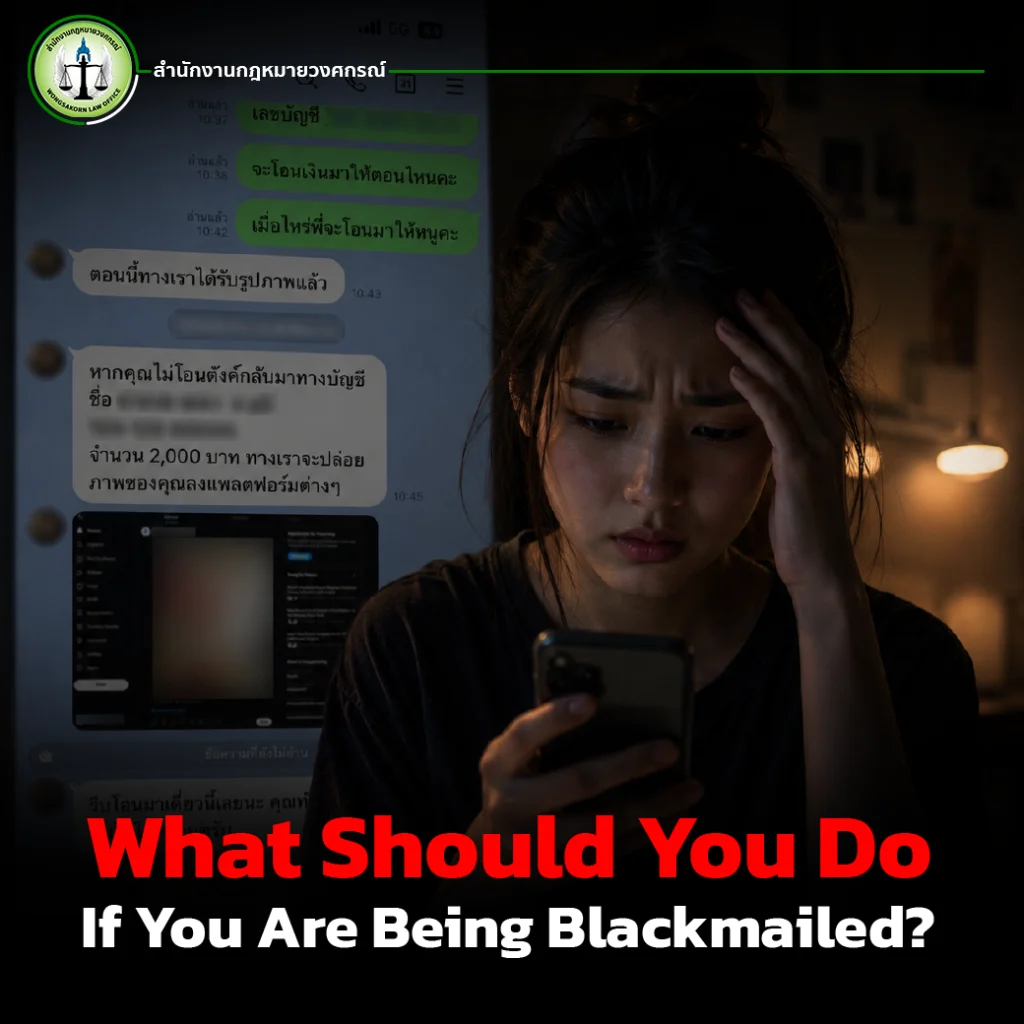
What Should You Do If You Are Being Blackmailed?

The most important thing is not to panic and delete the evidence.

Victims should preserve all relevant information, including:

  • Chat messages and conversation records
  • Screenshots of threats or extortion attempts
  • Proof of money transfers
  • Bank account details used by the offender
  • The offender’s social media accounts
  • Dates and times of all communications

This evidence can play a crucial role in any legal proceedings.

In addition, victims should seek legal advice as soon as possible in order to develop an appropriate strategy, prevent further damage, and take the necessary legal steps.

Do Not Let Fear Cause Greater Harm

What criminals want most is the victim’s fear.

When victims are afraid that their information will be exposed, afraid that their family will find out, or afraid of public embarrassment, offenders use that fear as a tool to continue demanding money.

In many cases, victims who consult a lawyer at an early stage are able to develop an effective response strategy, preserve evidence properly, and pursue legal remedies more effectively than those who attempt to handle the situation alone.

If you or someone close to you is being blackmailed, threatened with the release of private photos or personal videos, or being forced to pay money because of information previously shared with another person, do not let fear prevent you from protecting your legal rights.

Wongsakorn Law Firm is ready to provide legal consultation regarding blackmail cases, extortion cases, and online-related offenses. Our goal is to help victims develop an appropriate legal strategy, minimize potential damage, and protect their rights in accordance with the law.

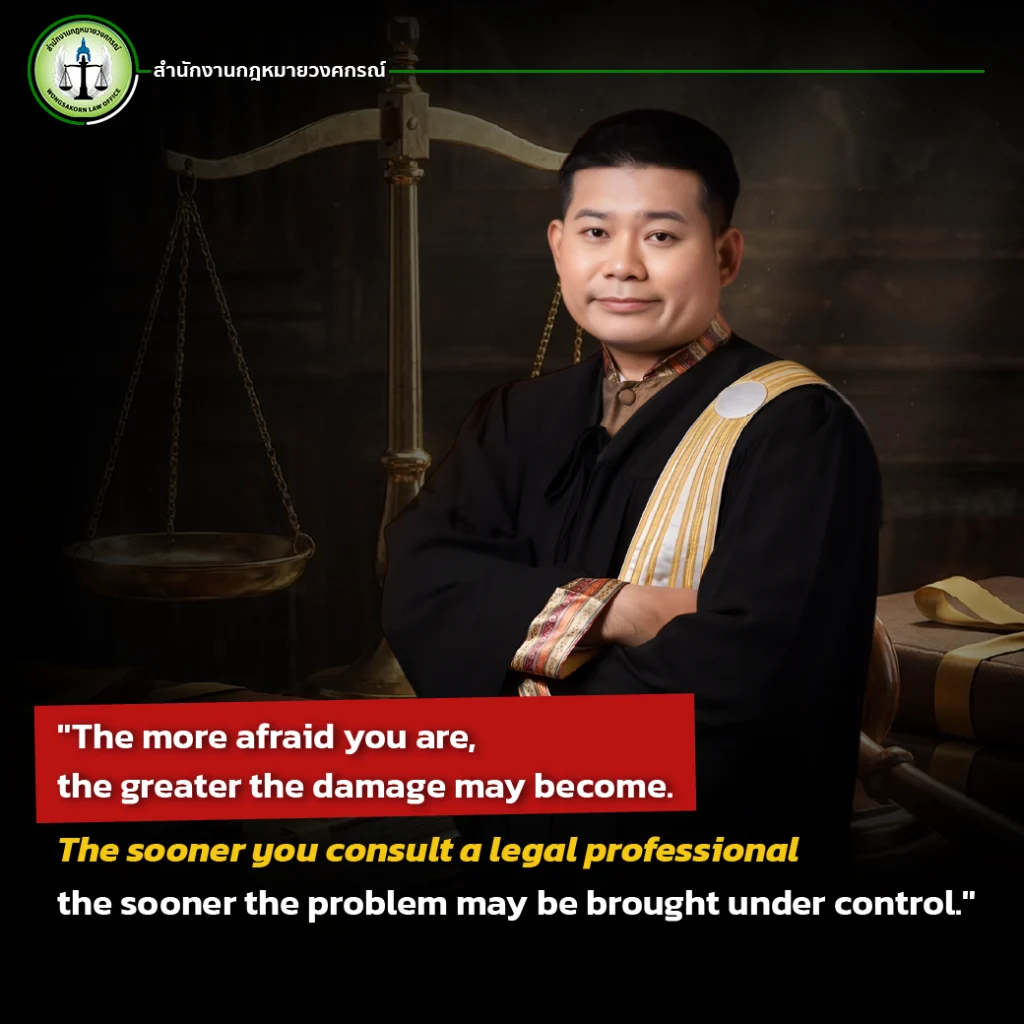
Remember:

“The more afraid you are, the greater the damage may become. The sooner you consult a legal professional, the sooner the problem may be brought under control.”

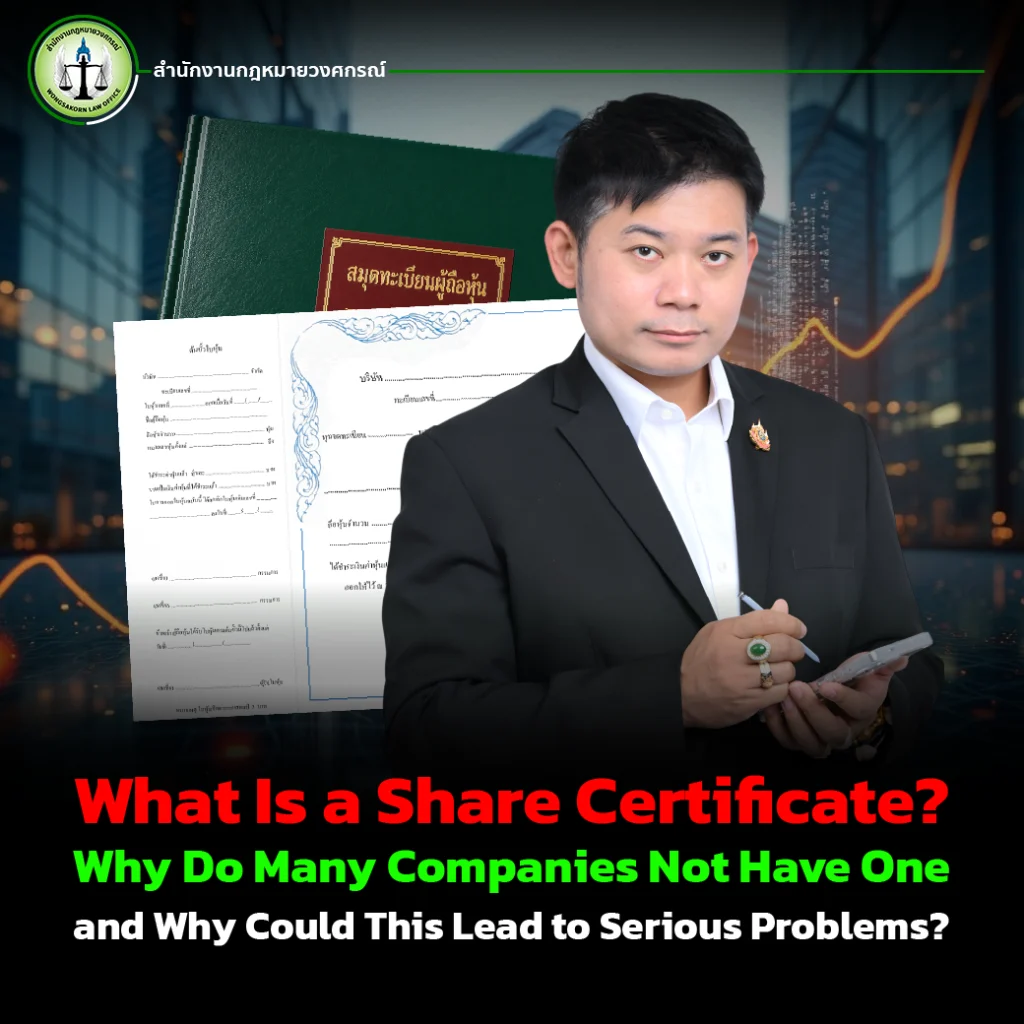
What Is a Share Certificate? Why Do Many Companies Not Have One, and Why Could This Lead to Serious Problems?

If you are a company owner or a shareholder of a private limited company, take a moment to ask yourself: “Have you ever seen your company’s share certificate?”

Many people may answer no, while others may not even realize that after a company is incorporated, it is legally required to maintain share certificates and a register of shareholders.

Based on the experience of Lawyer Arm, Supasit Siri of Wongsakorn Law Firm, a considerable number of companies have been operating for many years without issuing share certificates to their shareholders and without properly maintaining a register of shareholders.

This issue may appear insignificant while the business is operating normally. However, when disputes arise, shares are transferred, shareholders change, or government authorities request the company’s corporate records for inspection, the company may encounter unexpected legal complications.

What Is a Share Certificate?

A share certificate is an important document issued by a company to a shareholder as evidence of ownership of shares in the company.

Simply put, when a person acquires shares in a company, the company has a duty to issue a share certificate confirming that such person is a shareholder holding the specified number of shares.

Important information commonly contained in a share certificate includes:

  • Company name
  • Juristic person registration number
  • Shareholder’s name
  • Number of shares
  • Share value
  • Share certificate number
  • Signature of the authorized director

A share certificate is therefore an important document that serves as direct evidence of a shareholder’s ownership rights in the company.

The Register of Shareholders Is Just as Important as a Share Certificate

In addition to share certificates, the law also requires a company to maintain a Register of Shareholders.

A Register of Shareholders is a document used to record the details of all shareholders in the company, including the number of shares held by each shareholder and any history of changes in share ownership.

This document is highly important because it serves as the company’s internal record for verifying the status of shareholders at any given time.

In practice, if a company does not maintain a Register of Shareholders, or if the register is not properly prepared and maintained, it may adversely affect the company’s management and the ability to establish shareholders’ rights in the future.

Why Do Many Companies Not Have Share Certificates?

One common issue is that business owners assume that once they receive the company registration documents or the company affidavit from the Department of Business Development, the company incorporation process is fully completed.

In reality, however, company registration and the preparation of the company’s internal corporate documents are two separate matters.

In many cases, when business owners consult company incorporation service providers or accounting firms, they are often told:

“No one ever uses share certificates.”

or

“The shareholder list (Bor.Or.Jor. 5) is sufficient.”

Such misunderstandings may cause company owners to have an incorrect understanding of the purpose and legal significance of each type of corporate document.

Can Bor.Or.Jor. 5 Be Used in Place of a Share Certificate?

The answer is no.

Form Bor.Or.Jor. 5 is merely a document relating to shareholder information that is filed with the Department of Business Development for the purpose of notifying the relevant government authority of such information.

However, Bor.Or.Jor. 5 is not a share certificate, nor is it an original document that directly certifies ownership rights in shares.

Therefore, if a dispute arises concerning share ownership, or if shares are transferred between shareholders, having only Form Bor.Or.Jor. 5 may not be sufficient to establish and prove the rights of each party.

What Risks Arise When Shares Are Sold Without a Share Certificate?

Under the law, the transfer of shares in a private limited company is not completed merely by entering into a share purchase agreement.

As a general rule, the transferor should deliver the share certificate to the transferee, and the company should properly record the change of share ownership in the Register of Shareholders.

If no share certificate has been issued from the outset, proving who the true owner of the shares is may become a matter of dispute in the future.

This is particularly problematic in cases involving disputes among shareholders, business partners, or the heirs of a shareholder.

These Documents Become Critical the Moment a Dispute or Legal Issue Arises

Many companies pay little attention to share certificates or the Register of Shareholders until a legal issue arises.

Examples include:

  • Shareholder disputes
  • Share transfers or share sale transactions
  • Changes in directors
  • Government inspections or regulatory reviews
  • Civil or criminal proceedings

When such situations occur, company owners often begin searching for the corporate documents that should have been prepared from the very first day of the company’s incorporation. However, in some cases, they discover that these documents were never prepared at all.

Should You Have a Legal Advisor Before Incorporating a Company?

Based on the experience of Wongsakorn Law Firm, company incorporation is not merely a matter of completing the registration process.

It also requires proper legal structuring and the preparation of all necessary internal corporate documents in accordance with the law.

Having a lawyer as a legal advisor from the outset can help determine whether:

  • Share certificates have been properly issued;
  • A Register of Shareholders has been properly prepared and maintained;
  • The company’s internal corporate documents comply with legal requirements; and
  • Future share transfers can be carried out safely and effectively.

These matters may appear to be minor details today, but they can significantly reduce the risk of disputes and prevent substantial business losses in the future.

Wongsakorn Law Firm Is Ready to Provide Corporate Legal Consultation

If you are in the process of incorporating a company, reviewing shareholder documents, or have questions regarding share certificates, the Register of Shareholders, or share transfers in a private limited company, Wongsakorn Law Firm is ready to provide comprehensive legal consultation and corporate document review services. Click >> Contact Us <<

Because having the proper documents in place from the very first day is always better than attempting to resolve legal issues after a dispute arises. Proper legal documentation also helps ensure that a business can operate smoothly and securely in compliance with applicable laws.

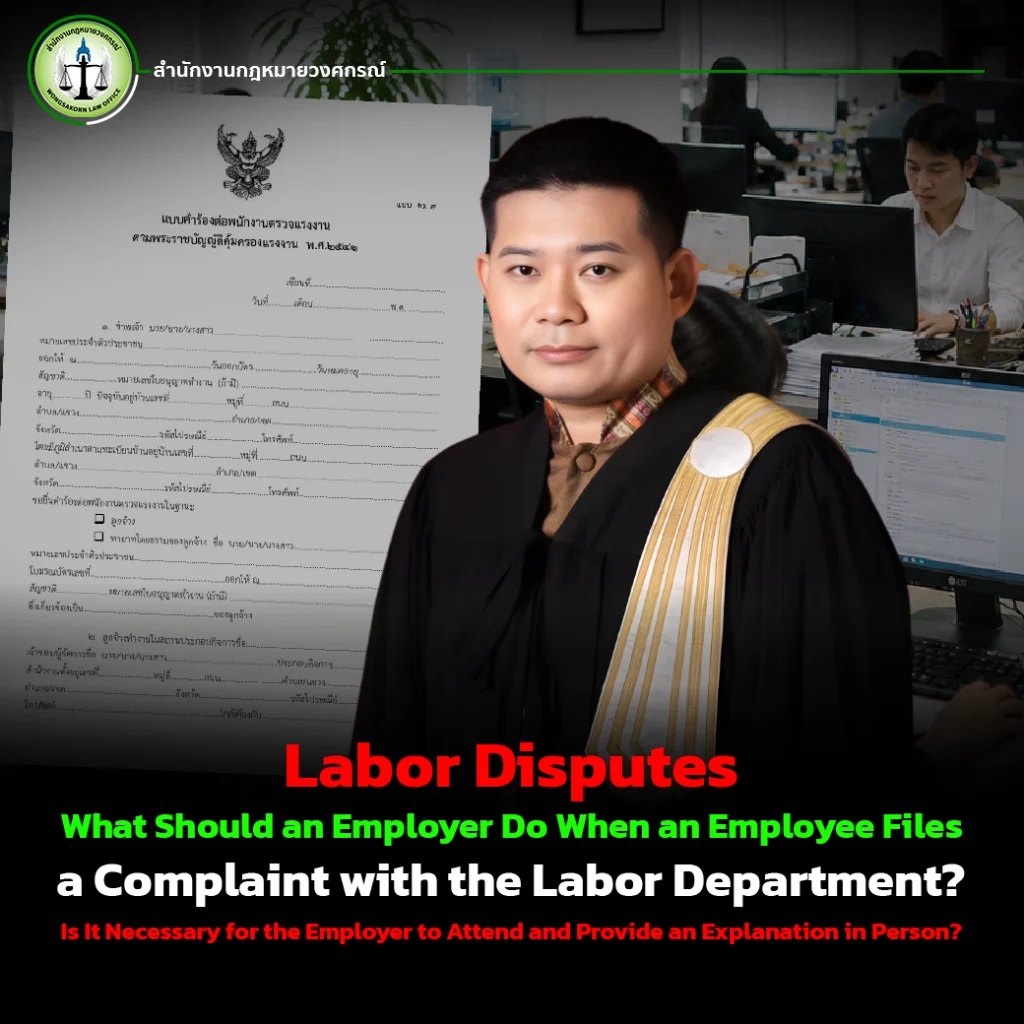
Labor Disputes: What Should an Employer Do When an Employee Files a Complaint with the Labor Department? Is It Necessary for the Employer to Attend and Provide an Explanation in Person?

Labor disputes are one of the most significant risks faced by business owners and employers, regardless of whether they operate a small business, a medium-sized enterprise, or a large organization. Even with careful management, disagreements between employers and employees can arise at any time.

When a dispute occurs, one of the most common ways employees seek to enforce their rights is by filing a complaint with the Department of Labour Protection and Welfare, commonly referred to as “filing a complaint with the Labor Department.”

However, once an employer receives a summons or notice from a Labor Inspector, what steps should be taken? Is the employer required to appear and provide explanations in person? If attending is inconvenient, are there alternative options available? This article from Wongsakorn Law Firm provides the answers.

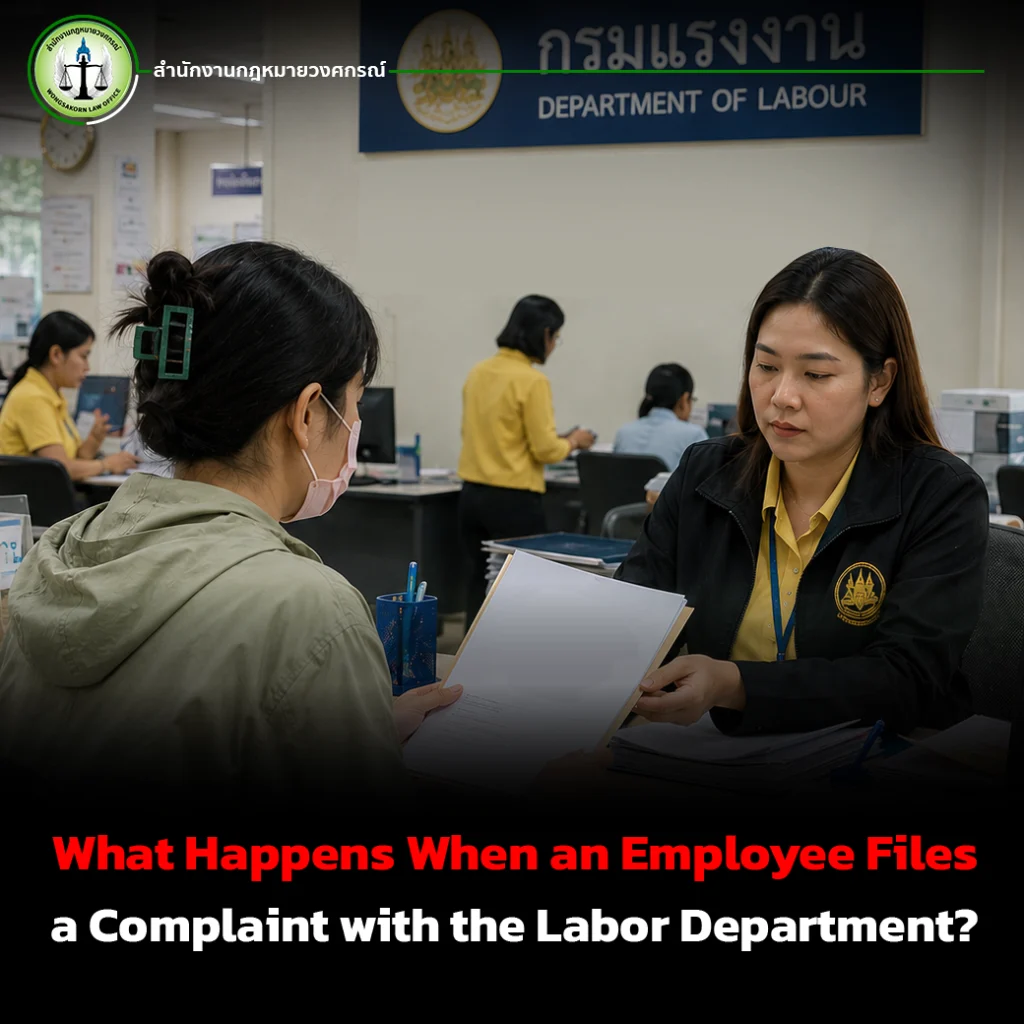
What Happens When an Employee Files a Complaint with the Labor Department?

When a complaint relating to labor rights is filed, a Labor Inspector will review the facts of the case and may issue a notice requiring the employer to provide an explanation or submit relevant documents for consideration.

Common complaints include:

  • Unpaid wages
  • Overtime pay (OT)
  • Severance pay upon termination
  • Special compensation
  • Leave and holiday entitlements
  • Unfair dismissal
  • Employee rights and benefits under labor law

Upon receiving a notice from the Labor Inspector, employers should not ignore or overlook it, as doing so may affect the consideration of the facts and their legal rights at a later stage.

If the Employer Is Unable to Attend, Can a Lawyer Be Authorized to Act on Their Behalf?

One of the most common misconceptions is that once an employee files a complaint and specifies the amount they are seeking, the employer is automatically required to pay the full amount claimed.

In reality, an employee’s claim is merely an initial allegation or demand.

The relevant authorities will consider:

  • The facts of the particular case
  • Documentary evidence
  • The employment agreement
  • The company’s rules and regulations
  • Witness testimony and documentary evidence
  • Applicable labor laws

Therefore, the fact that an employee claims a certain amount of money does not necessarily mean that the employer will be liable for that amount. If there are facts or evidence showing that the employer has complied with the law, the employer has the right to provide explanations and contest the claim.

Why Should Labor Issues Be Addressed from the Beginning?

Based on Wongsakorn Law Firm’s experience in providing labor law consultation, many organizations only seek legal assistance after a dispute has already arisen.

In reality, most labor-related problems can be prevented before they occur through the implementation of proper labor law compliance and internal employment systems.

Examples include:

  • Preparing comprehensive employment agreements
  • Establishing workplace rules and regulations
  • Implementing employee disciplinary policies
  • Managing leave and holiday entitlements properly
  • Ensuring accurate payment of wages and overtime compensation
  • Establishing legally compliant termination procedures

When an organization has proper systems in place from the outset, the likelihood of labor disputes arising with employees can be significantly reduced.

Why Should Every Organization Have Legal Counsel?

Today, labor laws are becoming increasingly complex and subject to ongoing changes. As a result, personnel management is no longer solely a human resources function, but also a matter that directly affects an organization’s legal risk exposure.

Having legal counsel as part of the organization can help businesses:

  • Prevent problems before disputes arise
  • Review important legal documents
  • Provide legal guidance before making termination decisions
  • Reduce the risk of litigation
  • Establish legally compliant human resource management systems
  • Address other legal issues that may arise in the future

Which is significantly less costly than resolving problems after legal proceedings have already commenced.

Wongsakorn Law Firm Is Ready to Assist with Your Organization’s Labor Law Matters

If your organization has received a notice from the Labor Department, is currently facing a dispute with an employee, or has concerns regarding labor law compliance, Wongsakorn Law Firm is ready to provide legal advice and develop appropriate solutions tailored to your situation.

Our services include representing employers in meetings and proceedings before government authorities, reviewing labor-related documents, drafting employment agreements, establishing human resource management systems, and serving as ongoing legal counsel for organizations.

Because the best labor dispute is the one that is prevented before it arises.

Having legal counsel from the very beginning is one of the most effective tools for helping organizations operate with confidence, reduce legal risks, and prepare for future labor-related challenges.

For legal consultation, click >> Contact Us <<.

Line @ คลิก! โทรหาเรา คลิก!