How Can Chinese Nationals Legally Own a Home in Thailand? What You Should Know Before Investing in Thai Real Estate

Over the past several years, Thailand has remained one of the most popular destinations for foreign nationals, particularly Chinese nationals seeking to live, invest, or retire in the country. This is largely due to Thailand’s reasonable cost of living, well-developed infrastructure, diverse cuisine, and convenient transportation system.

However, one of the most common questions asked by Chinese nationals is:

“Can Chinese nationals purchase a house or own land in Thailand?”

The answer is that foreign nationals may acquire rights in certain types of real estate in Thailand, but such ownership or use must be structured and carried out in compliance with Thai law.

In this article, Wongsakorn Law Firm explains the lawful options available to Chinese nationals who wish to own a home or make use of real estate in Thailand.

Can Chinese Nationals Own Land in Thailand?

Under Thai law, foreign nationals are generally prohibited from directly owning land in Thailand in the same manner as Thai citizens.

As a result, a Chinese national cannot, in ordinary circumstances, purchase land and register ownership in his or her own name.

In the past, some individuals attempted to acquire land through nominees or other structures that were not compliant with Thai law. Such arrangements may create significant legal risks, including civil and criminal liability, as well as the potential loss of the property in the future.

For this reason, foreign nationals who wish to invest in or reside in Thailand should pursue only those ownership or investment structures that are clearly recognized and permitted under Thai law.

Chinese Nationals Can Purchase Condominium Units in Thailand

One of the most popular ways for Chinese nationals to own real estate in Thailand is through the purchase of a condominium unit.

Thai law permits foreign nationals to own condominium units, provided that the legal requirements are satisfied, including compliance with the foreign ownership quota applicable to the condominium project.

Key advantages include:

  • Direct ownership of the condominium unit
  • The ability to resell the unit in the future
  • The ability to lease the unit and generate rental income
  • Greater legal certainty and security compared to high-risk ownership structures

For these reasons, purchasing a condominium has become one of the most common and practical options for Chinese nationals seeking either a residence or a real estate investment in Thailand.

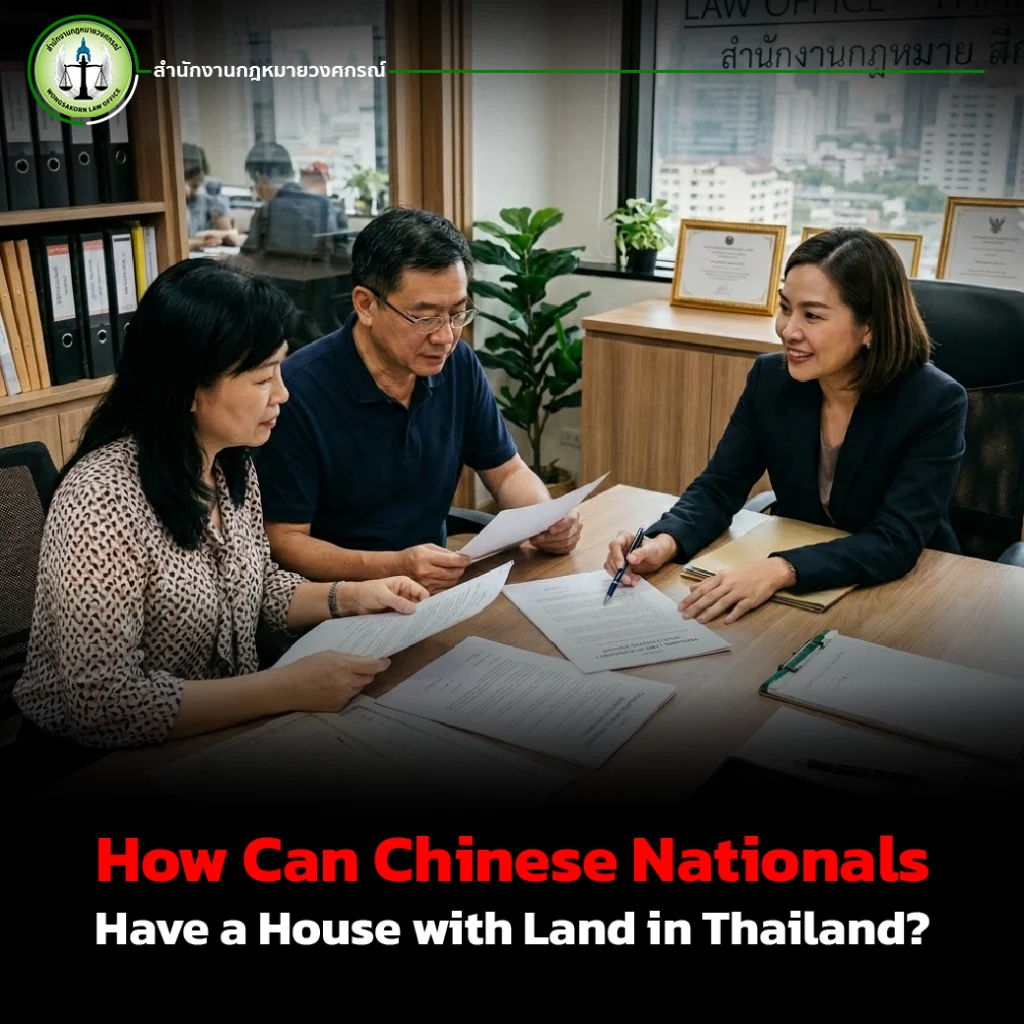
How Can Chinese Nationals Have a House with Land in Thailand?

Although Chinese nationals cannot directly own land in Thailand, Thai law provides several legal mechanisms that allow foreign nationals to lawfully use and benefit from land.

Usufruct

A usufruct is a right that can be registered with the relevant authority, granting the holder the right to possess, use, and enjoy the benefits derived from the land or immovable property.

Examples include:

  • Living in a house on the land
  • Gardening or agricultural use
  • Operating a business as permitted by law
  • Leasing the property and receiving rental income

A usufruct allows Chinese nationals to legally use and benefit from land in Thailand, even though they do not hold ownership of the land itself.

Long-Term Lease Rights

Another option is to enter into a long-term lease agreement in accordance with Thai law.

Leasing land or a house on a long-term basis can enable foreign nationals to reside in and make use of real estate without acquiring ownership.

However, lease agreements should be carefully reviewed and structured by legal professionals to help prevent future disputes and protect the interests of all parties involved.

Where the Foreign National Has a Thai Spouse

Many Chinese nationals who are married to Thai citizens often ask:

“Can a house or land be purchased if my spouse is Thai?”

As a general rule, a Thai national spouse may legally own land in Thailand.

However, the ownership structure and rights relating to the property should be carefully planned to avoid potential issues in the future, such as:

  • Division of property
  • Transfer of ownership rights
  • Divorce proceedings
  • Inheritance matters

In many cases, legal mechanisms such as a usufruct or other rights recognized under Thai law may be utilized to provide greater security and protection for both parties.

Do Not Rely on Illegal Land Ownership Arrangements

Today, there is a significant amount of information and advertising online regarding ways for foreign nationals to acquire land rights in Thailand.

Some of these arrangements may carry substantial legal risks or could be regarded as attempts to circumvent Thai law.

Before making any investment decision, Chinese nationals should carefully verify the information they receive and seek advice from qualified real estate legal professionals.

Establishing a legally compliant ownership or usage structure from the outset is always safer and more effective than attempting to resolve legal disputes after problems arise.

Wongsakorn Law Firm Is Ready to Assist Chinese Nationals Seeking to Own a Home in Thailand

If you are a Chinese national or other foreign investor seeking to purchase a home, invest in real estate, enter into a long-term lease, register a usufruct, or establish a legally compliant real estate ownership structure in Thailand, Wongsakorn Law Firm is ready to provide comprehensive legal consultation, document review, and related legal services.

A successful real estate investment is not merely about acquiring property. It is about ensuring that the property can be legally owned, used, and enjoyed in a secure manner while receiving long-term protection under Thai law.

If you require legal advice regarding the purchase of a home, the registration of a usufruct, long-term lease arrangements, or real estate ownership structures for Chinese nationals, you may contact Wongsakorn Law Firm for guidance tailored to your specific circumstances.

Blackmail in 2026: A Warning for Teenagers! Tricked into Sending Private Photos and Intimate Videos Before Being Threatened and Extorted for Money Repeatedly 

In 2026, blackmail conducted through online channels remains a serious threat that continues to cause significant harm to many people. Teenagers and youths, in particular, have increasingly become targets of new and evolving schemes used by criminals.

Based on the legal consultation experience of Wongsakorn Law Firm, a considerable number of victims have been deceived through social media platforms. Offenders often begin by establishing credibility, building familiarity, and engaging in conversations until trust is formed. They then offer rewards or various incentives to persuade victims to send private photos or personal videos.

Once the offenders obtain the desired content, the promised rewards are never delivered. Instead, the photos or videos are used as tools to threaten and extort money from the victims. As a result, many victims suffer substantial financial losses, while some experience severe psychological distress.

A New Tactic Used by Criminals: Get the Victim to Send Images First, Then Blackmail Them

Today, criminals rarely begin with direct threats. Instead, they create incentives that encourage victims to voluntarily send photos or videos of themselves.

Common examples include:

  • Claiming they will transfer money to the victim
  • Promising special compensation or rewards
  • Offering a brand-new smartphone for free
  • Promising expensive gifts
  • Offering financial assistance
  • Claiming they can provide employment opportunities or make the victim a brand ambassador

Once the victim is persuaded to send private photos or videos, the offender’s behavior changes immediately. The offender then begins threatening to distribute the content to the victim’s family members, friends, school, or the public unless the victim transfers the amount of money being demanded.

This is one of the most common forms of blackmail increasingly seen today.

Why Are Teenagers Common Targets?

Teenagers and young people are among the most active users of online platforms and are generally more likely to communicate with strangers through various social media channels.

In addition, offenders often use psychological manipulation to gain trust, such as:

  • Pretending to be someone of a similar age
  • Using trustworthy-looking profile photos
  • Spending a long period building rapport before initiating the scam
  • Creating relationships that resemble friendship or romance
  • Offering benefits or rewards that appear attractive

Once the victim’s trust has been gained, the offender begins requesting private photos or videos, using various reasons to persuade the victim to voluntarily provide the content.

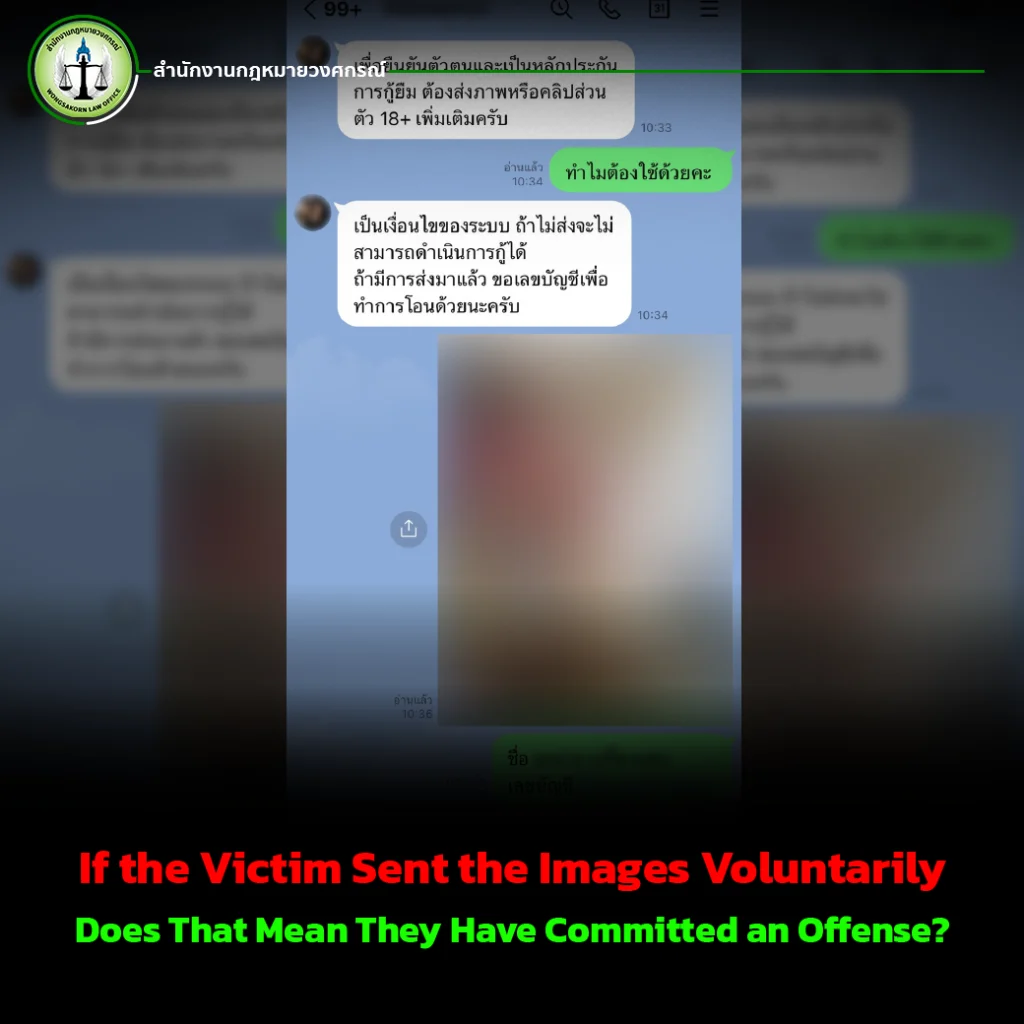
If the Victim Sent the Images Voluntarily, Does That Mean They Have Committed an Offense?

This is one of the most common concerns among victims.

Many people are afraid to seek help because they believe that, since they voluntarily sent the photos or videos, they may not be entitled to legal protection.

In reality, the fact that a victim previously shared personal photos or information does not give another person the right to use that content as a tool for intimidation or financial gain.

If photos or videos are used to coerce, threaten, or demand money from a victim, such conduct may constitute a criminal offense under Thai law.

Therefore, individuals who are threatened or extorted for money using private photos or videos are considered victims, not perpetrators, in cases of blackmail.

Is It True That the More You Pay, the More They Demand?

Based on experience with cases of this nature, the answer is: “Yes, it happens frequently.”

Many victims believe that making the first payment will bring the problem to an end. In reality, however, offenders often keep the photos and videos and continue using them as tools of intimidation.

Once the offender realizes that the victim is willing to pay, additional demands often follow, such as:

  • Requesting more money
  • Demanding repeated transfers
  • Asking for other assets or valuables
  • Threatening the victim into complying with further demands

As a result, some victims lose substantial amounts of money while the problem never truly ends.

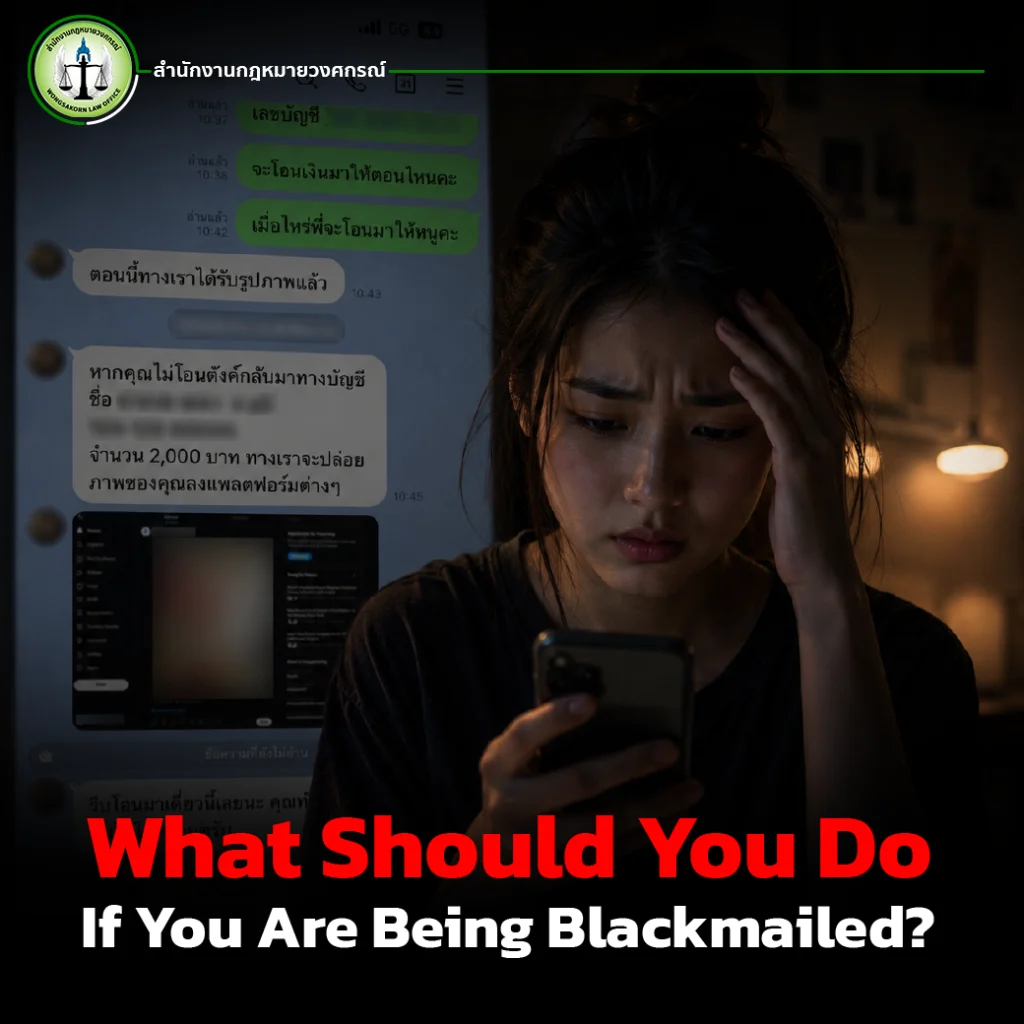
What Should You Do If You Are Being Blackmailed?

The most important thing is not to panic and delete the evidence.

Victims should preserve all relevant information, including:

  • Chat messages and conversation records
  • Screenshots of threats or extortion attempts
  • Proof of money transfers
  • Bank account details used by the offender
  • The offender’s social media accounts
  • Dates and times of all communications

This evidence can play a crucial role in any legal proceedings.

In addition, victims should seek legal advice as soon as possible in order to develop an appropriate strategy, prevent further damage, and take the necessary legal steps.

Do Not Let Fear Cause Greater Harm

What criminals want most is the victim’s fear.

When victims are afraid that their information will be exposed, afraid that their family will find out, or afraid of public embarrassment, offenders use that fear as a tool to continue demanding money.

In many cases, victims who consult a lawyer at an early stage are able to develop an effective response strategy, preserve evidence properly, and pursue legal remedies more effectively than those who attempt to handle the situation alone.

If you or someone close to you is being blackmailed, threatened with the release of private photos or personal videos, or being forced to pay money because of information previously shared with another person, do not let fear prevent you from protecting your legal rights.

Wongsakorn Law Firm is ready to provide legal consultation regarding blackmail cases, extortion cases, and online-related offenses. Our goal is to help victims develop an appropriate legal strategy, minimize potential damage, and protect their rights in accordance with the law.

Remember:

“The more afraid you are, the greater the damage may become. The sooner you consult a legal professional, the sooner the problem may be brought under control.”

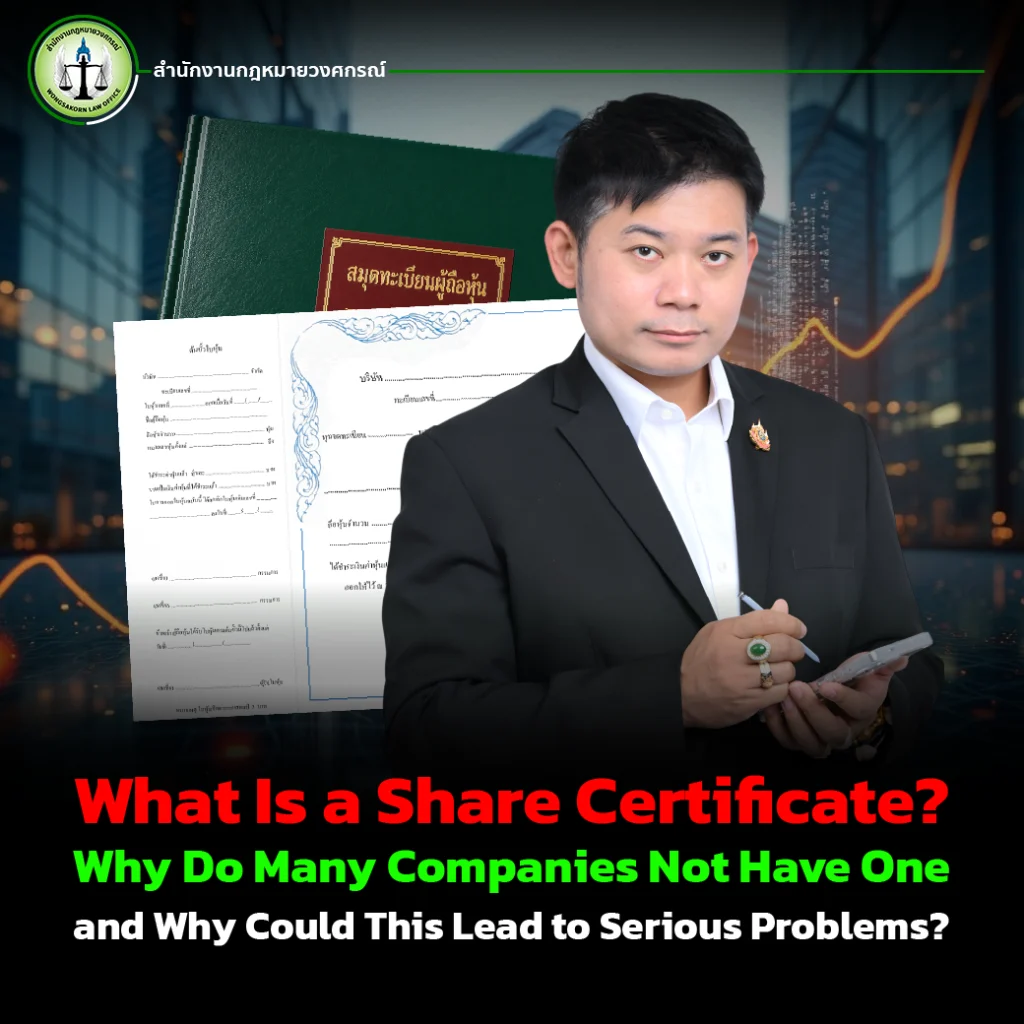
What Is a Share Certificate? Why Do Many Companies Not Have One, and Why Could This Lead to Serious Problems?

If you are a company owner or a shareholder of a private limited company, take a moment to ask yourself: “Have you ever seen your company’s share certificate?”

Many people may answer no, while others may not even realize that after a company is incorporated, it is legally required to maintain share certificates and a register of shareholders.

Based on the experience of Lawyer Arm, Supasit Siri of Wongsakorn Law Firm, a considerable number of companies have been operating for many years without issuing share certificates to their shareholders and without properly maintaining a register of shareholders.

This issue may appear insignificant while the business is operating normally. However, when disputes arise, shares are transferred, shareholders change, or government authorities request the company’s corporate records for inspection, the company may encounter unexpected legal complications.

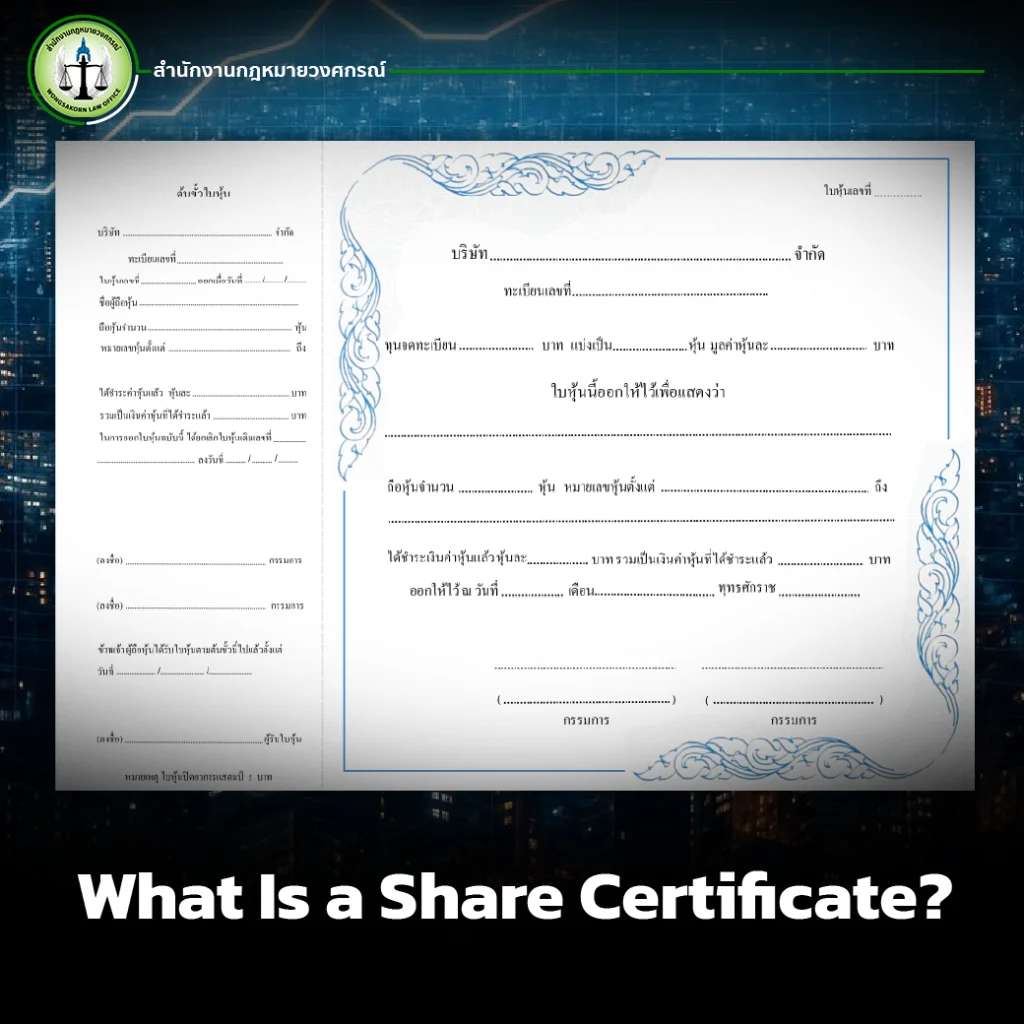
What Is a Share Certificate?

A share certificate is an important document issued by a company to a shareholder as evidence of ownership of shares in the company.

Simply put, when a person acquires shares in a company, the company has a duty to issue a share certificate confirming that such person is a shareholder holding the specified number of shares.

Important information commonly contained in a share certificate includes:

  • Company name
  • Juristic person registration number
  • Shareholder’s name
  • Number of shares
  • Share value
  • Share certificate number
  • Signature of the authorized director

A share certificate is therefore an important document that serves as direct evidence of a shareholder’s ownership rights in the company.

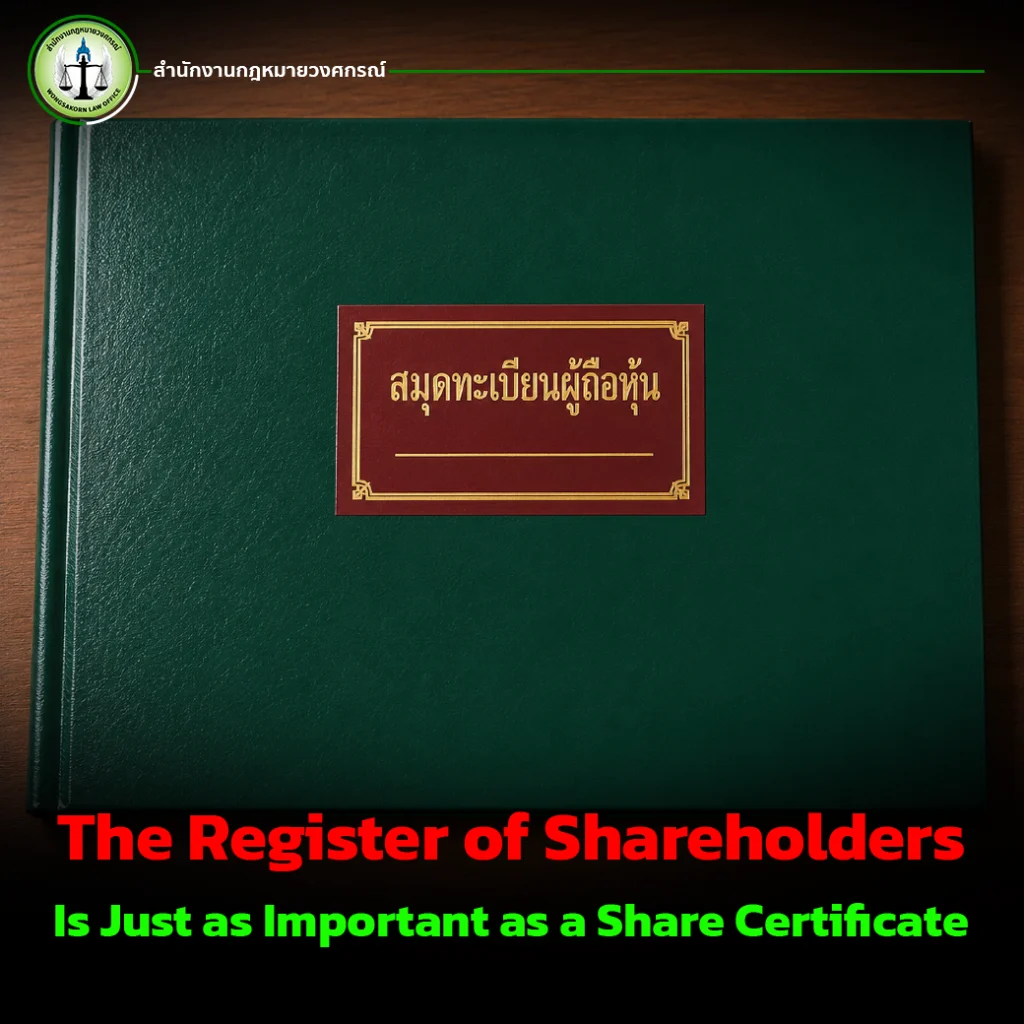
The Register of Shareholders Is Just as Important as a Share Certificate

In addition to share certificates, the law also requires a company to maintain a Register of Shareholders.

A Register of Shareholders is a document used to record the details of all shareholders in the company, including the number of shares held by each shareholder and any history of changes in share ownership.

This document is highly important because it serves as the company’s internal record for verifying the status of shareholders at any given time.

In practice, if a company does not maintain a Register of Shareholders, or if the register is not properly prepared and maintained, it may adversely affect the company’s management and the ability to establish shareholders’ rights in the future.

Why Do Many Companies Not Have Share Certificates?

One common issue is that business owners assume that once they receive the company registration documents or the company affidavit from the Department of Business Development, the company incorporation process is fully completed.

In reality, however, company registration and the preparation of the company’s internal corporate documents are two separate matters.

In many cases, when business owners consult company incorporation service providers or accounting firms, they are often told:

“No one ever uses share certificates.”

or

“The shareholder list (Bor.Or.Jor. 5) is sufficient.”

Such misunderstandings may cause company owners to have an incorrect understanding of the purpose and legal significance of each type of corporate document.

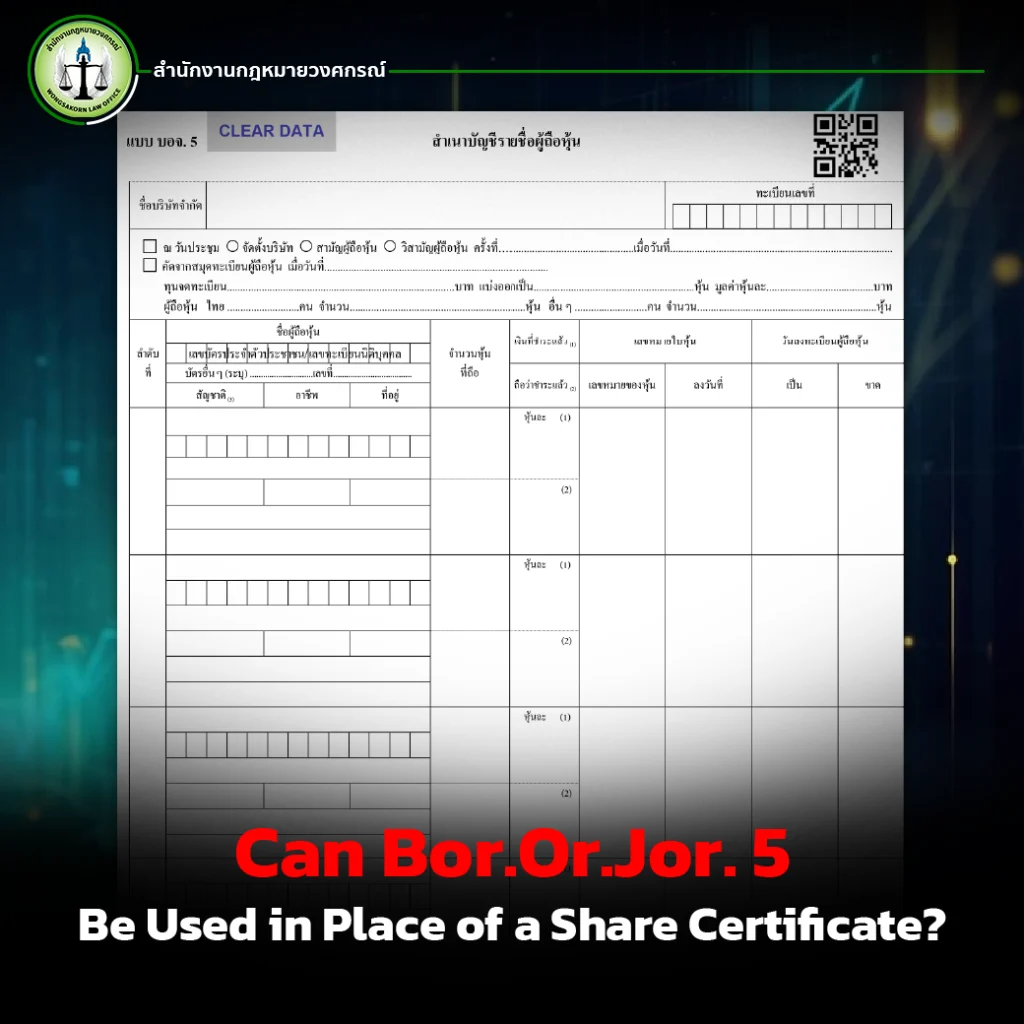
Can Bor.Or.Jor. 5 Be Used in Place of a Share Certificate?

The answer is no.

Form Bor.Or.Jor. 5 is merely a document relating to shareholder information that is filed with the Department of Business Development for the purpose of notifying the relevant government authority of such information.

However, Bor.Or.Jor. 5 is not a share certificate, nor is it an original document that directly certifies ownership rights in shares.

Therefore, if a dispute arises concerning share ownership, or if shares are transferred between shareholders, having only Form Bor.Or.Jor. 5 may not be sufficient to establish and prove the rights of each party.

What Risks Arise When Shares Are Sold Without a Share Certificate?

Under the law, the transfer of shares in a private limited company is not completed merely by entering into a share purchase agreement.

As a general rule, the transferor should deliver the share certificate to the transferee, and the company should properly record the change of share ownership in the Register of Shareholders.

If no share certificate has been issued from the outset, proving who the true owner of the shares is may become a matter of dispute in the future.

This is particularly problematic in cases involving disputes among shareholders, business partners, or the heirs of a shareholder.

These Documents Become Critical the Moment a Dispute or Legal Issue Arises

Many companies pay little attention to share certificates or the Register of Shareholders until a legal issue arises.

Examples include:

  • Shareholder disputes
  • Share transfers or share sale transactions
  • Changes in directors
  • Government inspections or regulatory reviews
  • Civil or criminal proceedings

When such situations occur, company owners often begin searching for the corporate documents that should have been prepared from the very first day of the company’s incorporation. However, in some cases, they discover that these documents were never prepared at all.

Should You Have a Legal Advisor Before Incorporating a Company?

Based on the experience of Wongsakorn Law Firm, company incorporation is not merely a matter of completing the registration process.

It also requires proper legal structuring and the preparation of all necessary internal corporate documents in accordance with the law.

Having a lawyer as a legal advisor from the outset can help determine whether:

  • Share certificates have been properly issued;
  • A Register of Shareholders has been properly prepared and maintained;
  • The company’s internal corporate documents comply with legal requirements; and
  • Future share transfers can be carried out safely and effectively.

These matters may appear to be minor details today, but they can significantly reduce the risk of disputes and prevent substantial business losses in the future.

Wongsakorn Law Firm Is Ready to Provide Corporate Legal Consultation

If you are in the process of incorporating a company, reviewing shareholder documents, or have questions regarding share certificates, the Register of Shareholders, or share transfers in a private limited company, Wongsakorn Law Firm is ready to provide comprehensive legal consultation and corporate document review services. Click >> Contact Us <<

Because having the proper documents in place from the very first day is always better than attempting to resolve legal issues after a dispute arises. Proper legal documentation also helps ensure that a business can operate smoothly and securely in compliance with applicable laws.

What is Blackmail? If You Voluntarily Sent Private Photos, Can You Still Take Legal Action Against Someone Who Threatens You for Money?

Today, communication through online platforms has become a normal part of life for many people, whether for chatting, doing business, or even applying for loans online. However, such convenience also comes with risks that many people may not expect, especially becoming a victim of blackmail, or being threatened for property through the use of another person’s private information.

Recently, a victim contacted Wongsakorn Law Firm for legal advice after becoming a victim of deception and being threatened for money using private photos and video clips that had previously been sent to a person known through an online platform.

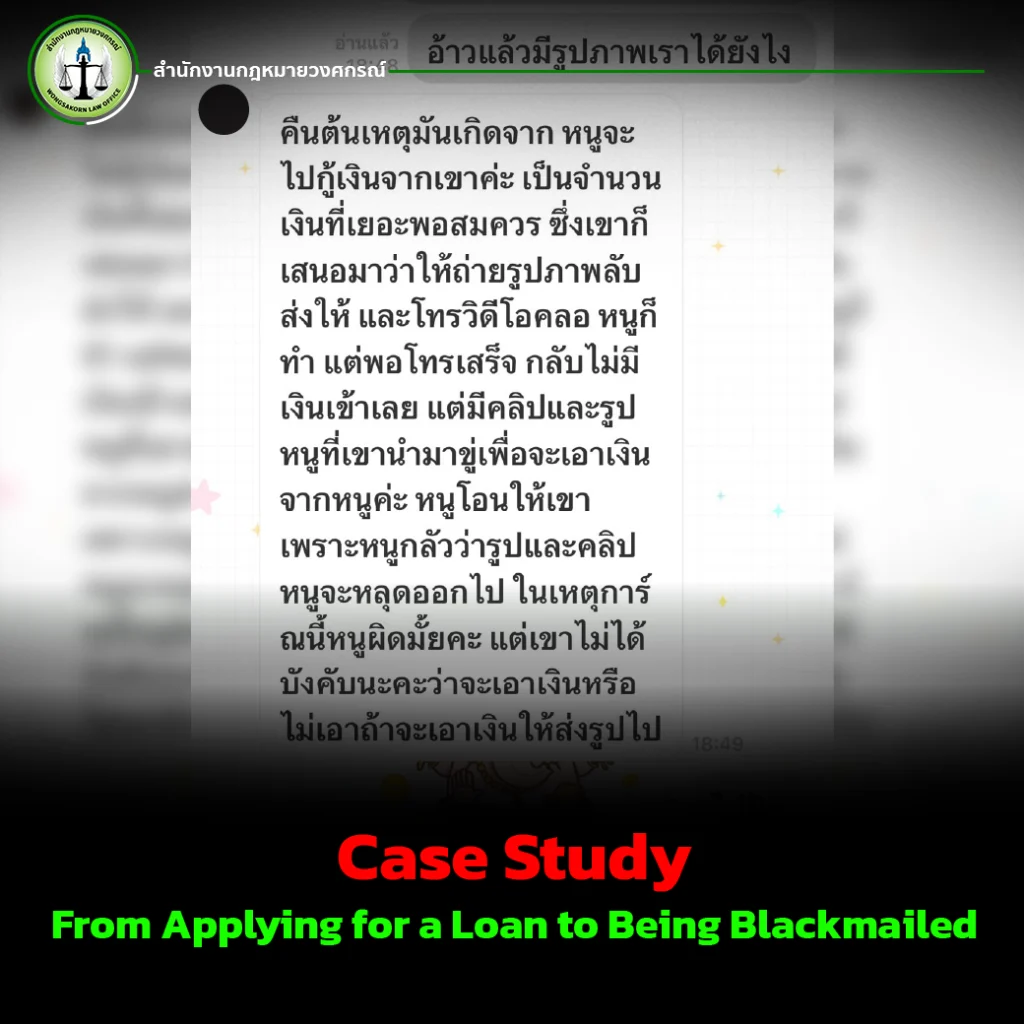
Case Study: From Applying for a Loan to Being Blackmailed

The victim needed money and therefore contacted a person known through an online platform to apply for a loan.

During their conversation, the other party proposed a condition that, in order to obtain loan approval, the victim would have to send private photos and participate in a private video call for consideration in the lending process.

Out of trust and necessity, the victim complied with that condition. However, after sending the photos and participating in the video call, the victim did not receive the loan as agreed.

The matter did not end there. After that, the other party used the photos and private video clips received as a tool for making threats, claiming that if the victim did not transfer money, those photos and clips would be shared with other people.

Fearing embarrassment and damage to reputation, the victim transferred money several times as demanded.

If You Voluntarily Sent the Photos, Does That Mean the Victim Is at Fault?

This is a question that concerns many victims.

Many people believe that if they voluntarily sent photos or personal information to another person, they would not be able to take legal action against that person, or they might themselves be considered to be at fault.

However, in reality, the key issue is not simply the act of sending photos or personal information.

What must be considered is the subsequent conduct of the person who received that information.

If that person uses photos, video clips, or personal information as a tool to threaten, demand money, or force the victim to do anything for their own benefit, such conduct may constitute a criminal offence.

In other words, in cases of this nature, the victim is the person who was deceived and threatened, not the person who committed the act of threatening and demanding money.

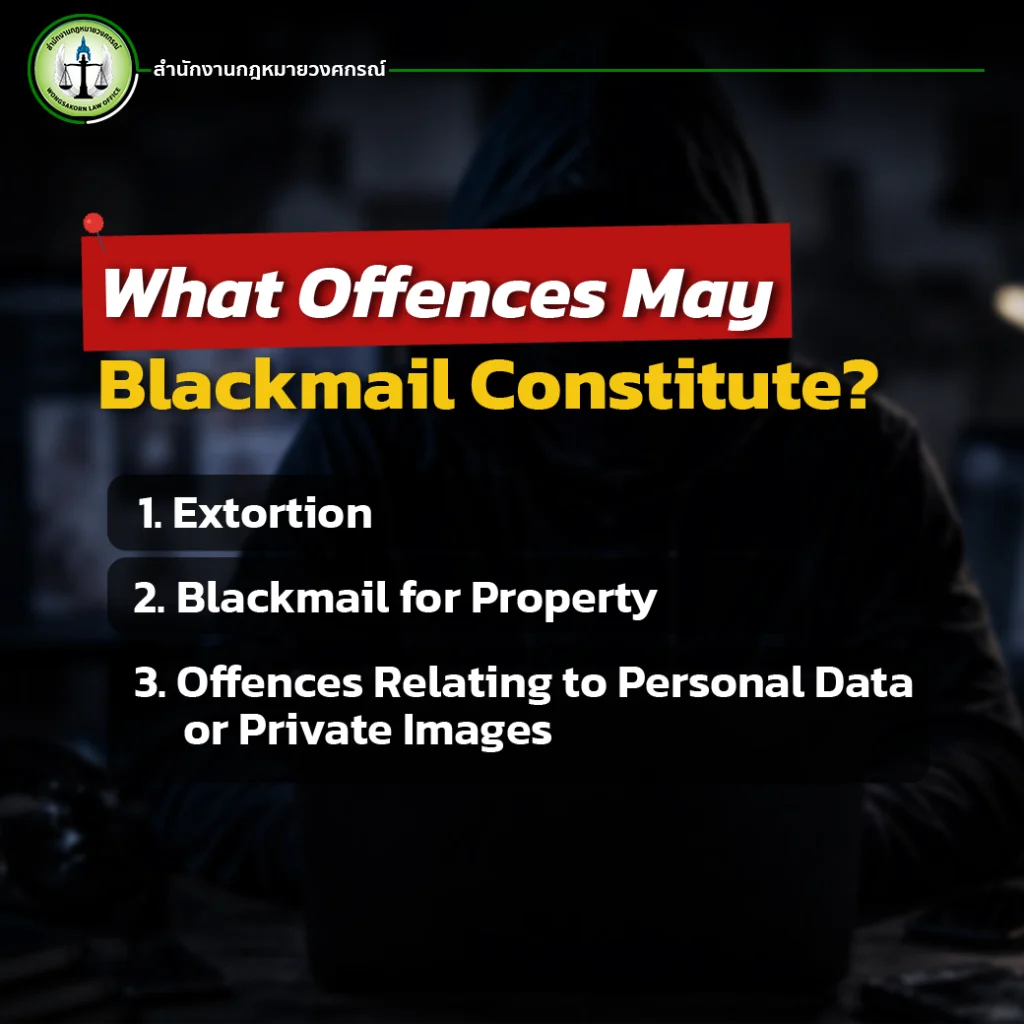
Although the term “Blackmail” is commonly used, under Thai law such conduct may fall under several offences, depending on the facts of each case.

For example:

1. Extortion

Where there is a threat to cause damage to the victim’s reputation, property, or rights in order to make the victim hand over money or property.

2. Blackmail for Property

Where threats or coercion are used to obtain property or benefits from the victim.

3. Offences Relating to Personal Data or Private Images

If photos or personal information are distributed, forwarded, or disclosed to the public without consent, there may be additional legal liability depending on the facts of each case.

Therefore, even if the victim voluntarily sent photos or video clips, it does not mean that the other party has the right to use such information to threaten or obtain benefits from the victim.

What Should You Do If You Are Being Blackmailed?

The most important thing is: “Do not delete the evidence.”

The victim should collect and keep all relevant information, such as:

  • Chat messages
  • Screenshots of the threats
  • Proof of money transfers
  • Recipient bank account details
  • Social media account information
  • Links or contact channels of the perpetrator

These pieces of evidence are extremely important for legal proceedings and for tracing the perpetrator.

In addition, a lawyer or legal professional should be consulted as soon as possible before taking any action, in order to plan the reporting process and properly protect one’s rights.

Do Not Let Fear Make You a Victim Again

From the experience of Wongsakorn Law Firm in providing legal consultations, it has been found that many victims choose to pay money as demanded because they fear that their photos or personal information will be disclosed.

However, in many cases, paying money does not bring the problem to an end. Instead, it creates an opportunity for the perpetrator to continue demanding more money.

If you are facing blackmail, being threatened for money using photos or private video clips, or being deceived through online channels, you should consult a legal professional as soon as possible.

Wongsakorn Law Firm provides legal consultation on blackmail cases, cases involving threats to obtain money, online-related cases, and related criminal proceedings, in order to plan the direction of the case, protect your rights, and reduce possible future damage. For legal consultation, click >>Contact Us<<

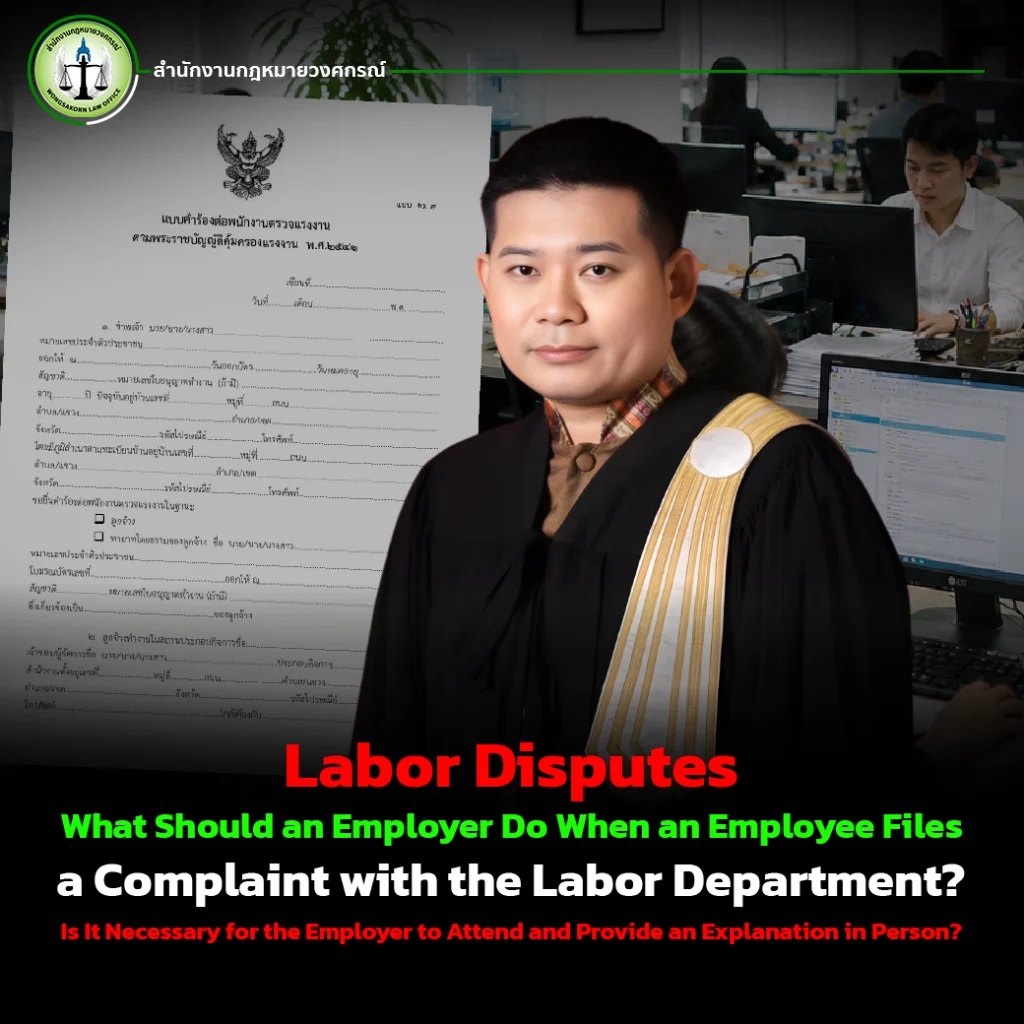
Labor Disputes: What Should an Employer Do When an Employee Files a Complaint with the Labor Department? Is It Necessary for the Employer to Attend and Provide an Explanation in Person?

Labor disputes are one of the most significant risks faced by business owners and employers, regardless of whether they operate a small business, a medium-sized enterprise, or a large organization. Even with careful management, disagreements between employers and employees can arise at any time.

When a dispute occurs, one of the most common ways employees seek to enforce their rights is by filing a complaint with the Department of Labour Protection and Welfare, commonly referred to as “filing a complaint with the Labor Department.”

However, once an employer receives a summons or notice from a Labor Inspector, what steps should be taken? Is the employer required to appear and provide explanations in person? If attending is inconvenient, are there alternative options available? This article from Wongsakorn Law Firm provides the answers.

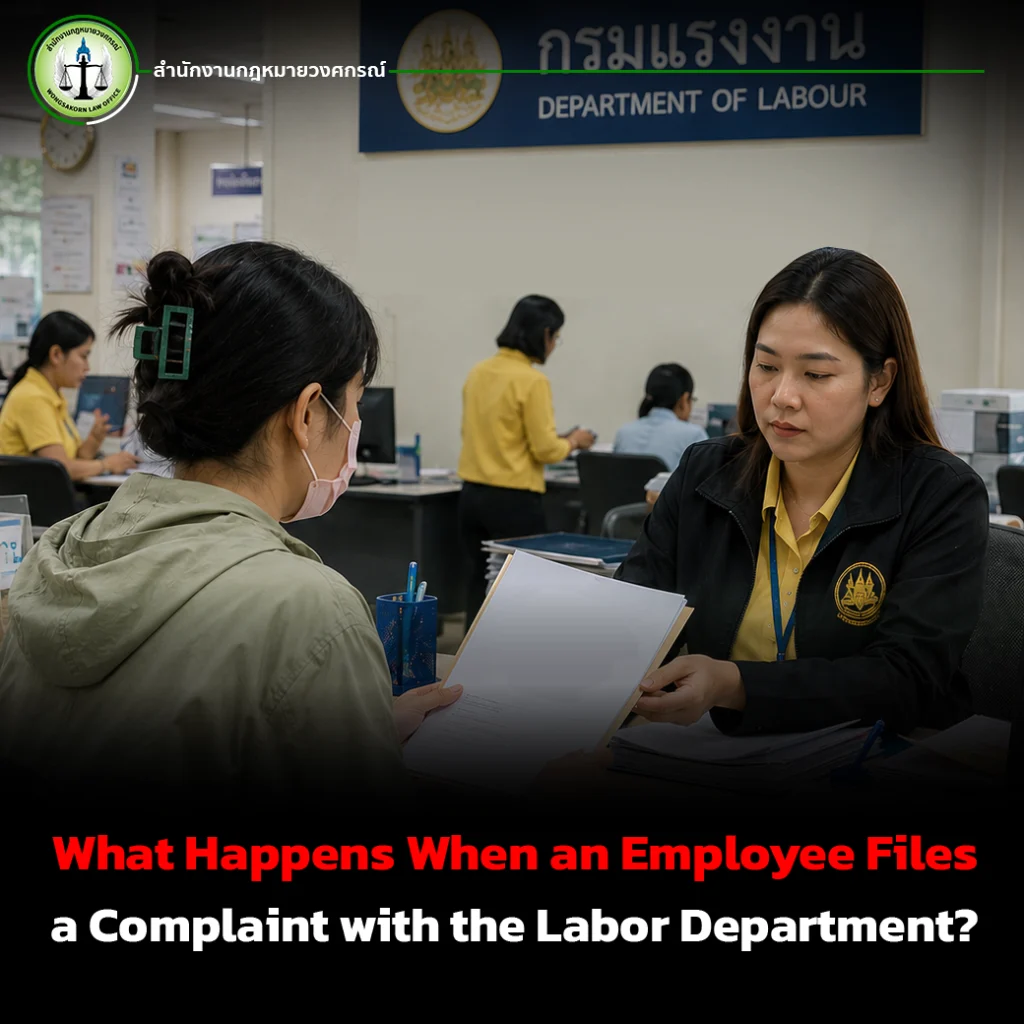
What Happens When an Employee Files a Complaint with the Labor Department?

When a complaint relating to labor rights is filed, a Labor Inspector will review the facts of the case and may issue a notice requiring the employer to provide an explanation or submit relevant documents for consideration.

Common complaints include:

  • Unpaid wages
  • Overtime pay (OT)
  • Severance pay upon termination
  • Special compensation
  • Leave and holiday entitlements
  • Unfair dismissal
  • Employee rights and benefits under labor law

Upon receiving a notice from the Labor Inspector, employers should not ignore or overlook it, as doing so may affect the consideration of the facts and their legal rights at a later stage.

If the Employer Is Unable to Attend, Can a Lawyer Be Authorized to Act on Their Behalf?

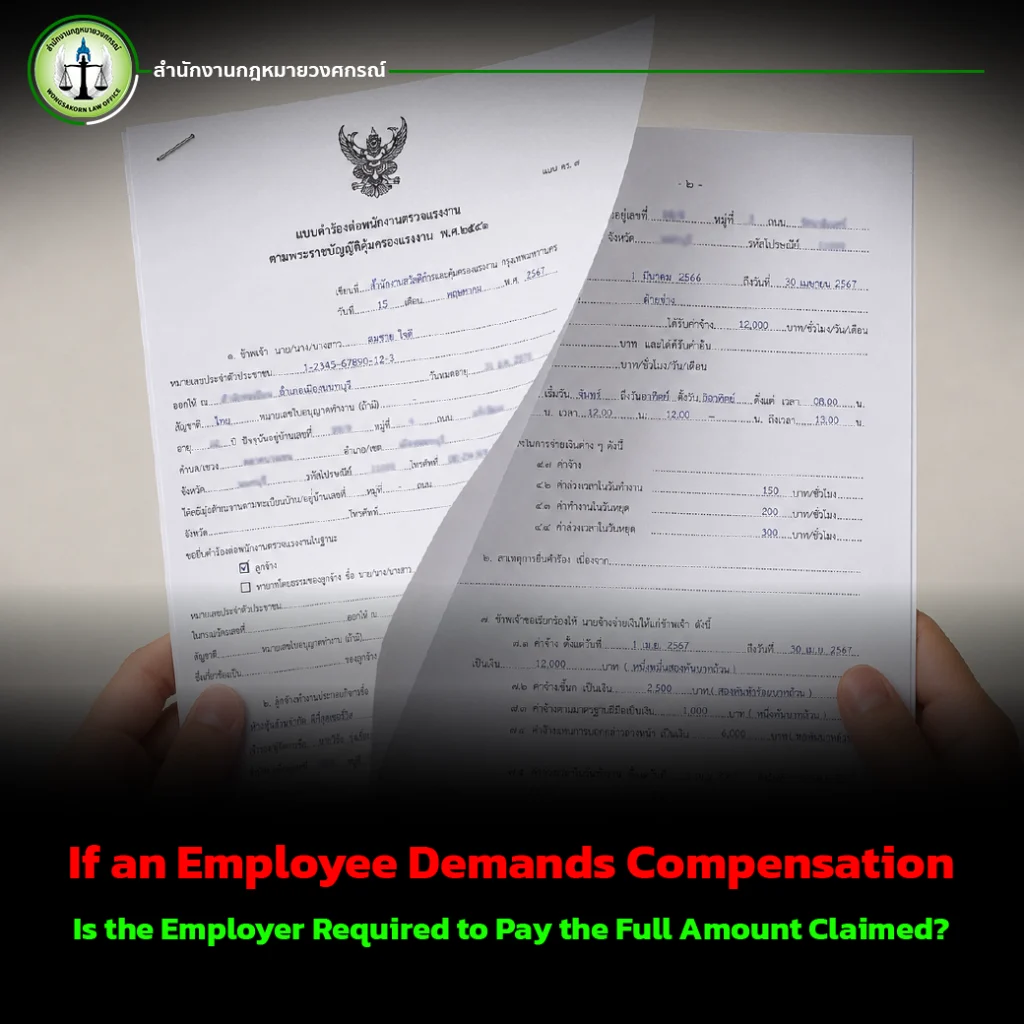
One of the most common misconceptions is that once an employee files a complaint and specifies the amount they are seeking, the employer is automatically required to pay the full amount claimed.

In reality, an employee’s claim is merely an initial allegation or demand.

The relevant authorities will consider:

  • The facts of the particular case
  • Documentary evidence
  • The employment agreement
  • The company’s rules and regulations
  • Witness testimony and documentary evidence
  • Applicable labor laws

Therefore, the fact that an employee claims a certain amount of money does not necessarily mean that the employer will be liable for that amount. If there are facts or evidence showing that the employer has complied with the law, the employer has the right to provide explanations and contest the claim.

Why Should Labor Issues Be Addressed from the Beginning?

Based on Wongsakorn Law Firm’s experience in providing labor law consultation, many organizations only seek legal assistance after a dispute has already arisen.

In reality, most labor-related problems can be prevented before they occur through the implementation of proper labor law compliance and internal employment systems.

Examples include:

  • Preparing comprehensive employment agreements
  • Establishing workplace rules and regulations
  • Implementing employee disciplinary policies
  • Managing leave and holiday entitlements properly
  • Ensuring accurate payment of wages and overtime compensation
  • Establishing legally compliant termination procedures

When an organization has proper systems in place from the outset, the likelihood of labor disputes arising with employees can be significantly reduced.

Why Should Every Organization Have Legal Counsel?

Today, labor laws are becoming increasingly complex and subject to ongoing changes. As a result, personnel management is no longer solely a human resources function, but also a matter that directly affects an organization’s legal risk exposure.

Having legal counsel as part of the organization can help businesses:

  • Prevent problems before disputes arise
  • Review important legal documents
  • Provide legal guidance before making termination decisions
  • Reduce the risk of litigation
  • Establish legally compliant human resource management systems
  • Address other legal issues that may arise in the future

Which is significantly less costly than resolving problems after legal proceedings have already commenced.

Wongsakorn Law Firm Is Ready to Assist with Your Organization’s Labor Law Matters

If your organization has received a notice from the Labor Department, is currently facing a dispute with an employee, or has concerns regarding labor law compliance, Wongsakorn Law Firm is ready to provide legal advice and develop appropriate solutions tailored to your situation.

Our services include representing employers in meetings and proceedings before government authorities, reviewing labor-related documents, drafting employment agreements, establishing human resource management systems, and serving as ongoing legal counsel for organizations.

Because the best labor dispute is the one that is prevented before it arises.

Having legal counsel from the very beginning is one of the most effective tools for helping organizations operate with confidence, reduce legal risks, and prepare for future labor-related challenges.

For legal consultation, click >> Contact Us <<.

Can Foreigners Register a Usufruct Over Land in Thailand? An Important Legal Option That Many People Still Do Not Know About

One of the major issues faced by many foreigners who come to live in Thailand is the legal restriction on land ownership. Under Thai law, foreigners are generally not permitted to own land in the same way as Thai nationals. As a result, many people are concerned about how they can legally use land in Thailand if they wish to live, invest, engage in agriculture, or operate a business.

However, although foreigners cannot directly own land, Thai law provides legal mechanisms that can help protect their rights to use and benefit from land in a lawful manner. One such mechanism is a usufruct.

This article by Wongsakorn Law Firm will help you understand what a usufruct is and why many foreigners choose this legal option when planning to live in or invest in Thailand.

What Is a Usufruct Over Land?

A usufruct is a real right recognized under Thai law that allows a person to use and enjoy land or other immovable property owned by another person, including the right to receive benefits derived from that property.

Simply put, even though the usufructuary is not the owner of the land, they are legally entitled to use and benefit from it within the scope permitted by law.

Examples include:

  • Living on the land
  • Operating a farm, plantation, or agricultural business
  • Conducting business activities on the land
  • Leasing out the property and collecting rental income
  • Benefiting from crops, produce, or other income generated from the land

For this reason, a usufruct has become a popular option for foreigners who wish to live in Thailand on a long term basis.

Foreigners and Land Owned by a Thai Spouse

Many families with spouses of different nationalities encounter challenges in managing property ownership, particularly when purchasing land in Thailand.

Since Thai law requires land ownership to be registered in the name of a Thai national, land is often registered under the name of the Thai spouse.

However, even if the land title is registered in the Thai spouse’s name, a foreign spouse may still register a usufruct over the land.

Once the usufruct has been properly registered, the foreigner will have legally recognized rights to use and enjoy the land, even though they are not the legal owner.

How Does a Usufruct Protect Foreigners?

One of the key benefits of registering a usufruct is that it provides security and stability in the use of the land.

For example, if a foreigner lives on land owned by their Thai spouse and has registered a usufruct, their right to use the land remains protected by law even if relationship issues arise in the future or the couple separates.

The landowner cannot terminate the usufruct at will and cannot evict the usufructuary from the land as long as the usufruct remains legally valid and in force.

In addition, if the owner wishes to sell the land, any new purchaser will be required to accept the existing registered usufruct. As a result, the transfer or sale of the land may become more restricted unless the usufructuary agrees to the transaction.

How Long Does a Usufruct Last?

In general, a usufruct may be granted for a period permitted by law, or it may be established for the lifetime of the usufructuary.

In cases where a lifetime usufruct is registered, the right will automatically terminate upon the death of the usufructuary.

For this reason, many foreigners choose to register a usufruct as a legal tool for long term residential planning in Thailand.

Should You Consult a Lawyer Before Registering a Usufruct?

Although a usufruct is a right recognized under Thai law, the details of the agreement, its conditions, and the registration process are extremely important.

If the registration is not carried out properly, disputes may arise in the future, such as:

  • Disputes between spouses
  • Issues relating to the transfer of land ownership
  • Problems involving the sale of the property
  • Disagreements regarding the scope of rights and permitted use of the land

Seeking legal advice from a lawyer from the outset can help ensure that the legal structure of the land rights is established correctly and that the interests of all parties are properly protected.

Wongsakorn Law Firm Is Ready to Advise on Land Rights and Usufructs

If you are a foreigner who wishes to live in Thailand, or a Thai spouse seeking to structure land ownership and land use rights in a lawful manner, registering a usufruct may be a suitable option for you.

However, every case involves different legal considerations, and inadequate planning may affect your property rights in the future.

Wongsakorn Law Firm has experience in providing legal advice on land law, usufructs, rights of habitation, and property structuring for both Thai and foreign clients.

If you would like more information about registering a usufruct over land, please contact Wongsakorn Law Firm through our Contact Us page to receive legal advice and guidance tailored specifically to your circumstances.

What Is a Private Investigator? Why Are Both Individuals and Organizations Increasingly Using Investigation Services Today?

A private investigator is a professional whose role is to locate, verify, and gather information or facts based on a client’s objectives in order to obtain accurate information that can be used to support informed decision-making.

In today’s world, information plays a critical role in decision-making, whether in personal matters, business operations, or legal disputes. Access to accurate facts is more important than ever. In many cases, relying on assumptions or information from only one side can result in legal or financial consequences. For this reason, private investigators have become an important resource for uncovering the truth and gathering evidence in a systematic and professional manner.

Wongsakorn Law Firm provides private investigator and fact-finding services in a wide range of matters. Our services emphasize accuracy, confidentiality, and compliance with the law, helping clients obtain clear and reliable information before making important decisions.

The Important Role of Private Investigators in Today’s World

In the past, many people viewed private investigators as professionals whose primary responsibility was simply to follow or monitor individuals. Today, however, the role of a private investigator extends far beyond surveillance and encompasses a wide range of personal, family, business, and legal matters.

Why Do People Use Private Investigator Services?

People choose to hire private investigators for a variety of reasons, including:

  • To verify facts before initiating legal proceedings
  • To obtain information for informed decision-making
  • To locate assets or track individuals
  • To assess the credibility of business partners
  • To gather evidence in disputes or legal conflicts

Having accurate information from the outset can help reduce risks and prevent potential losses or damages in the future.

Wongsakorn Law Firm’s Private Investigator Services

Wongsakorn Law Firm provides private investigation and information verification services in a variety of forms, with a focus on professionally uncovering the facts.

Popular Investigation Services

  • Family and relationship investigations
  • Fact-finding investigations for legal cases
  • Debtor tracing and asset investigations
  • Background checks on individuals
  • Employee conduct investigations
  • Internal fraud investigations
  • Due diligence on business partners and contracting parties
  • Information gathering for legal proceedings

Whether for personal matters or business-related concerns, our team is committed to conducting investigations carefully and confidentially in accordance with our clients’ objectives.

Family and Relationship Investigations

One of the most frequently requested services is family and relationship investigations, which often involve situations where clear and accurate facts are needed before making important decisions or pursuing legal action.

Common Family Cases That Require Private Investigation Services

  • Investigating a spouse’s behavior
  • Gathering facts and evidence for divorce proceedings
  • Verifying matters relating to child care and custody
  • Obtaining information about individuals involved in family disputes

Having accurate information helps individuals make decisions based on facts rather than suspicion or assumptions.

Private Investigators for Businesses and Organizations

OToday, the business sector places greater importance on risk management. As a result, verifying information before making business decisions has become essential.

Examples of business investigation services include:

  • Background checks on executive-level job applicants
  • Investigations into internal fraud within organizations
  • Investigations of breaches of business agreements
  • Verification of assets and financial status
  • Due diligence on business partners and associates

Accurate information can help reduce business risks, minimize potential losses, and increase confidence in organizational decision-making.

Why Choose a Private Investigator Working with a Law Firm?

A key advantage of using private investigation services through a law firm is receiving both factual insights and legal guidance together.

Benefits for Clients:

  • Investigations conducted with consideration of future legal use
  • Analysis of facts by legal professionals
  • Strict client confidentiality
  • Systematic collection of information and evidence
  • Legal advice on appropriate next steps

Wongsakorn Law Firm is therefore able to assist clients from fact-finding to developing suitable legal strategies.

Frequently Asked Questions About Private Investigator Services (FAQ)

What can a private investigator investigate?
Private investigators can gather facts in a wide range of matters, including family disputes, relationships, assets, debtors, business matters, employee issues, and background checks on individuals.

Is it legal to hire a private investigator?
Hiring a private investigator is legal as long as the investigation is conducted within the boundaries of the law and does not violate the rights of others.Can information collected by a private investigator be used in court cases?
It depends on the nature of the information and the manner in which the evidence is obtained. Therefore, it is recommended to seek advice from a legal professional for proper guidance.

What Types of Cases Does Wongsakorn Law Firm Handle?

Wongsakorn Law Firm provides investigation services for all types of fact-finding matters, including family issues, assets, debtors, business matters, employees, as well as information related to legal disputes and important decision-making processes.

If you are looking for a professional private investigator who can help uncover the truth and verify facts in a systematic way, Wongsakorn Law Firm is ready to provide consultation and investigation services under the principles of accuracy, confidentiality, and legal compliance.               This ensures that you receive clear and reliable information before making any important personal or business decisions. Professional private investigator services by Wongsakorn Law Firm. Click >> Contact Us <<

What Is a Private Investigator? Why in 2026 Are Both Individuals and Business Owners Increasingly Using Investigation Services?

In today’s world, many surrounding problems have become far more complex, whether they involve family matters, business disputes, financial issues, or personal relationships. In many situations, relying only on “feelings” or “assumptions” is no longer enough to uncover the truth. This is one of the main reasons why private investigation services have become increasingly important in Thai society.

Wongsakorn Law Firm is one of the firms that provides private investigation and information-gathering services in a wide range of cases. The firm focuses on conducting investigations systematically, carefully, and within the framework of the law in order to help clients obtain information, facts, and evidence that can be appropriately used for legal or personal purposes.

What Are the Duties of a Private Investigator?

Many people may believe that a private investigator’s role is limited to following or surveilling individuals. In reality, investigative work involves far more detailed responsibilities than that.

The primary duties of a private investigator include:

  • investigating facts,
  • verifying information,
  • monitoring behavior,
  • gathering evidence, and
  • analyzing information related to legal cases or disputes.

The purpose is to help clients discover the actual facts so that the information can later be used for decision-making or legal proceedings.

What Types of Investigation Services Does Wongsakorn Law Firm Provide?

Wongsakorn Law Firm provides investigation and information-gathering services in a variety of forms based on each client’s needs, with a strong emphasis on professionalism and strict confidentiality.

Examples of investigation services include:

Family and Relationship Investigations

Family-related issues are highly sensitive, and in many situations, individuals are unable to uncover the truth on their own.

Services in this category include:

  • investigating a spouse’s behavior,
  • verifying personal relationships,
  • investigating affairs or infidelity,
  • tracking individuals, and
  • examining suspicious behavior.

The goal is to provide clients with clear facts before they make important decisions in the future.

Business and Corporate Investigations

Today, many business owners are increasingly turning to investigation services because internal corporate problems have become more complex than ever before.

Examples include:

  • employee fraud,
  • unauthorized disclosure of company information,
  • employees competing against their employer,
  • business partners concealing information,
  • background checks on business partners, and
  • investigation of investment-related information.

This type of information is extremely important for business operations because if left unresolved, it may cause serious long-term damage to the organization.

Asset and Debtor Investigations

In some cases, debtors attempt to avoid repayment obligations or conceal assets.

Wongsakorn Law Firm also provides investigation services relating to:

The purpose is to help creditors use the information effectively in legal proceedings and related actions.

Why Use Investigation Services Together with a Law Firm?

One major advantage of using investigation services through a law firm is the coordinated work between:

  • the legal team,
  • lawyers, and
  • investigators.

This is because information or evidence obtained through investigations may later need to be used in:

  • civil cases,
  • criminal cases,
  • labor disputes,
  • family cases, or
  • business-related litigation.

Therefore, when investigations are conducted alongside legal analysis from the very beginning, the investigation can proceed with clearer direction, and the information obtained can be effectively used for legal purposes.

Is Private Investigation Legal?

Another question many people often ask is whether using private investigation services is legal.

In reality, investigative services can legally be conducted, provided that the investigation is carried out within the boundaries of the law and does not excessively violate the rights of others.

At Wongsakorn Law Firm, our investigation services place great importance on:

  • legal compliance,
  • client confidentiality, and
  • professional ethics.

This is to ensure that clients receive services that are both safe and appropriate.

Why Are Private Investigators Important in 2026?

In an era where information can easily be concealed or distorted, having access to the truth has become extremely important.

Many people today:

  • are placed at a disadvantage in business,
  • become victims of deception,
  • have important facts hidden from them, or
  • are unable to obtain evidence on their own.

As a result, using private investigation services can help reduce risks and allow people to make decisions based on verified facts rather than assumptions.

Before Taking Legal Action, You Should Always Have Clear Information First

Many people rush into filing lawsuits or taking legal action before having sufficient information.

As a result, they may ultimately waste time, incur unnecessary expenses, or even end up at a disadvantage in the case.

Therefore, before taking any legal steps, investigating the facts and gathering accurate information are extremely important.

Wongsakorn Law Firm Provides Comprehensive Investigation Services

Wongsakorn Law Firm provides private investigator services for both individuals and businesses, with a strong focus on:

  • attention to detail,
  • strict confidentiality,
  • professional operations, and
  • coordinated analysis with the legal team.

Whether the matter involves:

  • family issues,
  • business-related matters,
  • debtor investigations, or
  • fact verification,

you may directly consult Wongsakorn Law Firm for assistance.

Private Investigators Are No Longer a Distant Concept

Today, private investigator services are no longer used only for major cases or highly complex matters. They have become an important tool for uncovering the truth and protecting one’s own interests.

Because in many situations, “the truth” is the most important thing.

Having a professional private investigator team working together with a legal team may help you: 

  • reduce risks,
  • prevent potential damage, and
  • make decisions with greater confidence in every situation.

Professional private investigator services by Wongsakorn Law Firm. Click >> Contact Us <<

Is the OIC Truly Fast and Fair? Another Perspective from the Real Experience of Lawyer Arm Supasit

Many people who purchase insurance, whether life insurance, health insurance, or motor insurance, are familiar with the “OIC,” or the Office of Insurance Commission, as the agency responsible for regulating the insurance business in Thailand, as well as protecting the rights of consumers who hold all types of insurance policies.
But the important question is:

Is the OIC Truly Fast and Fair?

This is another perspective from Lawyer Arm Supasit of Wongsakorn Law Firm, who would like to reveal facts based on direct experience so that the public can think, analyze, and gain a better understanding of the OIC’s processes before deciding to enter arbitration proceedings.
What Is the OIC? What Are Its Responsibilities?

Many people may still not fully understand that the OIC is the agency responsible for regulating all insurance businesses in Thailand, including:

  • Health insurance
  • Life insurance
  • Motor insurance
  • Accident insurance
  • Property insurance
  • As well as all other types of insurance

The OIC’s main responsibilities are to:

  • Supervise insurance companies
  • Protect consumers
  • Receive complaints
  • Conduct arbitration proceedings in certain cases

At first glance, it may seem like an agency that fully supports and assists the public. However, once people enter the actual process, many begin to question whether it is truly “fast and fair” as promoted.

What Is OIC Arbitration?

When members of the public visit the OIC website, they will find a description of “arbitration” as a process that is:

  • Fast
  • Fair
  • Cost-effective

The phrase “fast and fair” immediately gives many people confidence because the general public naturally understands that if a dispute arises with an insurance company, this process should help them obtain justice quickly.

However, from the perspective of Lawyer Arm Supasit, the following questions are raised:

“What does speed really mean?”

And more importantly:

“Who determines what is fair?”

Even Lawyer Arm Supasit himself believes that the meaning of the word “fair” is something that is very difficult to define in practice.

Revealing the Actual Timeline of a Case at Wongsakorn Law Firm

To help the public see the process more clearly, Lawyer Arm Supasit shared a real case handled by Wongsakorn Law Firm.

Step 1: Submission of the Petition
8 May 2025
The OIC accepted the arbitration petition.

Step 2: First Hearing Appointment
17 June 2025
The first hearing was scheduled.

Many people may ask: Was that fast?

From the perspective of the general public, some people may feel that this already took quite a long time.

From the first hearing to the appointment of the arbitrator, the process took another month.

After 17 June 2025, the parties had to wait until:

18 July 2025

to appoint the arbitrator, or the neutral party who would decide the dispute.

The question is:

Why did appointing the neutral decision-maker alone take almost another full month?

This is one of the observations raised by Lawyer Arm Supasit, who believes that if something is described as “fast,” each person’s standard of what counts as fast may be different.

Preliminary Hearing, Witness Examination, and Waiting for the Award

After the arbitrator was appointed, the next stage was the preliminary hearing, which is the stage used to:

  • Define the disputed issues
  • Determine what evidence the consumer would present
  • Determine what arguments the insurance company would raise in response

After that, the process moved into the witness examination hearing.

However, reaching this stage required waiting until:

8 October 2025

A simple calculation shows that from June to October, the process took approximately four months.

When Was the Arbitration Award Issued?

After the witness examination was completed on 8 October 2025, the arbitration award was issued on:

12 February 2026

Meanwhile, the OIC had already received the arbitration award on:

6 February 2026

When calculating the total period from the submission of the petition to receiving the arbitration award, the process took many months.

The question therefore returns:

Can this truly be considered “fast”?

The Meaning of Speed for the Public and for an Agency May Not Be the Same

From the perspective of the general public, the word “fast” may mean:

  • Not having to wait for several months
  • Not having to spend a long time going through procedures
  • Receiving an answer quickly

However, from the perspective of an institutional process or the arbitration system, there may be a different standard.

Therefore, Lawyer Arm Supasit would like the public to:

  • Analyze it for themselves
  • Compare it for themselves
  • And decide for themselves whether the process is truly fast

The Agency Says It Is Cost-Effective. Is That Really True?

Another phrase that the public often sees is “cost-effective.” However, based on a real case handled by Wongsakorn Law Firm, the total cost came to approximately:

THB 12,800

And simply to begin the process, the party submitting the arbitration petition was required to pay an initial filing fee of:

THB 10,000

This means that the process is not free, as many people may understand.

From the perspective of the general public, the word “fast” may mean:

  • Not having to wait for several months
  • Not having to spend a long time going through procedures
  • Receiving an answer quickly

However, from the perspective of an institutional process or the arbitration system, there may be a different standard.

Therefore, Lawyer Arm Supasit would like the public to:

  • Analyze it for themselves
  • Compare it for themselves
  • And decide for themselves whether the process is truly fast

The Agency Says It Is Cost-Effective. Is That Really True?

Another phrase that the public often sees is “cost-effective.” However, based on a real case handled by Wongsakorn Law Firm, the total cost came to approximately:

THB 12,800

And simply to begin the process, the party submitting the arbitration petition was required to pay an initial filing fee of:

THB 10,000

What Should the Public Do When They Have a Problem with an Insurance Company?

The most important thing is not to make a decision based solely on advertising messages or short descriptions.

Whether it is claims such as:

  • Fast
  • Fair
  • Cost-effective

Because in reality, every case has different details and circumstances.

Why Should You Consult a Lawyer Before Entering the OIC Process?

Many people only consult a lawyer after they have already:

  • Entered the process
  • Paid the fees
  • Spent several months waiting

Even though proper planning from the beginning is extremely important.

Because a lawyer can:

  • Analyze which process is the most appropriate
  • Assess the chances of success in the case
  • Develop the legal strategy for the case
  • Help prevent the client from being placed at a disadvantage

Especially in insurance disputes, where insurance companies often have legal teams involved from the very beginning.

Is the OIC Truly Fast and Fair? Let the Public Decide

This article from Wongsakorn Law Firm is not intended to criticize any agency. Its purpose is to reflect another perspective based on real experience so that the public can gain a better understanding of the OIC process.

Because in the end, the terms:

  • “Fast”
  • “Fair”
  • “Cost-effective”

may carry different meanings depending on each person’s perspective.

Therefore, before entering any insurance-related process, people should carefully study all available information and consult a lawyer with direct experience in this area in order to avoid wasting time, incurring unnecessary expenses, and being placed at a disadvantage in the future.

For consultation with Lawyer Arm Supasit, click >> Contact Us <<

 Does the OIC Really Help the Public? The Truth Policyholders Need to Know About Why Many People Unknowingly End Up at a Disadvantage

When people talk about insurance, most assume that if an accident or damage occurs, the agency responsible for helping the public is the OIC, or the Office of Insurance Commission, which oversees the insurance industry in Thailand.

However, in reality, there are many things that the public may not know, especially regarding the process of filing complaints or claiming compensation from insurance companies. In many cases, policyholders or injured parties unknowingly end up at a disadvantage.

Recently, Lawyer Arm Supasit of Wongsakorn Law Firm shared real stories about the complaint process with the OIC that many people may never have known before. This is important information for everyone who has insurance.


When Filing a Complaint with the OIC but Being Told “The Officer Cannot Make a Decision”

หOne real issue that often occurs is when an injured party or policyholder files a complaint with the OIC, only to be told by the officer that:

“The officer cannot make a decision.”

The officer may then recommend that the person proceed through:

  • arbitration proceedings, or
  • court proceedings.

At first glance, this may seem normal. However, in reality, the issue is far more complex than many people realize.

Lawyer Arm Supasit believes that the public should not immediately believe everything without careful consideration. In some cases, officers may provide accurate information, but in other situations, matters should still be analyzed thoroughly.

The key problem is this: if an ordinary person has no legal knowledge, how can they determine:

  • what should be trusted, and
  • what should be further examined?

This is exactly why many injured parties unknowingly end up at a disadvantage.

Arbitration Proceedings: The Process Many People Believe Will Help

Most insurance policies contain provisions stating that:

the injured party or claimant has the right to choose to proceed through arbitration.

The important question is:

if the law or the insurance contract gives policyholders or injured parties the right to choose this process, why do problems often arise once they actually enter the proceedings?

The Truth Many People Have Never Known

From the experience of Wongsakorn Law Firm in handling client consultations, it has been found that in many cases, injured parties chose to enter arbitration proceedings based on the recommendation of the OIC. However, once the process began, the insurance company submitted a petition to the arbitration panel stating that:

“Requesting that the case be dismissed and that the claimant pursue the matter through court proceedings instead.”

This raises an important question:

if, in the end, the injured party must still return to court anyway,

then why should they first have to:

  • lose time,
  • incur expenses, and
  • pay arbitration-related costs?

In some cases, injured parties may have already spent tens of thousands of baht before discovering that the case had been dismissed from the arbitration process.

What Role Should the OIC Play in Situations Like This?

An important question many people have begun asking is: if this type of situation repeatedly happens to the public, what responsibility or protective role should the OIC have?

Most people believe that 

  • once they enter the process,
  • they will receive assistance,
  • or at least be given a clear path for exercising their legal rights.

However, when reality turns out differently, many injured parties end up feeling disadvantaged in terms of both time and expenses.

The Public Is Often at a Disadvantage Because They Do Not Understand the Law

The biggest issue is that most injured parties are not legal professionals.

As a result, they often do not understand:

  • which legal process is most appropriate,
  • which steps should be taken first, or
  • what rights insurance companies actually have within the process.

And when people lack legal knowledge, it becomes easy for them to misunderstand the process or proceed in the wrong direction.

This is exactly why many people end up at a disadvantage against insurance companies, even when they are genuinely the injured party.

Insurance Companies Have Legal Teams from the Very Beginning

One important thing injured parties must understand is that insurance companies already have:

  • legal teams,
  • lawyers, and
  • case specialists

handling matters from the moment an incident occurs. As a result, if an injured party handles the matter alone without legal counsel to guide the strategy, the chances of being placed at a disadvantage are extremely high.

This is especially true in cases involving:

  • denial of insurance claims,
  • interpretation of policy terms,
  • arbitration proceedings, and
  • court litigation.

Do Not Wait Until Problems Arise Before Looking for a Lawyer

This is something Lawyer Arm Supasit has consistently emphasized. Many injured parties wait until problems occur, wait until the insurance company denies the claim, or wait until they are already at a disadvantage before consulting a lawyer. In reality, establishing the right legal approach from the very beginning is far more important.

Because sometimes, simply:

  • drafting the complaint properly,
  • organizing the facts and supporting information, or
  • choosing the appropriate legal process

can significantly affect the entire direction of the case.

Understanding the OIC and Understanding Insurance Is Important

This article from Wongsakorn Law Firm is not intended to attack any organization. Its purpose is to help the public “stay informed” because in the world of insurance:

  • not every recommendation is suitable for everyone, and
  • not every process will always benefit the injured party.

Therefore, before deciding to enter any legal or insurance-related process, people should always study the information carefully and consult an insurance law specialist first.

Consulting a Lawyer Immediately After an Incident Is the Best Option

Wongsakorn Law Firm, led by Lawyer Arm Supasit, believes that the most important thing after an accident or insurance dispute occurs is:

“to consult a lawyer immediately”

in order to:

  • structure the case properly,
  • analyze the relevant legal issues,
  • assess the appropriate approach for claiming compensation, and
  • prevent being placed at a disadvantage throughout the legal process.

Because if the case is handled incorrectly from the very beginning, the injured party may ultimately lose significant time and incur unnecessary expenses.

Do Not Be Misled by Insurance Companies or the Process Itself

Today, having insurance is not just about purchasing coverage.

Policyholders must also:

  • understand their rights,
  • understand the legal process, and
  • stay informed about legal strategies.

This is especially important when dealing with the OIC, arbitration proceedings, or insurance compensation claims.

If you do not want to be placed at a disadvantage by insurance companies or by the legal process itself, consulting a lawyer from the very beginning is the safest option.

You may consult Lawyer Arm Supasit of Wongsakorn Law Firm today to properly structure your case from the start.

Line @ คลิก! โทรหาเรา คลิก!