2026 Scam Alert: Call Center Scam Gang Impersonates a Mobile Network Provider, Tricks Victims into Filing a Police Report Before Transferring the Call to a Fake Police Officer.

Scammers are constantly evolving their methods of deception, especially call center scam gangs. Unlike in the past, when they simply pretended to be police officers or government officials, they now operate through carefully planned schemes, creating convincing stories, using official terminology, and manipulating victims into believing they are suspects in a criminal investigation.
Recently, Wongsakorn Law Firm encountered a real-life incident involving one of our own employees, who nearly became a victim of such a scam. Had the employee not noticed the warning signs and remained calm, the consequences could have been far more serious. We are sharing this case as a real-life example to help the public recognize and stay alert to the latest call center scam tactics emerging in 2026.

The Beginning of the Scam 

The scam began when a fraudster called an employee of Wongsakorn Law Firm, claiming to be a representative from a mobile network service provider.
The caller stated that a mobile phone number had been registered and activated in a certain province, and that hundreds of complaints had been filed alleging that the number had been sending SMS messages containing links to online gambling websites. The caller then asked the employee to verify whether they were the owner of the number. Our employee immediately denied ever registering or using such a number and confirmed that it did not belong to them.

The Scammers Begin to Build Credibility
The caller then began asking for additional information, such as another phone number the employee had previously used, and recited part of the employee’s national ID number to verify their identity.
At first, the scammer provided information that was inaccurate. However, shortly afterward, they returned with the correct details and repeatedly mentioned them to make the story appear more credible.

The scammer then claimed that the phone number in question had been registered at a shopping mall in another province, specifying both the location and the registration date. They advised the employee to file a police report at the local police station where the number had supposedly been registered. When the employee explained that traveling there was inconvenient, the scammer offered to coordinate everything on their behalf.

The Key Tactic Used by the Call Center Scam Gang 

The next step is where many people are likely to be deceived.

The scammer claimed they would help contact the police and instructed the employee on how to file a police report. They further explained that after filing the report, several documents—such as the police daily report and other supporting evidence—would need to be obtained and submitted to the mobile network provider for further action.
During the conversation, the phone connection repeatedly became unstable. The scammer then claimed they needed time to check the mobile network signal and said they would call back shortly.
Not long afterward, another call came in from someone claiming to be a representative of the mobile network provider. This caller repeated the same information several times, making the victim believe that the case was genuinely being processed by multiple agencies as part of an official investigation.
Transferred to a Fake Police Officer 

After gaining a certain level of trust, the scammer transferred the call to another person who claimed to be a police officer.

The fake officer asked what the employee intended to report and spoke in a serious, authoritative tone.

However, our employee began to notice several suspicious signs and asked a colleague to take over the conversation.

When the colleague questioned the caller by asking for the officer’s name and other identifying details, the fake police officer responded defensively:

• Are you a scammer?
• Are you trying to trick me into revealing officers’ information?
• Don’t you have anything better to do?

Realizing that their deception had been exposed, the scammers quickly ended the conversation and instructed the employee to hang up after the employee stated that they would go to the police station in person.

Why Do Scammers Use This Tactic?
Based on the experience of Wongsakorn Law Firm, today’s call center scam gangs no longer rush victims into transferring money immediately.

Instead, they first create fear and confusion by using tactics such as:

  • Claiming that the victim is involved in a criminal case
  • Claiming that there are numerous victims connected to the case
  • Claiming that phone numbers have been registered under the victim’s name
  • Using excessive official or legal terminology
  • Repeating the same statements over and over until the victim becomes confused
  • Claiming that they will coordinate and handle everything on the victim’s behalf

Once the victim begins to trust them, the scammers move on to requesting personal information or persuading the victim to follow their instructions.

Older adults, young people, and individuals with little or no experience reporting incidents to the police may be more vulnerable to these scams than the general public.

What Should You Do If You Receive a Call Like This? 

If someone calls claiming to be an official from a government agency or another organization and tries to pressure or intimidate you, stay calm and follow these precautions:

  • Do not provide your personal information immediately.
  • Do not trust the caller simply because they know some of your personal details.
  • Do not follow instructions or take any action over the phone right away.
  • If you are unsure, hang up and contact the agency directly through its official communication channels.
  • If the caller claims they will transfer your call to the police or another government agency, be especially cautious. Government agencies generally have their own official procedures for contacting the public and do not typically transfer calls in this manner.

If You Become a Victim of an Online Scam, Consult a Lawyer Immediately 
If you have accidentally shared your personal information, transferred money, or suffered financial loss due to an online scam, do not delay. Consult a lawyer as soon as possible to develop an appropriate legal strategy and assess the case from the outset.

Taking the right legal approach early is crucial. It can significantly improve the collection and preservation of evidence, help trace the flow of funds, and strengthen any legal proceedings that may follow.

Wongsakorn Law Firm Is Ready to Provide Legal Consultation for Online Scam and Call Center Fraud Cases
Scammers and call center scam gangscontinue to develop increasingly sophisticated methods of deception. As a result, even cautious individuals can sometimes become victims.

If you or a member of your family receives a suspicious phone call, has been deceived into transferring money, has disclosed personal information to a scammer, or is unsure about what to do next, you can consult Wongsakorn Law Firm without delay. Our legal team can help assess your situation, develop an appropriate legal strategy, and advise you on the best course of action before the damage escalates.


Hai Arpaporn Nakornsawan Warns of AI Deepfakes Used to Promote Online Gambling Websites Don’t Let Victims Become Suspects

Artificial intelligence (AI) is playing an increasingly important role in our daily lives. It can generate images, edit videos, and even replicate a person’s voice. However, the same technology is also being misused, particularly to create fake videos promoting online gambling websites, leaving many well-known public figures as victims. 

One of the victims who came forward to warn the public and held a press conference to clearly address the legal case is Hai Arpaporn Nakornsawan, a well-known Thai singer. She became a victim of AI technology being used to fake her face, clone her voice, and create moving images of her, in order to produce promotional videos persuading people to gamble on online gambling websites, even though she herself has never had any involvement with online gambling. 

“If these skills were used for good, our country would be a much better place.”

This was one of the remarks made by Hai Arpaporn Nakornsawan during the press conference after discovering that her image and voice had been used to create AI-generated fake videos. 

These brief remarks reflect how unfortunate it is that a technology capable of benefiting society has instead been used to deceive the public and cause harm to others. 

The investigation found that the fake videos were highly realistic. The facial features, voice, and mannerisms closely resembled the real person, leading many people to believe they were authentic. Some videos were estimated to be about 80% similar to the real person, causing many viewers to mistakenly believe that Hai Arpaporn Nakornsawan was the one promoting online gambling websites. 
How the AI Identity Impersonation Case Began

At the press conference, Hai Arpaporn Nakornsawan revealed that she first discovered fake videos using her image in 2025. 

At first, many fans sent her fake videos. After confirming that her image, voice, and likeness had been used without her permission, Hai Arpaporn Nakornsawan immediately sought legal advice from Lawyer Arm Supasit Siri of Wongsakorn Law Firm to plan the appropriate legal action. 

Over the past six to seven months, evidence has been continuously collected, relevant information has been monitored, and legal procedures have been carried out in accordance with the law to protect the victim’s rights and prevent further damage. 

From Victim to Nearly Becoming the One Under Investigation 

The biggest concern in cases like this is not simply the unauthorized use of someone’s image. More importantly, many people may mistakenly believe that the person in the image is actually involved with an online gambling website. 

Hai Arpaporn Nakornsawan said that quite a number of people believed she had actually promoted online gambling websites. In reality, however, she had never accepted any advertising work of that kind and had never encouraged the public to participate in online gambling.

Misunderstandings like this can directly damage a person’s reputation, credibility, and public image that has been built over decades.
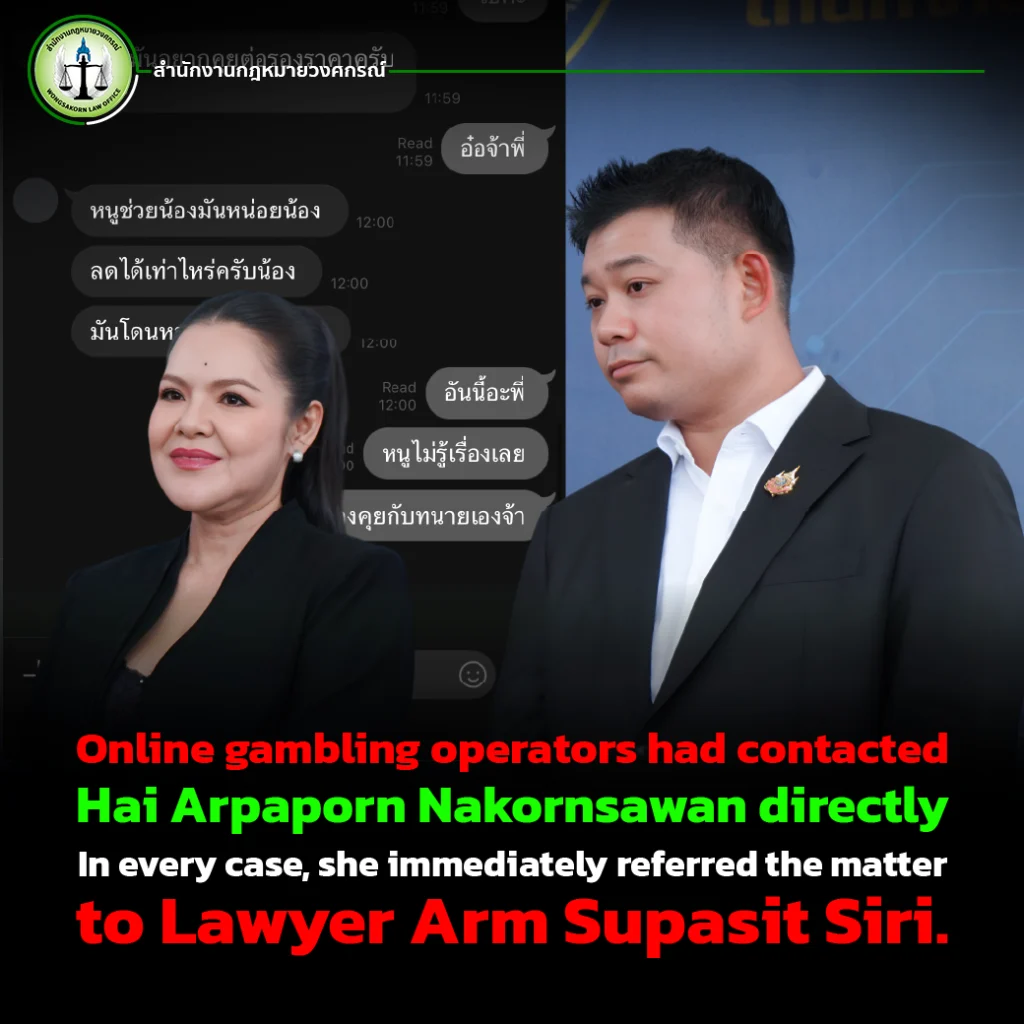
Online gambling operators had contacted Hai Arpaporn Nakornsawan directly. In every case, she immediately referred the matter to Lawyer Arm Supasit Siri
Ms.Hai revealed that, based on her past experience, people associated with online gambling operations had attempted to contact her personally. 

However, Ms.Hai chose not to negotiate, bargain, or handle the matter on her own.

Instead, every case was referred to Lawyer Arm Supasit Siri, who handled all legal proceedings on her behalf.

This decision helped reduce the risk of any communication being misinterpreted and ensured that every step was handled through the proper legal process. 

Scammers Use Every Means to Evade Legal Responsibility

Information obtained during the legal proceedings indicates that the offenders often operate as organized groups, with each member taking on a specific role.

In some cases, mule accounts registered under other people’s names are used, or minors are recruited to open bank accounts, making it much more difficult for authorities to trace those responsible. 

In addition, some offenders attempt to fabricate stories to gain sympathy from victims or other related individuals. In reality, however, these actions are often carried out by organized criminal networks operating under carefully planned schemes.

For this reason, effective legal action requires thorough evidence collection and a carefully planned legal strategy. 

Without proper planning from the outset, victims may suffer far greater consequences than they realize.

Lawyer Arm Supasit Siri commented

In technology-related crime cases, the most important thing is not simply reporting the case to the police as quickly as possible, but planning the legal strategy from the very beginning.

In many cases, if victims take action without proper preparation, they may lose the opportunity to preserve and collect crucial evidence, or misunderstand key facts of the case. 

Hai Arpaporn Nakornsawan’s case clearly demonstrates that without a systematic approach from the very beginning, victims may find themselves misunderstood by the public. In some cases, they may even spend a long time proving their own innocence. 

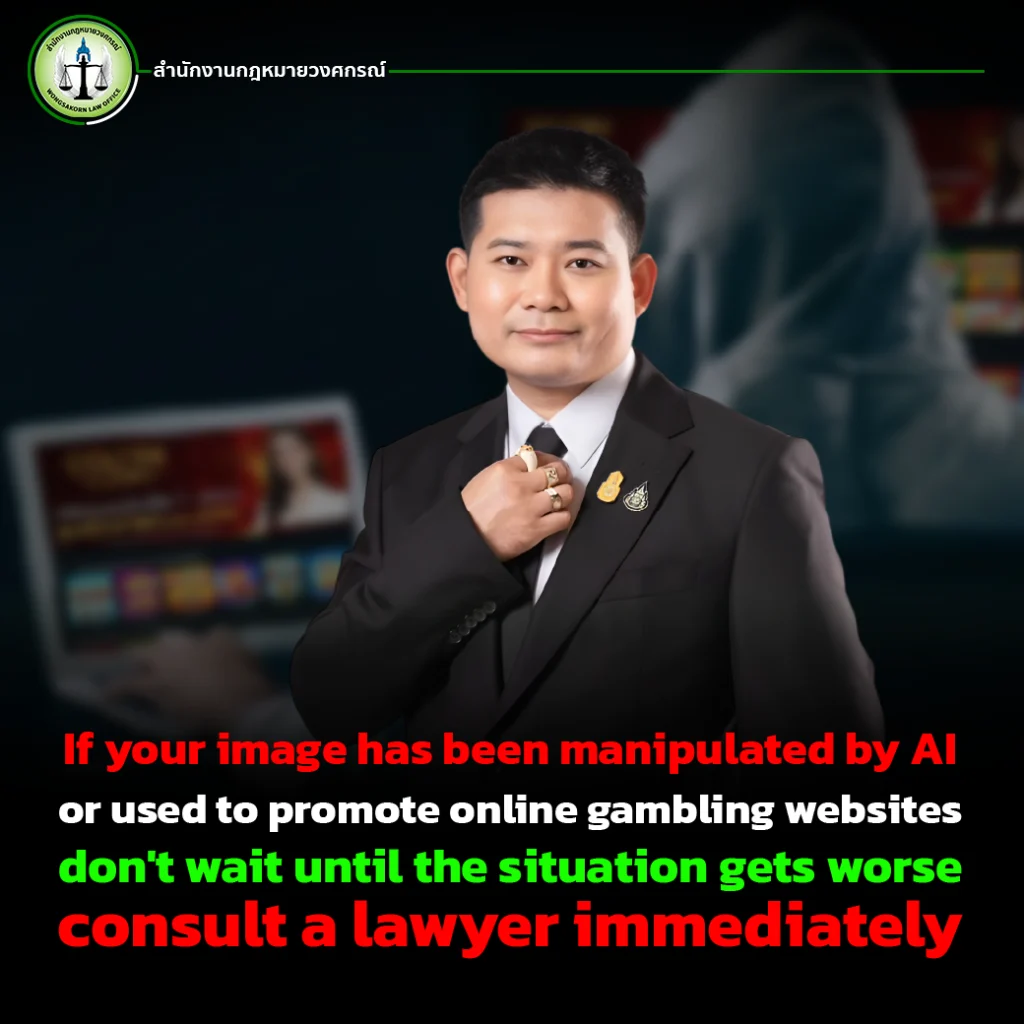
If your image has been manipulated by AI or used to promote online gambling websites, don’t wait until the situation gets worse consult a lawyer immediately

Today, AI technology is capable of generating increasingly realistic images, voices, and videos. As a result, anyone including members of the public, artists, influencers, business owners, and public figures can become a victim. 

If you discover that your photos, voice, or videos have been used to promote online gambling websites, or have been misused in any way that causes harm, you should preserve evidence as soon as possible. This includes screenshots, website links, and the date and time the content was found. You should also avoid contacting the perpetrators directly before seeking legal advice from a qualified legal professional. 

Hai Arpaporn Nakornsawan’s case is an important reminder that anyone can become a victim of AI identity impersonation. The damage extends far beyond reputation; it may also affect a person’s career, credibility, and legal rights.

If you are an artist, influencer, business owner, or a member of the general public, and your image, voice, or videos have been used without your permission, or your identity has been misused to promote online gambling websites, do not try to handle the situation on your own.

Seeking legal advice from a lawyer at the earliest stage can help you develop an effective legal strategy, preserve and collect evidence, and protect your rights in the most appropriate way.

Wongsakorn Law Firm provides legal consultation and representation in cases involving AI identity impersonation, unauthorized use of images, and online gambling-related offences. Our goal is to help victims protect their legal rights and minimize potential damage in the future.

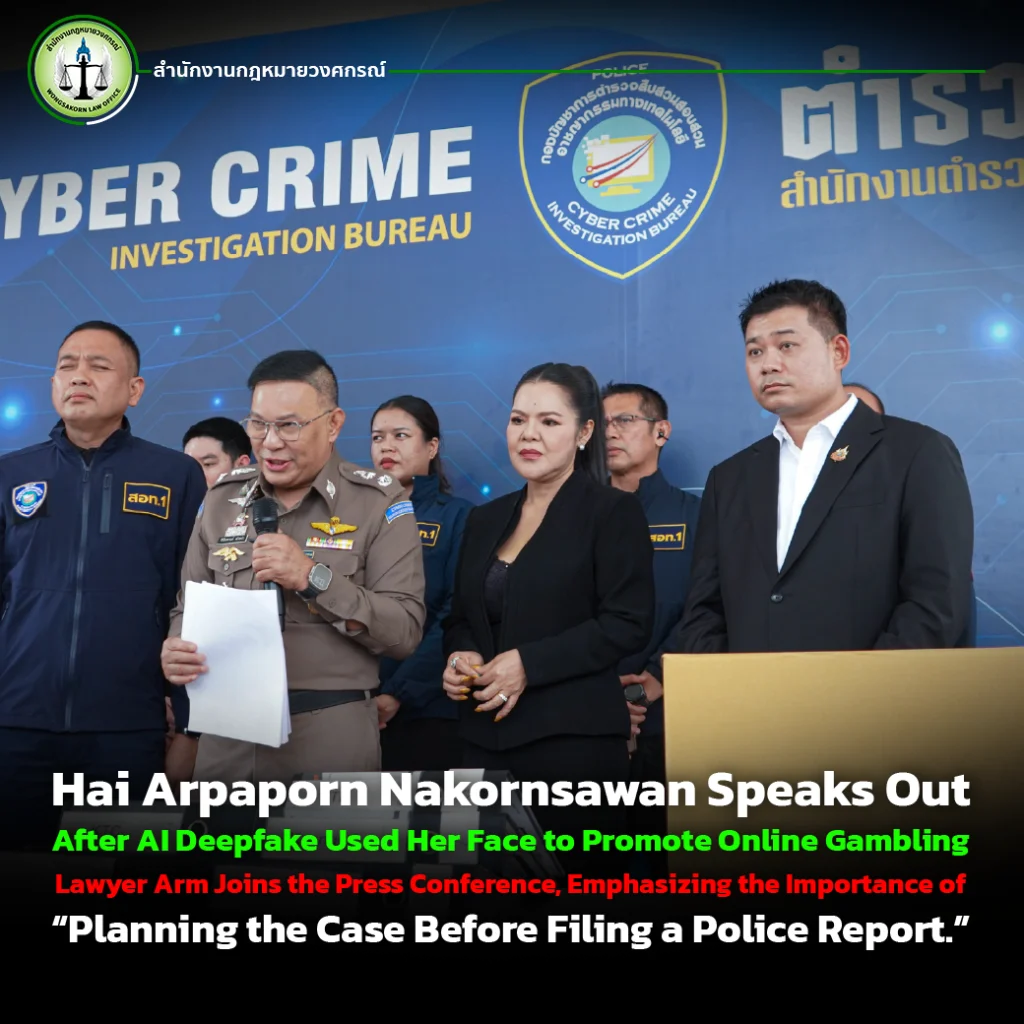
Hai Arpaporn Nakornsawan Speaks Out After AI Deepfake Used Her Face to Promote Online Gambling; Lawyer Arm Joins the Press Conference, Emphasizing the Importance of “Planning the Case Before Filing a Police Report.”   

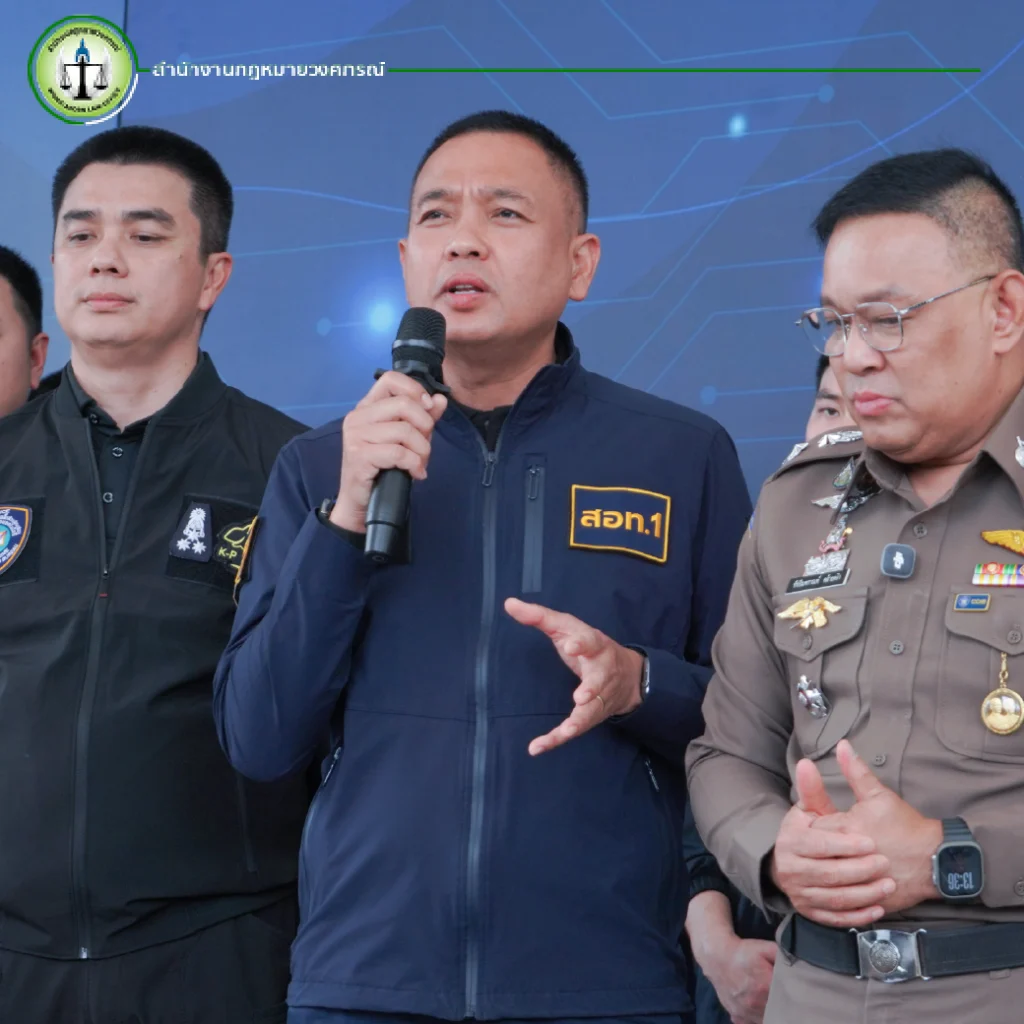
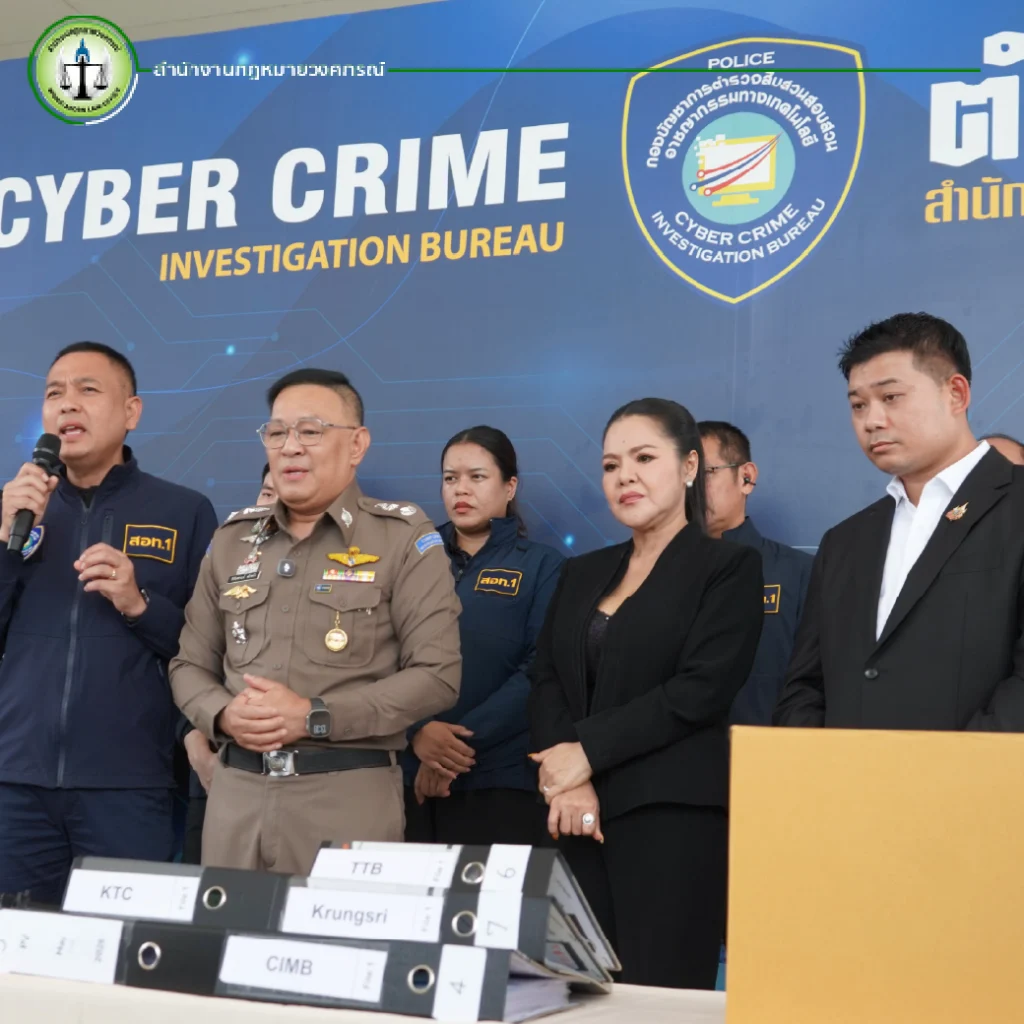
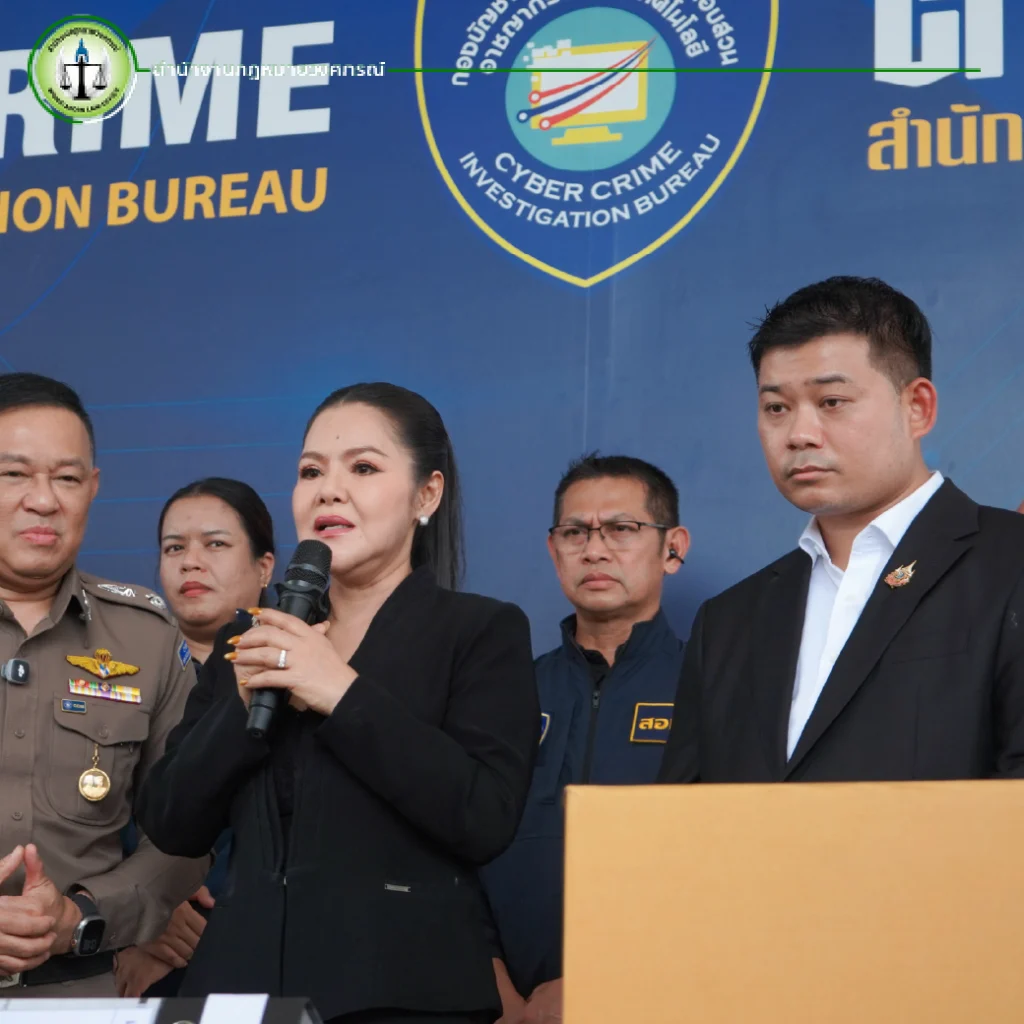
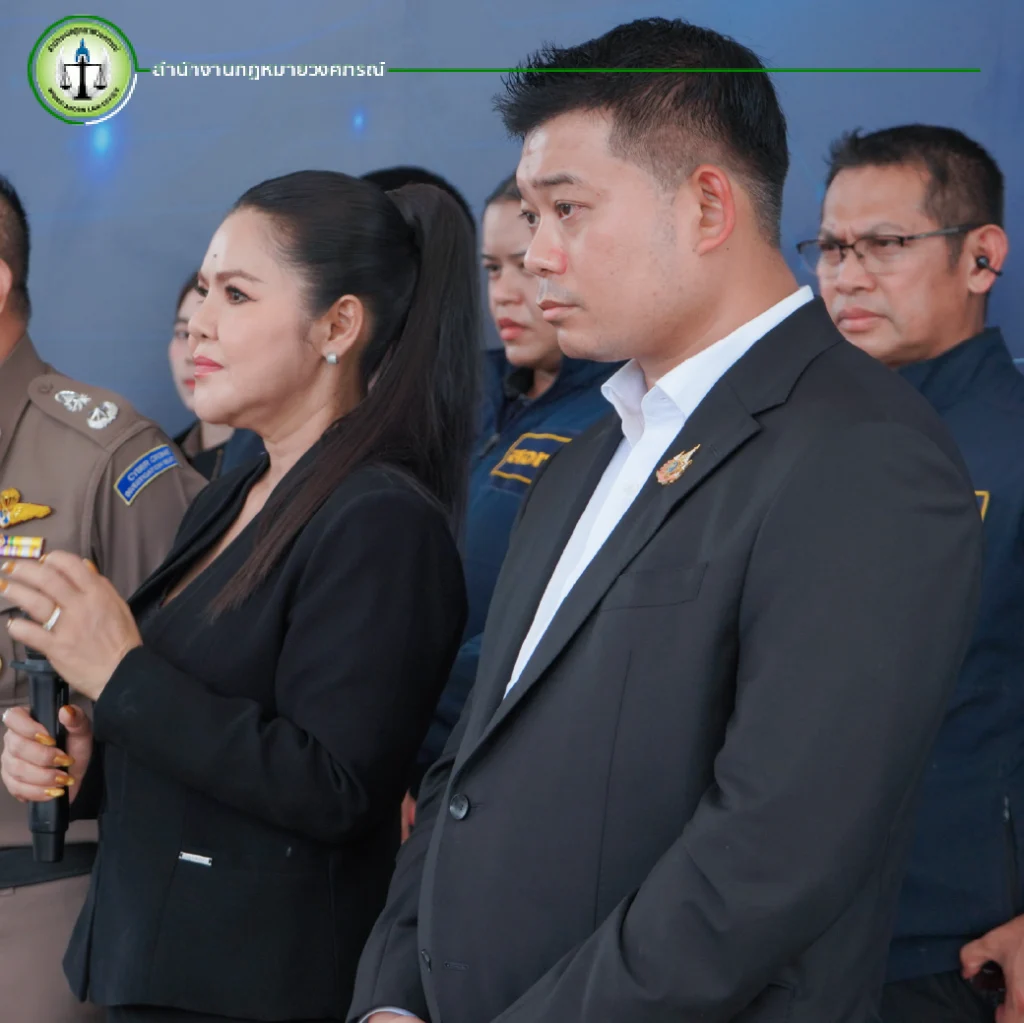
On 1 July 2026, Lawyer Arm Supasit Siri of Wongsakorn Law Firm, acting as the legal counsel for renowned Thai singer Hai Arpaporn Nakornsawan, attended a press conference at the Technology Crime Suppression Division 2 (TCSD Division 2) regarding a high-profile case that has attracted widespread public attention. The case involves the unauthorized use of artificial intelligence (AI) to create deepfake videos using Ms. Hai’s face and voice to promote online gambling websites. The unauthorized content has damaged her reputation and could mislead the public into believing that she is associated with those gambling websites.

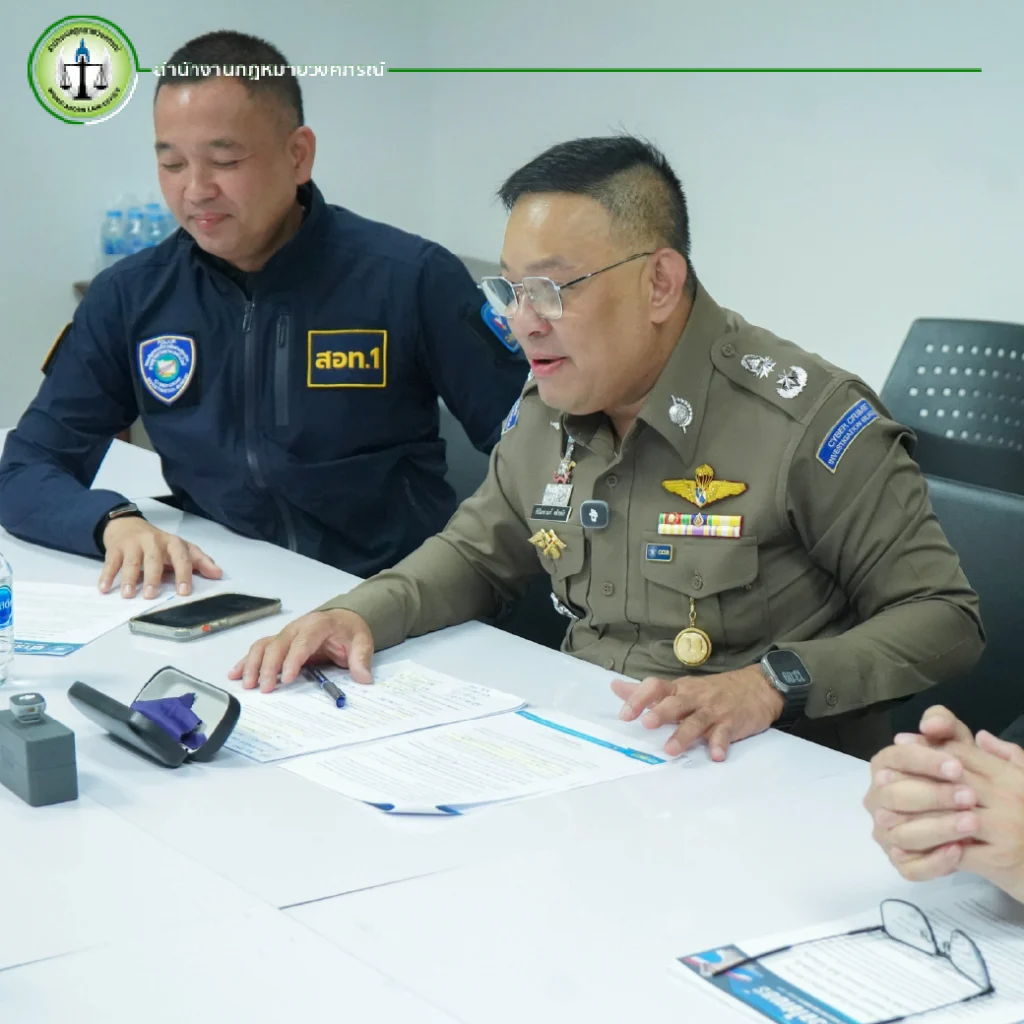
At the press conference, the Cyber Crime Investigation Bureau, under the direction of Pol.Lt.Gen. Surapol Prembut, Commissioner of the Bureau, assigned Pol. Maj. Gen. Chatphandakan Klaiklueng, Deputy Commissioner, and Pol.Maj.Gen. Siriwat Deepor, Commander of Technology Crime Suppression Division 1, together with relevant officers, announced the results of an operation against the online gambling network KFC888. The investigation found that the website had an annual cash flow of more than 2.5 billion baht. Officers also discovered that the network had used AI technology to generate images and voice recordings that imitated Hai Arpaporn Nakornsawan in advertisements designed to persuade the public to gamble online, even though she had never given permission and had no connection whatsoever with the website. The case highlights a new form of cyber threat arising from the misuse of AI technology.

Further investigation revealed that a Payment Gateway service provider was involved in processing financial transactions for the online gambling website. As a result, officers carried out search operations at two targeted locations, where they seized computers, mobile phones, and a large number of important documents for use as evidence in the legal proceedings. In addition, summonses have been issued to individuals connected to the case. The investigation is also being expanded to identify other members of the network, while authorities continue tracing financial transactions in order to locate and seize assets that may have been obtained through illegal activities.

Following the incident, Hai Arpaporn Nakornsawan shared a message with the public, especially those whose identities have been impersonated or whose images, voices, or personal information have been used online without permission: “Don’t be afraid to file a police report. Don’t be afraid to consult a lawyer. There is nothing embarrassing about it. If you discover that your personal information has been used without your permission, take action immediately.” Her message highlights the importance of protecting one’s legal rights and not allowing offenders to remain unpunished and continue harming others.

According to Lawyer Arm Supasit Siri, handling online crime cases today involves more than simply collecting evidence or filing a police report. An equally important step is planning the legal strategy and carefully analyzing the facts before entering the legal process. Decisions made at each stage of a case may affect its direction, the ability to identify and apprehend the offenders, and the collection of additional evidence later in the investigation. A well-planned legal strategy from the very beginning can improve the effectiveness of the case and reduce the risk of mistakes that may affect the rights of the victim.

Based on its experience in handling and advising on cybercrime cases, Wongsakorn Law Firm has found that many victims file a police report immediately without first preparing sufficient evidence or carefully planning their legal strategy. As a result, some may miss the opportunity to preserve important evidence or take certain actions that could benefit the case. For this reason, consulting a lawyer at an early stage is an important factor in helping ensure that legal proceedings are handled more effectively and thoroughly.

Wongsakorn Law Firm would like to take this opportunity to remind artists, actors, influencers, content creators, students, internet personalities, and the general public that the use of AI technology to create fake faces, voices, or videos of individuals for product advertising, fraud, or the promotion of online gambling websites is becoming increasingly common. If you discover that your identity has been impersonated, or that your image, voice, or personal information has been used without your permission, you should preserve all available evidence and seek legal advice as soon as possible to protect your rights and minimize potential damage.

Wongsakorn Law Firm would like to thank Hai Arpaporn Nakornsawan for placing her trust in Lawyer Arm Supasit Siri as her legal counsel in this important case. The firm remains committed to providing legal advice and representation in online crime cases, unauthorized use of images, AI-related impersonation and deepfake cases, and other identity fraud cases, with the goal of protecting the rights of victims to the fullest extent possible. If you are facing a similar situation, you should consult a lawyer as early as possible to develop an appropriate legal strategy before filing a police report. Careful planning from the beginning can help ensure a more effective legal process and better protect the interests of the victim throughout the justice system.

A New Milestone of Success: Wongsakorn Law Firm Celebrates the Opening of Building C

On 28 June 2026, Wongsakorn Law Firm proudly marked another significant milestone with the blessing ceremony for its new Building C, symbolizing the firm’s continued growth and organizational development. Under the leadership of Lawyer Arm Supasit Siri, Founder and Managing Director of Wongsakorn Law Firm, this expansion reflects not only the firm’s achievements but also its unwavering commitment to enhancing the quality of legal services to accommodate its growing organization and the increasing trust of its clients.

The blessing ceremony was graciously led by five Buddhist monks from Wat Suthat Thepwararam Ratchaworamahawihan, who chanted the Mahāsamaya Sutta to invoke blessings for the new office, its personnel, and all future visitors. The resonant chanting throughout the building created an atmosphere of serenity, faith, and auspiciousness, marking a meaningful beginning for the new office.

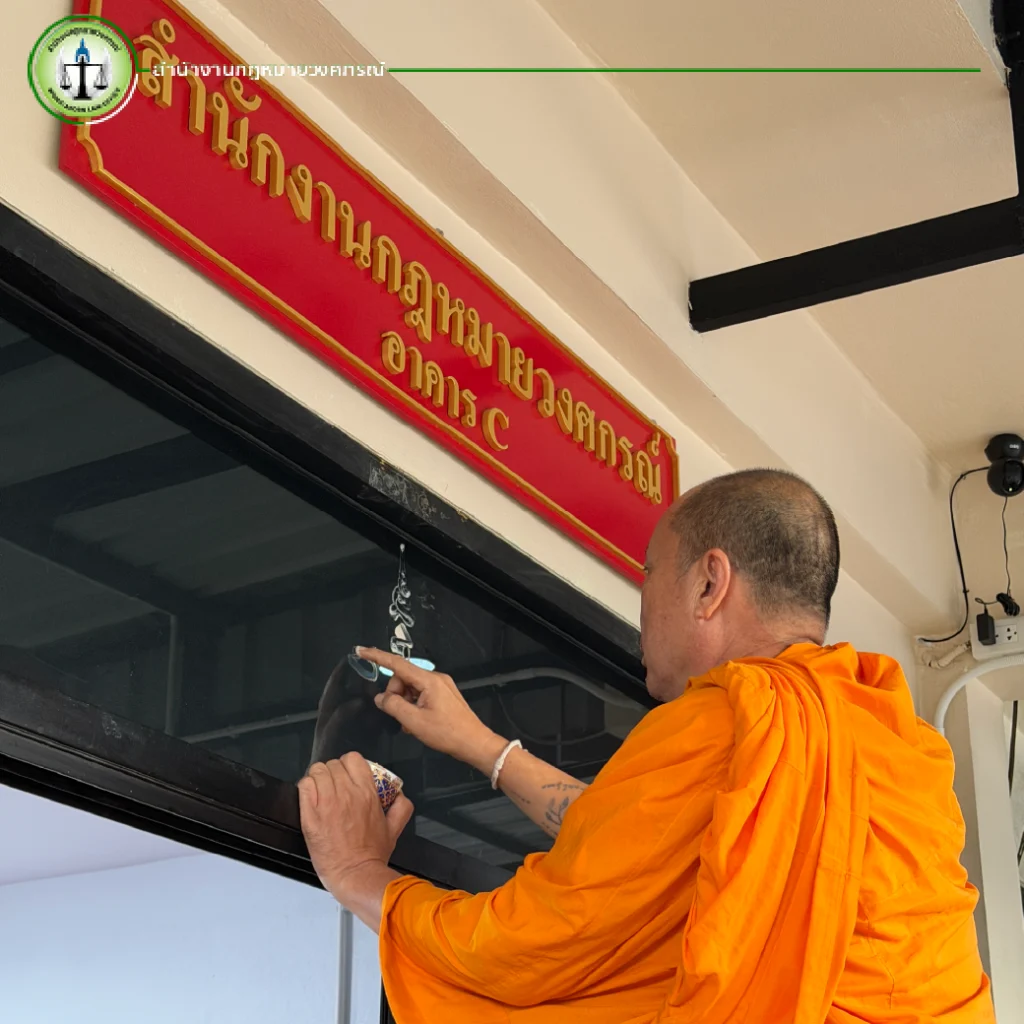
The firm was also honored by the presence of Phra Ajarn Khwan from Wat Thap Yai Chiang, Phitsanulok Province, who presided over a meditation and blessing ceremony. He also performed the traditional blessing of the office entrance and the building sign to invoke prosperity, success, and harmony for the firm’s management, staff, and clients. His participation was regarded as a meaningful blessing that inspired confidence and encouragement throughout the organization.

The ceremony was hosted by Group Captain Suphawit Thammasitthiruj, Chaplain, who ensured that every part of the event proceeded smoothly and with dignity. The occasion was filled with warmth, devotion, and unity among the firm’s executives, staff, and distinguished guests. Every moment reflected shared pride and optimism as Wongsakorn Law Firm embarks on the next chapter of its journey.

One memorable moment during the ceremony was the gentle rainfall that began as the rituals were taking place. According to Thai belief, rain during an important new beginning is considered an auspicious sign, symbolizing abundance, peace, and prosperity. Many attendees remarked that the rainfall felt like a blessing from nature, representing hopes for the firm’s continued growth and future success.

The opening of Building C represents far more than an expansion of office space. It stands as a symbol of Wongsakorn Law Firm’s ongoing commitment to organizational development, raising the standard of legal services, and continuing to serve both the public and the business community with integrity, fairness, and a steadfast commitment to the rule of law.

How Can Chinese Nationals Legally Own a Home in Thailand? What You Should Know Before Investing in Thai Real Estate

Over the past several years, Thailand has remained one of the most popular destinations for foreign nationals, particularly Chinese nationals seeking to live, invest, or retire in the country. This is largely due to Thailand’s reasonable cost of living, well-developed infrastructure, diverse cuisine, and convenient transportation system.

However, one of the most common questions asked by Chinese nationals is:

“Can Chinese nationals purchase a house or own land in Thailand?”

The answer is that foreign nationals may acquire rights in certain types of real estate in Thailand, but such ownership or use must be structured and carried out in compliance with Thai law.

In this article, Wongsakorn Law Firm explains the lawful options available to Chinese nationals who wish to own a home or make use of real estate in Thailand.

Can Chinese Nationals Own Land in Thailand?

Under Thai law, foreign nationals are generally prohibited from directly owning land in Thailand in the same manner as Thai citizens.

As a result, a Chinese national cannot, in ordinary circumstances, purchase land and register ownership in his or her own name.

In the past, some individuals attempted to acquire land through nominees or other structures that were not compliant with Thai law. Such arrangements may create significant legal risks, including civil and criminal liability, as well as the potential loss of the property in the future.

For this reason, foreign nationals who wish to invest in or reside in Thailand should pursue only those ownership or investment structures that are clearly recognized and permitted under Thai law.

Chinese Nationals Can Purchase Condominium Units in Thailand

One of the most popular ways for Chinese nationals to own real estate in Thailand is through the purchase of a condominium unit.

Thai law permits foreign nationals to own condominium units, provided that the legal requirements are satisfied, including compliance with the foreign ownership quota applicable to the condominium project.

Key advantages include:

  • Direct ownership of the condominium unit
  • The ability to resell the unit in the future
  • The ability to lease the unit and generate rental income
  • Greater legal certainty and security compared to high-risk ownership structures

For these reasons, purchasing a condominium has become one of the most common and practical options for Chinese nationals seeking either a residence or a real estate investment in Thailand.

How Can Chinese Nationals Have a House with Land in Thailand?

Although Chinese nationals cannot directly own land in Thailand, Thai law provides several legal mechanisms that allow foreign nationals to lawfully use and benefit from land.

Usufruct

A usufruct is a right that can be registered with the relevant authority, granting the holder the right to possess, use, and enjoy the benefits derived from the land or immovable property.

Examples include:

  • Living in a house on the land
  • Gardening or agricultural use
  • Operating a business as permitted by law
  • Leasing the property and receiving rental income

A usufruct allows Chinese nationals to legally use and benefit from land in Thailand, even though they do not hold ownership of the land itself.

Long-Term Lease Rights

Another option is to enter into a long-term lease agreement in accordance with Thai law.

Leasing land or a house on a long-term basis can enable foreign nationals to reside in and make use of real estate without acquiring ownership.

However, lease agreements should be carefully reviewed and structured by legal professionals to help prevent future disputes and protect the interests of all parties involved.

Where the Foreign National Has a Thai Spouse

Many Chinese nationals who are married to Thai citizens often ask:

“Can a house or land be purchased if my spouse is Thai?”

As a general rule, a Thai national spouse may legally own land in Thailand.

However, the ownership structure and rights relating to the property should be carefully planned to avoid potential issues in the future, such as:

  • Division of property
  • Transfer of ownership rights
  • Divorce proceedings
  • Inheritance matters

In many cases, legal mechanisms such as a usufruct or other rights recognized under Thai law may be utilized to provide greater security and protection for both parties.

Do Not Rely on Illegal Land Ownership Arrangements

Today, there is a significant amount of information and advertising online regarding ways for foreign nationals to acquire land rights in Thailand.

Some of these arrangements may carry substantial legal risks or could be regarded as attempts to circumvent Thai law.

Before making any investment decision, Chinese nationals should carefully verify the information they receive and seek advice from qualified real estate legal professionals.

Establishing a legally compliant ownership or usage structure from the outset is always safer and more effective than attempting to resolve legal disputes after problems arise.

Wongsakorn Law Firm Is Ready to Assist Chinese Nationals Seeking to Own a Home in Thailand

If you are a Chinese national or other foreign investor seeking to purchase a home, invest in real estate, enter into a long-term lease, register a usufruct, or establish a legally compliant real estate ownership structure in Thailand, Wongsakorn Law Firm is ready to provide comprehensive legal consultation, document review, and related legal services.

A successful real estate investment is not merely about acquiring property. It is about ensuring that the property can be legally owned, used, and enjoyed in a secure manner while receiving long-term protection under Thai law.

If you require legal advice regarding the purchase of a home, the registration of a usufruct, long-term lease arrangements, or real estate ownership structures for Chinese nationals, you may contact Wongsakorn Law Firm for guidance tailored to your specific circumstances.

Wongsakorn Law Firm Visits Parliament to Learn About Democracy Firsthand

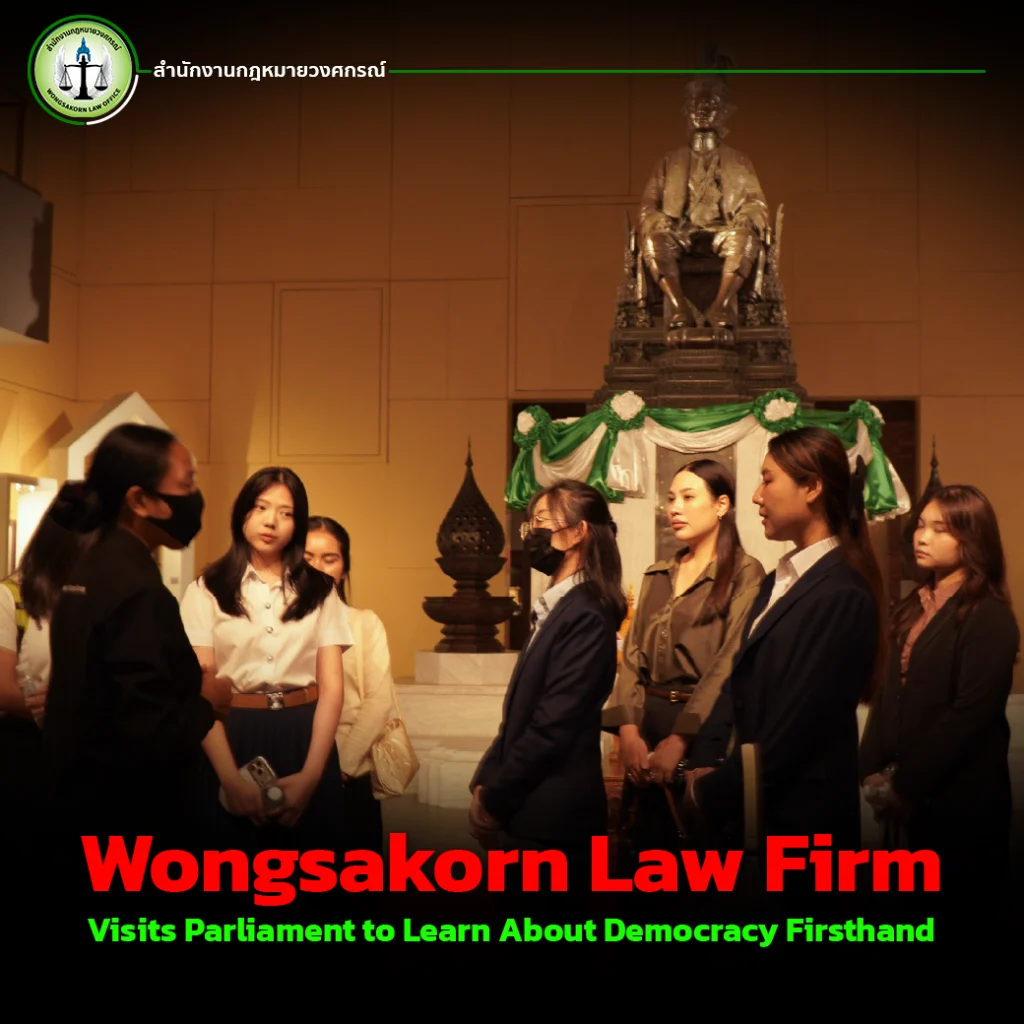
On 25 June 2026, Wongsakorn Law Firm, under the leadership of Mr. Krit Silpachai, Member of Parliament for Rayong from the People’s Party, together with Lawyer Arm Supasit Siri, brought a group of 12 lawyers, staff members, and interns from the firm on a study visit to Sappaya-Sapasathan, Thailand’s new Parliament House. The visit provided participants with the opportunity to learn about Thailand’s legislative institution firsthand. 

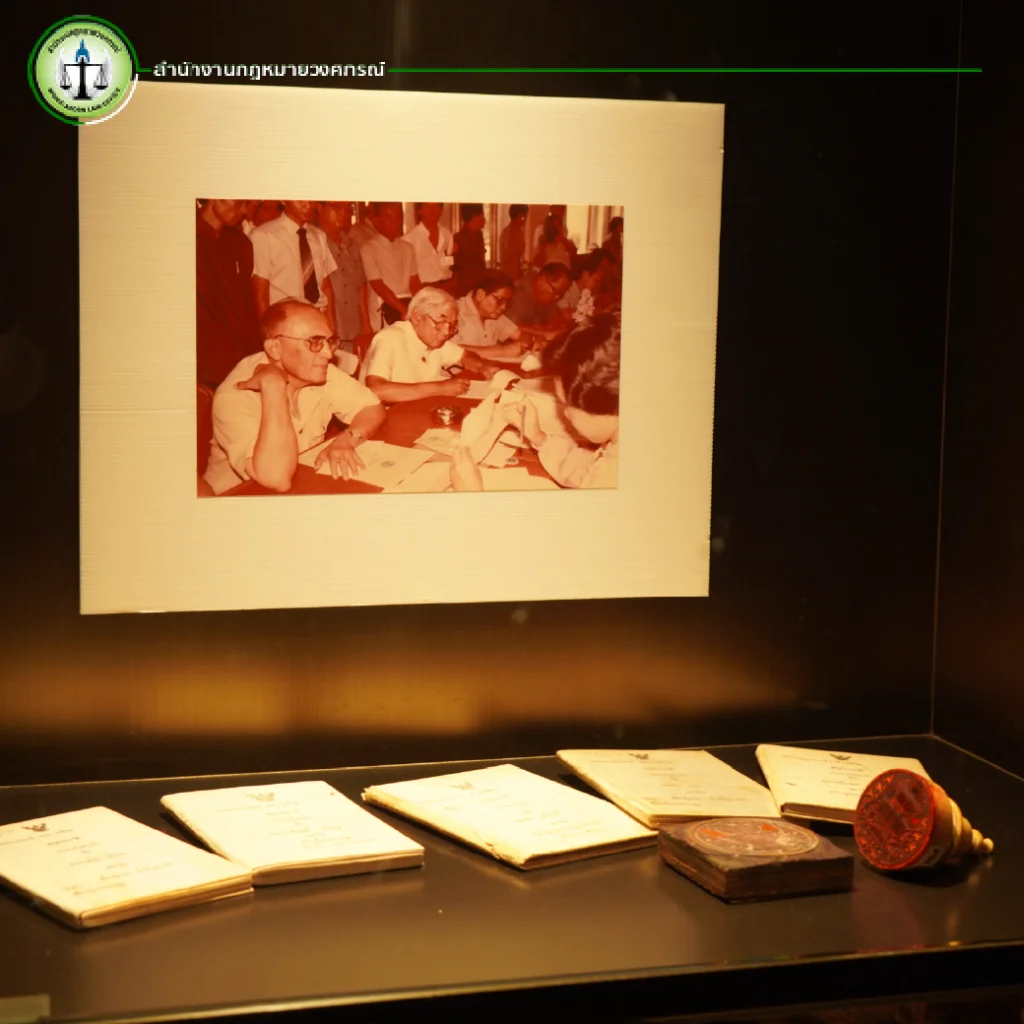
The study visit was warmly welcomed by the Parliament staff. Participants were introduced to the history, design concept, and significance of Sappaya-Sapasathan through an introductory video before touring several important areas within the Parliament building, including the Parliament Museum, the Ceremonial Hall, and the Golden Pinnacle Ornament exhibition. These exhibits beautifully reflect Thailand’s history, politics, and cultural heritage. 

Another highlight of the visit was the opportunity to observe a House of Representatives sitting from the public gallery. This allowed the participants to gain a close understanding of the work of the legislative branch, learn about the roles and responsibilities of Members of Parliament, as well as the legislative process and the scrutiny of government administration. It was a highly valuable learning experience for legal practitioners and students pursuing a legal career. 

For the interns who participated in this visit, it was a valuable opportunity to broaden their perspectives beyond the classroom. They experienced the working environment of the country’s legislative institution firsthand and gained insight into how the democratic process operates in practice. This valuable experience will help them further develop their academic knowledge and professional skills in the future.

Wongsakorn Law Firm would like to express its sincere appreciation to Mr. Krit Silpachai, Member of Parliament for Rayong from the People’s Party, for providing this valuable opportunity for the study visit. We also extend our heartfelt thanks to all Parliament officials for their warm welcome and thoughtful assistance throughout the visit. This visit was more than just a study tour. It enriched the participants’ knowledge and understanding, while also inspiring them to continue working for society under the principles of the rule of law and a stable democratic system. 

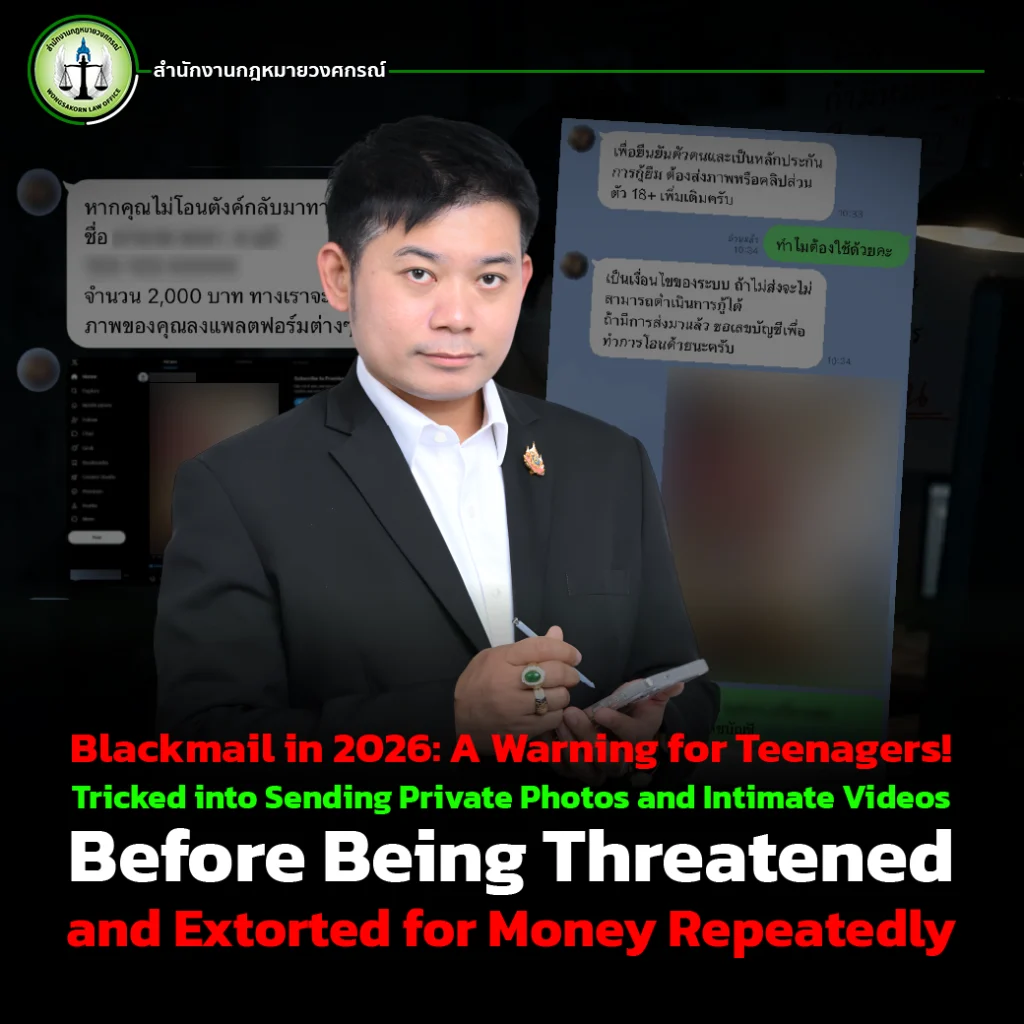
Blackmail in 2026: A Warning for Teenagers! Tricked into Sending Private Photos and Intimate Videos Before Being Threatened and Extorted for Money Repeatedly 

In 2026, blackmail conducted through online channels remains a serious threat that continues to cause significant harm to many people. Teenagers and youths, in particular, have increasingly become targets of new and evolving schemes used by criminals.

Based on the legal consultation experience of Wongsakorn Law Firm, a considerable number of victims have been deceived through social media platforms. Offenders often begin by establishing credibility, building familiarity, and engaging in conversations until trust is formed. They then offer rewards or various incentives to persuade victims to send private photos or personal videos.

Once the offenders obtain the desired content, the promised rewards are never delivered. Instead, the photos or videos are used as tools to threaten and extort money from the victims. As a result, many victims suffer substantial financial losses, while some experience severe psychological distress.

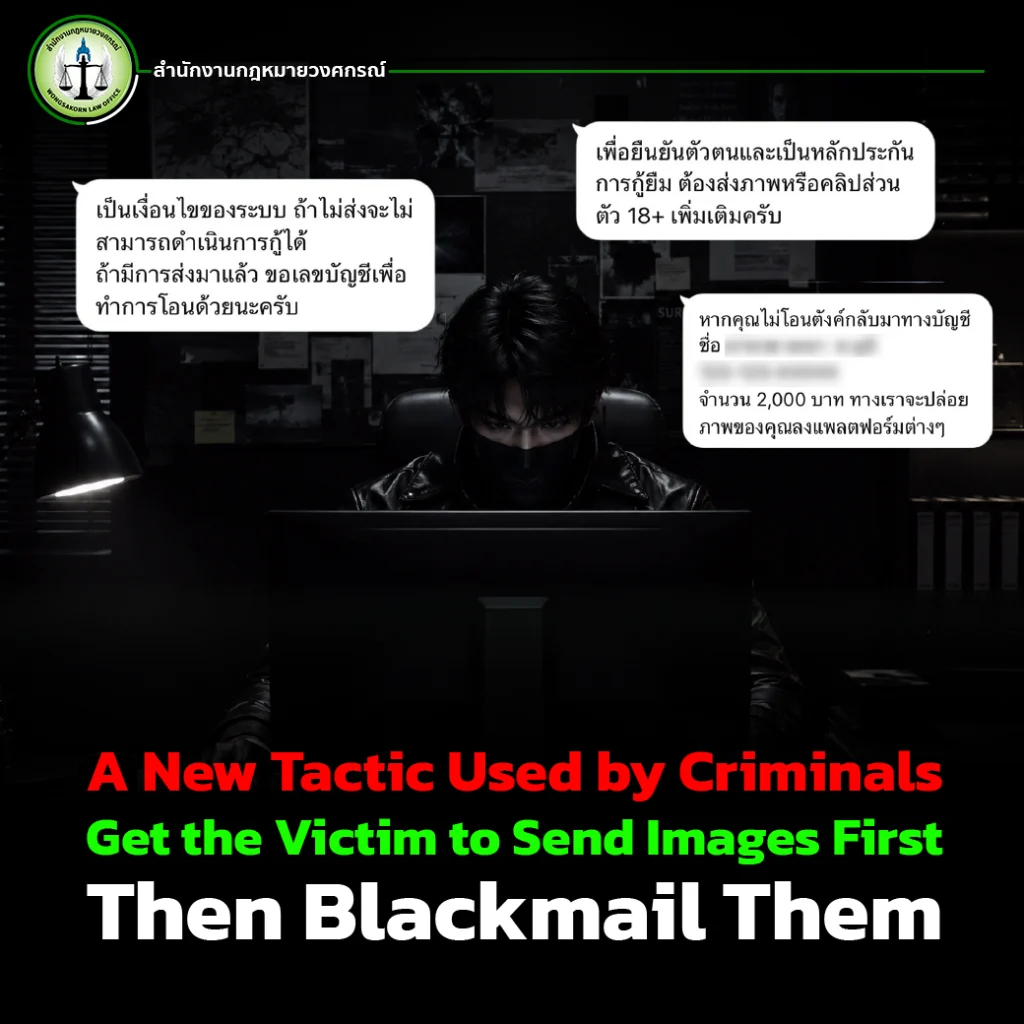
A New Tactic Used by Criminals: Get the Victim to Send Images First, Then Blackmail Them

Today, criminals rarely begin with direct threats. Instead, they create incentives that encourage victims to voluntarily send photos or videos of themselves.

Common examples include:

  • Claiming they will transfer money to the victim
  • Promising special compensation or rewards
  • Offering a brand-new smartphone for free
  • Promising expensive gifts
  • Offering financial assistance
  • Claiming they can provide employment opportunities or make the victim a brand ambassador

Once the victim is persuaded to send private photos or videos, the offender’s behavior changes immediately. The offender then begins threatening to distribute the content to the victim’s family members, friends, school, or the public unless the victim transfers the amount of money being demanded.

This is one of the most common forms of blackmail increasingly seen today.

Why Are Teenagers Common Targets?

Teenagers and young people are among the most active users of online platforms and are generally more likely to communicate with strangers through various social media channels.

In addition, offenders often use psychological manipulation to gain trust, such as:

  • Pretending to be someone of a similar age
  • Using trustworthy-looking profile photos
  • Spending a long period building rapport before initiating the scam
  • Creating relationships that resemble friendship or romance
  • Offering benefits or rewards that appear attractive

Once the victim’s trust has been gained, the offender begins requesting private photos or videos, using various reasons to persuade the victim to voluntarily provide the content.

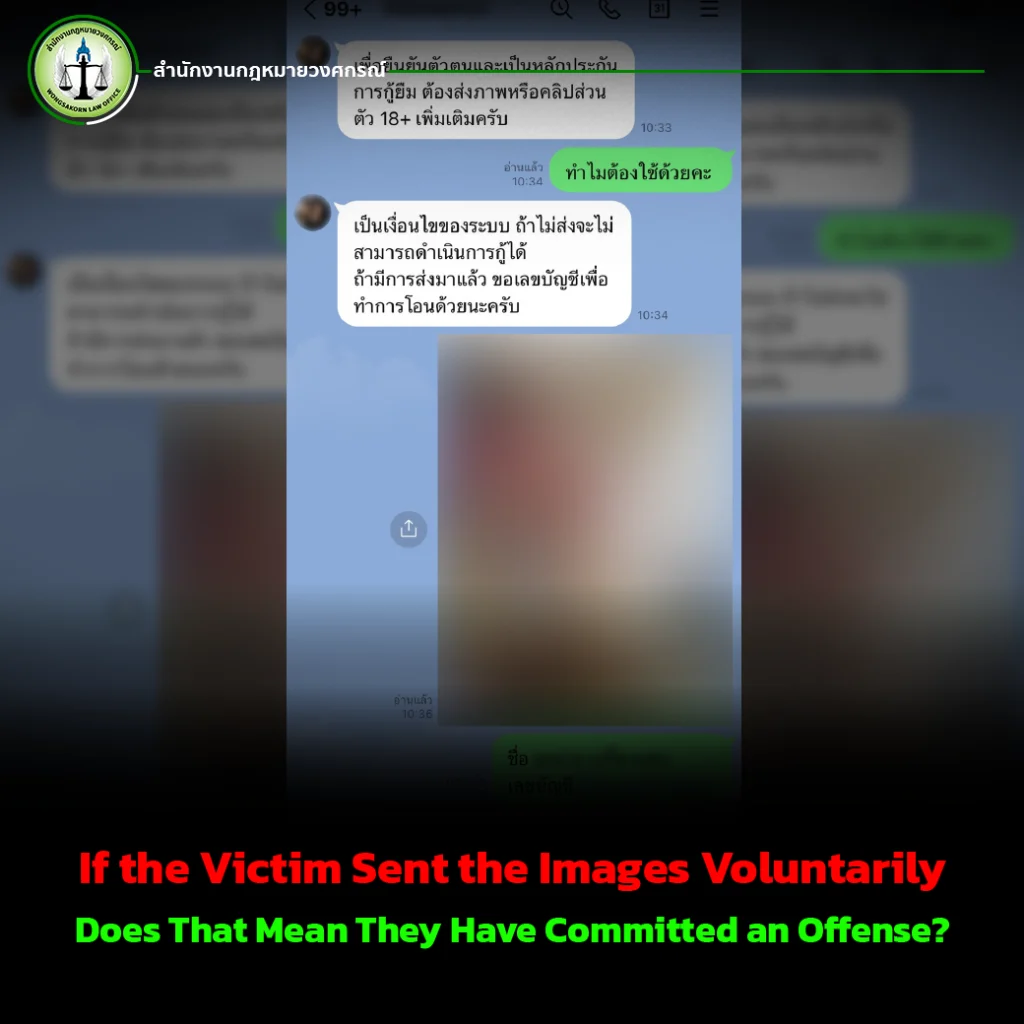
If the Victim Sent the Images Voluntarily, Does That Mean They Have Committed an Offense?

This is one of the most common concerns among victims.

Many people are afraid to seek help because they believe that, since they voluntarily sent the photos or videos, they may not be entitled to legal protection.

In reality, the fact that a victim previously shared personal photos or information does not give another person the right to use that content as a tool for intimidation or financial gain.

If photos or videos are used to coerce, threaten, or demand money from a victim, such conduct may constitute a criminal offense under Thai law.

Therefore, individuals who are threatened or extorted for money using private photos or videos are considered victims, not perpetrators, in cases of blackmail.

Is It True That the More You Pay, the More They Demand?

Based on experience with cases of this nature, the answer is: “Yes, it happens frequently.”

Many victims believe that making the first payment will bring the problem to an end. In reality, however, offenders often keep the photos and videos and continue using them as tools of intimidation.

Once the offender realizes that the victim is willing to pay, additional demands often follow, such as:

  • Requesting more money
  • Demanding repeated transfers
  • Asking for other assets or valuables
  • Threatening the victim into complying with further demands

As a result, some victims lose substantial amounts of money while the problem never truly ends.

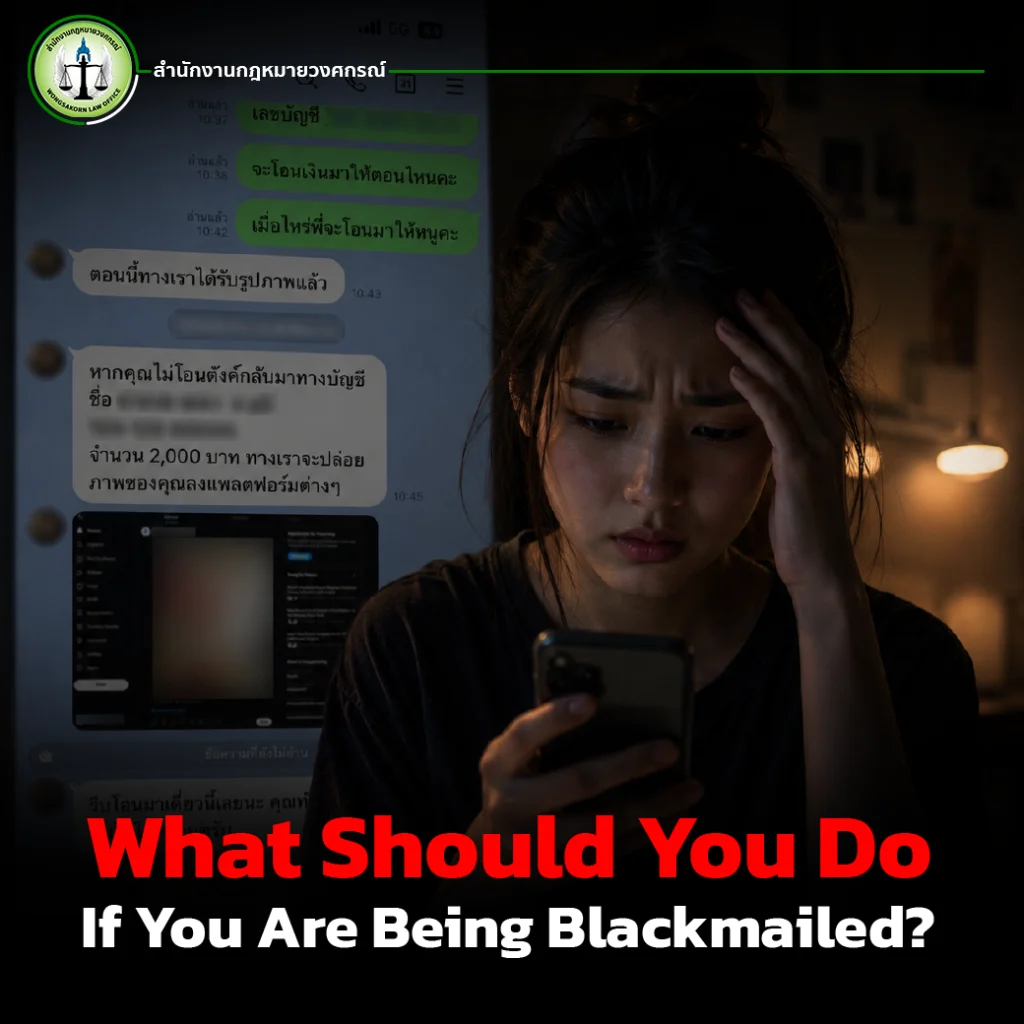
What Should You Do If You Are Being Blackmailed?

The most important thing is not to panic and delete the evidence.

Victims should preserve all relevant information, including:

  • Chat messages and conversation records
  • Screenshots of threats or extortion attempts
  • Proof of money transfers
  • Bank account details used by the offender
  • The offender’s social media accounts
  • Dates and times of all communications

This evidence can play a crucial role in any legal proceedings.

In addition, victims should seek legal advice as soon as possible in order to develop an appropriate strategy, prevent further damage, and take the necessary legal steps.

Do Not Let Fear Cause Greater Harm

What criminals want most is the victim’s fear.

When victims are afraid that their information will be exposed, afraid that their family will find out, or afraid of public embarrassment, offenders use that fear as a tool to continue demanding money.

In many cases, victims who consult a lawyer at an early stage are able to develop an effective response strategy, preserve evidence properly, and pursue legal remedies more effectively than those who attempt to handle the situation alone.

If you or someone close to you is being blackmailed, threatened with the release of private photos or personal videos, or being forced to pay money because of information previously shared with another person, do not let fear prevent you from protecting your legal rights.

Wongsakorn Law Firm is ready to provide legal consultation regarding blackmail cases, extortion cases, and online-related offenses. Our goal is to help victims develop an appropriate legal strategy, minimize potential damage, and protect their rights in accordance with the law.

Remember:

“The more afraid you are, the greater the damage may become. The sooner you consult a legal professional, the sooner the problem may be brought under control.”

Blackmail in 2026: A Warning for Teenagers! Tricked into Sending Private Photos and Intimate Videos Before Being Threatened and Extorted for Money Repeatedly 

In 2026, blackmail conducted through online channels remains a serious threat that continues to cause significant harm to many people. Teenagers and youths, in particular, have increasingly become targets of new and evolving schemes used by criminals.

Based on the legal consultation experience of Wongsakorn Law Firm, a considerable number of victims have been deceived through social media platforms. Offenders often begin by establishing credibility, building familiarity, and engaging in conversations until trust is formed. They then offer rewards or various incentives to persuade victims to send private photos or personal videos.

Once the offenders obtain the desired content, the promised rewards are never delivered. Instead, the photos or videos are used as tools to threaten and extort money from the victims. As a result, many victims suffer substantial financial losses, while some experience severe psychological distress.

A New Tactic Used by Criminals: Get the Victim to Send Images First, Then Blackmail Them

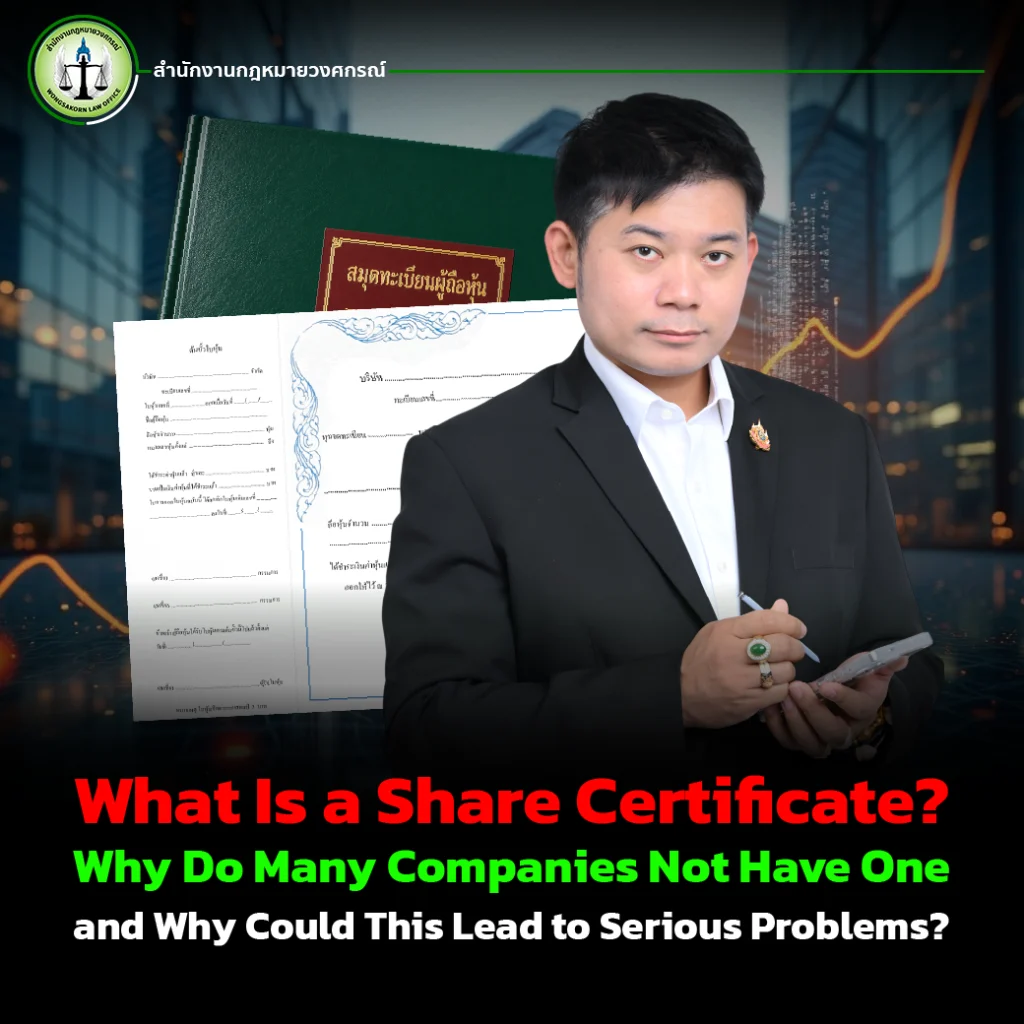
What Is a Share Certificate? Why Do Many Companies Not Have One, and Why Could This Lead to Serious Problems?

If you are a company owner or a shareholder of a private limited company, take a moment to ask yourself: “Have you ever seen your company’s share certificate?”

Many people may answer no, while others may not even realize that after a company is incorporated, it is legally required to maintain share certificates and a register of shareholders.

Based on the experience of Lawyer Arm, Supasit Siri of Wongsakorn Law Firm, a considerable number of companies have been operating for many years without issuing share certificates to their shareholders and without properly maintaining a register of shareholders.

This issue may appear insignificant while the business is operating normally. However, when disputes arise, shares are transferred, shareholders change, or government authorities request the company’s corporate records for inspection, the company may encounter unexpected legal complications.

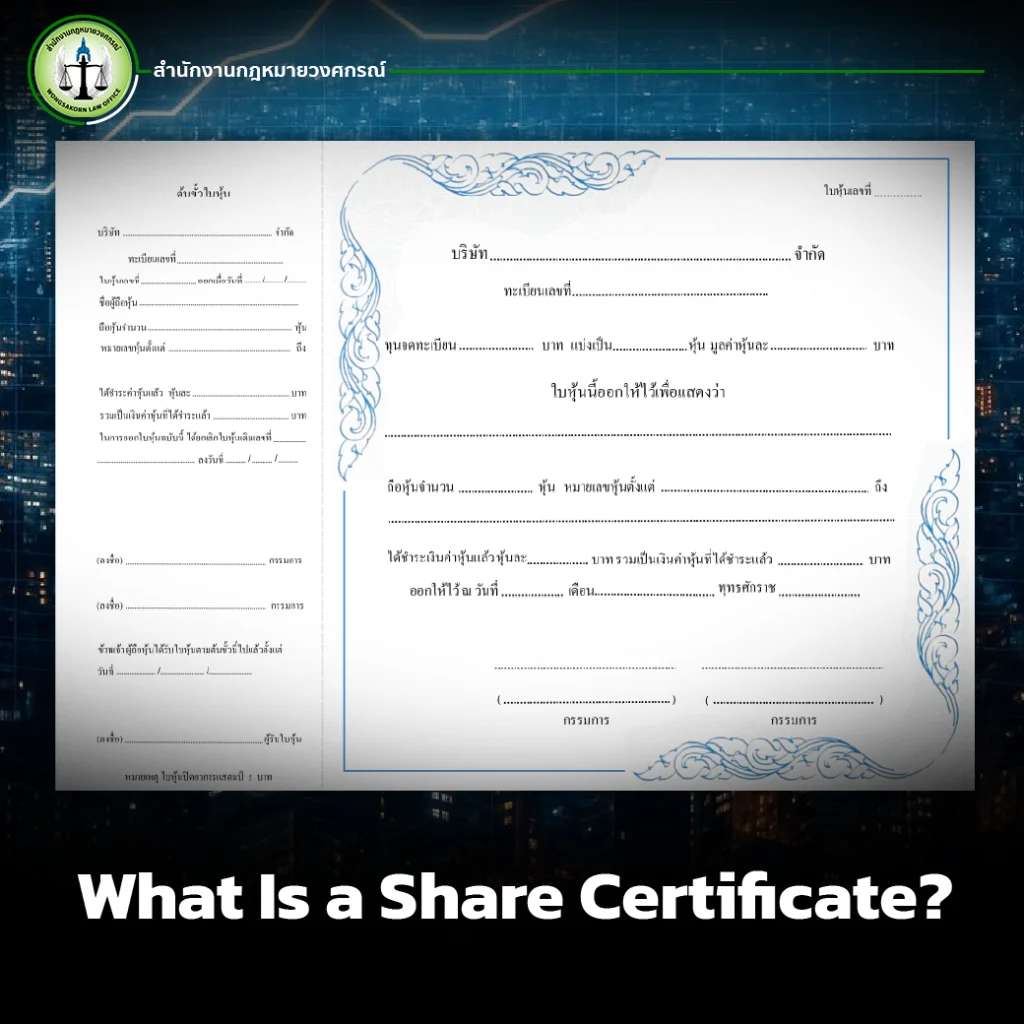
What Is a Share Certificate?

A share certificate is an important document issued by a company to a shareholder as evidence of ownership of shares in the company.

Simply put, when a person acquires shares in a company, the company has a duty to issue a share certificate confirming that such person is a shareholder holding the specified number of shares.

Important information commonly contained in a share certificate includes:

  • Company name
  • Juristic person registration number
  • Shareholder’s name
  • Number of shares
  • Share value
  • Share certificate number
  • Signature of the authorized director

A share certificate is therefore an important document that serves as direct evidence of a shareholder’s ownership rights in the company.

The Register of Shareholders Is Just as Important as a Share Certificate

In addition to share certificates, the law also requires a company to maintain a Register of Shareholders.

A Register of Shareholders is a document used to record the details of all shareholders in the company, including the number of shares held by each shareholder and any history of changes in share ownership.

This document is highly important because it serves as the company’s internal record for verifying the status of shareholders at any given time.

In practice, if a company does not maintain a Register of Shareholders, or if the register is not properly prepared and maintained, it may adversely affect the company’s management and the ability to establish shareholders’ rights in the future.

Why Do Many Companies Not Have Share Certificates?

One common issue is that business owners assume that once they receive the company registration documents or the company affidavit from the Department of Business Development, the company incorporation process is fully completed.

In reality, however, company registration and the preparation of the company’s internal corporate documents are two separate matters.

In many cases, when business owners consult company incorporation service providers or accounting firms, they are often told:

“No one ever uses share certificates.”

or

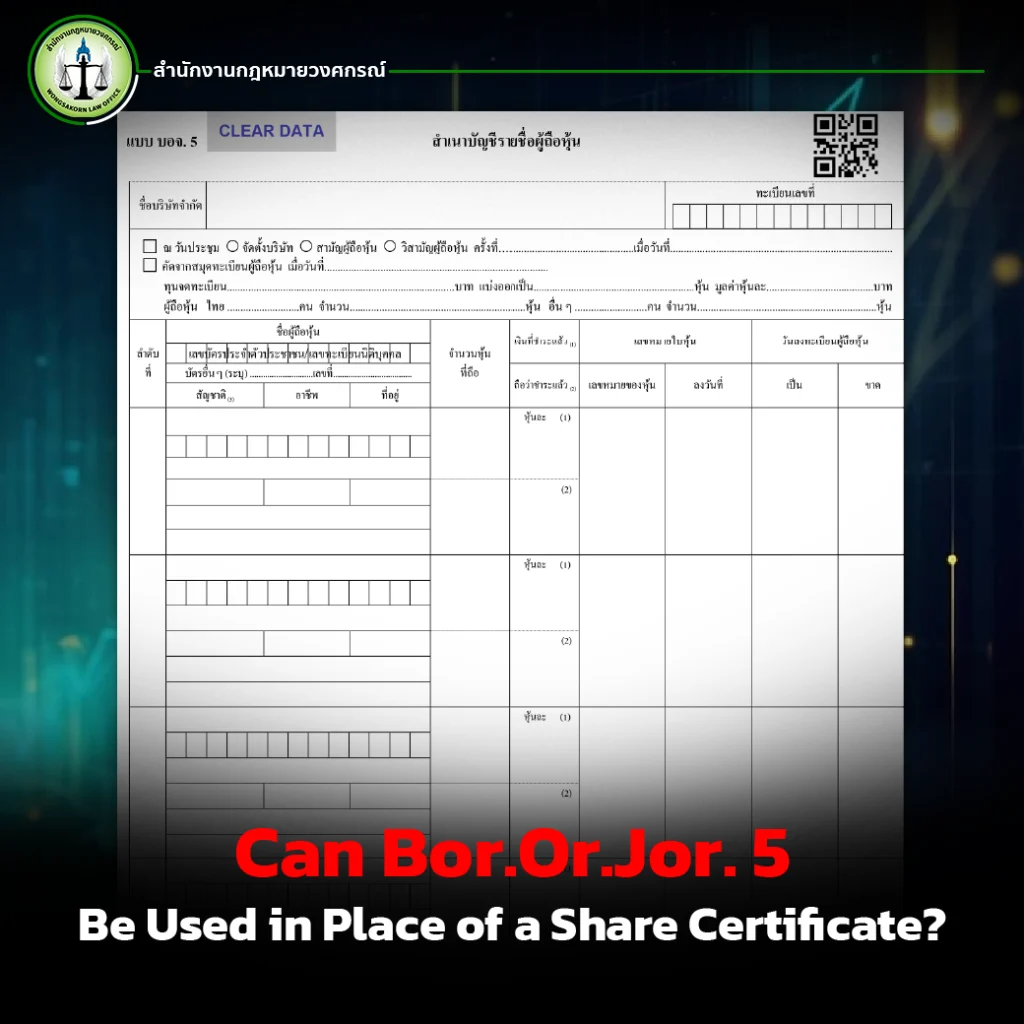
“The shareholder list (Bor.Or.Jor. 5) is sufficient.”

Such misunderstandings may cause company owners to have an incorrect understanding of the purpose and legal significance of each type of corporate document.

Can Bor.Or.Jor. 5 Be Used in Place of a Share Certificate?

The answer is no.

Form Bor.Or.Jor. 5 is merely a document relating to shareholder information that is filed with the Department of Business Development for the purpose of notifying the relevant government authority of such information.

However, Bor.Or.Jor. 5 is not a share certificate, nor is it an original document that directly certifies ownership rights in shares.

Therefore, if a dispute arises concerning share ownership, or if shares are transferred between shareholders, having only Form Bor.Or.Jor. 5 may not be sufficient to establish and prove the rights of each party.

What Risks Arise When Shares Are Sold Without a Share Certificate?

Under the law, the transfer of shares in a private limited company is not completed merely by entering into a share purchase agreement.

As a general rule, the transferor should deliver the share certificate to the transferee, and the company should properly record the change of share ownership in the Register of Shareholders.

If no share certificate has been issued from the outset, proving who the true owner of the shares is may become a matter of dispute in the future.

This is particularly problematic in cases involving disputes among shareholders, business partners, or the heirs of a shareholder.

These Documents Become Critical the Moment a Dispute or Legal Issue Arises

Many companies pay little attention to share certificates or the Register of Shareholders until a legal issue arises.

Examples include:

  • Shareholder disputes
  • Share transfers or share sale transactions
  • Changes in directors
  • Government inspections or regulatory reviews
  • Civil or criminal proceedings

When such situations occur, company owners often begin searching for the corporate documents that should have been prepared from the very first day of the company’s incorporation. However, in some cases, they discover that these documents were never prepared at all.

Should You Have a Legal Advisor Before Incorporating a Company?

Based on the experience of Wongsakorn Law Firm, company incorporation is not merely a matter of completing the registration process.

It also requires proper legal structuring and the preparation of all necessary internal corporate documents in accordance with the law.

Having a lawyer as a legal advisor from the outset can help determine whether:

  • Share certificates have been properly issued;
  • A Register of Shareholders has been properly prepared and maintained;
  • The company’s internal corporate documents comply with legal requirements; and
  • Future share transfers can be carried out safely and effectively.

These matters may appear to be minor details today, but they can significantly reduce the risk of disputes and prevent substantial business losses in the future.

Wongsakorn Law Firm Is Ready to Provide Corporate Legal Consultation

If you are in the process of incorporating a company, reviewing shareholder documents, or have questions regarding share certificates, the Register of Shareholders, or share transfers in a private limited company, Wongsakorn Law Firm is ready to provide comprehensive legal consultation and corporate document review services. Click >> Contact Us <<

Because having the proper documents in place from the very first day is always better than attempting to resolve legal issues after a dispute arises. Proper legal documentation also helps ensure that a business can operate smoothly and securely in compliance with applicable laws.

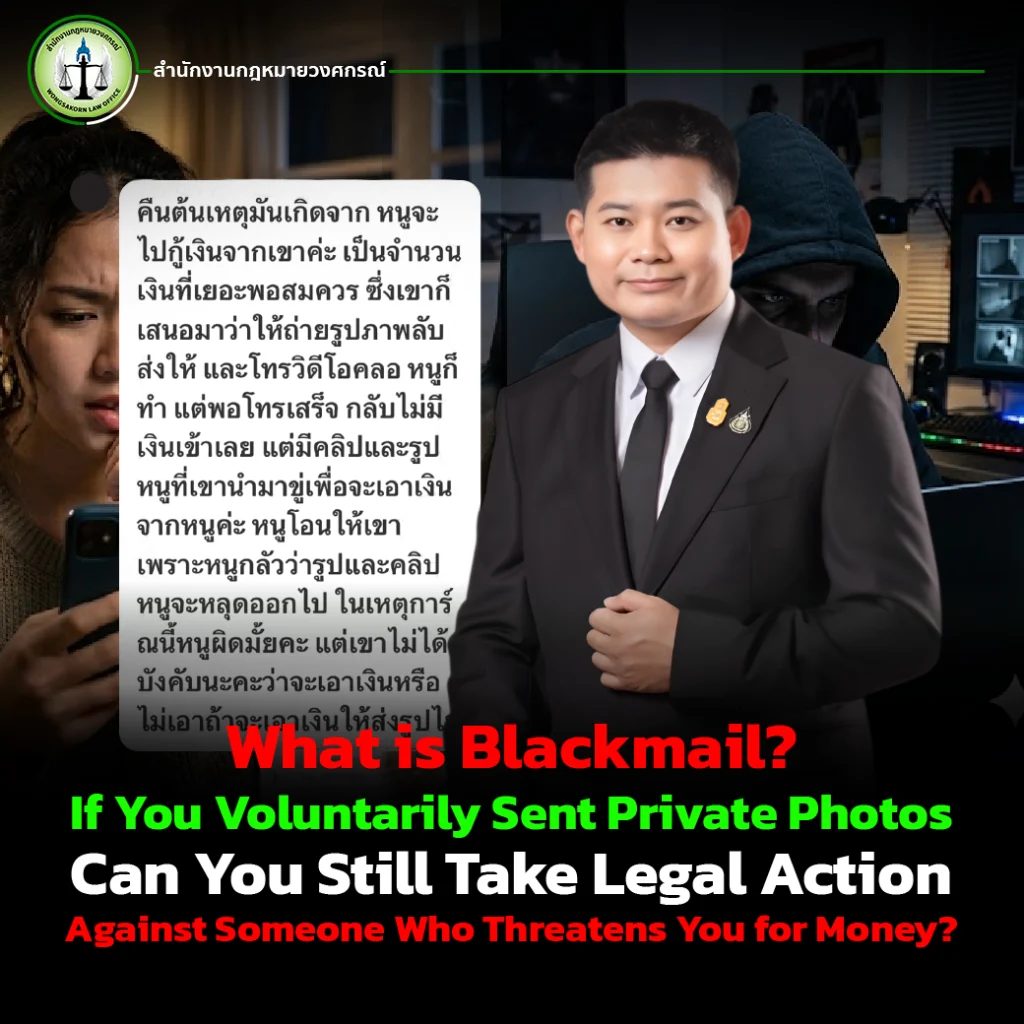
What is Blackmail? If You Voluntarily Sent Private Photos, Can You Still Take Legal Action Against Someone Who Threatens You for Money?

Today, communication through online platforms has become a normal part of life for many people, whether for chatting, doing business, or even applying for loans online. However, such convenience also comes with risks that many people may not expect, especially becoming a victim of blackmail, or being threatened for property through the use of another person’s private information.

Recently, a victim contacted Wongsakorn Law Firm for legal advice after becoming a victim of deception and being threatened for money using private photos and video clips that had previously been sent to a person known through an online platform.

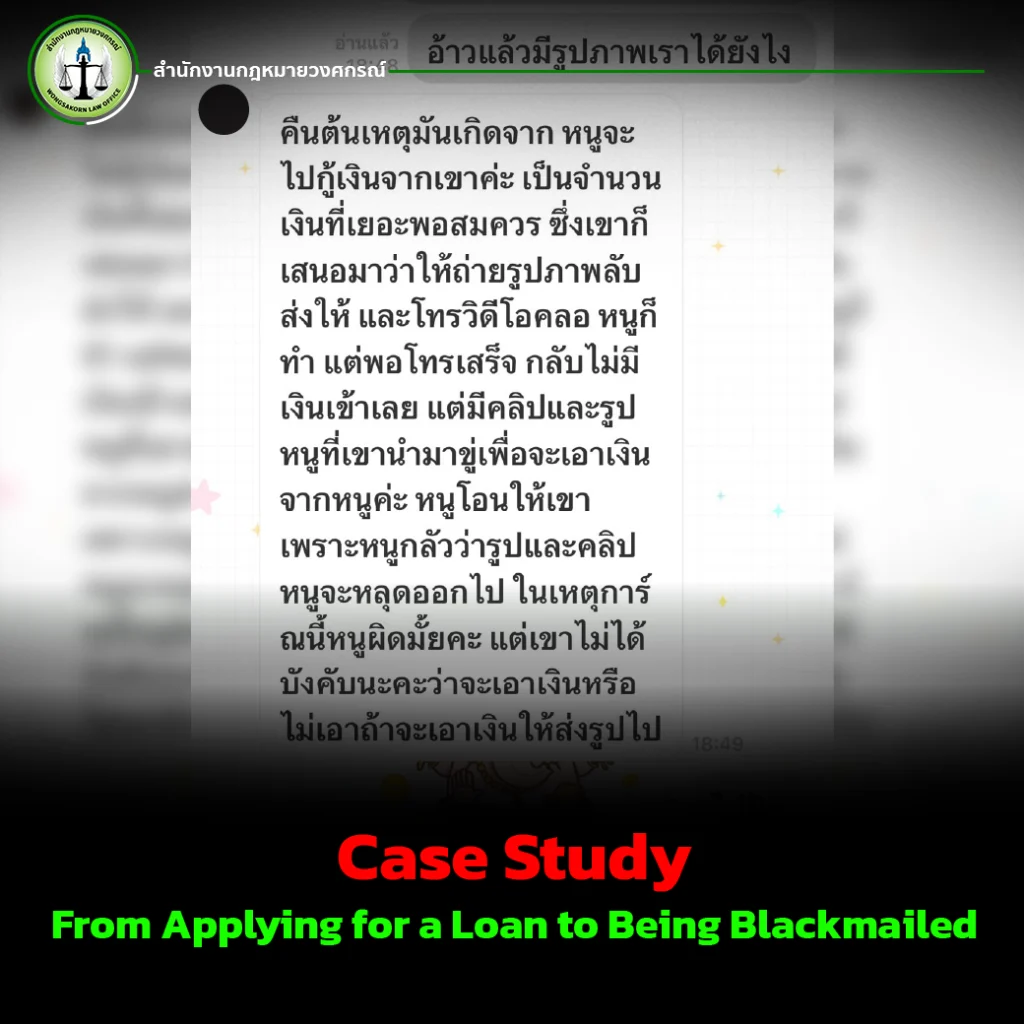
Case Study: From Applying for a Loan to Being Blackmailed

The victim needed money and therefore contacted a person known through an online platform to apply for a loan.

During their conversation, the other party proposed a condition that, in order to obtain loan approval, the victim would have to send private photos and participate in a private video call for consideration in the lending process.

Out of trust and necessity, the victim complied with that condition. However, after sending the photos and participating in the video call, the victim did not receive the loan as agreed.

The matter did not end there. After that, the other party used the photos and private video clips received as a tool for making threats, claiming that if the victim did not transfer money, those photos and clips would be shared with other people.

Fearing embarrassment and damage to reputation, the victim transferred money several times as demanded.

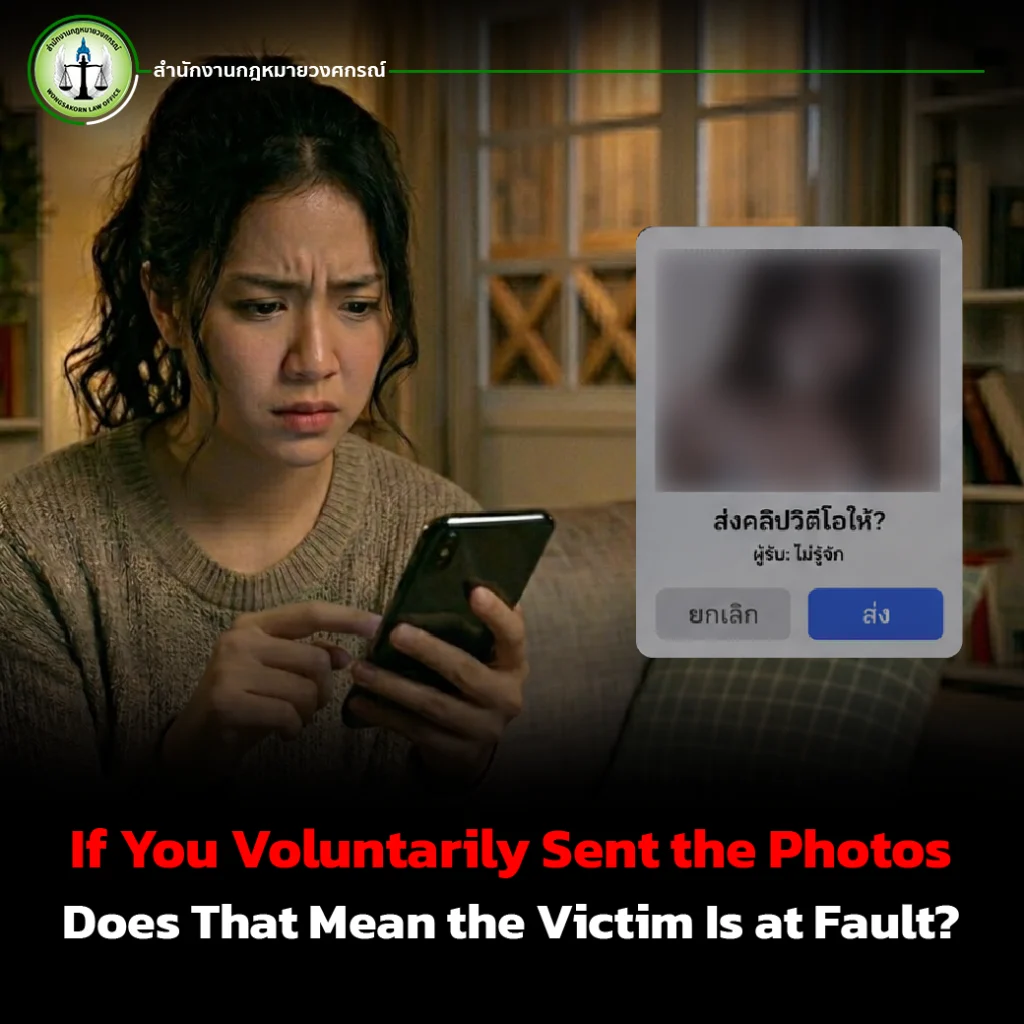
If You Voluntarily Sent the Photos, Does That Mean the Victim Is at Fault?

This is a question that concerns many victims.

Many people believe that if they voluntarily sent photos or personal information to another person, they would not be able to take legal action against that person, or they might themselves be considered to be at fault.

However, in reality, the key issue is not simply the act of sending photos or personal information.

What must be considered is the subsequent conduct of the person who received that information.

If that person uses photos, video clips, or personal information as a tool to threaten, demand money, or force the victim to do anything for their own benefit, such conduct may constitute a criminal offence.

In other words, in cases of this nature, the victim is the person who was deceived and threatened, not the person who committed the act of threatening and demanding money.

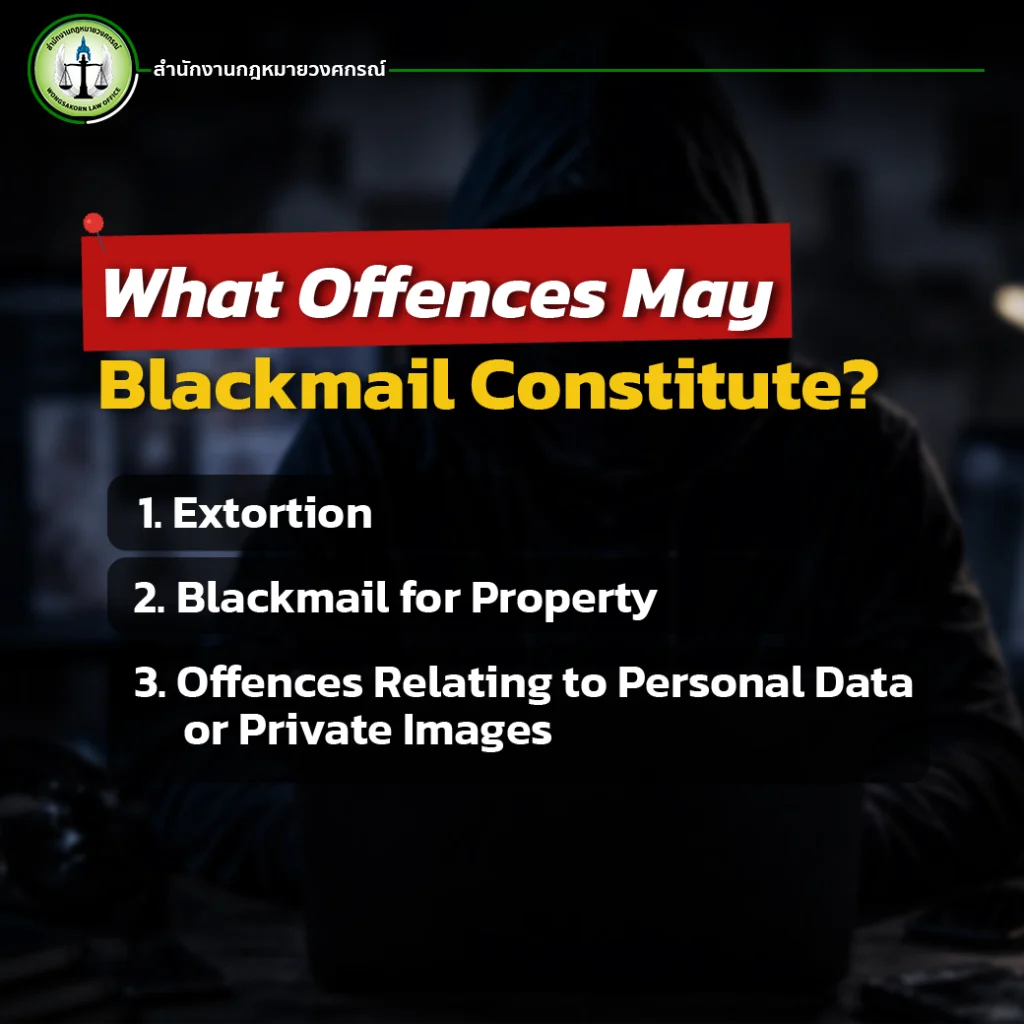
Although the term “Blackmail” is commonly used, under Thai law such conduct may fall under several offences, depending on the facts of each case.

For example:

1. Extortion

Where there is a threat to cause damage to the victim’s reputation, property, or rights in order to make the victim hand over money or property.

2. Blackmail for Property

Where threats or coercion are used to obtain property or benefits from the victim.

3. Offences Relating to Personal Data or Private Images

If photos or personal information are distributed, forwarded, or disclosed to the public without consent, there may be additional legal liability depending on the facts of each case.

Therefore, even if the victim voluntarily sent photos or video clips, it does not mean that the other party has the right to use such information to threaten or obtain benefits from the victim.

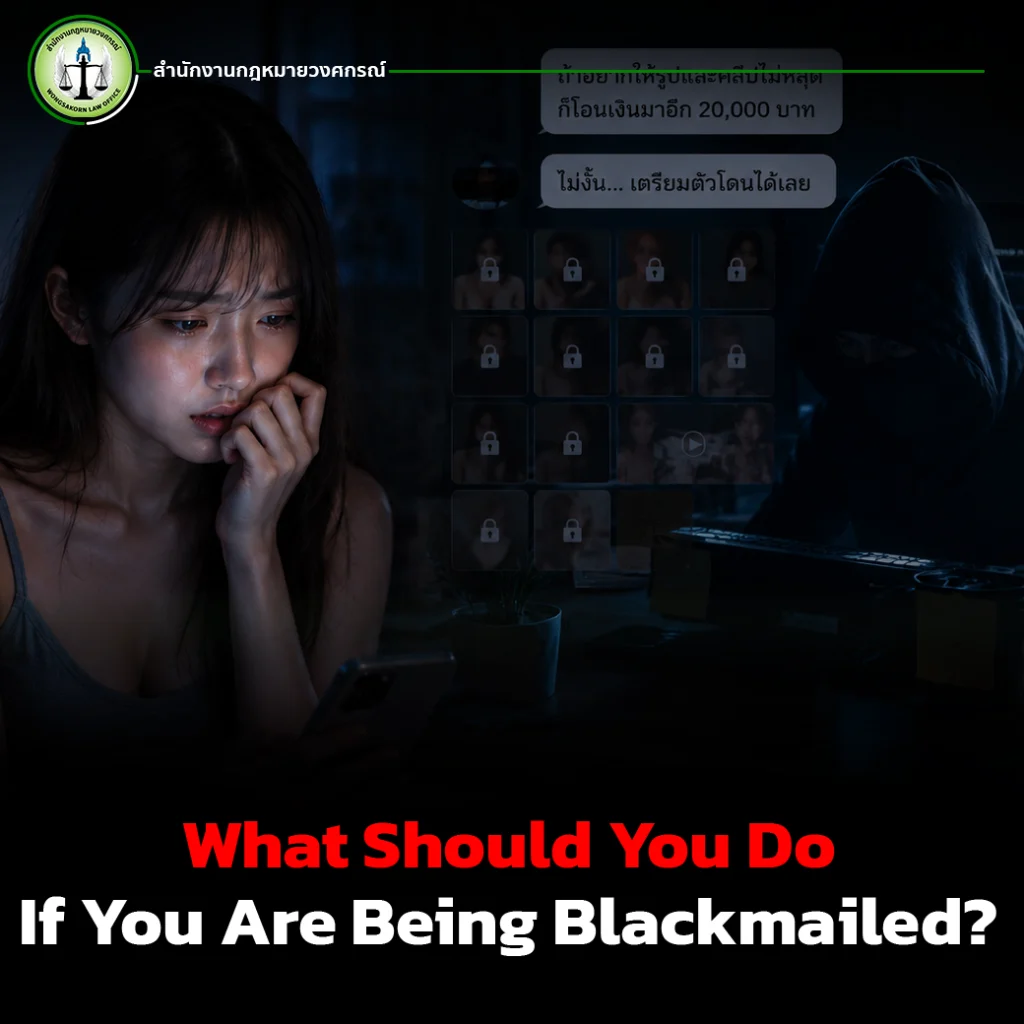
What Should You Do If You Are Being Blackmailed?

The most important thing is: “Do not delete the evidence.”

The victim should collect and keep all relevant information, such as:

  • Chat messages
  • Screenshots of the threats
  • Proof of money transfers
  • Recipient bank account details
  • Social media account information
  • Links or contact channels of the perpetrator

These pieces of evidence are extremely important for legal proceedings and for tracing the perpetrator.

In addition, a lawyer or legal professional should be consulted as soon as possible before taking any action, in order to plan the reporting process and properly protect one’s rights.

Do Not Let Fear Make You a Victim Again

From the experience of Wongsakorn Law Firm in providing legal consultations, it has been found that many victims choose to pay money as demanded because they fear that their photos or personal information will be disclosed.

However, in many cases, paying money does not bring the problem to an end. Instead, it creates an opportunity for the perpetrator to continue demanding more money.

If you are facing blackmail, being threatened for money using photos or private video clips, or being deceived through online channels, you should consult a legal professional as soon as possible.

Wongsakorn Law Firm provides legal consultation on blackmail cases, cases involving threats to obtain money, online-related cases, and related criminal proceedings, in order to plan the direction of the case, protect your rights, and reduce possible future damage. For legal consultation, click >>Contact Us<<

Line @ คลิก! โทรหาเรา คลิก!